They were the movers, the shakers, backslappers and opportunity-seekers, all cheerleaders for progress as long as nothing really changed. They were the members of the 1909 Santa Rosa Chamber of Commerce, and Press Democrat editor Ernest L. Finley was their president and the town's Booster in Chief.
 (RIGHT: 1909 Santa Rosa Chamber of Commerce officers)
To an outsider, it might have seemed as if the Chamber was much ado about not much except for their annual membership dinner. It was civic groups such as the Woman's Improvement Club that organized the Rose Carnival and other projects that made Santa Rosa a nicer place to live, and the Sonoma County Automobile Association - led by James Wyatt Oates - lobbied for first-ever street paving and other needed infrastructure upgrades. On the flip side, we do have the Chamber mostly to thank for the 107-page "Illustrated Portfolio of Santa Rosa and Vicinity," which served to beautifully promote the town and remains the most valuable photographic artifact about Santa Rosa from that era. But what the Chamber also sought was to silence critics of the status quo.
Boosterism has a long history in America, going back at least as far as the early 19th century drive to promote Chicago as the commercial hub of the westward expansion. By the end of the 1800s, towns everywhere were puffing up about their specialness to attract new businesses and residents. But the term "knocker" apparently didn't appear until around 1906*. It quickly devolved from simply meaning someone who didn't sufficiently boost their town into describing someone who was sabotaging the community, and within a few years, to be a knocker was to being labeled a pariah. A 1910 magazine offered a booster/knocker checklist (which was reprinted in other journals) that included venom such as, "The booster is a loving husband. The knocker is a wife beater..."
There are many examples of Chambers of Commerce promoting this us-versus-them antagonism, although they hardly had a monopoly on the idea. In Babbitt and other novels of the 1920s, Sinclair Lewis pointed out that groups like the Rotary Club and Kiwanis were spending more energy whipping up members to hate skeptics than they were in the performance of good works. But it was at the 1909 Santa Rosa Chamber of Commerce dinner where District Attorney Clarence Lea warned that knockers were "instinctively" opposed to any form of change and cut from lesser cloth than "The Progressive Man." ("Progressive" had dual meaning at the time; where it usually described Teddy Roosevelt-style reforms, it was also conflated with being a pro-progress booster.)
Lea's speech was rich in willful ignorance or hypocrisy. The very men in his audience were the ones who were actually fighting progress and change; just a year before, they had won the 1908 city elections with a keep-the-status-quo ticket headed by the Chamber's previous president, defeating a coalition of reformers who wanted to weed out Santa Rosa's entrenched corruption.
 The attendance list for the Chamber's dinner (CLICK or TAP to enlarge) is also interesting for who did not attend. Missing were James Wyatt Oates and John Comstock; Oates' absence is not surprising because he had no truck with the Good Old Boy clique that made up most of the Chamber, but Comstock might have been expected to attend, as he and his sisters had recently opened an art gallery on Fourth Street. Also MIA was Luther Burbank, who always stood with the reformers - even as he permitted the Chamber to endlessly tout his name and image to boost the town.
The Press Democrat account of the dinner also includes a detailed description of the 1908 nickelodeon film made about Burbank, which is now presumed lost. A later short, "Nature Study," was produced by the Ford Motor Company ca. 1917 and is widely available.
*Google Books shows "knocker" being used between 1901-1904 to criticize trade union members who didn't support their union. |
ANNUAL BANQUET OF THE SANTA ROSA CHAMBER OF COMMERCEMany Men Interested in Advancement of the City Gather at Festal Board in Brilliantly Decorated HallMusic, Fine Menu, Oratory and Moving Pictures on Thursday Evening--Excellent Reports of Work and Officers and Directors are Reelected Unanimously--Praise for Woman's Improvement Club
Two hundred men, representing all the professions and the commercial side of Santa Rosa, met Thursday night around the festal board at the annual banquet of the Santa Rosa Chamber of Commerce at Native Sons' Hall...
...Every detail of the banquet was admirably carried out. It was expected that this would be the case, seeing that the energetic, clever women of the Improvement Club had taken charge of the arrangement of the tables and the serving of the menu. A committee of ladies was in charge of each table. It was the setting of an alluring picture. The tables were beautifully adorned. Magnificent clusters of chrysanthemums, roses and other blooms--each table offering a different hue, and the whole scheme blending in one effective whole. Adding to the effect were the candelabra from which the soft light of candles filtered through silken shades. A dainty boutonniere at each plate was a Chilean flower--"scyphanthus elegans" kindly donated by Mr. Luther Burbank. In addition to this was a pretty souvenir menu card. The menu was as follows...
...During the enjoyment of the feast the large orchestra, under the direction of Mrs. Joe P. Berry, rendered a number of selections from the balcony. The music was a fine feature and the spontaneous applause of the auditors showed their appreciation. It was a bounteous spread of everything and all concerned earned many compliments for the excellence of the arrangements.
After the cigars had been passed around, President Ernest L. Finley as master of ceremonies, called the assemblage to order. He paid the Woman's Improvement Club a deserved compliment for the serving of the banquet and the part they had taken in the success of the evening, his words being greeted with prolonged applause...
...With his characteristic force and spirit, the Hon. Clarence F. Lea, District Attorney of Sonoma County was heard in his address on "The Progressive Man." His plea was for less "knocking" and more "boosting," and his words on this point had the right ring. He characterized the "knocker" as being "dissatisfied with what is, and instinctively being opposed to any change." He spoke of the broad vision and aim of the progressive man, and his keen appreciation of advancement that tended for the uplifting and advancement of the community. He spoke enthusiastically of the benefits to be derived from the building of the proposed railroad into Lake county, and gave some good advice to the builders, urging that the route selected should be so arranged as to be of use and service to the entire county...
...Horatio F. Stoll, secretary of the Grape Growers of California, had a very entertaining address. His topic was "Our Experiences at the Seattle Exposition," dealing with the manner in which the California exhibit and "boosting" was received at the exposition. He said some very good things along the line of future promotion effort. A most interesting part of his remarks was their illustration by a set of excellent views and moving pictures, in which Santa Rosa and Sonoma county were particularly brought to the front. A complete set of these pictures is being shown at the great Irrigation and Land Congress now in session in Chicago. The pictures created a great deal of enthusiasm at last night's assemblage. They showed the Luther Burbank residence on Santa Rosa avenue; Mr. Burbank coming out of the door and starting to work in his experimental grounds; his reception of visitors and other interesting features. One of which Mr. Burbank's aged mother, who comes out and seats herself on the porch. Mr. Burbank's secretaries, Miss Pauline Olsen and Miss Swanson. The other picture reproduced the great Italian-Swiss Colony at Asti, Sonoma county; the vineyards and wine-making; the Sbarboro Pompeiian villa and Mr. Sbarboro receiving visitors with the accustomed genuiness [sic] of California hospitality.
After the proceedings were over men and women lingered to discuss the success of the evening in all its varied forms. One could not help remarking what an eye-opener it would have been for an easterner, coming from his November frosts and snows, if he could have looked in upon that festive scene in Native Sons' hall and viewed those magnificent chrysanthemums, roses and carnations that had been plucked a few hours previously from their blooming in the open air i;n the gardens of the "City of Roses."
[..]
- Press Democrat, November 19, 1909
Street improvement time! In the neighborhood that would become the Ridgway Historic District, the big news was that Benton street would finally become the town's northern most thoroughfare, opening a straight shot between the Southern Pacific train station on North St. and Ripley Street. At the time, Benton didn't connect between Glenn and Morgan (see map in a previous neighborhood article).
 (RIGHT: Detail of 1885 Santa Rosa bird's eye view showing most of the Ridgway Historic District. CLICK or TAP to enlarge. Image courtesy the Mark Parry Map Collection)
The Ridgway district is a bit of a hodgepodge because most it wasn't added to the town as a single developer's platted subdivision, with streets and parcels already neatly sliced up. As this closeup of the 1885 map shows, Benton Street then ended at Mendocino Avenue, which was called the Healdsburg road. (Want to be really confused? Cleveland Ave. was "West Benton" at that time, and College Avenue was also known as Guerneville Road.)
For a new street to be added retroactively, several landowners might need arms twisted to convinced them it's in their own best interest to give away a swatch of land to the city, in the hopes that they would profit greatly by selling many small home lots on their former pasture or orchard farmland. Although this deal seems like a no-brainer today, great-grandpa sometimes seemed to have no brains at all; it wasn't unusual to read in the newspapers that someone foolishly demanded the town or county pay full freight for some nearly worthless sliver of land. For example, that summer of 1909 ended a three year-old city campaign to widen Fifth Street and transform it into a sister boulevard to Fourth. What killed that vision was the unbudging price by a man named John McCormick for a ten-foot strip of frontage at B street (which, in fact, he might not have legally owned).
In the Benton Street deal, the arm twister appeared to be our own James Wyatt Oates. In August, 1909, he was elected president of the Sonoma County Automobile Association and vowed to promote the "betterment of good roads." A month later he was making a rare appearance before City Council and mentioned "property owners between Glenn and Morgan streets were contemplating the opening of Benton street." And just five short weeks later, the property owners handed over right-of-way to the city to allow construction of the new block to immediately begin. Likely attorney and Association president Oates did the legal work gratis.
The only glitch in the plans was that there was a house at 1238 Morgan that was in the way, and the owner said she would move it to a lot on the new block of Benton street (this is probably the Italianate house at 322 Benton). County Clerk Fred L. Wright was renting it with his family, and stayed there after it was relocated. But Fred was slow in correcting his house numbers - in the 1910 census, he was recorded living at 1238 Benton Street. (Wright later moved, but remained close by; Fred, Bessie and their four kids lived for a decade or so at 425 Carrillo, a jewel that still dominates the street.)
Oates' appearance before the City Council was also to present a petition that the city use Mendocino Avenue for the new 20" sewer line, "to relieve the very unsanitary and unfortunate overflow of sewage during last winter, which everybody agreed was deplorable." This was a surprising bit of news; at the time, a small item in the papers reported that the intersection of Carrillo and Mendocino was flooded because the storm drain backed up during a downpour. And there I was imagining the squeals of children splashing around in their wonderful neighborhood lake, not groans of disgust from nearby homeowners.
Also in local news for 1909 was the renaming of "Joe Davis" street to Healdsburg Avenue. Residents of that short block had petitioned the city council since 1900 to have the name changed, and finally won. Thus endeth another link to old Santa Rosa.
The bulk of articles transcribed below, however, concern improvements to nearby streets. Mendocino Street - the section between Fourth and College - was paved, and a load of crushed rock was spread on College Ave. The difference underscores the two faces of Santa Rosa; business streets in the downtown core were now mostly asphalt because of the exploding number of automobiles in use. College Avenue was still a busy farmer's horse-and-buggy thoroughfare across town, not to mention the route used to drive cattle herds to the slaughterhouse from the Southern Pacific stockyard on North Street. College would still be pretty bumpy ride with its new coarse gravel, but as the PD noted, "It has been a long time since any work of a permanent nature was done" on that street at all.
And then there was the surprise that there were still wooden plank curbs all around town. Wooden street curbs hardly seem worth the bother, given that they're likely to rot and fracture, particularly when made from a soft material like redwood. But that was the 19th century standard, and a Google image search reveals they can still be found in New Orleans' preservation district, albeit in the expected shabby shape.

(Excerpts from PD coverage various city council meetings)
Want Sewer Relief
In behalf of property owners in the section Colonel J. W. Oates addressed the council and asked that the new twenty-inch main that is to be laid from the College avenue section to the sewer farm be run from Mendocino avenue instead of Ripley street, so as to relieve the very unsanitary and unfortunate overflow of sewage during last winter, which everybody agreed was deplorable.
City Engineer Newton Smyth said in his opinion the new twenty-inch main from Ripley street to the sewer farm would relieve the conditions mentioned, but would not say that it would entirely eradicate it.
[..]
Sidewalks on Benton
In response to a petition presented by Colonel Oates and other property owners the City Council ordered that cement walks be laid on Benton street from the Southern Pacific depot to Glenn street on both sides. Col. Oates also mentioned that property owners between Glenn and Morgan streets were contemplating the opening of Benton street through to Morgan, and the giving of a deed of right of way. Crushed rock was also ordered placed on Benton street from North to Glenn street.
[..]
- Press Democrat, September 22, 1909
Mendocino Street Improvement
The matter of street repairs was considered at some length and it was decided to remove the basalt blocks on Mendocino street, lay a base of Healdsburg gravel with a binding of crushed rock, similar to the roadway at the Northwestern Pacific depot, and then bituminize the street. All sewer, water, gas and wire connections are to be laid in the street before the work is done, and the property owners will be assessed for half the cost.
- Press Democrat, June 16, 1909
Mendocino Street Improvement
John S. Taylor and James O. Kuykendall have had the old redwood plank curbing removed and a concrete curbing laid along Mendocino street in front of their residence properties. They have also had concrete gutters laid. The work is a marked improvement and adds materially to the appearance of the street.
- Press Democrat, May 25, 1909
Now "Healdsburg Avenue"
Residents and property owners of "Joe Davis" street asked the council to change the name of that thoroughfare to "Healdsburg Avenue." W. T. Hurt spoke of the existing difficulty on account of the conflict of names. The request was granted. The street is only one block long...
- Press Democrat, June 2, 1909
MORE IMPROVEMENTS ON MENDOCINO AVENUE
The old wooden curb along Mendocino avenue in front of the Riley property is being removed and is to be replaced by a modern concrete curb and gutter the entire length of the property. The change will greatly improve the appearance of the thoroughfare and add to the value of the property.
- Press Democrat, October 15, 1909
COLLEGE AVENUE IMPROVEMENTSWork Commenced in Laying Cement Curbs and Gutters--Will be One of the Best Thoroughfares
The improvement of College avenue from Mendocino avenue to Fourth street has been commenced and Contractor J. D. Sullivan is at work putting in cement curbs and gutters. It is the plan to lay these curbs and gutters the entire distance between the points named and then the city will put down crushed rock on the thoroughfare. The advantage derived from this improvement will make College avenue one of the best boulevards in the city and will greatly enhance the appearance and value of property. It has been a long time since any work of a permanent nature was done on College avenue and everybody is pleased to see the work commenced.
- Press Democrat, October 10, 1909
STREET OBSTRUCTIONS ARE DANGEROUS
The lack of lights on College avenue, where dirt has been thrown into the street from the excavating for the concrete gutter and curb, and piles of gravel and mixing boxes strewn along, makes that thoroughfare very dangerous at night. Sunday night from Slater to Humboldt street there were no lights and with the heavy shade of the trees along the north side it was almost impossible to keep out of danger. Unless more care is taken in protecting such places in the public streets there may be a serious accident and some one may be killed or crippled.
- Press Democrat, November 9, 1909
TO OPEN BENTON STREET TO MORGANNoteworthy Improvement is Contemplated And a Number of New Houses Will Be Built
Arrangements have been completed for the deeding to the city of the right of way through several pieces of property for the opening of Benton street from Glenn to Morgan street. City Surveyor Smyth has made the survey and secured the descriptions to be placed in the deeds to be drawn by City Attorney Ware. When the deed has been prepared the necessary land will be transferred to the city for the purpose stated.
Property owners in the vicinity have raised the funds for the purpose of defraying the cost of removing the house occupied by County Clerk Fred L. Wright and owned by Mrs. M. F. Calderwood, which partially stands in the lot to be deeded. It is understood that the house will be moved around so as to face on the new Benton street, and in all probability a new house will be erected on the corner by Mr. Wright.
E. D. Seaton, who owns considerable frontage on Benton street, between Mendocino avenue and Glenn street, is preparing to erect several two-story modern houses on Benton street as soon as it is opened through to Morgan street. H. H. Moke, who owns the entire half block facing on the north side of the new street, and W. E. Nichols, who owns the other quarter block on the south side, are both contemplating improvements on their property.
When the street is opened it will give a main thoroughfare from the Southern Pacific depot to Ripley street and divide the drainage of storm water which is now all carried on Carrillo street during the rainy season. The street opening will be a marked improvement to that part of the city.
- Press Democrat, September 26, 1909
DEEDS PASS FOR BENTON STREET OPENING
Deeds were signed and passed Saturday for the required land for the opening of Benton street from Glenn to Morgan streets, and the street will be opened at once. H. H. Moke, W. A. Nichols and Mrs. M. F. Calderwood are the property owners affected. Mrs. Calderwood will be compelled to move one of her houses which is now partially in the proposed street. Monday the fences were removed from the Moke and Nichols property and preparations are being made for the immediate clearing of the Calderwood property so that the street can be put in condition for use before the heavy rains begin.
Work is progressing rapidly on the other part of Benton street, which is being given a heavy coat of crushed rock. The rock has been laid from Mendocino avenue to a point half way between Orchard and Beaver streets. A number of the property owners are also laying cement walks along the street as ordered by the Council, while others are making preparations to do so.
The laying of cement curbs and gutters on College avenue is also progressing rapidly. The work has practically been completed on each side as far as Slater street and will be pushed right along as fast as possible. Both of these streets present a much improved appearance where the work has been completed.
- Press Democrat, November 2, 1909
A long road lay ahead for James Wyatt Oates in 1909, and he was determined to drive every last mile of it.
Santa Rosa was quite the car-crazy town that year. Someone's purchase of a new auto merited an item in the Press Democrat, the same as for a birth announcement; when the latest models arrived for sale it was important enough for a full article (it probably didn't hurt that the downtown dealerships were increasingly buying large ads in the paper). And for years to come, Santa Rosans would still be talking about the 1909 California Grand Prize Race, which drew thousands of visitors to town and was won by local hero Ben Noonan. But probably no one here was burning with auto fever more than the 59 year-old attorney with the fine house on Mendocino Avenue.
Prior to his buying a car, Mattie and Wyatt Oates could be counted upon to host spectacular parties at their home. In 1908, two hundred guests showed up for an engagement party, and there were at least four major parties at (what would become known as) Comstock House in 1907. But in 1909 there was only a small dinner party and a couple of weekends with house guests. Mattie Oates and her mother did host a debutante party for a trio of young women, but it was held at the Saturday Afternoon Club and not at the Oates' home, as in years past.
Although their social calendar was nearly blank that year, Oates' name appeared in the papers far more than before, as the "Colonel" took family and friends daytripping. Off to the Petrified Forest, Healdsburg, Inverness, Mendocino County. Their house guests "were taken on a number of excellent auto trips in Judge Oates' splendid machine" and always, "the Colonel's fine touring car ran like a charm."
Thanks to Oates' weakness for bragging, we know exactly the make and model of his ride: It was a 1909 Chalmers-Detroit "30" touring car, with a top speed of about 50 MPH and boasted about 25 miles per gallon. (Pictured below is the 1910 model, which differed only slightly.) The surprise here is that Oates chose a mid-price, mid-performance vehicle - even Chalmers-Detroit offered models that were faster, larger, or more luxe in other ways. The "30" was, however, reliable; the roadster version won a race that year for being the only car that crossed the finish line without problems. Still, one might have expected Oates to pick something flashier; it's a bit like discovering your teenage son, who just won't shut up about the latest and greatest ends up passing by a tricked-out Corvette for a sensible Honda SUV.

The new car brought entry into a new social circle, most prominently friendship with 43 year-old widow Dorothy Farmer (think Farmer's Lane). That summer Mrs. Farmer purchased a Packard in Los Angeles and drove all the way to Santa Rosa with her 22 year-old daughter, Helen. No easy feat, that, in the day when roads were horse trails; expect to find more about the remarkable Dorothy Farmer in future pages.
It was also probably gratifying that Oates, an outsider by nature, was elected president of the Sonoma County Automobile Association that year. As the primary aim of the group was to lobby for better roads, Oates finally had the opportunity to follow his famous brother into politicking, albeit in a small way.
The Association's meeting was held at a redwood grove easily reachable by autos (natch) and the highlight was a surprise drop-in by Ben Noonan in his race car. "When Noonan stepped from his machine he was immediately surrounded by a band of the younger element present," the PD reported. There under the "glorious shade of stately redwoods and alongside a sparkling, babbling brook," three generations shared their madness for motorcars and the bright future for same.
Col. and Mrs. Oates have received their new automobile. They anticipate enjoying my much pleasure out of the machine.
- "Society Gossip" Press Democrat, October 3, 1908
Colonel J. W. Oates is just longing for sunshine so that he can get out his Chalmers-Detroit touring car. He is promising himself all kinds of good rides.
- "Autos and Drivers and Other Notes" Press Democrat, January 24, 1909
Colonel James W. Oates and a party of ladies drove to Healdsburg on Thursday in Mr. Oates' Chalmers-Detroit.
- "Auto Notes" Santa Rosa Republican, March 19, 1909
Colonel James W. Oates and party spent Sunday at the Petrified Forest and on Porter Creek. They drove in the Colonel's handsome touring car.
- "Busy Times With Automobiles" Press Democrat, April 27, 1909
Several days ago Colonel and Mrs. James W. Oates and Mrs. M. S. Solomon enjoyed a drive and outing in their fine touring car, visiting the Petrified Forest and other places of interest in that section. The Oates' take much pleasure out of their machine.
- "Society Gossip" Press Democrat, May 2, 1909
PROMINENT PEOPLE ARE GUESTS OF JUDGE OATES
Judge and Mrs. James W. Oates are entertaining Captain and Mrs. John B. Milton, of Mare Island, the visitors having come to the City of Roses to view the pretty Rose Carnival. Captain Milton is commander of the "Independent," the receiving ship at Mare Island, and a man prominent in naval affairs. He and Judge Oates are friends of many years' standing, and are linked together by peculiar circumstances which cements this friendship the more firmly. They became particular friends back in 1879, when Captain Milton first came to the Pacific coast from Annapolis, and Judge Oates was then residing in the metropolis. Mrs. Oates, then Miss Mattie Solomon, introduced Captain Milton to Miss Hattie Steele, and he wooed and won the heart and hand of that lady. She is the granddaughter of Commander Steele. Captain Milton, in turn, introduced Judge Oates to Miss Mattie Solomon, and the gallant judge lost no time in wooing Miss Solomon and asking her to be the partner of his joys for life. The reunion of these four people here at the Oates home is one of the joyous occasions of their lives and they are enjoying it right merrily. Captain Milton and his wife are affable people, and are making friends of all they meet in the City of Roses.
- Santa Rosa Republican, May 8, 1909
Colonel Oates and the Rev. George T. Baker enjoyed a drive to Healdsburg the other night in the Colonel's fine touring car.
- "Busy Times With Automobiles" Press Democrat, May 29, 1909
Colonel and Mrs. James W. Oates and Mr. And Mrs. Shirley Burris had a very delightful trip into Lake and Mendocino counties last Saturday and Sunday. There was not the slightest hitch to and the pleasure and the Colonel's fine touring car ran like a charm.
- "Busy Times With Automobiles" Press Democrat, June 5, 1909
Talk about feeling good, then Colonel James W. Oates was the man after the wires had flashed the news that the Chalmers-Detroit car had won the great Indiana trophy race. Colonel Oates has a Chalmers-Detroit of exactly the same make an model of the one that carried off the honors.
- "Society Gossip" Press Democrat, June 20, 1909
HAD WEEK-END PARTY AT JUDGE OATES' HOME
Judge and Mrs. James W. Oates entertained some friends at a week-end party at their handsome home on Mendocino avenue last week. Miss Madge Fairman of San Francisco, Miss Sadie Morrell of Duncan's Mills, and Charles H. S. Rule of Duncan's Mills were the guests. They had a delightful time in the City of Roses with their charming hosts, and besides the hospitable entertainment at the Oates home, were taken on a number of excellent auto trips in Judge Oates' splendid machine. The guests spent Friday, Saturday and Sunday at the Oates home.
- Santa Rosa Republican, July 12, 1909
At their picturesque home on Mendocino avenue Saturday night Colonel and Mrs. James Wyatt Oates had a very charming and unique affair. If was very informal, too, and was in the nature of a "Bohemian Evening." One feature was a Spanish supper. The menu was composed of many dainties and the idea of the party was carried out down to the colors, very cleverly by Mrs. Oates, who is always equal to any occasion when it comes to delightful entertaining. Her gusts on this occasion were loud in their praises of her hospitality. The decorations were also in keeping with the general scheme. Mrs. Rogers of San Francisco, wife of an army officer, who has been here for a visit with Mrs. Edward F. Woodward, and also with Mrs. Dorothy Farmer and Mr. Spitz of Los Angeles, were the guests of honor. The guests lingered long at the tables enjoying the good things and the entertaining conversation. Then the remainder of the evening was devoted to music and other forms of entertainment.
- "Society Gossip" Press Democrat, August 9, 1909
Colonel and Mrs. James W. Oates and Mr. And Mrs. Shirley Burris will drive in the Colonel's big touring car to Inverness today. They will return this evening.
- "Society Gossip" Press Democrat, August 15, 1909
BRILLIANT PARTY AT THE CLUBHOUSEMrs. Oates and Mrs. Solomon Entertain in Honor of Three Popular Young Ladies
At the Clubhouse on Tenth street last night there was a large and brilliant party given by Mrs. James W. Oates and her mother, Mrs. M. S. Solomon.
The function was in honor of Miss Catherine Rockwell, Miss Margaret Metcalf and Miss Hazel Farmer, and they certainly must have felt much complimented at the attention shown them.
The hospitality shown by the hostesses was very delightful, and all their guests spent a very enjoyable evening. Dancing was the principal feature of entertainment.
- Press Democrat, August 27, 1909
SONOMA COUNTY AUTO ASSOCIATION MEETINGHon. James W. Oates Elected President-Basket Picnic Enjoyed
Sunday was a bid day for the autoists from all over the county, as the annual election of officers and a basket picnic was held by the Sonoma County Automobile Association at Bice's redwood grove, three milse southeast of Healdsburg, and to it came automobiles from every part of the county...
[..]
...After luncheon had been served the business meeting was called to order by Dr. J. H. Seawell of Healdsburg, vice president of the association. Attorney J. Rollo Leppo is on a vacation and was not able to be in attendance. Secretary Don Prentiss had the top of a large rock for his table and sat on the ground. Hon. James W. Oates was the only nominee for president for the ensuing year, being nominated by Dr. S. S. Bogle and seconded by Attorney Edward M. Norton of Healdsburg. Dr. Harry Leppo moved the nominations be closed and the motion was seconded by Sheriff John K. Smith. The question being put, it was unanimously carried and the secretary was instructed to cast a ballot to elect Judge Oates unanimously.
Answering a general call from the members for a speech, Judge Oates spoke to those assembled with a few well chose words, admonishing them that it is the duty of all to co-ojerate [sic] for the betterment of good roads. He stated that California has reached that point where the question of good roads is the paramount issue of our time. He said the question was of as much concern to the farmer as any one else, and in fast more than to the autoist, as the automobile could go where the good roads are, while the farmer must travel the road in his immediate vicinity. The speaker called attention to the bill that passed the last legislature, providing for the people to vote on the question of bonding the state for $18,000,000, with which to build connecting highways between all county seats in the state...
[..]
...Great satisfaction was fe;t and expressed by the members that Judge Oates accepted the office tendered him and all feel that he will inject much interest into the good road question during his term in office.
- Santa Rosa Republican, August 30, 1909
AUTOISTS HOLD REUNION UNDER STATELY REDWOODSAnnual Meeting of the Sonoma County Association
Beneath the glorious shade of stately redwoods and alongside a sparkling, babbling brook, in a dell replete with natural embellishments to make it an ideal picnic ground, the Sonoma County Automobile Association met on Sunday morning to hold its annual meeting [to] name its new officers...
[..]
...Colonel Oates, the new president, was called upon for a speech. His reply was brief and well chosen. He told of the important factor the Association had been and would be in the promulgation of the doctrine of good roads and in bringing a successful outcome of it all. He thanked the Association for the honor done him in electing him president, and asked the hearty co-operation of all the members, and interest that would increase the membership and bring together all in one common aim for the betterment of good roads, and the accomplishment of legislation that would be for the benefit of all concerned...
[..]
...Ben Noonan drove a party of friends to the picnic grounds in his great racing Stoddard-Dayton "No. 12." When Noonan stepped from his machine he was immediately surrounded by a band of the younger element present, headed by Harrison Leppo. They immediately took possession of Mr. Noonan and he was soon answering many questions propounded by Leppo, Jr. Not foolish questions either. It is doubtful if a more intelligent lad for his years on the matter of auto mechanism can be found anywhere. He and Louis Norton, son of the Healdsburg attorney, share honors.
- Press Democrat, August 31, 1909
Colonel and Mrs. James W. Oates and Mrs. Solomon drove to the suburban home of Mr. and Mrs. Blitz W. Paxton, near Healdsburg, the other day. They were much interested in watching the harvesting of the hop crop.
- "Society Gossip" Press Democrat, September 12, 1909
In the years straddling the turn of the last century, it seemed everyone in Santa Rosa was coming and going to the Russian River during the summer months. For many of them, however, the appeal of the river area had less to do with water activities than the siren call of rocking chairs in rented cabins, croquet and bowling and billiards with friends from town, hotel service, and for some above all, eating.
View Russian River train stops and resorts c. 1900-1909 in a larger map |
Much has been written about the river scene from the mid-1920s onward, but info about the first decade of the river resorts is scarce, although they were a central part of Santa Rosa life in early 20th century summers. Where exactly were these places, and what were they like? Why would someone prefer to go to Camp Vacation instead of Summerhome Park? After picking through out-of-town newspaper ads, railroad timetables, maps and atlases and all those "personal mention" columns tracking local residents, I present (what I believe to be) the first cross-referenced map of the Russian River byways during that era.
My early confusion centered upon the tangled names. Some spots were known by two or more - the Olivet train stop became Woolsey and Trenton became Laguna, for instance - and making matters worse, the Santa Rosa newspapers were sometimes sloppy about accuracy. Before Eaglenest became Rionido, then later Rio Nido, it was also in the papers as Eagle Nest, Eagle's Nest and Eagle's Nest Camp. And don't even ask about Camp Six.
It's also tricky to judge the popularity of any of these places. A new get-away popped up almost every summer during those years, while the paint was still almost fresh on the oldest resort, only about a dozen years old. Time spent anywhere on the river was still a novelty, something to talk about with your neighbors and friends, and the next time you went maybe you'd try another place that you'd heard good things about.
 Today it's hard to imagine the Russian River wasn't always a tourist destination, but most thanks for transforming a no-man's-land of redwood stumps into a primo resort area goes to north coast railroad baron A. W. Foster, president of the Northwestern Pacific (NWP). Mr. Foster is best remembered as a heartless supervillain in the 1905 "Battle of Sebastopol Avenue" (although it's more likely that history has given him a bum rap). As logging was winding down in the mid-1890s, Foster saw an opportunity to cash in on the growing popularity of Sunday excursion trips and vacation rentals, as best told in the often-quoted (but rarely credited) book "Redwood Railways" by Gilbert Kneiss:
To Foster, however, belongs much of the credit for opening up the Russian River country as a vacation land. Informal camping in the forests and two-week rocking-chair sojourns at American plan, pitcher, basin, and thunder-mug resort hotels had long been common. Foster was thinking in terms of summer homes and traffic for the Guereneville Branch where logged out country had left rusty rails. He bought some of the cut-over land, now green an bushy with second growth...[soon] Guerneville converted itself from a hard-drinking, bullwhacking lumber camp to a village of parasols, mandolins, and ice-cream sodas. |
It's not the job of this Santa Rosa-centric blog to tell the story of railroads, but I wish more history was available on how Foster and his railway developed this area. Did the NWP plan and build the resorts, then selling or leasing them once profitable? The intriguing thread tying most of the resorts together was Santa Rosa's industrious Cnopius family, who were apparently managing nearly all of them at different times between 1896 and 1906. Did they work for Foster? Mrs. L. C. Cnopius (no first name found, sorry) was particularly key to the progress, and her importance was even noted in San Francisco obituaries. Mrs. Cnopius is also known here for being the last direct victim of the 1906 Santa Rosa earthquake.
 TOP: Section of the Camp Vacation dining room, 1908. Note the hungry fellow peering through the window
RIGHT: Boating at Camp Vacation, 1907
MIDDLE: NWP Locomotive No. 99, "Coffee Grinder"
BOTTOM: Boarding the eastbound passenger train at Guernewood Park, probably 1909. Note the pile of luggage at the far end
Dining room photo courtesy UC/Berkeley, all others courtesy Sonoma County Library
CLICK or TAP any image to enlarge
The first resort to open was Mirabel Park, which soon became a particularly popular spot for large groups - unions, churches, fraternal organizations - to hold day-long Sunday picnics. So great was Mirabel's appeal that it threatened the overall success of the area. In the 1900 San Francisco papers it was reported that "many families fear to take [Russian River trains] owing to the dread of coming in contact with Sunday picnics," although the railway assured the public that "this road has had no trouble on this score." Still, they promised to herd picnickers into separate train cars: "In the future, therefore, no one traveling on the California Northwestern Railway on Sundays will come in contact with Sunday picnics."
Mirabel Park was also somewhat unusual in this era for having a "villa" offering actual boarding rooms. More common were partially-furnished bungalows for rent or sale, should you have the overwhelming urge to buy a tiny shack with no running water or electricity. And these cottages near the river did not sell cheap; ads from real estate brokers listed them for $400 up, about three times more than a place in Camp Meeker.
Bungalows were suited for anyone spending the season on the river or planning to entertain friends, as many people did. But most people vacationing for a few days or so stayed at one of the tent hotels, adults $2/day, $10 per week, children under ten half-price. An advertisement for Camp Vacation describes the accommodations: "To sleep beneath a tent, to pass the day in the open air and have nothing else to do is to camp with luxury. Camp Vacation makes this easy for all. It is a hotel under canvas. Regular hotel service is furnished, but the guests live in tents. The tents are provided with wooden floors, are well furnished and are taken care of by those in charge."

Meals were included in the deal, and the all-you-can-eat grub seemed to be as much an attraction as the Great Outdoors. In a September, 1908, San Francisco Call how-I-spent-my-summer-vacation writing contest, 8th grader Ruth Moore told of her good times at one of the tent hotels:
My vacation was spent in the beautiful redwood groves of Sonoma county...we arrived at Montesano station about 3 p. m. and lugged our heavy baggage up hill, over stumps, rocks, brush and other obstructions to our camping grounds. Then our troubles were over. Nothing to do but eat, sleep and seek pleasure.... ...When I first arrived at the camp I did not have a very big appetite, and I was surprised to see my friends eat. Their table manners seemed to have been left at home. They grabbed everything in sight with both hands. They would drink out of the bucket in preference to using a cup and wipe their mouths on the tablecloth. But in about three days I was just as bad. I simply could not get enough to eat, and how good everything did taste. I never did get enough of hot cakes and maple syrup any morning... |
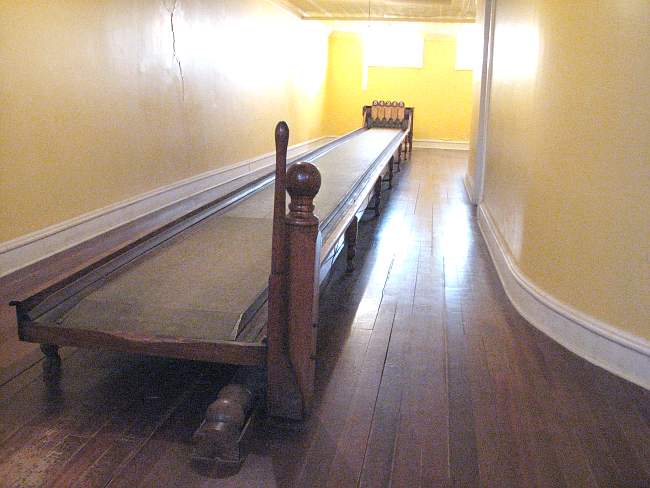
For Santa Rosans and other locals, the most popular resorts - or at least, the most often mentioned in the newspaper columns - were Camp Vacation, just across the river from Bohemian Grove, and Eaglenest, location of modern-day Rio Nido. The latter included bungalows and a true resort hotel, complete with a "box ball" bowling alley (a cross between a half-length 9 pin bowling lane and and a looooong coffee table, often found in arcades at the time - photo here). Besides four miles of beaches, Camp Vacation offered tennis courts, and it's worth noting that tennis and box ball bowling were among the few genteel sports where women could compete against men.
 But maybe the best part of those months was having the entire lower river available as your personal playground. When passenger and freight trains weren't scheduled, the railway used the tracks to offer a kind of trolley service using an ancient steam engine and open railway car recycled from the old timber days. Meeting your friends at a particular swimming hole by catching a ride on the "Coffee Grinder" - which looked like an oversized toy, and puffed away at less than ten miles per hour - added to summer's delight.
Even the James Wyatt Oates family joined the river stampede, in their own way. The couple escorted a
This chapter of the resorts ended in late 1909, when the NWP line finally met the narrow gauge railway that came up the coast. After that the railroad began promoting the "Triangle Trip" Sunday excursion trains from San Francisco, a 150-mile ride with a little stopover at Monte Rio. A day out of the city sitting on trains while watching some nice scenery, then home for dinner. Oh, look, there's a beach. Those trees look tall. Gee, I wish there was only some way I could stop thinking about work.
NO PICNIC CROWDSTo Interfere With Regular Sunday Travel.
The California Northwestern Railway is making heavy preparations for handling next season's business, and among other things will give special attention to its Sunday travel. The section which this road traverses is more than attractive for short Sunday trips, but many families fear to take them owing to the dread of coming in contact with Sunday picnics. While it is true this road has had no trouble on this score, it is determined to eliminate from the minds of the public all idea of this contact. Although the picnics up the road to Mirabel Park, etc., have in the past been kept separate from the regular travel, there will be none whatever this coming year, and those attending Schuetzen Park will be run on separate boats and trains. In the future, therefore, no one traveling on the California Northwestern Railway on Sundays will come in contact with Sunday picnics.
- SF Call, November 11, 1900
I hear that box ball in the bowling alley at Eaglenest has been a fascinating pastime for a number of our society women who have been spending a portion of their vacation there during the past few weeks. So interested did they become, some of them, in the sport, that quite a little good-natured rivalry was aroused as to who could make the highest score. I know one lady who made a record score, but social excommunication is threatened if the newspaper divulges the name. Some of the best players, however, are members of the Irene Club and some of them have been guests of Mrs. Charles A. Wright at her bungalow at Eaglenest.
- "Society Gossip" Press Democrat, August 9, 1909
Colonel and Mrs. Oates, Mrs. Dorothy Farmer and Miss Hazel Farmer were included in a house party at Rule Ranch as the guests of Charles H. Rule. Colonel Oates will return the first of the week, but the ladies will remain for several days longer. The hospitality of Rule Ranch is always very cordial.
- "Society Gossip" Press Democrat, September 19, 1909
CHANGE NAME OF STATIONCamp Vacation Will be Known as Rio Campo
Camp Vacation as the name of a railroad station on the Northwestern Pacific is a thing of the past. In future the place will be known as Rio Campo and unless the name of the popular resport which was created by Lewis C. Cnopius is maintained, the name of Camp Vacation will disappear forever. To the efforts of Mr. Cnopius and the late Mrs. Cnopius Camp Vacation owes its great popularity as a resort and its wide reputation over the state.
With the changes that come and go. the railroad company has determined to call the station at the place Rio Campo, and with the completion of the bridge near that place there will be no other stops on this side of the river for the trains will continue their journey across the bridge and on down to Monte Rio.
With the coming summer season the loop completed by this bridge will make the redwoods section even more popular than it has been heretofore. Annually thousands of visitors spend their vacations in this delightful section.
The rails are laid on the Monte Rio side of the river, and everything is in readiness to connect the same when the officials give orders for the same.
- Santa Rosa Republican, September 21, 1909
Credit our last century ancestors with this: When they fought, they fought with conviction, and in 1909 there were more dust-ups reported than in preceeding years. Not that those tangles were unusually violent; it would be hard to compete with the year 1907, when there was a point blank shootout that wounded only bystanders, or 1908, when a brawl ended with one contestant trapped in a barber's chair where a variety of bones were broken.
Some of the 1909 tangles could have ended in fatalities, certainly. James Maloney was lucky to survive when his fellow woodcutter attacked him with an axe in the kitchen of their cabin (although that 9-inch gash in his chest must have hurt a bit). And then there were the two Sebastopol lawyers whose fight ended up in court, one claiming that he punched the other because he was just about to be bashed in the head with a hammer. Attorney L. G. Scott conceded to the judge that yes, he was indeed carrying a tack hammer at the time, but had no intent of wielding it as a weapon against the party of the second part. Ah, lawyers.
Also in court that year was Mrs. Emma Fetters, charged with "flourishing a dangerous weapon in a threatening manner" and disturbing the peace. The plaintiff was her husband's mother, who lost some of her hair in a battle between the two. The paper didn't identify the dangerous weapon - unless it was presumed to be Mrs. Fetters' disturbingly firm grip and tugging skills - but did note she was fined for disturbing the peace because the woman was "accustomed to use a great deal of profane language." Some of the cussing may have been because Emma and husband George had recently opened their Fetters Hot Springs resort and starting any new business is stressful, even without the helpful presence of moms-in-law.
But probably the strangest fight of 1909 started over a family breakfast on West Third Street in Santa Rosa, when a father chided his 22 year-old son for using too much sugar in his coffee. Son Harry spitefully dumped half the sugar bowl into his cup, then began pitching chunks of bread at his father and brother. Papa John followed suit by swearing out an arrest warrant against his kid for disturbing the peace. Your obl. believe-it-or-not twist: The feuding family members were the father and brother of Blaine G. Selvage, who has been honored here as one of the very first U.S. aviators, having made his maiden flight a few months earlier.
USES SUGAR TO EXCESSDisturber Escapes Before Serving of Warrant
Harry Selvage, a warrant for whose arrest had been sworn to Friday, by John Selvage, his father, before Justice Atchinson, on the charge of disturbing the peace, had quietly left town. In some way he got wind of the fact that he was scheduled for arrest and when Constable Boswell came upon the scene with the warrant, Selvage had gone hence. The latter does not bear the best of repute, having been given a "floater" in the justice court some time ago.
The present trouble all began over a few morsels of sugar. Harry Selvage had been reprimanded at the family table for putting several spoonfuls of sugar in his coffee. To show how cheerfully he received the admonition and reproof, he dumped half of the contents of the bowl into his beverage receptacle. He then started throwing pieces of bread at the heads of his various kinsmen. Whereupon the warrant referred to above was issued.
- Santa Rosa Republican, August 5, 1909
HAIR PULLING MATCH HELDYoung Woman Lost Hair; Old Lady Lost Natural Hair
Mrs. Emma Fetters, of Fetters' resort near Agua Caliente, appeared before the justice court at Glen Ellen Wednesday and was fined ten dollars in each of two cases for which warrants had been sworn out against her. One of the charges was that of flourishing a dangerous weapon in a threatening manner last Sunday and the other charge was that of disturbing the peace, which arose from a quarrel resulting in the committing of the first offense. The testimony in the two cases showed that Mrs. Fetters, Jr., in a quarrel with her husband's mother, got into a hair-pulling match in which the elder woman lost some of her natural hair and the younger woman had her artificial coiffure severely handled. From the testimony induced it appeared that the woman fined is accustomed to use a great deal of profane language. District Attorney Clarence F. Lea attended the session of the court for the county.
- Santa Rosa Republican, August 19, 1909
USED AXE ON BREASTJohn Riley Chops Anatomy of James Maloney
For cutting James Maloney on the breast with an axe, John Riley has been held to answer to the Superior Court on the charge of assault with a deadly weapon, with intent to commit murder. The men were wood choppers employed on the J. K. Bigelow ranch, near Sonoma, and after a quarrel in the cabin had apparently patched up their differences.
Maloney subsequently went into the kitchen of the cabin, and there Riley is alleged to have followed and made the assault with the axe. A gaping wound nine inches in length was made on the breast of Maloney. Tbe wonder is that the man was not killed by the blow from the axe.
Riley fled, but was captured later in the night in a box car at El Verano. He was asleep when Constable Joe Ryan found him, but made no denial of his guilt.
Before Justice J. B. Small of Sonoma the preliminary examination of Riley was held Wednesday afternoon. District Attorney Clarence F. Lea and Court Reporter Harry A. Scott were present from this city.
- Santa Rosa Republican, January 28, 1909
LAWYERS FALL OUT AND HAVE A FIGHT
Attorneys L. G. Scott and Joseph Rafael, exponents of the law of Sebastopol, having been mixed up in a manner decidedly contrary to law. Rafael struck Scott, and the latter alleges it was without cause or excuse. Rafael paid the sum of ten dollars in Justice Harry B. Morris' court having been arrested on a charge of battery, which was later raised to a higher misdemeanor, Rafael alleged that Scott had attempted to strike him with a hammer, but this is indignantly denied by Scott. The latter admits having had in his possession a small tack hammer, but denies he ever thought of using it on Rafael's cranium or any other portion of his anatomy.
- Santa Rosa Republican, July 22, 1909
Thanks to Santa Rosa's two newspapers, we know pretty much everything newsworthy that happened in town a century ago, that being an era when newsworthy was writ with a small "n" - broken bones were mentioned, as was anyone's day trip to San Francisco and who invited who over for a hand of cards and a bite of pie.
What's missing from the picture are details of how they spent their unexceptional moments. Could kids play in the streets after school? What did adults do on an average weekend? Where did someone dispose of non-burnable trash? How much did they rely upon their new home telephones for conversations with friends and family just across town? None of this is important stuff, but these hard-to-answer little questions - and a thousand more - remind that we really don't know much about what it was once like to live in our town, even in the reasonably recent past.
 (RIGHT: Interior of the Frank Brush home at 1322 Fourth St. Today it's the location of Umpqua Bank on the intersection with the Foster's Freeze. Photo from "Illustrated Portfolio of Santa Rosa and Vicinity," 1909)
These thoughts popped up while looking at photos in "Illustrated Portfolio of Santa Rosa and Vicinity," a 1909 book put together by the Chamber of Commerce and the Press Democrat. The contents are quite the mishmash; some photographs come from older PD promotional supplements on the wonders of Sonoma County, and many portraits of residential houses probably came from that paper's unproduced 1905 special section on the "Homes of Santa Rosa." There are postcard views and grade school class pictures and the error of using a circa-1902 photo of the firehouse destroyed in the Great Earthquake. But the work is still quite the treasure because image quality is so high, thanks to H. A. (Herman August) Darms, a skilled Napa photoengraver.
The Portfolio has only a few interior shots of homes, social lodges and businesses, but they're indistinguishable from many other pictures of rooms during that same period, which seem to share a common problem: Really, really bad lighting. From the ceiling of each room were chandeliers or pendant electric lights. In daytime, natural light softly filtered through blinds or window lace, but after dark illumination would be turned inside out, as each room blazed from a cluster of overhead suns. Rarely visible were floor or table lamps with shades, or wall brackets/sconces for muted light. These would be rooms with deep shadows in every corner.
There were exceptions to the ceiling light norms, of course. Comstock House, designed in 1904, has electric or gas/electric wall brackets in almost every room, and many have no ceiling fixtures at all. In fact, ceiling lights were installed in all bedrooms, per the blueprints, and removed in the early years (possibly because the 1906 quake ruptured or made suspect the gas lines to the second floor). Clearly, indirect lighting from the side suited the first-owner Oates family just fine.
More typical was the home of Frank Brush, as pictured in the Portfolio (Mr. Brush, BTW, went down in Santa Rosa history as the human rope in the 1905 battle of Sebastopol Avenue tug-of-war). These views show rooms with only multiple light ceiling fixtures in each room - fine for playing cards or entertaining visitors, but terrible for personal activities like reading and letter writing. Does this mean that the Brush family was less bookish than the Oates? Of course not; there might have been an unphotographed parlor or family room, for starters.
For three years, two of the largest companies in the world battled for dominance of a market worth untold billions of dollars. No, it's not today's competition between Apple and Samsung for the most popular smartphone; the fight was between General Electric and Westinghouse for the most popular light bulb, and the years were 1907-1910, when a billion dollars really meant something. In the first decade of the 20th Century, four different types of incandescent light bulbs were competing to dominate the industry: The kind with a carbon filament developed by Edison and others (see my earlier discussion on the brightness and color of light), and an improved carbon bulb from General Electric first sold in 1904 - the improvement had slightly better efficiency and the insides of the bulb didn't become sooty. Within a year an even more efficient bulb using a tantalum filament was invented by a German company and licensed in America to Westinghouse, but had the drawback that it only operated on DC electricity. GE fought back by spending the astonishing sum of $1.5 million in 1906 to corner U.S. rights in tungsten R&D from four European inventors. The key patent that eventually became the light bulb that would illuminate the world for a century was developed by Alexander Just and Franz Hanaman, chemistry lab assistants at the Technical High School in Vienna. The pair were so poor that they were couldn't afford to file patents in all countries, much less manufacture a commercial product. (MORE) Between 1907 and 1910, carbon (both original recipe and GE's improved "GEM" brand), tantalum and tungsten bulbs were all in common use. The sturdy tantalum lights, made by Westinghouse until 1910, were used in factories that operated their own generators (not at all uncommon in that day) and were always found on trains and trolleys. The tungsten bulbs were far brighter and lasted longer, but quickly earned a bad reputation. GE had rushed its technology to market too early in 1907 (not 1910, as claimed on almost all Internet websites). The filament broke easily from vibration and the earliest version only worked when hanging downwards because it relied upon gravity to keep the coils of soft tungsten filament from collapsing. The tungsten bulb factory also had QA problems, and 1 in 6 bulbs burned out within a few hours. Still, when it worked it worked well; up to 100w and lasting 750-1000 hours. General Electric discovered how to support the tungsten filament so it could operate in upright or sideways positions and made improvements that resulted in sturdier and cheaper manufacture. By 1910 GE had almost a complete monopoly on new bulbs sold in the United States, and the company's main competitor was...itself. GE still made its "GEM" brand of carbon bulb which it continued to advertise as the "improved" light bulb, and the company likewise boasted its tungsten bulb was "improved." In the 40-60 watt range used in the home or office, people couldn't tell the difference in brightness, and the carbon bulbs may actually have lasted longer at this lower wattage because of thicker filaments. The product confusion finally ended when Congress banned the production of carbon filament lights in August, 1918 because of war-related coal shortages (and perhaps, a little GE lobbying). |
Lamps also may not be pictured because the Brush family (and most everyone else) probably still had the 19th Century habit of carrying light around with them. Mantle and wick lamps were still advertised in the papers, and kerosene was easy to buy. Put a nice glass Welsbach mantle lamp, with its bright and steady light, on that table by the rocking chair and it becomes a cozy spot to read the paper while listening to Precious Child bang away on that partially-seen upright piano.
We can be certain that hand-carried lamps were in widespread use because electrical service in these years was unpredictable. As in the previous five years, in 1908 the "juice" would still go off for hours for no apparent reason, driving Santa Rosans to fury. Kerosene lamps might also be preferred because electricity was so costly; for the pleasure of using this (dis) service, a 1905 article revealed customers were charged about the same per Kwh as today. Adjusted for inflation, however, that means electricity was over 25 times more expensive than we're now paying.
And then there were the costly light bulbs, which were around the equivalent of $40.00 today. Some electric companies provided a service of "renting" each light bulb to customers for approximately $6.00 per month, adjusted for inflation. We don't know the exact arrangement and costs here in Sonoma County, as this topic was never mentioned in the papers (as far as I know), but if anyone finds great-grandma's electric bill or terms of service c. 1910, please don't throw it out!
Combine the expensive light bulbs and high cost of using electricity and it's easy to conclude that most residents of early 20th Century Santa Rosa used electric lighting sparingly, probably only in certain rooms for short periods of time, or when company came calling. And it's another hat tip to James Wyatt Oates' wealth and extravagance that so many light fixtures were installed when his great house was built.
Where new bulbs came from was another one of those missing-picture mysteries; the stores that sold lighting fixtures never advertised they had the best and brightest bulbs, or any bulbs for sale at all. Yet the Press Democrat's 1904 promo insert mentioned that there were 12,000 incandescent lights in use around town. How on earth did they know the precise count? It's been quite the head-scratcher.
The answer comes from a government report from this period, which explains light bulbs were available only though the local electric utility company. Bulbs were delivered to your home or business, and some companies even screwed in the replacement bulbs for you. That explains another small puzzle; a previous article had mentioned a "lineman [would] answer lamp kicks at all hours of the night," which now is apparent that it meant PG&E would send someone out pronto to replace your burned-out bulb.
Between the government report and a 1909 item in the Press Democrat, it's also now understood how street lighting worked in that era. All I knew heretofore is that they used electric lights and not gas. But how many lights were on each street, and how many overall? With the exceptions of commercial districts like Fourth street, it appears lights were only found at intersections. The PD noted that "100 watt Tungsteins" [sic] were being added to fifteen intersections, and the federal report mentions lamps were usually suspended by wires 25 feet over the center of an intersection. It was a good idea to live in the middle of the block if you didn't like night lights.
As a final note, the report also observed that repairmen often attempted to fix burned out light bulbs before replacing them. Their technique was turning the bulb on and shaking it vigorously, in hopes that the broken filament would reconnect to the ultra-hot (3410 degrees centigrade) coil and flash weld itself again in place. Kids, please don't try this at home unless you're a certified light bulb repairman.
BEAUTIFUL VIEWS OF CITY OF ROSESCopies of Harms' Illustrated Portfolio on Sale at Chamber of Commerce for Only $1 per Copy
By special arrangement with the publisher a number of copies of Darms' Illustrated Portfolio of Santa Rosa and Vicinity have been placed on sale at the Chamber of Commerce for the low price of $1.00 per copy. In spite of the fact that the regular price of this beautiful book is $3.75, the supply now on hand at the Chamber of Commerce headquarters will be sold without reservation for $1.00 while they last, and it is hoped that as many copies will be purchased and sent out as possible. The book is beautifully printed and elaborately illustrated, and various parts of the county are represented. The book would make an acceptable present for anybody, particularly friends living in the east. The cost of mailing is 26 cents.
- Press Democrat, February 8, 1910
STREET LIGHTS IN MANY DARK SPOTSNew Lights are Being Installed in Different Parts of Town at the Present Time
A number of additional lights are being placed at the corners of a number of dark streets in different parts of the city. H. W. Jacobs is installing the lights for the city and already has eleven in position.
The new lights will be at Sixth and Wilson streets, Seventh and Davis streets, Ninth and Davis streets, Tenth and Washington streets, Orange and Laurel street, Chestnut street, Wheeler street, Beaver street, near Fifth...
The lamps being used are 100 watt Tungsteins, eighty candle power each.
- Press Democrat, November 24, 1909
For Santa Rosa newspaper editors and other fans of the "gentleman hobo," 1909 had to be the greatest year ever. The traffic of tramps was more than the previous five years combined, judging by the number of articles that appeared in the papers, and local scribblers of prose dusted off their thesauri to see who could write the most magniloquent panegyric to the knights of the dusty road.
The winner - which is to say, absolutely the worst writing - was the description of a hobo scrounging food at a farm near Fort Ross: "One Sabbath morning, when a holy calm brooded somnolently over the seashore, including the ranch of Mr. Zeek, and when the tide was away out upon the distant deep, and the deputy sheriff was angling for fish in a nearby creek, came the tramp, unheralded and uninvited..." The article continues with an inventory of food stolen, including a 50 lb. ham. "Having secured this and a hammock and two or three bars of soap and a painted tin flower vase and a few other things, he betook himself away." Not to spoil the ending, but farmer Zeek "set off through the falling ocean evening fog upon the trail of the depredator" and finds Mr. Hobo eating his ham while lounging in his hammock. Complications follow.
The runner-up is the "Conservation of Tramps" editorial, which like the other article, appeared in the Santa Rosa Republican. Written likewise with tongue firmly in cheek, it bemoans "unsentimental people, without a grain of romance in their composition, would like to put the tramp out of business...He is an American institution as indigenous and native as a Kansas cyclone or a Dakota blizzard. He is as much a part of us as Iowa's corn and hogs, or Chicago's smoky air and dirty streets." Alas, no one apparently proofread this masterpiece of wit, as there is a line or three of type missing.
Honorable mention goes to another Republican item (seeing a pattern, here?) that described a vagabond beggar. "[When] he approached a house, he would literally crawl up and down the steps as if he were in utter weakness and horrible pain. Upon gaining the street again, however, he lapsed into a perpendicular attitude and his strength appear to return and his anguish assuaged." The man also brandished a little book with a statement that he was unable to work "signed by a couple of physicians who had forgotten to append thereto their places of residence" and insisted his destitute wife and six helpless and starving children were waiting for him in a Southern California town that couldn't be found on any map.
Also that year was a visit from "Tennessee Bill," a well-known drunk "who has been frequently arrested for yelling at the top of his voice from the steps of the old court house." When in jail, Bill was known to tear off his clothes and set his cell on fire.
But the bulk of 1909 hobo coverage went to Leon Ray Livingston, who called himself "A Number One." A relentless self-promoter, he introduced himself to the local newspaper upon arriving in every town, and the Press Democrat obligingly printed all of his tall tales, including that he had only spent $7.61 on railroad fare to travel almost a half-million miles and that he supported himself by carving portraits in potatoes.
 (RIGHT: Leon Ray Livingston, known as "A-No. 1" as shown in his 1910 autobiography)
He invited himself to dessert with Luther Burbank and thanked him with an Indian profile carved out of (appropriately) a Burbank spud. The PD noted that "he is also a wood carver of ability" which sometimes got him in trouble; a pioneer graffiti artist, Livingston carved
-->A-No.1<--
everywhere he went, and a few weeks after his Santa Rosa visit, was given six months in the San Francisco pokey for carving his tag on the valuable mahogany doors of a major saloon.
Livingston also told the Press Democrat that he had written a book about his adventures, and that turned out to be true; the following year he self-published Life and Adventures of A No. 1, followed by Hobo Camp Fire Tales and several other books, all of which are available for free Internet download. Among his titles was From Coast to Coast with Jack London, published the year after London's death. His memoir claimed 18-year old Jack London had proposed a "hobo partnership" with Livingston for a cross-country trip, which is possible, but not probable. Livingston had visited the famous author in 1909, and his book reproduced a very short note from the author and two post-mortem letters from his widow, thanking him for sending copies of his earlier books. The note from Jack and the letters from Charmian London printed in his book - one of hers almost completely obscured by overlapping - give no affirmation that the two men traveled together. (The undertone of Charmian's letters is, "please remind me who you are again?") Nor did Jack mention a partner in his exceptional collection of short stories from his hobo year, The Road. Whatever the truth about his life, Leon Ray Livingston had a long post-hobo retirement, dying at 72 in 1944.
Santa Rosa was not alone in experiencing 1909 as a hobo year. While our local papers romanticized the rambling life and made light of theft and other hobo crimes, a Jan. 13 San Francisco Call article headlined "Army of Tramps Invading State" quoted a Southern Pacific special agent who claimed "vicious, idle men" were pouring into California and that the railroad was currently tracking the movements of 3,100 hoboes around the state. Solutions to the vagabond problem were widely discussed; a popular 1908 pamphlet, The Elimination of the Tramp, called for anyone without steady employment to be forced into labor camps, potentially for life.
What caused the explosion of the hobo population? Answers are not clear; as discussed here before, the bank panic of 1907 nearly destroyed the U.S. economy; unemployment in New York state reached 36 percent - 200,000 were estimated to be out of work in New York City alone - causing a vast number of men to seek work wherever they could find it.
A landmark 1911 study published by a New York charity, One Thousand Homeless Men, looked at 220 tramps and found that most drifted into the vagabond life. About a third took to the road out of wanderlust and many were well-educated, some with college degrees. Others couldn't find work in their home communities or were outcasts; some were drunks or otherwise broken men, and a small number were on the run from the law. The study reprinted without dispute a widely-held guesstimate that there had been a fairly persistent population of over 500,000 hoboes nationwide for years.
CONSERVATION OF TRAMPS
Some unsentimental people, without a grain of romance in their composition, would like to put the tramp out of business. Their way of accomplishing this reform is through the instrumentality of rockpiles and shotguns. Other very ultra-sentimental people, hopelessly addicted to altruistic notions, would eliminate the aforesaid specimen of tired humanity by kindness. By various unaccountable means, not particularized, they think to make him abominate rest and spirituous things and to get him in love with soap and toil.
Both of these classes of people need suppressing as bad as any tramp. What would we do without the "bum"? In this new country we have no scenes of ruin to show the traveler. But we have Niagara, Yellowstone, the Grand Canyon and the tramp. The latter serves as a national feature and a piece of local color all in one. He is an American institution as indigenous and native as a Kansas cyclone or a Dakota blizzard. He is as much a part of us as Iowa's corn and hogs, or Chicago's smoky air and dirty streets. tive benius [sic] of a country can produce, make him uninteresting or commonplace.
Why do away with him? He wants to stay and he has his uses after all. What would the poor dog do lying lonely in the monotony of the back porch without a chance to exercise his jaws, or give vent to the exuberance of his feelings upon the person of an occasional hobo? How would the hundreds of thousands of housewives exhibit their hospitable and other traits of character unless opportunities were presented them to break bread for the wanderer or to break a broomhandle over his headpiece? Who else would supply the authorities in the country towns with jobs? And who would wrest free transportation from the grinding railroad monopolies?
A more striking spectacle can be hardly imagined than the one presented for weeks last winter all along the Southern Pacific line from Puget Sound to San Francisco. During that time on the road, more troops could be seen riding on top of the passenger trains than there were passengers sitting on the cushioned chairs inside.
If this personage inhabited Santa Rosa, the water question would not bother him. So long as the saloons ran beer, he would not care if the municipal and other water plants were made away with entirely.
- Santa Rosa Republican editorial, March 13, 1909
WORLD FAMOUS TRAMP IN TOWN"A No. 1" in Santa Rosa Yesterday--Visits Burbank--Has a Remarkable Record
Have you ever seen a queer cabalistic sign painted on fences and barns along the railroad lines, or carved artistically into shanties or water tank supporters, etc., etc., "A No. 1" with a date and arrow underneath it?
If you have never seen it, watch and look for it and you will be surprised to notice for how many years some of these marks have been decorating those above mentioned places. It is a queer sign, yet it means that "A No. 1," the world's most famous tramp, has passed through Santa Rosa, and has left behind him this mark, showing the date and the direction he was journeying. This man, whose only known name is this sobriquet, "A No. 1," visited the Press Democrat office yesterday and gave some very interesting experiences of his roving life.
"A No. 1" is interesting because:
He has hoboed 458,193 miles.
He has spent only $7.61 on railroad fare.
He has traveled 10,738 miles since January 1, 1908, without paying a cent in fare.
He has been around the world three times.
He is a linguist; speaks and writes in four languages.
Has prevented twenty wrecks.
Wears a $40 suit of clothes.
Wears a gold watch.
Keeps his name secret.
Carves potatoes for a living.
Does not smoke, drink, chew, swear or gamble.
How did he adopt this queer name? That is a story, too. When he first started on the road it was with an older man. The latter was attracted by the ingeniousness of the younger companion, by his bright ways, his natural attitude for a life in box cars and riding the rods beside the grinding wheels underneath the heavy freight, where release for a moment of the bar of iron would have meant a horrible death. "Kid, you're all right," declared the older one at the end of a particularly hard journey, "you're A No. 1." The title has since stuck, and the wanderer has more than lived up to it, for ever a hobo's life could be said to be a success it is that of this fellow.
He travels in overalls and jumpers, but after arriving in Santa Rosa yesterday he divested himself of these and appeared neat in a brown suit, is always clean shaven and has a prosperous appearance.
"A No. 1" has been "on the road" since elven years of age, and he is now thirty-five. His real name is not known, and of his family connection he does not speak. He has a profession, which is carving potatoes, and in this he has no equal. Hundreds of times he has carved faces for persons in return for small favors. He is also a wood carver of ability.
From the Press Democrat office "A No. 1" went over to call at the Burbank residence in the hope that he could get a look at the great scientist. He did more. He had a chat with Mr. Burbank and had the time of his life. "I had supper there, too," he told a Press Democrat representative--that is he had some coffee and cake on the porch of the residence. He carved for Mr. Burbank an Indian's head out of a huge Burbank potato, and he thanked Mr. Burbank for having produced such large potatoes.
Many railroad officials who have given him cards freely state that he has prevented the loss of many lives in frequent cases. By telling train operators, when beating his way, of broken car wheels or other disasters, or other disarrangements, he has prevented serious wrecks. He has been in four wrecks, but has never been badly hurt.
During his travels "A No. 1" has learned four languages--English, German, French and Spanish. His parents were of French and German descent,
His toilet set is complete, though it takes little room to carry it. It consists of a tooth brush and soap, shaving soap, comb and a few other necessaries. His carving tools are two knives kept very sharp. Blackening and shining rags occupy a part of his pockets.
"A No. 1" has written a book telling of his adventures and experiences, and some copies will be on sale at the local bookstores. He keeps a book system, showing where he has been and the distance traveled from one city to another. He showed this register in the Press Democrat office. The total distance traveled is equal to eighteen trips around the world. With pride the visitor produced a gold medal which signifies that "A No. 1" has won a $1000 prize from the Police Gazette for beating his way from New York to San Francisco in less time than six competitors: His time was 11 days and 6 hours.
"You would not believe me," he said, "yet it is a fact that I realize that my end will be the same as ninety per cent of all tramps--an accident. This is why I have at least provided for a decent burial. In 1894, of the $1,000 I received as a prize from the Police Gazette I bought for $750 a tombstone and lot at Cambridge, Pa. Seems strange that almost every night that silent monument seems to beckon from yonder green hillside in my dreams entreating me to stop my roving. This I have tried to do many a time, but in vain, and my epitaph, which I hope, will be a silent, everlasting warning to the restless, is simple: 'A No. 1, the Rambler, Resting at Last.'"
"A No. 1" leaves for Sacramento this morning.
-- Press Democrat, March 28, 1909
"A NO. 1" LANDED IN JAIL IN 'FRISCOFamed Tramp Who Visited Santa Rosa Some Time Ago Gets Into Trouble For Carving Name
Some weeks ago the Press Democrat contained an interesting story of the visit paid Santa Rosa by the world-famous tramp, "A No. 1," whose autograph, "A No. 1," can be found on fences, posts and sides of buildings all over the continent and in foreign lands. His penchant for inscribing his name got him into trouble in San Francisco on Thursday and led to his arrest. A San Francisco newspaper has this to say of the incident:
"An attempt to carve his tramp sign "A No. 1" upon all the doors in San Francisco has landed Leon R. Livingston, gentleman tramp, in the city prison. Complaint after complaint reached the police of the appearance of the tramp sign upon expensive doors. At a prominent downtown bar three mahogany doors worth $75 each were marred.
"Detectives Taylor and Macphee arrested Livingston while he was apparently waiting an opportunity of carving his sign upon a door at the Western National Bank.
"The man said he was an expert carver. He was living at the Hotel Langham, was well attired when arrested and had a suit of hobo clothing at the hotel."
-- Press Democrat, April 17, 1909
WAS GUEST OF HONORJack London Entertains Notable Tramp at Home
Jack London, Sonoma County's celebrated son, is entertaining at his Glen Ellen ranch this week a guest whom he delights to honor. No, it is neither a potentate nor a philosopher, nor any of the mighty and distinguished of the earth, that one would think would benefit the company of one of the two or three great creative literary artists of the country and generation. It is a tramp, just a tramp. Nevertheless through a tramp he be, he is no ordinary everyday sort of one. He is no less than the celebrated A No. One, whose reputation like his travels has eucircled the earth.
When A No. One arrives at any big city in the land, though he arrives not in purple and fine linen nor in a Pullman coach, but in a box car. A hobo in attire he is received by the representatives of the newspapers as if he were a whole congressional delegation, and his picture and story are always given publicity by the press. He appreciates all this complimentary mention made of him and has a complete collection of all such clippings, and treasures them above silver and gold and precious stones. Apropos of which it may be noted that he has kindly consented to accept a copy of the issue of this paper containing the tale of him.
Mr. A No. One has not confined his attention, time and energies to traveling, though he has been around the earth on a half dozen different occasions. He is something of a carver, having the ability to do sculpturing, not in wood, stone or marble, but in potato. He can cut any physiognomy out of that vegetable. Furthermore he is quite a writer himself. He has written a book on the Life and Adventures of A No. One.
He was unable to extend his stay with London longer than a few days, as he is an ardent devotee of the "strenuous life," and to tarry in ease and luxury has no attraction for him. He makes visits to the great novelist's Sonoma county home periodically. Readers of London have sought to connect A No. One with the much traveled and versatile hobo who appears in several of the former's short stories.
- Santa Rosa Republican, September 15, 1909
HOBOES ROAST STOLEN PIGConstable Sullivan Lands Sextette in Jail
Six hoboes were arrested by Constable James Sullivan at Denman's Friday morning, and have been charged with vagrancy. The men killed a porker belonging to a farmer in that vicinity and roasted the carcass, that they might have a feast. When the rancher discovered the loss of the pig he sent for the officers and had the men arrested.
Constable Sullivan, being the nearest officer to the scene of the trouble, was dispatched to bring the culprits in, and he captured the sextette without difficulty.
At Petaluma the rumor had spread around that the men were bold burglars and that they would put up considerable resistance before they would be captured. The return of Constable Sullivan was awaited with interest when this report gained currency.
- Santa Rosa Republican, April 23, 1909
GOFORTH COMES TO TOWN
William Cornelius Tennessee Goforth, well known to the residents of Santa Rosa, came to town Sunday. His first act was to hunt up Chief of Police Fred J. Rushmore and ask to be taken to the county jail for a rest. He was accommodated and Jailer Charles Meyers is now his guardian temporarily. Goforth also wanted to be remembered to the newspaper boys. He is the man who has been frequently arrested for yelling at the top of his voice from the steps of the old court house.
- Santa Rosa Republican, June 28, 1909
BEGGAR GETS TEN DAYSMendicant is Subject to Temporary Sickness
An Italian, going about from house to house about town, soliciting coin, and representing himself as sick, disabled, the husband of one destitute wife and six helpless and starving children, was brought before Judge Bagley by Chief of Police F. J. Rushmore on Saturday morning on the charge of public begging, and was sent for ten days to sojourn at the county jail. He had a little book with a statement signed by a couple of physicians who had forgotten to append thereto their places of residence. These were in English and Latin and besought the public to assist pecuntarily the bearer, who was worthy and unable to work, assuring them that the Lord would bless them if they would.
Menera, according to those who saw him on his way, seemed to be temporarily subject to his infirmities. For when in his capacity of a mendicant, he approached a house, he would literally crawl up and down the steps as if he were in utter weakness and horrible pain. Upon gaining the street again, however, he lapsed into a perpendicular attitude and his strength appear to return and his anguish assuaged.
Upon being questioned as to the number and location of his wife and children, he appeared at a loss to answer until his little guide book was in his hands. He finally had them placed in a town in Southern California that nobody had ever heard of being on the map before. He didn't sort of fancy the prospect of ten days in confinement very well, but when some one remarked that the county set a substantial table three times every day, his dark complexioned visage lightened perceptibly. The thirty unsolicited meals coming to him evidently anticipatively struck him in a tender spot somewhere.
- Santa Rosa Republican, July 10, 1909
BUNCH OF HOBOS COME TO TOWN
The usual morning formalities in the police court, consisting of an occasional drunk or disturber of the peace, was varied slightly Monday. Seven offenders were sent around the county jail for a few days each more or less, by Judge Bagley. Five of them were hobos--hobos of genuine, unadulterated article. They were rounded up and run in by Officer Boyes and Chief Rushmore Sunday evening. They had started in an endeavor to enliven the sabbath evening dullness in the vicinity of lower Ninth street and succeeded with a tolerable degree of success. They had not, however, proceeded far in this way before their hilarity had attracted the attention of the patrolmen. Hence their capture. Each was given three days in jail.
- Santa Rosa Republican, August 16, 1909
TRAMP STEALS BARS OF SOAPHobo Appears and Makes Things Disappear
From the Sonoma county seacoast near the old fortress at Fort Ross, comes a weird and almost unbelievable tale of a tramp and his depredations. Deputy Sheriff C. E. Zeek is the bearer of the tidings and the victim of the unscrupulous and unbecoming doings of the hobo as well. In addition to his duties in preserving intact the majesty of the law in his domain, Zeek is also the proprietor of a ranch. It was at this ranch that the tramp first breaks into the story and incidentally where he breaks into a few other things. Going back to the beginning, it is like this. One Sabbath morning, when a holy calm brooded somnolently over the seashore, including the ranch of Mr. Zeek, and when the tide was away out upon the distant deep, and the deputy sheriff was angling for fish in a nearby creek, came the tramp, unhearalded and uninvited. He first proceeded to satisfy his gastronomic pangs. Though it wasn't easter, he started with eggs. He invaded every hen's nest on the place--there were over fifty of them--and ate the contents, leaving with a criminal extravagance, the shells and the whites of the eggs. Then he fell upon the dairy. Here sat a hundred pans of milk, with a crust of cream a half inch thick overspreading their surfaces. He consumed the cream, or what of it he could, and benignantly poured out the milk upon the ground as an offering to the cats. In the back porch of the house was a heavy wooden chest, which was the family meat repository. This was securely locked, but the hobo found the key. This he did not use, for he preferred a more sinful method yet of making an entrance into the house of ham. Hence he deliberately and maliciously cut a hole through one side of the box and through the aperature extracted a 50 pound ham. Having secured this and a hammock and two or three bars of soap and a painted tin flower vase and a few other things, he betook himself away. That evening Mr. Zeek returned. He didn't say anything--for publication, but with evil in his heart and a double barreled shotgun in his hand, he set off through the falling ocean evening fog upon the trail of the depredator. He found him reclining in his hammock under a tree, nibbling ham. The latter denied ever having been in the vicinity of Mr. Zeek's ranch, but was induced after a short argument to disassociate himself from his spoils. The hobo, says Zeek, was not particularly hard pressed for cash, having something more than a hundred dollars in coin and greenbacks, besides sporting a diamond ring and waring a lady's gold watch chain five feet long, bespattered with pearls and a ruby or two. This individual has not been seen since, and it is presumed that he has left for other parts.
- Santa Rosa Republican, September 1, 1909