Great Scott! There was a summer camp in Alexander Valley where kids were brainwashed with Commie propaganda! Under a banner front page headline the Press Democrat reported July 20, 1929, "...boys and girls of tender years are taught the principles of communism and hatred of the American government."
There were 36 kids there, ages from 8 to 17, and after morning exercises and swearing allegiance "to the Soviet flag, red with a symbolic sledge and sickle, the children paraded behind their flag and sang the Internationale," the PD continued. Then came "weird ceremonials and class instructions on the river beach," including an exercise where an instructor took rocks which "he pounded in his hands until one crumpled, [showing] how the 'workers' should crush the 'capitalist' government of the United States." On a bulletin board was a poster reading, "Down with the Boy Scouts."
"Bay Cities' Pioneer Camp #1" was near the Alexander Valley Bridge and just one of many summer camps on the river.1 According to the PD story, there was "a near-riot" when women and girls from another one nearby "paraded behind the youngsters of 'Pioneer Camp,' waving the American flag and singing The Star-Spangled Banner."
The PD story was picked up by both the AP and UP newswires and proved quite popular, appearing in papers nationwide and usually on page one. While the item was sometimes cut down to a paragraph or two, the editors always mentioned the camp was on the Russian River. (Oscar Wilde: "The public have an insatiable curiosity to know everything, except what is worth knowing.")
Hearst's San Francisco Examiner lied to readers (no surprise, there) by claiming "authorities immediately raided the place and seized propaganda pamphlets and other evidence," but what the District Attorney actually said was he could do nothing under state law. He passed the matter to the U. S. District Attorney in San Francisco while sending County Detective John W. Pemberton to investigate. A Press Democrat reporter tagged along and the piece that appeared the next day revealed that much of the original article was either made up or grossly exaggerated. That story apparently relied only upon hearsay from Arthur H. Meese, commander of Healdsburg's American Legion Post.
The rest of this article can be read at the SantaRosaHistory.com website. Because of recurring problems with the Blogger platform, I am no longer wasting my time formatting and posting complete articles here. I will continue to create stubs for the sake of continuity, but will be publishing full articles only at SantaRosaHistory.com.
- Jeff Elliott
They made a terrible racket, shattering the early morning peace by honking horns and cranking sirens as the caravan entered Healdsburg and rounded the Plaza. Many in town, however, were probably awake and anxiously awaiting just such a signal - that they had pulled off a perfect crime and killed three men.
This is a postscript to the series on the 1920 lynchings in Santa Rosa, “THERE WILL BE PRICES PAID” and looks into the most significant of the conspiracies of silence that followed: How people in a small farm town executed a triple murder, then kept the planning behind it and the names of all those involved secret for 65 years. Now - more than a century later - new details have emerged that show the vigilante operation was even more cunning than suspected.
A previous chapter, "VENGEANCE FOR SUNNY JIM" covered events of just that night as reported at the time by first-hand witnesses. Also incorporated were later comments by Clarence H. "Barney" Barnard, the only member of the vigilantes to talk about it. Gaye LeBaron broke that story in 1985 after he spoke to her and in 1989 she recorded an interview which is available on the SSU website.
Barnard said the decision to raid the county jail and lynch the gangsters was made the same day that Sheriff James A. Petray was killed. On that night - Sunday, Dec. 5 - a mob of up to 3,000 had attacked the jail to seize them but the sheriff and deputies, reinforced by the Santa Rosa police and fire departments, were able to repel the rioters. It's likely many of the Healdsburg vigilantes were also on the scene and came away with the lesson that brute force was no guarantee of success.
"We could have had 500 men, if we'd wanted them," Barney told Gaye in 1985. "But the fellow who got it all organized, the Captain would only take 30. he wanted everybody to have an assignment and didn't want anybody who was going to get trigger happy and blow it all."
After a day spent organizing the crew, they gathered together for the first time on Tuesday night to begin rehearsing the mission in the back part of the Standard Machine Works building.
They drilled again on Wednesday night and made a final run-through on Thursday before leaving for the county jail in Santa Rosa. Each man knew his role and was expected to act without supervision.
Before they left, Barnard recalled the Captain saying, “If any one of you wants to back out, this is the time. Do it now. There won't be one word said. Nobody will think you a coward. But if you stay, from now on, we're all one." Barney repeated much the same thing in his 1989 interview, except changing the speech to end with, "after tonight, we’ve got an active war."
The rest of this article can be read at the SantaRosaHistory.com website. Because of recurring problems with the Blogger platform, I am no longer wasting my time formatting and posting complete articles here. I will continue to create stubs for the sake of continuity, but will be publishing full articles only at SantaRosaHistory.com.
- Jeff Elliott
When the big book of Sonoma county history is writ, there should be a special chapter on some of the remarkably dumb business ventures that were tried here and flopped spectacularly.
Near the top of the list would be Jack London's eucalyptus obsession, which caused him to squander a fortune. London wasn't alone in the mistaken belief that blue gum trees would be a valuable cash crop but he was probably the largest investor, planting about 100,000 seedlings. The trees proved worthless (plus a fire hazard, to boot) and just made London's Beauty Ranch stink like cheap menthol cough drops.
London only wasted money with his dream of a eucalyptus plantation, but in the 1870s a Glen Ellen farmer inadvertently launched an environmental disaster. In 1871 Julius A. Poppe set up a fish farm but he didn't stock it with Steelhead or Rainbow Trout or another native fish; instead, he imported common carp all the way from Germany.
Often called a "trash fish," common carp could be the eucalyptus of the piscatorial world. They grow big very fast, spawn prolifically and crowd out any other species in its vicinity. And like blue gum trees, they are mostly worthless - very difficult to clean as well as eat because of their tiny bones, not to mention being also an acquired taste. Yet it was a traditional food for German/Central European immigrants and carp ponds became a local fad, with Poppe selling breeding fish to more than a dozen farmers.
Big winter storms caused some of the ponds to overflow and by the middle of the decade carp were found in creeks, rivers and the Laguna. That was the death knell for commercial carp farming in Sonoma county, although Poppe also sold stock to farmers in Southern California, Hawai'i, and even Central America.
But there seemed to be an upside to the release of the fish into the wild; carp fishing in the Laguna became a popular sport and a tourist draw. In 1879 the State Board of Fish Commissioners even supported carp by introducing catfish, which would eat the "water dogs" - newts of the now endangered tiger salamander - which preyed upon juvenile carp.
Shift forward fifteen years and attitudes are flipped. Sportsmen realized the carp were forcing out trout and other types of fish which people actually liked to eat, while carp were also reducing the food supply of migratory ducks. Thus in 1896 the state introduced largemouth bass into the Laguna to eat the carp ("all the carp which are now in the stream will eventually be destroyed, as black bass are death on carp" - Sonoma Democrat, 4/24/1897). Two years later the bass itself had become such a nuisance that someone began trying to wipe them out with dynamite: "Every few days a stick of powder is touched off under the water and as a result dead bass in great quantities can be seen floating on the surface," reported the Sebastopol Times in 1898.
What a fine example this was of the Unintended Consequences Law; in less than a quarter century, a modest side business of a few farmers ended up wrecking an entire ecosystem. Even today, catfish and bass appear to be in all our local waterways, while Mr. Poppe's carp can still be found in Green Valley Creek, Estero Americano, the Petaluma River and elsewhere.
Although the carp and eucalyptus projects didn't make any money (or at least not much), at least they moved the ball forward; Poppe successfully imported fish from Germany and sold some. London indeed planted a carpload of trees which no one wanted. But John M. King badly fumbled between the dreaming and the doing. John M. King wanted to become the first steamboat captain on the Russian River.
 |
| A 1908 steamer with the same dimensions as King's Enterprise |
Nothing is known about King - whether he had any experience aboard ships or even how old he was. "John King" and even "John M. King" was a surprisingly common name at that time. From descriptions in the weekly Russian River Flag newspaper we know he indeed built a very small stern-wheel steamboat in 1869. There are no photos but it must have resembled the Mazama steamer shown above. Named the Enterprise, King's little ship was only fifty feet long and sat high in the water, with a draft of only a foot and the paddles dipping in merely ten inches. Although it was so tiny that it probably looked like somebody's hobby boat, the specs were a good match for the shallow Russian River except for one issue - the very first article about him mentioned "...in the season of high water the Captain expects to run to Healdsburg."
Paddling around the lower Russian River and piloting a boat through the bendy twists of the river around Healdsburg are two very different goals. Yes, his dinky steamer was more maneuverable than a larger craft, but that's not gonna help if that part of the river dried up completely (or nearly so), as it did every autumn back then. The river was only legally declared navigable in 1976 by a court revising the meaning of "navigable" as not necessarily allowing passage year-round. And closer to King's day back in 1886, the state Supreme Court had declared specifically that "the [Russian] river is not navigable for boats larger than canoes, skiffs, etc., and is not in fact navigable for commercial purposes."*
Captain King built the Enterprise just downstream from Heald and Guerne's lumber mill, which is to say a mile west of today's Safeway store in Guerneville. He also built two barges to tow with his steamer; he had a contract with the mill to carry shingles and lumber to the mouth of the river, where presumably an ocean-going ship would connect to take the barges down to San Francisco. But before he began barging or making his quixotic run to Healdsburg, King wanted to show off a bit.
King took out an ad in the Flag announcing an "excursion" from Guerneville to Duncan's Mills. "...The trip will afford one continuous panorama of the most beautiful and romantic scenery," he burbled, as well as the chance to see lumbermen's camps - which seems to me a bit like the SMART train trying to draw riders by promising scenic views into junky backyards and homeless encampments.
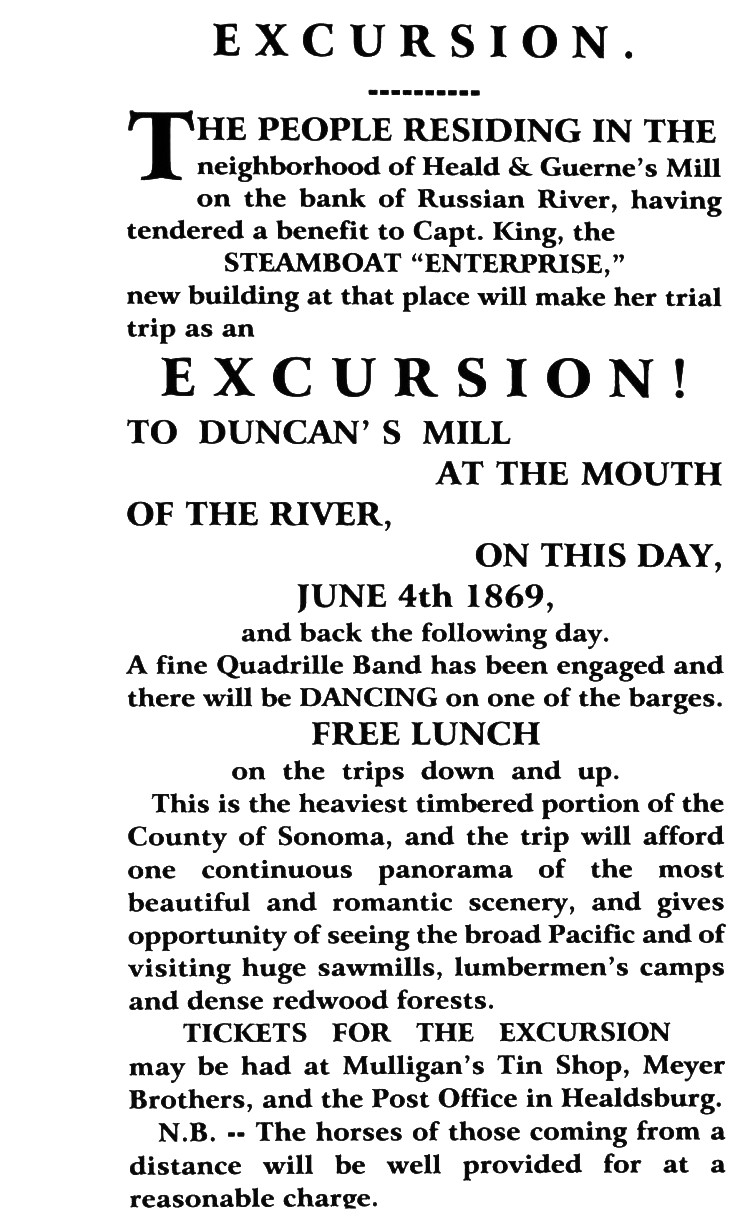 Alas, a cancellation notice quickly followed. "The excursion trip is postponed for a few days, owing to an unavoidable accident which will be soon remedied, when all will be right again." As the summer and autumn of 1869 passed, King continued to tinker with his boat and just before Christmas the Flag reported that he was actually towing cargo. The excursion to Duncan's Mill and back (with dancing on the barges in tow) supposedly happened Dec. 23-24, but nothing further appeared in the paper.
He failed to meet his goal of reaching Healdsburg before Christmas, but told the Flag he "intends next Summer to make regular trips - three times a week — from the month of the river to Healdsburg." Besides working on his boat, "the Capt. has constructed a dam and lock, which gives the river a three foot rise above the dam," reported the Flag. "He will open the lock and let the boat ride through to the sea on the accumulated waters."
Then sometime after the New Year with the river around its winter peak, he made a run for Healdsburg. He sank two miles past Guerneville.
"The indomitable Captain has got her afloat again," reported the Flag a few weeks later. King was aided by someone from the Mare Island Navy Yard as well as fifteen men clearing obstructions in the water. "Capt. King's steamer, 'Enterprise,' will probably reach Healdsburg today. as she is now but a short distance below town," the paper reported on March 24.
He didn't. The ship ran aground again and this time could not be budged. It stayed wherever it was for months, maybe years.
In November of 1871 a visitor was told "...she twisted off her shaft and went to the bottom; and how the hulk now lies half-buried in the sand — a warning to any man so presumptuous as to attempt steamboat navigation on a river along which there is not yet enough traffic to have made even a decent bridle-path..."
Hannah Clayborn, who writes some about the steamboat in the "Roads, Ferries, and Bridges" chapter of her Healdsburg history page, suggests it got no farther than the Windsor area, but Dr. Shipley's "Tales of Sonoma County" says King almost made it to the summer dam:
| She struck hard aground and fast, the water went down and left the tug high and dry on the bar and it had to be abandoned until the next high water when the fall rains set in, at which time she was repaired, re-caulked, and with the crew who brought her up the river the spring before, they sailed, or rather steamed, down the muddy water back to the sea... |
Why he risked - and ultimately, lost - his river hauling business at Guerneville is a mystery. What was so important about reaching Healdsburg by water? His steamer was so small he could not have carried much cargo aboard, and he certainly could not have gotten his barges through the channel. And even in the middle of the rainy season, Healdsburg was not cut off by road, or at least no more than other towns. A January, 1870 letter from a Healdsburger who went to Vallejo remarked, "the road to Santa Rosa was so so - very fair for our county; from thence to Petaluma it was too abominable to talk about to strangers."
My guess is that King's venture was bankrolled by Thomas W. Hudson, who owned considerable property on the southern end of Healdsburg. A one-term member of the state Assembly 1869-1871, the only bill he tried to get passed was to declare the Russian River navigable so state money could be spent on improvement. "This is intended to encourage and protect the indomitable enterprise of Capt. John M. King," the Flag noted. Hannah Clayborn wrote, "...declaring the river navigable would have served Hudson's interests, as he owned the west bank of the river and half of a ferry system throughout the 1860's, a natural location for a proposed Healdsburg Wharf."
There's an odd little Believe-it-or-Not! twist to the sad tale of steamboat captain John M. King, and I'm not sure what to make of it. About two months after the (final) sinking, he wrote a letter to the Flag informing them he was now running a sawmill near Cloverdale, and would return to the Russian River soon and build a new ship which he would name the "Perseverance.” Alas, he wrote, Heald and Guerne were trying to break him and had attached the Enterprise for money owed. They had even attached his dog, Gipsey, "which I valued more than money." The pooch was supposedly sold for $200. "This seems like a large sum. but I would not have taken twice that amount for it."
The next week Tom Heald wrote the paper. "Heald and Guerne have not attached the boat as represented by King, and, as to his dog 'Gipsie,' I never as much as knew he had such a dog. Heald and Guerne do not wish to 'break' J. M. King, nor to 'keep him broke,' but suppose we will have the pleasure of seeing the 'Perseverence' when she comes along."
| * The 1976 case was Hitchings v. Del Rio Woods Recreation & Park District. One of the lawyers in the 1886 Wright v. Seymour suit was this journal's favorite antihero, James Wyatt Oates. |
The Steamboat “Enterprise.” — This boat now being built at Heald's Mill by Capt. John M. King, will be launched next Saturday the 15th. The machinery is all aboard now and the boat will be completed within two or three weeks, when she will make an excursion to Duncan's Mill on the Coast, going down one day and returning the next. As many of our citizens will want to join the excursion the Flag will give timely notice of the day set for it to come off. The livery stables will run stages down to the landing twelve miles from Healdsburg. Capt. King has been running a barge on the river, drawing from fourteen to twenty-six inches, according to the load. He has made six round trips from Heald's Mill, carrying, in the aggregate, 200,000 shingles and 20,000 feet of lumber, besides considerable farm and dairy produce. He has built another barge drawing only twelve inches when loaded. He is now building the “Enterprise” to tow these barges. The boat is 50 feet long; 10 foot beam on the bottom and 14½ on deck; Engine 15 horsepower; draught 12 inches; depth of hull 44 inches; dip of paddles (stern wheel) 10 inches. She is built in a superior manner and fitted up with a cabin and all necessary conveniences for carrying passengers. Capt. King having a contract for carrying the lumber from Heald & Guern's Mill the regular trips of the boat will be between that point and the Coast. In the season of high water the Captain expects to run to Healdsburg. This would give us cheap freight between Healdsburg and San Francisco while the mud road to Petaluma was at its worst. We hope Capt. King's enterprise in building the “Enterprise” will be richly rewarded.
- Russian River Flag, May 13 1869
Particular attention is likewise invited to the advertisement of Capt. John King, of the new steamboat "Enterprise." He proposes an excursion which will give every one an opportunity to enjoy the delightful scenery along the navigable portion of Russian River, and also to visit the coast on the first steamboat ever built or run on this river. We hope the Captain may have an encouraging benefit on this occasion. His pioneering energy should be well rewarded. It is twelve miles we believe to the Mill from which the excursion starts.
- Russian River Flag, May 20 1869
Read Capt. King's advertisement carefully once more and decide whether you can afford to lose the trip. — We learn from Capt. King, and you will learn from our correspondent “Visitor,” that the excursion is postponed for a few days. Be ready for another announcement.
- Russian River Flag, June 3 1869
Letter from "Big Bottom.” Big Bottom, May 29th, 1869.
Mr. Editor: The most important event of th« day to the people of Lower Russian River, is the successful launching of the steamboat “Enterprise" built at Heald’s Mill by Capt. J. M. King. The scene was witnessed by many of the citizens — ladies and gentlemen — who met there on the occasion. The little boat sat on the water beautifully, and promises all that her sanguine friends could have anticipated of her. The excursion trip is postponed for a few days, owing to an unavoidable accident which will be soon remedied, when all will be right again. When ready, due notice will be given to all. - Visitor
- Russian River Flag, June 10 1869
The steamer Enterprise, Capt. John King, has steam up again and is running. It will make a trial trip to the mouth of the river this week. The Capt. has constructed a dam and lock, which gives the river a three foot rise above the dam. He will open the lock and let the boat ride through to the sea on the accumulated waters. — Capt. King says that three locks would be sufficient to make the Russian River navigable to Healdsburg the whole year; also that we may expect to see his boat up here the first Fall rains.
- Russian River Flag, August 12 1869
We visited the steamer Enterprise, lying one mile below the mill. Capt. King is quite confident that he will visit Healdsburg by steam before Christmas. Says he intends next Summer to make regular trips - three times a week — from the month of the river to Healdsburg. Next Saturday he intends making his first trip to the mouth of the river.
- Russian River Flag, August 26 1869
Capt. King of the steamer Enterprise was in town last week having some repairing done to the machinery of his boat, which will soon be skimming over the waters of Russian River.
- Russian River Flag, September 2 1869
A Success. - The new steamer Enterprise recently constructed by Captain King for navigating the Russian River, made her trial trip on the 23d ult., and we are glad to learn, proved a success. Her speed was some ten miles an hour.
- Petaluma Argus, October 7 1869
The Steamer Enterprise. — We are pleased to learn from Mr. J. W. Bagley that Capt. King's boat, the Enterprise, is now successfully running on Russian River. She left Heald & Guern's Mill on the 16th with several passengers for Duncan's Mill, with barges in tow loaded with charcoal. On her next trip she will carry hoop poles and several thousand Christmas trees for San Francisco. At last, after several unsuccessful attempts, Russian River is navigated by a live steamboat, and we hope, when the river rises, to see the little vessel throw out her bow lines and stern lines and spring lines to the Healdsburg wharf! Captain King is entitled to great praise for his indomitable pluck and perseverance under difficulties and we hope his "Enterprise” may prove a great success. Since the above was in type we are informed that the boat will leave Heald & Guern's Mill today at 12 o'clock on a pleasure excursion to Duncan's Mill and return at noon tomorrow. Fare down and back, $2.50. Two barges fitted up for dancing will be in tow.
- Russian River Flag, December 23 1869
Mr. Hudson's bill declaring Russian River navigable and providing for its improvement, has passed the Assembly. This is intended to encourage and protect the indomitable enterprise of Capt. John M. King, who has built a steamboat to navigate Russian River, and it will no doubt become a law. It will be of great benefit to our county.
- Russian River Flag, February 17 1870
The Enterprise. - Some weeks since Capt. King attempted to make a passage to Healdsburg with the “Enterprise," but a little above Heald and Guern's mill the pilot backed the boat upon a snag and sank her. This occasioned delay and considerable expense, but the indomitable Captain has got her afloat again and with the experienced help of his friend Capt. Parker, of the Mare Island Navy Yard, he will make the first voyage to Healdsburg as soon as some obstructions can be removed from the river, which he is now engaged in doing, with a force of fifteen men. The boat is now above the mouth of Mark West creek about ten miles below Healdsburg. The captain has bought new sixty horse power engines for her and he will keep her here when she comes up until they are put in.
- Russian River Flag, March 10 1870
Capt. King's steamer, “Enterprise,” will probably reach Healdsburg today. as she is now but a short distance below town.
- Russian River Flag, March 24 1870
The Russian River Boat.
We have learned with considerable regret that Capt. King's boat the "Enterprise.” is, for the present, a failure. The Captain has met with many serious difficulties in his undertaking, the chief of which lately, seem to have been the summary manner in which some of his creditors have secured their claims, whether rightfully or not we have no knowledge, and of course have nothing to say upon that head, though we had hoped that the Captain's energy and perseverance would be rewarded. At his request we publish the following letter:
Eds. Flag: — I take this opportunity of thanking you for the many favors you have done me during the time I have been endeavoring to prove that Russian River is navigable. Although I differ very widely from you in politics, yet as long as I can use a hammer and cold chisel you may consider me one of your subscribers. Messrs. Heald & Guern have attached my boat, but that will not prevent me from making a living, as some friends have engaged me to run the Perseverance Saw mill, which is located thirteen miles above Cloverdale. They also attached my dog, "Gipsey,” which I valued more than money. They sold the dog for $200. This seems like a large sum. but I would not have taken twice that amount for it. They may break me, but they cannot keep me broke. The first of August, I will commence building another steamboat, at the mouth of Russian River, to be called the "Perseverance.” Again thanking you for past favors I ask that you do me one more by publishing this letter. Respectfully, yours,
John M. King.
- Russian River Flag, May 5 1870
A Card From Mr. Heald.
Eds Flag: — If I may be permitted the space in your paper to correct some errors in the card of John M. King, in your issue of May 5th, I will be thankful for the favor, as it seems to throw the blame of the failure of his boat where it does not belong. I think, however, the fact of his trying some four weeks to get the boat to Healdsburg over the shoals, with the river falling every day, without any probability of a rise till next December, and only making twelve miles, should convince any one that the “Enterprise for the present is a failure," and Heald and Guerne not wholly answerable tor it, if they had lately attached the boat; but the facts are, that Heald and Guerne have not attached the boat as represented by King, and, as to his dog “Gipsie,” I never as much as knew he had such a dog. Heald and Guerne do not wish to “break" J. M. King, nor to “keep him broke,” but suppose we will have the pleasure of seeing the "Perseverence” when she comes along.
Thos. T. Heald. May 8th. 1870.
- Russian River Flag, May 12 1870
IN THE REDWOODS.
Life among the Lumbermen - How the Redwoods are Cut and Hauled, etc.
[Correspondence to the Bulletin.]
Stumptown, Sonoma Co., Nov. 20th
...Two or three hours I listened to these heavy stories, and to my hosts narrative of his financial shipwreck through a rash steamboat venture up Russian river with one King; how she twisted off her shaft and went to the bottom; and how the hulk now lies half-buried in the sand — a warning to any man so presumptuous as to attempt steamboat navigation on a river along which there is not yet enough traffic to have made even a decent bridle-path...
- Russian River Flag, November 30 1871
Yay, sesquicentennial! So what was Sonoma county really like in 1868? If a movie was made of Santa Rosa in those days, would it have the flavor of the sweet little town in "The Music Man" or the sort of rough place seen in "Gunfight at the O.K. Corral?"
I recently visited the Midwest and while waiting at the St. Louis airport I met a very nice Dutch family (Jan, if you're reading this, please get in touch; I lost your business card). They found it novel to meet someone from the West Coast, then became excited when they learned I was a local historian - to them, this place called Santa Rosa was somewhere between Deadwood and Dodge City.
Jan used to follow the Wild West festival circuit around Europe (yep, that's really a thing). He even had a custom-made Indian costume which he said was authentic down to the eagle feathers. (NOTE: the feathers were probably imitations, as it's illegal to sell them in the U.S.)
He peppered me with questions: Does our history museum have any guns of famous outlaws? (Uh, I doubt it.) Was Billy the Kid ever here? (No.) Jesse James? (No.) Wild Bill Hickok? (No.) Buffalo Bill? (Yes, but only with his circus.) Was there an army fort? (No.) Did Indians go on the warpath? (Oh, please.) Were there gunfighter shootouts? (No.) Were there lynchings? (Sure, the last being in 1920 - which gave him such pause that he asked me to write down the year to make sure he understood correctly.)
There never really was a "Wild West" here, I explained; Sonoma county was mostly settled by farmers from Missouri, and as a result the people in Santa Rosa and the rest of the county acted pretty much like, well, Missouri farmers. Yeah, it was unusual that Santa Rosa cheered for the Confederacy to win the Civil War and anti-Chinese racism was virulent, but there was never exceptional violence or lawlessness in Sonoma county during the latter 19th century. Then reflecting on our conversations during my long flight back to California, I regretted portraying that our history was ever so clear cut.
First, Sonoma county indeed had the sort of Old West outlaws that so intrigued my friend from Holland - he even might have heard of the poetically-inclined “Black Bart” who robbed three stage coaches here. B.B. gets all the press, but there was also the Cloverdale-based Houx Gang in 1871 and just a bit further north there was the cattle rustling and stage robbing Buck English Gang in the mid-1870s (and yes, Jan, his gun is in a museum). This pattern of stick-em-ups continued through the next decade with Dick Fellows and others whose names were never known.
As per Missouri: Sure, Santa Rosa's love of Dixie came from Missouri families often having deep ties to the Old South - but it was simplistic to say those Missouri immigrants hung on to all their Midwestern values once they were here. Even a deeply-rooted belief in civility can be degraded when someone is dropped into a frontier situation, where there are loose rules for conduct and weak institutions. All of the tales told below show the result; there are acts of impetuous behavior which never would have been tolerated back in their hometowns - including person-on-person violence and community vigilantism.
Historian Frederick Jackson Turner discussed this across several essays about the unique problems of the American frontier. When people are "unchecked by restraints of an old social order," it didn't matter if the frontier was the Carolinas during the 1730s, Missouri in the 1810s or California in the 1850s. The pattern was the same: American pioneers were quick to take the law into their own hands instead of waiting for the legal system to preserve order. "If the thing was one proper to be done, then the most immediate, rough and ready, effective way was the best way." That often meant lynching or pulling out a pistol.
Turner also pointed out that "a crime was more an offense against the victim than a violation of the law" and an insult or show of disrespect could swiftly lead to violence. Add the presence of firearms and a confrontation which might never have gone beyond shouting or bloody noses can become a deadly situation. And that brings us to the first tale from our Wild West days.

This is the "half" tale, which means I'm only summarizing it because you should read the whole story in John Schubert/Valerie Munthe's Hidden History of Sonoma County. It's a gripping yarn and well told by them; the book also has a chapter that reveals the history of Houx Gang (I once tried to figure out their doings, but there was so much confusing info I gave up). All together, "Hidden History" is easily the best book on Sonoma county history published in ages. My only quibbles are the lack of footnotes/endnotes, and the title grossly overpromises - a full "hidden history" would fill bookcases. As of this writing, it's even on sale at the Santa Rosa Costco.
In 1867, Charles Henley killed James Rowland. The two farmers lived about a half-mile apart near Windsor, and there was bad blood between them because Henley's pigs kept getting loose. Rowland corralled some of those hogs and Henley went over to fetch them, carrying a shotgun; there was a confrontation inside the pig pen and Rowland was shot dead at close range. The animals would mutilate his body until it was later discovered.
Later that night Henley visited a friend, confessed to the shooting and sought advice. The friend urged Henley to ride over to Windsor and surrender to the authorities, though he was hesitant because "they are all Odd Fellows," as was Rowland. Henley also asked the friend not to tell his hired hand because he was likewise a I.O.O.F. member, but the man had overheard Henley's confession anyway. Henley turned himself in the next morning and later that day, members of the Windsor Odd Fellows Lodge showed up to claim the body. Lodge members wore their badge of mourning for thirty days.
Henley was taken to the county jail to await trial. Exactly thirty days after the killing, Santa Rosa's night watchman was surprised by four masked men. "Keep quiet," he was told, "there are 150 of us, well-armed, and we have come to take a certain man out of jail." The watchman was held captive and soon joined by the jailer. Another of the masked vigilantes encountered a policeman on patrol and held the officer at gunpoint.
The jailer was forced to open Henley's cell and the prisoner was bound and gagged before being carried away. His body was found hanging about a mile west of town in what's now the Roseland district.
There was an outcry over the lynching in both the local press and the big San Francisco newspapers, with a reward of $2,000 offered for information on the identity of the mob. Any suggestion that the masked men were Odd Fellows was met with fierce denial and the pursuit of the guilty was soon forgotten.
Then just a few days after the lynching there was another killing in Santa Rosa.
Around midnight on the night of June 20, 1867, Byrd Brumfield used his pocket knife to slash John Strong to death at Griffin's Saloon. The number of wounds varied between 7-16, depending on who was telling the story. Although witnesses testified that Strong was running for the door at the time, the Coroner's Jury ruled that Brumfield had killed him in self defense. Testimony also revealed Strong had a six-shooter that he may (or may not) have attempted to draw, but the verdict seemed to come down to the jury being told that nobody liked Strong and Brumfield was a good guy.*
Between the slashing and the lynching, we can all probably agree 1867 was a pretty violent year in Santa Rosa (and remember, that was the year just before the one which we are about to sesquicentennial-ly celebrate). Still, the Sonoma Democrat boasted after Brumfield was acquitted, "to the credit of our town, that this is the first man ever killed in Santa Rosa. Few California towns can say as much." That of course was technically true, as Henley had been just strung up outside of city limits and when Michael Ryan had buried the point of a pickaxe in his poor wife's head two years earlier, his murder victim was not male.
Brumfield apparently decided that a pocket knife was no longer adequate for his needs. The following year he had an argument with Captain L. A. Norton and both men drew their guns. Brumfield fired four times before Norton's sidearm left his holster and the Mexican War vet was shot in the left hand. A jury again ruled Brumfield merely acted in self-defense.
In his youth Byrd had worked on the big Brumfield family farm, somewhere in the Russian River valley. By the 1870 census he appears at age 32 with the profession of "sporting man," by which we can assume means he was a professional gambler. By 1875 he found himself blacklisted by all saloon owners around Healdsburg; we don't know if that was because he was a card shark or just a violent alcoholic.
“Byrd’s on a big drunk today,” Harry Truitt warned those sitting in front of a Healdsburg Hotel on an afternoon that November. Brumfield was more than just liquored up - he was looking for a fight.
"There’s been a big poker game in town,” Byrd told a friend. “I'm going to play poker in this town,” adding he had been kept out of the bars long enough.
“They don’t treat me right in this town,” he told another, who asked, “Who don’t treat you right?”
“These Zane boys; they’ve got rich now and don’t notice a common man. I knew them when they didn't have a cent: then they treated me all right. I’m going into Will Zane’s saloon today or die; and I'll get away with it if I go in.”
Byrd held some sort of grudge against Willis Zane; six months earlier, Brumfield had borrowed Zane's revolver only to turn it on the owner and attempt to kill him (or so the "special reporter" for the Sonoma Democrat wrote). Zane was warned that Byrd was drinking and telling people he intended to show up at the bar. "I'll let them know that I'm not dead yet, but don't care a damn how soon," said the drunken Brumfield.
Shortly before sunset, Byrd staggered into Zane's saloon. Willis told him twice to get out. Byrd didn't say a word, but moved towards Willis (it was unclear whether his gun was drawn or his hand was still reaching under his coat). Zane drew his pistol from a pocket and shot three times. Byrd Brumfield was dead.
The Coroner's Jury acquitted Zane, declaring it was justifiable homicide, but much of the testimony was a mirror image of the 1867 inquest - only this time, nobody liked Brumfield and Zane was the good guy.
The takeaway from the story is not that Byrd Brumfield was a bad guy (which is pretty indisputable); it's how every time he had a beef with someone, he expected that other person to be armed. And he was right.
Scholars like to point out communities in the Wild West had strict no-gun laws, requiring those entering town to check firearms with a peace officer - remember the plot of "Gunfight at the O.K. Corral." While that's true, our local newspapers also show there were multiple "shooting affrays" every year in Sonoma county, although rarely did the incidents end in a death or even injury.
It's doubtful anyone ever walked the mean streets of Healdsburg or Santa Rosa with a gun holstered on his hip (other than lawmen), but all those affray items reveal some people were packing under that Victorian garb. Often they were the Usual Suspects (see Male: young, drunkenness of) but others would probably be surprising. Captain Lewis A. Norton, the man Brumfield shot in the hand, was not a cocky ne'er-do-well; he was a middle-aged Healdsburg lawyer and local Democratic party bigwig, a former Justice of the Peace who ran for county judge the year before he was shot, then state senate a year after.
And sometimes the shooters were even women.
| J. G. Hill of Forestville, better known as “Sock” Hill, while on his way to church at Forestville last Sunday evening, was fired at twice by Miss Georgia Travis. The first shot passed close to his left ear and through the rim of his hat, the second shot missing him entirely. Miss Travis was arrested Monday morning, on a charge of assault with intent to commit murder... |
That little item appeared in the Healdsburg Enterprise and other local papers in September 1879. (The item right below it, incidentally, was another shooting affray, describing a 21 year-old Lakeport bartender killing a patron who was told to leave but went for his gun instead.)
Details emerged a few days later: Sock - whose real name was Joshua - along with two young women, were walking to a Sunday night church service, as was Georgia. As they passed Faudre's Chair Factory (there's a reference sure to excite Forestville historians), Georgia drew her "bull-dog" pistol and began shooting at him. After firing both shots, she handed the gun over to a man who intervened. Sock and his women friends sat through the entire service (!) then went to Santa Rosa to file a complaint. He said Georgia had been threatening to kill him for over a year and he was afraid. The Grand Jury dropped the charges for lack of evidence, and it was never explained why she wanted the 42 year-old man dead. All she ever said was that she had been "slandered" by him.
Another month passed and there was a meeting of the Forestville Blue Ribbon Club, part of a very popular nationwide evangelical temperance movement. Although it was a night of heavy rain, 60-70 still turned out including women and children. Sock Hill attended as did Georgia Travis and her brothers, Wirt and John.
John was seated two rows behind Hill, and Wirt was the same distance in front. John reached over and punched Hill in the face. Sock Hill jumped up and confronted John Travis, drawing his gun. Wirt Travis then shot Hill point blank in the base of his skull. Amazingly, he would remain conscious until he died about fifteen hours later.
Panic ensued. John Travis apparently fired his own gun and Wirt shot again, wounding a bystander in the leg as he fled the room along with the dozens of other attendees. In court testimony there would be the usual claims and counterclaims - Hill fired his gun, John did not, John socked Hill because he turned around "made a face at me," Wirt claimed he shot Hill because he believed his brother's life was in danger, &c.
Wirt was found guilty of manslaughter and sent to San Quentin. The jury returned a verdict of not guilty for his brother John. "One of the most exciting trials ever had in Sonoma county," sighed the Sonoma Democrat, having stretched the sensationalist coverage over two issues.
So there you are, Jan; I was mistaken to tell you at the airport that we were just a bunch of boring ol' Missouri farmers. There absolutely was a true gun culture here in Sonoma county, and our communities - with somewhat of an exception for Petaluma - were very much gun-toting "Wild West" towns. Here I've only describe some of our frontier-type violence over a dozen years, but there could be dozens of essays like this to document all our uncivil behavior in the latter 19th century.
And don't presume the pistol-packin' days ended with the Gaslight Era. As documented here earlier, it was common to carry a “bicycle revolver" at least through the 1910s. There was also a dramatic four-way shootout in 1907 that managed to avoid hurting anyone seriously because no one knew how to aim.
A final note: Lest anyone rush to claim that crimes were deterred in those 50+ years of locals carrying concealed weapons, let it be known that I've never found an incident where a good guy with a gun stopped a bad guy with a gun. Instead, it's a miserable chronicle of holdup men using them to scare victims, fools and drunkards wielding these deadly toys at times of heated emotions, plus a hearty portion of gun owners shooting themselves by accident. Just tragedies with a dose of farce.
| * Later that year Byrd's sister, Jane, married an Alfred Strong, who is listed in the 1860 census as a farmer living in the Brumfield family home. I cannot find any family connection between him and John Strong. Byrd was living with the Alfred Strongs in the 1870 census. |
Quick Work.—Santa Rosa might be called a fast place in some respects. This week a man was killed, buried, and the perpetrator examined and discharged, all in less than twenty-four hours. We may remark, to the credit of our town, that this is the first man ever killed in Santa Rosa. Few California towns can say as much.
- Sonoma Democrat, June 22 1867
Disgraceful. —We regret to see in the San Francisco Police Gazette a disgusting wood cut, purporting to represent Byrd Brumfield in the act of killing John Strong in Santa Rosa on the night of the 20th of June. The Gazette was grossly deceived by its informant in regard to the relations of the parties, circumstances of the killing, and burial of Strong. The latter, we learn, was buried under directions of a relative, had a good coffin, and was decently interred.
- Sonoma Democrat, July 6 1867
Testimony in the Case of the People vs Brumfield
[inquest]
- Sonoma Democrat, October 26 1867
Death of Byrd Brumfield.
[inquest]
- Russian River Flag, November 18 1875- Sonoma Democrat, November 20 1875
From Forestvllle. Our regular correspondent writes us November 11th, as follows; "Forestvllle against the world. We have said this before and have occasion to reiterate it now. Saturday night last, 8th Inst., was one of our dark limes, and we were pained to witness such scenes as then occurred in our usually quiet village. As our tempetauce club was about to be called to order its peace and quiet was disturbed and the lives of women and children endangered by two brothers, Wirt and John Travis, who assaulted and shot to death J. G. Hill. The meeting was of course broken up for the evening, and the Society will hereafter convene at the Christian Church instead of the hall. Mr. Hill’s funeral took place at 2 o’clock on Monday, and the high esteem in which he was held by the community was manifested in the unusually large number of persons who attended the obsequies, over three hundred persons escorting his remains to the grave. He was a kind hearted man; one who was always ready to help the needy and to accommodate his neighbors. During an acquaintance of twelve years your correspondent always found him correct in his dealings, and his neighbors generally deplore his untimely death.
- Sonoma Democrat, November 15 1879
People Vs. Wirt Travis
[testimony]
- Sonoma Democrat, March 20 and 27 1880
Imagine asking someone in the Bay Area anytime around the turn of the last century to "Name someone who lives in Santa Rosa." There's little doubt that first pick would be that guy named Burbank. But depending upon the year, a surprising number of people might have thought of Blitz W. Paxton. Unlike Burbank, he wasn't famous because of personal achievements; he was well known because he was often mentioned in the newspapers on account of being sued - and he was sued a lot.
The saga of Blitz (and yes, that was his real name) is a pretty good story in its own right, but it's really all background to the article which will follow, describing the magnificent house Blitz and his family built in Santa Rosa. Whether that second chapter in his life redeems him or not is up to Dear Reader to decide - or maybe you'll read this and come away feeling he did nothing amiss and was treated unfairly. Either way you're likely to have strong feelings about him, just as your Bay Area great-grandparents probably had.
When Blitz was born in 1858 his father was already on his way to a fortune; by the time he reached adulthood, theirs had to be the richest family in the north end of Sonoma county. John A. Paxton was a banker and investor who was among the founders of the Santa Rosa Bank and president of the town's gas company, among other investments. He built the family a 17 room manse in 1880-1881 west of Healdsburg in the fashionable Second Empire style which is still around; you probably know it as the elegant Madrona Manor B&B.
In those years John spent the workweek at his San Francisco bank office, returning on the Friday train where he was met by a servant. "If the weather was a bit nasty, the coach and footman arrived in a closed carriage - some class!" Wrote Dr. William C. Shipley, the Boswell of old Healdsburg. Shipley described the Paxtons living like gentry. "There was a footman, groom and several maids. They had quite an entourage in keeping with their position and wealth, yet with it all they were perfectly likable human people...the whole town gloried in their dignity, majesty and power, but none were envious." It was a grand life.
According to the biographical sketch of Blitz in the 1911 county history (always self-serving because the sketchee paid to be included) young Blitz had a series of office jobs for a silver mine, a bank owned by his father and a dried fuit distributor. But unspecified "failure of his eyesight" caused him to stop working,
Blitz married Elizabeth "Bessie" Emerson in Healdsburg in 1882. She was from Rochester, New York and they likely met because her sister, Luta, had married into a prominent Healdsburg family and was living there. Bessie was the seventh of eleven children (no twins, either) all of whom lived to adulthood. Her father was an entrepreneur who ran many businesses; her mother was likely exhausted from running after so many children before dying at age 42.
The marriage of Bessie and Blitz quickly soured. A son, John, was born after their first anniversary but while the boy was still an infant, he and his mother were living back in Rochester with her father. It's unknown whether Bessie or Blitz knew she was again pregnant at the time they separated.
Soon after they split in mid-1884, Blitz left the country for 6+ years traveling in Latin America, then Europe. What he did in those years is a mystery; the hagiography in the county history notes only that "a number of years were pleasantly and profitably passed." (The history does not mention Bessie and their kids, by the way.)
While he was abroad, his father John disinherited Blitz not once, but twice; the first codicil in 1885 dropped his quarter-share in the $750,000 estate, and the next change took away his one-eighth interest in the farm. Just a few months later, John died in 1888 aboard a ship en route to London, where he was expected to meet - and presumably, reconcile - with Blitz.
Three months after John died, his mother, Blitz was joined in London by his mother, Hannah, and her niece. The three of them toured Europe together, so presumably the only one in the family that had a beef with Blitz was his dad.
Blitz returned to California in late 1890, moving into the grand house at Madrona Knoll Ranch with his mother and aunt. The year before he died John built a two-story winery with an impressive 200,000 gallon capacity; Blitz assumed control of this and other family business. Little happened for the next few years - until Hurricane Bessie landed in 1894.
Overnight the Paxtons found themselves cast as villains in a titillating scandal covered by the yellow press on both coasts.
 |
| Bessie and Blitz Paxton illustration from San Francisco Chronicle, May 11, 1894 |
Bessie sued for divorce, charging Blitz had deserted her ten years earlier and had refused to provide child support - and for good measure Bessie also sued his mom for $100,000, claiming she caused "alienation of her husband's affections." The divorce was granted but Bessie and Blitz would battle over support for the next eighteen years, making it surely the longest dustup in the history of Sonoma county courts.
Over the years, charges flew. In a later suit she claimed that she went to live with her father because "drugs he compelled her to take wrecked her health and caused her great suffering." She said he had provided almost no child support, but when they corresponded a year after the separation, Blitz allegedly offered half his fortune ($25,000) - although according to Blitz, she instead unsuccessfully tried to shake down his father for twice as much. (Blitz later said his first disinheritance was because his father didn't want her to benefit in any way from his estate.)
The core of Bessie's demand for money was always her children being helpless dependents. Son John had been completely blinded a few years before the divorce in some sort of accident, and his sister, Roma - born after her parent's separation - was portrayed as an invalid, although nothing specific was ever claimed except that she was "delicate" for once having hit her head. (Roma married in 1908, had four kids and lived to the great old age of 85.)
As the years passed and new lawsuits were filed, Bessie's pleas became more strident and dramatic. She sobbed in court testimony, claimed that her children were about to go hungry as she was months overdue on all bills. She blasted her wealthy ex-husband as every kind of monster - although in a 1906 appearance she turned her ire towards Blitz' attorney (and seemingly his best friend) James Wyatt Oates: "I know that if he were left alone Mr. Paxton would provide for me and my blind son, John, and my invalid daughter, Roma," she complained in 1906, "but Attorney J. W. Oates of Sonoma, who represents Mr. Paxton, will not let him settle the case, because the longer it goes on the larger will be his fee. This is common talk at our old home and is a fact."
Even as Bessie kept escalating her claims of pauperism, Blitz likewise kept deflating the size of his bankbook. He claimed at various times he was "practically bankrupt," his investments had flopped, he was "in such bad shape that I cannot tell at this time what I will be able to do," had no income because he could not work due to gout and heart disease (yet somehow managed a week-long fishing trip with Oates), had "no coin, and no property on which he can raise any" or was nearly penniless from paying lawyers to fight Bessie. In 1905 he filed an affidavit claiming he was flat broke - yet three months later, hosted a party for 300 at his grand Santa Rosa home.
From the beginning of their courtroom conflicts, the San Francisco press framed the story as the cold-hearted millionaire fighting the impoverished mother of his children and his pitiful children. During the 1894 divorce case the Chronicle was unusually honest in suggesting this spin was selling lots of papers: "The article published in the Chronicle lately concerning the suit...caused a sensation here and in Sonoma county, where the wealthy Paxton family is well known. The narrative of Mr. Paxton's treatment of his young wife and their two children was interesting reading in the clubs and swell places which he frequents."
Flash forward a few years later and the San Francisco Call offered a headline, "PAXTON HUNTS DUCKS AND CHILDREN STARVE." Scattered among the selection of articles transcribed below are a few other examples of the anti-Blitz spin (and there are certainly more) but this snark from the 1906 Call is my favorite:
| Every parent in the animal kingdom, by studied proximity and conscious sacrifice, feeds and shelters its offspring. Then why does Blitz W. Paxton stand alone? There are some animals that devour their young. Then there is the canis tribe – a class by themselves of carnivorous mammals, such as the dog, the fox, the wolf and the jackal, but these all outclass Blitz W. Paxton in the support and shelter they universally supply to their offspring. |
Was Blitz really that rich and was Bessie really that poor? More on Blitz is below and in the following article, but he was never close to being the Daddy Warbucks who Bessie portrayed. And it's very doubtful she or the children ever faced real financial hardship.
Bessie apparently returned to California in 1892, not long after Blitz came back from Europe. She and the children settled in San Francisco where her brother-in-law (General Richard H. Warfield, the husband of her sister Lute) leased and ran the California Hotel in the city's fashionable French Quarter centered around the intersection of Bush and Kearny. She remained a "permanent guest" there at least through 1899 - as a side lawsuit in the divorce proceedings, Warfield demanded Blitz pay $315 for two years of food, clothing and boarding.
While the press was telling readers that poor Bessie was counting nickels, she was actually hobnobbing with elites on Nob Hill, particularly multimillionaire James Graham Fair (he's the "Fair" in the name of San Francisco's Fairmont Hotel). A notorious philanderer whose wife had divorced him for ""habitual adultery," Fair died the year after the Paxton divorce. Women came forward claiming he had promised to leave them a generous bequest and rumors were that Bessie had a final will which named her a major beneficiary; it wasn't true, but it suggests the newspapers presumed she and Fair had a very close relationship.
The Paxton divorce was settled in the autumn of 1894: Bessie would get $7,500 in cash and $100 a month until the children were of age. Blitz also took out a life insurance policy naming her and the kids as beneficiaries. It wasn't a grand sum, but $100/mo in 1894 works out to about $40,000 a year in today's money - and remember, she was apparently paying little for living expenses at her family's nice hotel.
Following the divorce settlement and the flurry of excitement over the Fair affair, all was quiet concerning the former Mr. and Mrs. Paxton until the turn of the century. Then: Vaudeville!
(RIGHT: Bessie Blitz Paxton vaudeville publicity photo)

Bessie had long fancied herself a singer, and as far back as the original divorce suit she claimed of being "forced to sing in church choirs" to support herself and the children. It comes as news to me that was ever considered a well-paying gig, but she later expanded her claim to "singing in oratorio" and opera, although never were any specifics provided. (Full disclosure: I myself was in two productions of the New York Metropolitan Opera and can likewise say I have made operatic appearances. In one I marched onstage with other spear carriers and in another I waved a flagon in a tavern scene.)
In 1900 she made her first appearances in San Francisco and Los Angeles to polite reviews. Her voice was low but carried well and said to be "velvety in quality." Her stage name was "Mrs. Bessie Blitz Paxton" to milk the divorce infamy and per usual, she worked in a dig at Blitz when interviewed: "[T]here are bills to be paid," she told the San Francisco Call, "doctor's bills the result of my little daughter's recent illness. Her father won't pay them so I must, and I am going on the stage to earn the money." Ever sympathetic, the Call's headline was, "SINGS IN PUBLIC FOR HER CHILDREN."
The following year she did an East Coast tour which did not go so well. She began with a troupe playing Midwestern cities. (Lincoln, Nebraska review: a "California society woman with charming vocal powers and a most peculiar manner.") Bessie was fired a few weeks later for punching the leader of the company after he chided her for a lack of professionalism. According to the Los Angeles Herald, "She wheeled him around and out into the [train] aisle and planted a No. 5 [boxing lingo for an uppercut punch] where it was the most forceful." She ended 1901 on stage alongside bottom-of-the-barrel acts such as the Carmen Sisters ("banjoists") and "Fritz the monkey, who turns wonderful somersaults." For a few weeks she apparently tried to relaunch herself as a novelty act: "Alice Blitz Paxton, The Female Baritone."
Back home the legal battle with Blitz resumed, this time over a $918 medical bill for daughter Roma. Blitz argued he should not have to pay for it as he did not authorize the treatment and the state Supreme Court agreed. It was another example where he easily could be viewed as heartless - but that was a hefty bill (about $29,000 today) and we have no information about Roma's ailment or medical treatment. All we have to judge its merits is that the physician was Dr. Grant Selfridge, a homeopath who specialized in hay fever and allergies.
This brings us to 1902, probably the most eventful year of Blitz' life. He was now president of the Santa Rosa Bank, of which his father was a founder; he had a new wife and a new son and the family had moved into their fine new house in Santa Rosa. That year his mother also died, which seemed to make him the rich man Bessie had always falsely presumed him to be. Soon she was back demanding he double the alimony payments. This round of their epic fight would continue from 1903 to 1908.
Rehashed once again were the accusations from their old separation, with some new details added: Bessie now accused him of stashing away their $500 wedding silverware. It was probably Bessie's stage experience which brought tearful and wrathful drama to her court appearances, including a moment where she attacked Blitz in the courtroom like a bulldog prosecutor:
| Springing to her feet, bitterness marking every gesture, Mrs. Paxton walked toward the man whose abandonment of her has cost her years of suffering, and said:
"And who, if it please you, took care of your children when you took $40,000 from the bank and went to Europe for a good time? You say, you should support these children. You had an opportunity before any suit was filed, but you turned your blind son away from your home when he went to ask for aid." Paxton winced and reddened, but tried to smile unconcernedly. “Oh, you may well laugh," said Mrs. Paxton, "when you are living in luxury and we are starving." |
At first Bessie's new legal campaign against Blitz might seem like the action of someone foolish or desperate. He was no longer required to pay child support as John and Roma were no longer minors, being 22 and 20 (respectively) in 1905, the key year for their court decisions. But requesting more alimony was merely a clever gambit by her lawyers; under California's Civil Code §206 there was an obligation for parents to support children who could not provide for themselves because of infirmities - regardless of age. Now his children were individually suing him as well.
Blitz was ordered to pay Roma and John $50 a month each. He refused and his children's lawyer asked for him to be imprisoned on contempt. As reported in the Call, their attorney told the court that Blitz was such a monster that he even refused to see his kids after they trekked all the way to Santa Rosa on their own:
| Last week, alleges Attorney Hanlon, John, the blind son, and Roma, the invalid daughter, went to Santa Rosa to ask their father for aid, as the court had decided that not only morally but legally he was bound to support them. Leading her sightless brother by the hand, says Hanlon, Roma trudged from the station along the country road to the splendid home of their father. Up the drive they had once hoped would lead them to their own doorway they walked, two children intent upon executing their own judgment, but they were to be disappointed...when these children turned into the driveway leading to their father’s home he was sitting at his ease at that home. But as the children approached the blinds were drawn and a servant was dispatched to meet John and Roma. 'Your father is not at home,' said the servant. 'He has gone to San Francisco. I do not know when he will return.' Thus repulsed, these children turned back to the station, penniless." |
I tell you, the reporting on the Paxton court hearings was the best entertainment available during the autumn of 1905. Forget sports, forget politics; you can bet everyone in Northern California was eagerly flipping through their morning papers to see if there was a fresh salvo from Bessie and the kids or whether Blitz had finally sprouted horns and a tail.
While Blitz was being threatened with the court seizing his share of Madrona Knoll and/or throwing him in the clink for contempt, Bessie's society friends organized a gala concert on her behalf at the Tivoli Opera House. "When the total receipts were figured up if was found that a fund of fully $2000 was ready to relieve the temporary embarrassment of the brave Mrs. Paxton and her family," the Call reported.
Years were passing and like a soap opera storyline, details changed while the plot remained fundamentally the same. Court decisions kept falling in favor of the children, with one point being appealed to the state Supreme Court. John bitterly demanded judges to punish his father. Blitz said he had no property to sell, which was true - he had transfered the Santa Rosa house to wife Jane on New Year's Eve 1904. The only thing he truly owned was roughly one-third of the Healdsburg property which he had inherited from his mother. Bessie's lawyers had estimated his share at over $100,000, but much of its value was in the productive winery. That building collapsed in the 1906 earthquake and was not rebuilt, so when Madrona Knoll was sold at the end of the same year Blitz cleared only about seventeen thousand.
And lo, it finally came to pass, eighteen years and four U.S. presidents later: In 1912 there was a settlement for all claims. Blitz paid $5,000 to each of his kids.
Blitz always claimed (at least, when he could find a reporter willing to listen to his side) that he didn't object to supporting his children, but rather objected to any money reaching the ex-wife he and his family loathed. From a 1905 affidavit:
| The affiant admits that he deserted and abandoned his former wife, Mrs. Bessie E. Paxton, but asserts that he was compelled to do so, owing to her meanness of temper and bitterness of tongue; which made the life of this affiant unbearable. Mrs. Paxton further alienated the affection of the parents of this affiant for him and when this affiant returned from his trip abroad, it was only to learn that his father, John A. Paxton, had absolutely disinherited him, as he did not wish Mrs. Paxton to benefit in any way from his estate, owing to the meanness of her conduct. |
This contempt for Bessie was also seen in his mother's will, where Hannah Paxton only left a token $10 each to her grandchildren Roma and John Jr. And it is true that any contribution to John would have been a benefit to Bessie; he apparently lived with his mother until she died in 1937. (He passed away two years later.)
And even before the settlement, Blitz did aid his son. In 1907 he paid for the 24 year-old John to run a cigar stand on Sutter street, but his blindness left him open to theft. Blitz started another at California and Divisadero streets but again was robbed of everything. While today it might seem a setup for failure - or even cruel - to encourage a sightless person to operate a street business like that, magazine and tobacco stands were a common business for the blind in that era, and John did it for the rest of his life.
Personally, I feel Blitz and Bessie were equally despicable for turning John and Roma into pawns. It might look like a zero-sum game but wasn't; both parents considered they won a moral victory every time he ignored a court order to pay up. Money was only a phony excuse to go to war over their mutual hatred. I very much doubt either of the children ever suffered cold or hunger, but am certain both must have been scarred emotionally by being pushed to the battlefield frontlines in the roles of the pathetic invalid girl and blind boy.
Finally, if l'affaires Blitz haven't left you totally exhausted, you can open the Paxton matryoshka doll and find another collection of sensationalistic lawsuits, and still more court battles nested inside that one.
Blitz had a younger brother Charles, who was not mentioned here before because he has no real Sonoma county connection. He was a San Francisco stock broker and after their mother died in 1902 the brothers were named co-executors of the estate. Within the year Charles was accusing Blitz of embezzlement while Blitz was trying to force Charles out, charging he threatened "to destroy his reputation and to drive him out of Sonoma county." Meanwhile, the Santa Rosa Bank - where Blitz was still president - sued the pair of them as executors for not paying back the loans mom took out for Blitz' allowance in the 1890s. Then when Charles died and Blitz was executor of his estate there were still more lawsuits. At one point I think I read Blitz was suing himself, but am probably wrong about that. Still, as crazy as that seems, you couldn't blame the poor fellow for getting mixed up over such a little detail.
 |
| Roma and John A. Paxton illustration from San Francisco Chronicle, May 11, 1894 |
MRS. B. W. PAXTON SUES FOR DIVORCEShe Says Her Millionaire Husband Treated Her Cruelly and Deserted Her.
SAN FRANCISCO, March 10.--A complaint was filed to-day in a suit for divorce by Mrs. Bessie E. Paxton against Blitz W. Paxton, who is reported to be worth two millions of dollars. Paxton comes from a rich family in Santa Rosa, Sonoma county, and his fortune is largely in land and mining property.
The plaintiff, who is a young and handsome woman, says they were married in 1882 and lived happily until 1884. She had one son and was expecting another child when Paxton deserted her. She gave birth to a daughter, Roma, on Jan. 3, 1885, and her health was seriously affected by her husband's cruelty.
His action she ascribes to his parents, who desired him to separate from her. He induced her to return to her father and mother in Rochester, N.Y., promising to meet her there after paying a business visit to Texas. She fulfilled her part of the compact, but her husband returned here, and then went to Guatemala. She learned nothing of his whereabouts until the following year, when he wrote that he should never come back to her.
For eight years, the plaintiff declares, she has supported herself and her two children aided by her parents, receiving no more than $125 last year from Paxton. He refused any further aid, although his little son is totally blind and requires the mother's constant care. Mrs. Paxton alleges that her husband is living in luxury and that he spends large amounts at costly restaurants on periodical visits to San Francisco, while she is forced to sing in church choirs and give music lessons to get the simplest necessaries for herself and children.
The plaintiff has also secured an injunction restraining her husband from disposing of any of his property, and she demands money for support and counsel fees during this action. The complaint, when it is published tomorrow, will create a social sensation, as Paxton is a well-known club man and a member of San Francisco's four hundred.
- New York Sun, March 11 1894
Paxton Repudiates Doctor's Bill.
The action instituted by Dr. Grant Selfridge against Blitz W. Paxton and his former
wife, Bessie E. Paxton, who recently abandoned the society drawing-room for the vaudeville stage, to recover $918 for treating the son of the defendants, was tried and submitted for decision by Judge Seawell yesterday. Dr. Selfridge and Dr. J. S. Brooks testified as to the reasonableness of the plaintiff's claim. Mr. Paxton was placed on the stand in his own defense and repudiated the claim saying that he did not authorize the treatment of his son by Dr. Selfrldge. The case was then argued and submitted.
- San Francisco Call, March 20, 1901
MISHAP TO HARRY CORSON CLARKEBessie Blitz Paxton Chastises tha Actor
DENVER, Col., April 25.--Harry Corson Clarke undertook to reprimand Bessie Blitz Paxton, the plump land who sang "Twickenham Ferry" with the Clarke company, with results disastrous to himself.
While the company was en route to Cheyenne, Mr. Clarke undertook to tell Mrs. Paxton how little she knew about the show business, and how much she could learn from hum. He also referred to her failure to attend rehearsals, and ended by an expression which aroused the actress to more real anger, she says, than she has felt since he was married.
Bessie Blitz Paxton thereupon arose in her wrath and her car seat and swatted Mr. Clarke on the ear. She reached over with the other hand and jolted the comedian under the chin. Then she took a firm hold at the nape of his neck, and another and firmer hold farther down, and threw him up against the window sash. She seemed to be trying to let go of him, but could not. She wheeled him around and out into the aisle and planted a No. 5 where it was the most forceful, and Mr. Clarke dived into the stove box.
The rest of the company interfered and held Mrs. Paxton until Cheyenne was reached. Here Mr. Clarke paid her two weeks' salary, and the actress returned to Denver, arriving this morning.
- Los Angeles Herald, April 26, 1901
FILED FOR PROBATETHE LATE MRS. H. H. PAXTON LEFT PROPERTY VALUED AT OVER $200,000Will and Codicil Dispose of the Estate the Bulk of Which is Bequeathed to the Deceased Lady’s Two Sons
Blitz W. Paxton has petitioned the Superior Court for probate of the will of the late Mrs. Hannah H. Paxton of Madrone Knoll, Healdsburg,
Among other things the deceased’s property consists of an undivided five-eighths interest in 208 acres of land known as the “Madrone Knoll" place, the interest being valued at $62,500; furniture, furnishings, etc., valued at $5,000; jewelry, etc., $1,000; 200 shares of stock of Santa Rosa Bank valued at $28,125; cash in bank, $889; 60 first mortgage bonds valued at about $60,000; shares of Puget Sound Iron Co., worth about $28,000; an undivided interest in personal property worth about $2,500; Interest in wine 1 bond worth $2,600. T
The value of the property is about $200,000. Mrs. Paxton left a will bearing date October 11, 1894. with a codicil thereto dated January 24,1899, in the possession of Colonel James W. Oates, who is the attorney for the estate. Blitz W. Paxton. Charles E. Paxton and Mary M. McClellan are named in the will as executors.
In the will the deceased’s bequests Include $5.000 to her sister, Miss Mary McClellan; her sister, Ruth McClellan, $6.000; John A, Paxton and Roma W. Paxton, her grandchildren. $10 each.
To her son, Blitz W. Paxton, Mrs. Paxton leaves a legacy of $40,000.
All the residue and remainder of the estate is left to Blitz W. Paxton and his brother, Charles E. Paxton, in equal proportion, share and share alike. The reason for the additional legacy to the former son is explained by the testator for the reason that he did not share his father’s property at the time his brother did, the latter being left about $40,000.
In the codicil to the will, made January 24, 1899, Mrs. Paxton absolutely Revokes the bequest of $5,000 to her sister, Miss Ruth McClellan. The executors will serve as such without bonds and they are given power to buy. sell, convey, compromise, manage and control the estate.
- Press Democrat, September 9 1902
She Wants More MoneyMrs. Bessie Paxton has petitioned the Superior Court of San Francisco for an order to compel her former husband, Blitz W. Paxton, to allow her $200 a month. At present she receives an allowance of $100, but she declares that this is insufficient for the support of herself and her two minor children.
Mrs. Paxton obtained a divorce in 1894, and at that time was awarded the custody of her two children, John A. Paxton,now aged 20, and Roma Warren Paxton, now 18. When the divorce was granted Mr. Paxton offered his wife half of $25,000, his fortune at that time. She refused this and went to his father for $50,000. He would not listen to her, and finally when the divorce was granted, she accepted $7,500 in cash and $100 a month to be paid until the children were of age.
Mr. Paxton believes that the children will soon be legally out of her custody, and according to the stipulation she will no longer get the $100 a month. “That is not in any sense alimony,” said Mr. Paxton. “The $7,500 was in lieu of that. I carry a $10,000 insurance policy made out for her benefit and that of the children. 1 will make different arrangements for them when they are out of the legal custody of their mother.” Mrs. Paxton’s petition will be heard on August 21.
- Press Democrat, July 9 1903
LAW IS WITH BLITZ PAXTON.Banker Defeats His Former Wife in Her Efforts to Get Increase in Alimony.
A petition to modify a decree of divorce, the means taken by Bessie E. Paxton, the singer, the former wife of Blitz w. Paxton, the Sonoma County banker and capitalist, to secure more alimony, is not the proper proceeding, hence Judge Murasky found against her yesterday, and ordered the entry of an order denying her petition. She must file a suit in equity to set aside the agreement she made at the time she secured her divorce, in which she waived all claims against Paxton for the sum of $13,200 to be paid in monthly installments of $100, which agreement, she claims, was obtained from her by misrepresentation.
The matrimonial history of the Paxtons is a stormy one. They were married in 1882, and have two children, a boy and a girl. The boy, who is now almost 19 years of age, is blind. The troubles of the Paxtons commenced a short time after their marriage. In 1894 she sued him for divorce and obtained a decree on the ground of cruelty. She agreed that she would waive all claims upon Paxton provided that for a period of 132 months he would. pay her $100 a month. When the children grew up and the boy lost his sight and the girl became sickly, Mrs. Paxton found it hard to make both ends meet on $100 a month, and she went upon the stage. For a period of two weeks she sang at the Orpheum. Then Paxton fell heir to a fortune estimated to be worth $500,000, and Mrs. Paxton thought it about time that he should do a little more for her than give her $100 a month. She accordingly filed the suit to amend her decree of divorce, basing her claim on the ground that Paxton, to obtain her signature to the agreement concerning alimony, had willfully and fraudulently concealed the true state of his finances.
- San Francisco Call, March 26, 1904DEMANDS AID FROM FATHERDaughter of Blitz Paxton, Banker, Files Suit to Compel Him to Support HerGIRL PLEADS POVERTYSays She Is an Invalid and in Need of Necessaries. Marriage Bonds Severed
The litigation growing out of the matrimonial infelicities of Blitz W. Paxton, the Santa Rosa banker, and Bessie Paxton the singer, which began in 1893, when Mrs. Paxton sued for maintenance, and which was further complicated in 1894, when she dismissed the maintenance proceedings and instituted a suit for divorce, became still more involved yesterday, when Roma Paxton, the 19-year-old daughter of the couple, filed a suit against her father to compel him to support her. She says she is an invalid, unable to work to provide either the necessaries of life or medical attention for herself, and she asks the court to order her father to provide for her out of the fortune of more than $100,000 she says he possesses. She asks for $100 a month.
- San Francisco Call, May 27, 1904
Sues for Maintenance.
John A. Paxton, the blind son of Blitz W. Paxton, the wine grower and backer,
brought suit yesterday to compel his father to provide for his support. The young man's parents were divorced in 1894 and since that time the son has been living with his mother. He came of age on August 10 and It is now alleged that owing to his infirmity and need of constant medical attendance his mother is unable to provide for him.
- San Francisco Call, September 11, 1904
The Paxton Case.Divorced wife tells her story in San Francisco Court.Divorced in 1894.
“Since my husband, without cause or explanation to me, his bride of two years, abandoned me at the behest of his family twenty-one years ago (1884), I have struggled alone, while he has disported himself in luxury,” said Mrs. Blitz Paxton (Bessie Emerson Paxton), wife of the Sonoma Banker, when the suit of her two children against their father for maintenance came up before Judge Graham Friday in San Francisco.
“I simply worshipped my husband; when the blow fell on me I was nursing my little baby boy (John Alexander); my little girl (Roma) was born afterwards. Then misfortune seemed to pursue us; accidents happened to both children, a hard fall in each case rendered them helpless for life, my son having been blind from babyhood. An operation, the doctors said, would save his eyes, but my appeal to his father was in vain. Then it became too late to do anything for his sight. My daughter is delicate from a fall which caused concussion of the brain.
“I tried for awhile to turn my musical training to account, and the songs of happier days, when I entertained guests at my luxurious home, were heard on the Orpheum Circuit. But the children needed my care, and the work was too hard. This suit seems our last hope for relief.
The case was argued and taken under advisement by the court.
- Healdsburg Tribune, June 1, 1905
PAXTON WINCES UNDER CHARGES.Former Wife Verbally Flays Santa Rosa Banker for His Acts Toward Children.COURT SCENE DRAMATIC.Mother of Plaintiff Rises and Replies to Defendant's Statements on the Stand
Blitz W. Paxton, Santa Rosa banker and capitalist, winced under the verbal lash, wielded by Bessie W. Paxton, who was once his wife, in Judge Graham's department of the Superior Court yesterday. He was in court to fight against the petitions of his blind son and invalid daughter for maintenance. Well-groomed and showing in his dress every evidence of the possession of the wealth the mother of his children says he enjoys to their exclusion, he glanced at the sightless eyes of his son and at the frail form of his daughter without the faintest display of emotion.
With the eyes of the spectators upon him and the accusation of his former wife ringing in his ears he was less at ease, however.
Paxton first presented an answer to his children's petition in which he denies that he is possessed of the hundreds of thousands of dollars with which they credit him and says that he is worth no more than $30,000. He also presented an affidavit signed by his physicians in which it is stated that rheumatic gout and heart disease compelled him to relinquish his position with the Santa Rosa Bank, which left him without salary or income other than that derived from his small estate, which, he says, he needs for the support of his present wife arid child.
PAXTON MAKES ADMISSION.
Upon taking the stand the capitalist admitted, in answer to questions put by Judge Graham, that he believed he should support his children, but, he said, "I will contribute nothing to them that might be used by their mother for her support.”
Springing to her feet, bitterness marking every gesture, Mrs. Paxton walked toward the man whose abandonment of her has cost her years of suffering, and said:
"And who, if it please you, took care of your children when you took $40,000 from the bank and went to Europe for a good time? You say, you should support these children. You had an opportunity before any suit was filed, but you turned your blind son away from your home when he went to ask for aid."
Paxton winced and reddened, but tried to smile unconcernedly.
“Oh, you may well laugh," said Mrs. Paxton, "when you are living in luxury and we are starving."
Paxton was silent under the stinging accusation.
In an affidavit Mrs. Paxton said that since the expiration in August of an agreement entered into between herself and Paxton at the time she divorced him in 1894, under which he paid $100 a month for the support of his children, Paxton has only sent them $40, and that was to his blind son John. To his daughter Roma he sent nothing.
NO FOOD IN HOME.
"Why, even now," said Attorney. Hanlon, interpolating, "there is no food in the home of these people that are in sore need."
Again Paxton smiled; he found grim humor in the lawyer's statement.
Continuing in her affidavit Mrs. Paxton recited the facts of the abandonment of herself
and her children by her husband, who had become angered, she said under oath, at her through her refusal to submit to criminal means to stay the advent of her baby girl into the world. She said he sent medicines and got a doctor. In his effort to compel her to submit to his demand, but she refused, and although her daughter had been sorely tried through illness her gentleness of spirit has brought much comfort into a stricken home.
At the conclusion of the reading of Mrs. Paxton's affidavit, in concluding which she reiterates her statement that her former husband is a wealthy man and that his statement to the contrary is made solely to defeat the effort of her children to secure a judgment for maintenance, the case was continued until next Friday to enable Paxton to file counter statements, signed under oath.
- San Francisco Call, October 14, 1905
Pretty Hard Up.
An affidavit by Blitz W. Paxton, of Santa Rosa, as to his lack of money was filed in Judge Graham’s court Friday in response to the application of John A. Paxton and Miss Roma Paxton, his two children by his first wife, for an order to compel him to pay their counsel fees and costs in their suits against him for maintenance. Paxton declares on oath that he has no coin, and no property on which he can raise any. His stock in the Sonoma Consolidated Quicksilver company has no market value, he says, and his stock in the Santa Rosa bank and the Puget Sound Iron company is pledged to the Wickersham Banking company for more than it is worth.
- Healdsburg Tribune, February 15 1906
BESSIE PAXTON PLEADS FOR AIDAsks Judge Graham to Intercede for Her With Former Husband, Who Is Rich.SAYS RENT IS UNPAID.Explains That Her Credit With Tradesmen Is Exhausted and Hunger Nears
"For God's sake, Judge Graham," said Mrs. Bessie Paxton on the stand yesterday, "Intercede for me and my children with Mr. Paxton! You have stilled resentment in many hearts and have brought contentment to many unhappy mothers, and why cannot you do this for me?" Here the unfortunate woman, once the wife of Blitz W. Paxton, capitalist of Sonoma, broke down and sobbed bitterly. For several minutes there was silence in the court until Mrs. Paxton partly composed herself. Then she continued:
“I do not know what we will do, Judge. My rent has not been paid for three months; my credit at the butcher's, the baker's and the grocer's, is exhausted and my gas bill is overdue two months. We have nothing but a gas stove in the house, and if the gas is shut off we will have no way to cook our daily meal. We have now but one meal a day, and as the weeks pass we find that we must further economize, even in the amount of food that we can have at this one meal. It is dreadful, and I fear that my mind is breaking under the terrible strain.''
"I know that if he were left alone Mr. Paxton would provide for me and my blind son, John, and my invalid daughter, Roma, but Attorney J. W. Oates of Sonoma, who represents Mr. Paxton, will not let him settle the case, because the longer it goes on the larger will be his fee. This is common talk at our old home and is a fact. Cannot you intercede for me?"
"Well," said Judge Graham, visibly affected by the, unhappy woman's appeal, "l have done and am doing all I can for you. The last time Mr. Paxton appeared in court I asked him why he did not conduct himself like a man and see that you and your children were kept from want, but my criticism had no effect upon him."
Still in tears, Mrs. Paxton left the stand to listen to the argument of counsel on the motion of her children for an allowance pending the hearing of their father's appeal from Judge Graham's order directing him to pay them $50 a month each for their permanent maintenance. At the conclusion of the argument Judge Graham allowed the two children $350, but when they can collect that, sum is a matter for conjecture.
The case thus decided, Attorney John M. Burnett, who represents Paxton in this city, requested Attorney Charles F. Hanlon, who represents the children, to consent to the printing of the transcript on appeal in but one of the two cases involved. "This will save us great expense," said Burnett.
“If you will agree to give these children 75 per cent of the cost of the second I will release you," answered Hanlon.
Burnett would not consent to such a proposition, Attorney Hanlon settled the dialogue by saying:
“Mr. Burnett, you have chosen to live by the sword, and you can die by it. Prepare both transcripts and turn into useless print the gold that would buy these children food. You have given none, and hence you can expect no quarter, from us."
- San Francisco Call, February 22, 1906
PAXTON BENEFIT A BIG SUCCESS
Success, artistic at every point, and in a financial way far beyond expectation, marked the testimonial concert given to Mrs. Bessie Paxton, former wife of Blitz W. Paxton, and her two children, at the Tivoli In 19 House, in San Francisco, last Tuesday afternoon. Members of society flocked to hear the delightful program that had been prepared for them by Mrs. Camille d’Arviile Crellln, to whom most of the credit for the tremendous success of the affair must be given. When the total receipts were figured up it was found that a fund of fully $2,000 had been realized to relieve the temporary embarrassment of Mrs, Paxton and her children.
- Healdsburg Enterprise, March 17 1906
“MADRONA KNOLL” GOES TO HIGHEST BIDDER
About one mile west of this city is located beautiful “Madrona Knoll.” It is one of the most picturesque and artistic homes of this county. Many years ago John A. Paxton, a wealthy mining man purchased the site, cleared it of an undergrowth of brush and built on the knoll a mansion for his home and that of his family. It is an ideal spot from which one may overlook the Dry Creek and Russian River valleys.
After the death of Mr. Paxton and his wife, several years ago, the home was occupied by Blitz W. Paxton, a son. Later he removed to Santa Rosa and engaged in the banking business. The famous madrone home then stood in the name of the heirs as an estate. In the last few year it was decided to dispose of five eights of the estate. Accordingly it was advertised for sale at auction to the highest bidder, Including the entire tract of land, the home and all personal property.
On Tuesday last the sale took place as advertised under the auctioneer’s hammer. Five eights of the estate and all the belongings went to the highest bidder, the Santa Rosa Bank. The five eights of the reality was sold for $25,000.
The five eights of the personal property was knocked down to the bank for $6000. The furniture in the home which belonged to Mrs. Paxton went to the same purchaser for $3800.
The other three eights of the property is owned by Chas E. Paxton of San Francisco.
The auctioneer was John Hansen of Sebastopol. Attorney J. Rollo Loppo of Santa Rosa represented the bank. Colonel Oates looked after the Blitz Paxton interests and Attorney W. H. Rex of San Francisco appeared for Chas E. Paxton. There was a fairly good attendance at the sale.
- Healdsburg Enterprise, December 22 1906
THE PAXTON CASEOffer Made By Father to Contribute to Support of Blind Son
The long standing dispute as to whether Blitz W. Paxton should be compelled to support his two minor children John A. and Roma W. Paxton came to an end Thursday in Judge Graham’s court, San Frandisco, when the judge accepted Paxton’s offer that his interest in his mother’s estate should be turned over to the Judge as an individual to be used for the benefit of his blind son. The estate of Hannah Paxton was left to her two sons and is said to have been worth $100,000. John A. Paxton, who has been running a cigar stand on lower Sacramento street, is anxious to open a new stand up town, and his attorney. Charles F. Hanlon, said that $200 cash was necessary for immediate use. Judge Graham will use his good offices with Judge Seawell, in whose court the estate of Hannah Paxton now is. to obtain the cash, says a San Francisco paper. The order to show cause against Blitz Paxton was dismissed without prejudice pending the court’s investigation of his offer.
- Healdsburg Tribune, July 2 1908
PAXTON PAYS CHILDREN
By the payment of $5OOO to his two children by his first marriage in settlement of all claims, Blitz W. Paxton of Santa Rosa Friday brought to a close the litigation the children have waged against him for the last six years. The chief beneficiary is John Paxton, the blind son. He has been assisted by his sister, Roma, in the legal battle. Mr. Paxton, it is stated, has never been averse to paying for the support of his children, but made the long contest in an effort to prevent any of his money going to the support of his former wife.
- Healdsburg Tribune, September 26 1912