It was great good luck the house escaped damage that August morning; had the fire been discovered just a few minutes later the big roof could have been engulfed and quickly after that, the entirety of the landmark home which would later become known as Comstock House.
The item appearing in the Santa Rosa Republican was maddeningly brief and vague. Apparently someone spotted flames coming from the chimney during the night and sounded a fire alarm, also waking Mattie and James Wyatt Oates. Firemen arrived and put out the blaze with a handheld fire extinguisher combined with another one provided by Oates. The incident seems to have left the Oates' shaken, as discussed in the following post.
Chimney fires were a serious concern in that era, when almost all buildings in residential areas had wood shake or shingle roofs. Not only could a structure burn quickly, but flying embers could set afire nearby buildings, destroying neighborhoods and even entire cities; the 1923 Berkeley fire saw nearly 600 homes burn in a few hours as wind-whipped flames raced over rooftops. Towns like Santa Rosa were particularly vulnerable because at the time of the Oates fire, Santa Rosa firefighters were no better equipped than they were during the 1906 earthquake, still using the same old horse-drawn wagons. When there was a real conflagration – such as the 1910 Levin Tannery fire – the Santa Rosa Fire Department had to rely upon citizens to volunteer their automobiles and swiftly ferry gear and crew between the station house and scene of the blaze.
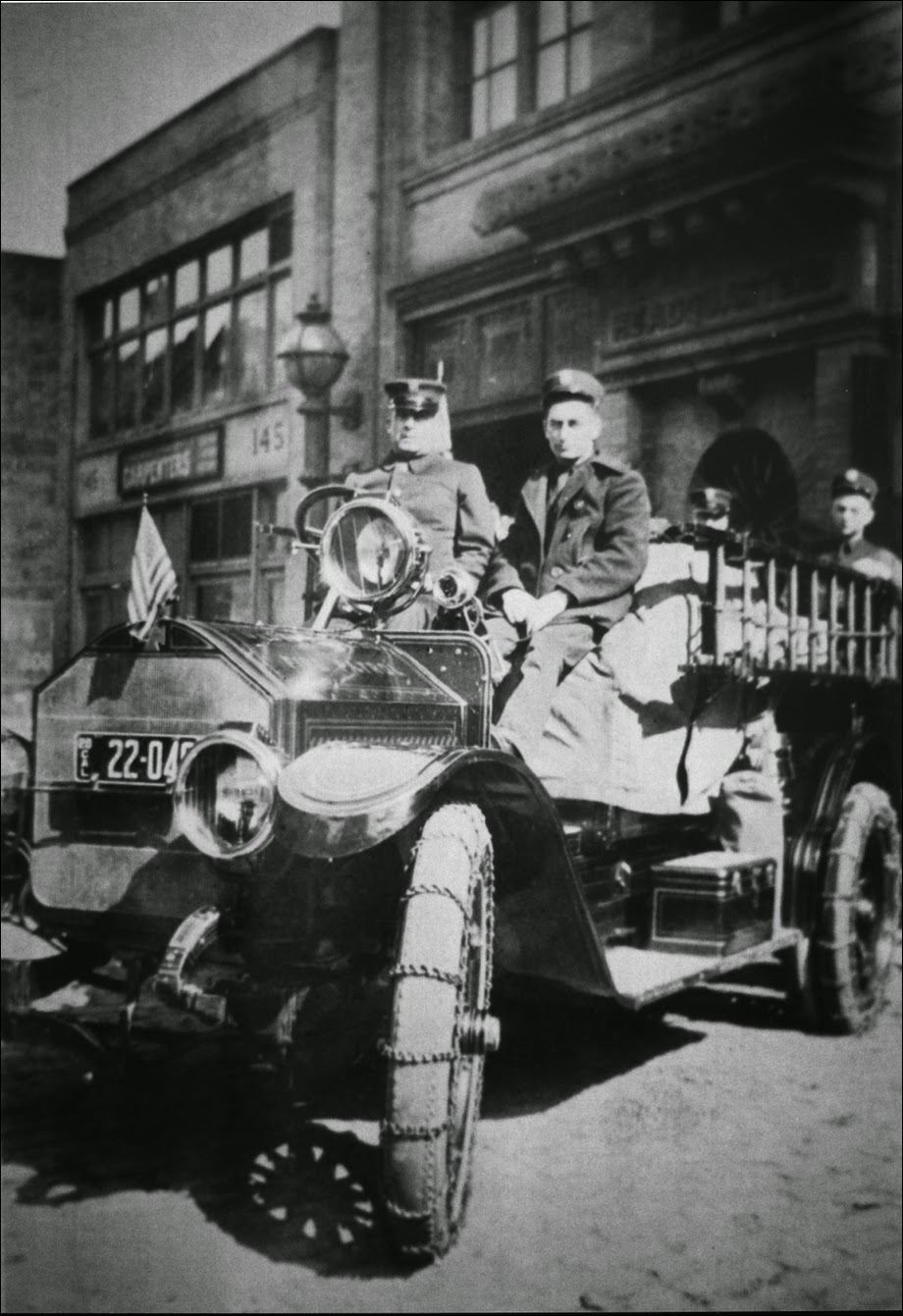 (RIGHT: Santa Rosa Fire Department seen in their Pope-Hartford fire truck, 1915. Photo courtesy Sonoma County Library)
All that was about to change later in 1911, thankfully. The city fathers, who shamefully went on the cheap in building the post-earthquake firehouse, were now willing to put a few bucks towards modern firefighting tools, including a gasoline engine fire truck.
The Knox truck dealership was vying for the sale and brought their latest model up from San Francisco. While demonstrating the machine's bells and whistles, a real fire alarm sounded in the Cherry street neighborhood. Firemen with the horse-drawn steam fire engine were quickly on their way. Not one to miss a great sales opportunity, the company rep invited the city councilmen and SRFD chief Frank Muther to jump aboard and head for the action.
Despite the driver not knowing Santa Rosa streets and taking a much longer route, the truck still reached the fire ahead of the horses. "The conflagration was a small one, but was quickly put out by the Knox chemical," reported the Santa Rosa Republican. "After the fire the members of the city council were taken for a ride about town." Deal closed, eh?
It was certainly a boffo demo, but a few months later the town chose instead to buy a Pope-Hartford model fire engine, which was a better known make. Like the Knox, it was technically a "Combination Chemical and Hose Wagon," which meant that it had tanks that could mix on the fly "carbonic acid gas" (AKA carbon dioxide) to smother flames. The Press Democrat article transcribed below gives a pretty good description of the truck's features, but additional details and a side photo can be found here.
Their Pope-Hartford fire truck was delivered in mid-December, driving up from the Petaluma wharf in less than an hour, thanks to its powerful 50 horsepower motor. Apparently the frenzy over its arrival was so great that a car hit their mascot Buster in front of the firehouse. "He was run over and killed by a careless auto driver who had the entire street, and yet would not get by without killing Buster," lamented the Press Democrat, noting the pooch was "a favorite with all who have occasion to visit the house or pass it regularly." As the Fifth St. PD offices were directly across the street, the writer undoubtedly had first-hand knowledge of the deceased.
The new fire engine finally brought the Santa Rosa Fire Department into the Twentieth Century and just a few months later, there was another page turned when SRFD chief Frank Muther retired.
Frank Muther was universally respected as fire chief and his tireless leadership on the morning of the 1906 earthquake likely saved the town from widespread destruction. Even Press Democrat editor Ernest Finley, who viewed Republicans with suspicion in that era, wrote admiringly of Muther in his collection of character sketches, "Santa Rosans I Have Known:"
| Frank Muther, pioneer cigar manufacturer and dealer, for years was chief of the fire department, and no matter what the hour he was always on hand when the bell rang. He was a picturesque character and in politics an ardent Republican, but with him friendship came first, even when everybody was supposed to take sides and when opposing tickets had to be place in the field as far down the line as dog catcher. Rough and often boisterous of manner, he was a real sport and an all-round good fellow. Muther was a man typical of the times. In later life he quieted down, as most men do, but he never lost his force and mental vigor. |
 (RIGHT: Frank Muther, 1849-1927. Photo from "Illustrated Portfolio of Santa Rosa and Vicinity," 1909)
Yet despite his historical bonafides, Frank Muther is about as forgotten as anyone can be forgotten. There isn't even a headstone on his grave (he's buried in the old Odd Fellows' Cemetery lot 21, just on the other side of the fence from the Fulkerson crypt in the Rural Cemetery). Possibly there was a wooden marker originally; in the 1950s the city made an ill-conceived effort to clean up weedy undergrowth at Rural with a controlled burn which ended up torching trees, roses and many, many wooden markers. As Muther's family plot and several others in that row are likewise bare, it's easy to presume the fire must have crossed the fence.
With the 110th earthquake anniversary coming up next year, some sort of tribute to that man is really overdue.
FIRE SCARE SUNDAY AT COLONEL OATES' HOMEThe residents of Mendocino avenue were alarmed early Sunday morning by an alarm of fire which summoned the department to the residence of Colonel and Mrs. James Wyatt Oates, at the corner of that thoroughfare and Benton street. A blazing chimney was the cause of the alarm, and an extinguisher that was on hand at the Oates home and one from the fire department extinguished the blaze. There was no damage from the fire.
- Santa Rosa Republican, August 28, 1911
AUTOMOBILE FIRE ENGINE WHICH MADE RECORD BREAKING RUN TO CHASE FIRE ON SUNDAYC. S. Richardson, manager of the Reliance Automobile Company of San Francisco and his chauffeur came up to this city Sunday morning, bringing with him a Knox automobile combination chemical fire extinguisher and hose wagon. He brought it here to demonstrate it to the city council in answer to the advertisement made by the city dads for bids for one of these machines to be addd to our fire fighting apparatus.
A fire in the residence owned by Mrs. Frank Graves and occupied by Mr. and Mrs. Guy Chase a few months before 2 o'clock gave the Knox automobile combination machine a chance to demonstrate its efficiency. Although starting from the engine house after the hook and ladder had left. It reached the fire first, going the long way to the fire, as the chauffeur did not know the direct route. The conflagration was a small one, but was quickly put out by the Knox chemical. Mr. and Mrs. Chase were over in Sebastopol at the time the fire started. They were preparing to move from the house, and the fire caught in some goods that were packed. The damage done was nominal. After the fire the members of the city council were taken for a ride about town by Mr. Richardson in the Knox. Mr. Richardson will be here until after the council meeting Tuesday evening.
The run to the fire was made under adverse circumstances, which taken in account, makes the Knox's performance remarkable. At the time that fire alarm 16 was rung in, no one was in the machine. It waited for Fire Chief Muther and several of the councilmen and others before starting and traveled a greater distance, turning three corners to one for the hook and ladder in reaching the conflagration. The working of the twin chemical tanks proved interesting to the people of the fire department. Both tanks have an outlet into one hose that can be run into the burning building. They are so arranged that while the chemicals are being used in one tank, the other can be filled, and then the chemicals drawn from the refilled tank without any loss of time. Chief Muther and the members of the city council who saw the demonstration at the fire and who went on the ride about town on the Knox, were greatly pleased at the high grade quality of the materials and mechanical construction, and its complete equipment.
- Santa Rosa Republican, May 1, 1911
CITY'S NEW AUTO CHEMICAL FIRE ENGINE HAS ARRIVEDSanta Rosa's new auto chemical fire engine, manufactured by the Pope-Hartford Automobile Company of Hartford, Conn., arrived last night, and is now at the Grand Garage on Main street. It is a handsome and substantially built machine, complete in every detail, and will be a valuable addition to the city fire-fighting equipment. It will be placed in commission at once.
The machine was brought up to Petaluma last night by boat, and from there proceeded under its own power, the run from Petaluma being made in less than an hour. S. W. Jewell of the Consolidated Motor Car Company of San Francisco and Charles O. Buckner of the Santa Rosa Fire Department were in charge. Buckner has been in San Francisco for several days, ever since the car arrived from the factory taking instructions as to its use and handling.
The machine is something like thirty feet long and the tires are 40xC. Two thirty-five gallon chemical tanks and two three-gallon hand tanks are carried, a thirty-foot extension and several smaller ladders and hose for the chemical tanks. Besides this a large space is provided for water hose. There is a full compliment of power for lights, including a huge searchlight, all by acetylene with electrical control. The finish is in dark maroon, with brass trimmings and the machine is appropriately lettered. The accompanying illustration gives a good idea of the appearance of the new machine. [Low quality photo on scratched microfilm not shown here - je]
- Press Democrat, December 16, 1911
BUSTER, THE FIREDOG, IS NO MOREBuster is dead. He was run over and killed by a careless auto driver who had the entire street, and yet would not get by without killing Buster.
Buster was the mascot at the fire engine house, a favorite with all who have occasion to visit the house or pass it regularly. The fire laddies amused themselves many an hour playing with the dog as he greatly enjoyed running after a stick, package or stone and returning it to the thrower with a wagging of his tail and a joyous bark.
- Press Democrat, December 17, 1911
HAS TENDERED RESIGNATIONFrank Muther Relinquishes PositionFrank Muther, Sr., who has been chief of the Santa Rosa fire department for several years past, has tendered his resignation of that position. Few men have ever served the City of Roses who have been better qualified in their respective departments than Mr. Muther, as chief of the fire department. He has been engaged in that work for many years, and has the matter of quenching conflagrations down to a science. The people of Santa Rosa have learned to regard Frank Muther as one of the most efficient chiefs on the Pacific coast, and he was always on hand where duty called, and in the thickest of the fray. At the time of the big fire here in April, 1906, he made a record for himself in the handling of the department.
- Santa Rosa Republican, April 4, 1912
It's always disheartening to attend a city council meeting and find your elected officials are acting like weepy drunks, but thus it was at a Santa Rosa council meeting in 1908.
The agenda item was the 8:30PM juvenile curfew, and the first sign of trouble was that each councilman was motivated to rise and deliver a sorrowful little speech about the need for a curfew because of a few wayward youths, some revisiting their own unhappy boyhood. Discussion turned to the question of how the time of curfew would be sounded each evening, and a councilman said they might be allowed to ring the bell at the new Santa Rosa Bank building. At that suggestion, the council meeting dissolved into pandemonium.
The councilman who proposed a curfew bell applauded his own brilliant idea; another broke out in tears; another council member waxed uncontrollably nostalgic about his recitations at school while yet another lunged towards the telephone to call the library for a poem that he could read aloud.
The hot button that turned them into drooling Pavlovian dogs was the concept of a "curfew bell." It seems that children of their day were expected to memorize a bit of Victorian doggerel titled, "Curfew Must Not Ring Tonight," a narrative poem about a man condemned to be executed at the sounding of the curfew bell and who is saved by his lady love who blocks the bell from ringing (read it here, if you must). Driven by the psychological need to redeem their own wanton youth (or as an alternative, see: weepy drunk), the emotional story about silencing the bell transformed into the councilmen wanting the curfew bell to ring, even though they would have to personally take weekly shifts yanking the bell rope.
Presumably after hankies blotted eyes and further maudlin verses were misquoted from memory, council business continued. Another item concerned a request from cigar store owners to be allowed the running of card games. These stores were already permitted to have slot machines, but adding card tables was a matter of controversy also being debated in Healdsburg at this time. To the apparent surprise of the council and the reporter, Fire Chief Frank Muther rose and spoke up in opposition. Muther was there on fire department business, but he also operated the most well-known cigar store in town. Muther concluded his remarks by saying, "...I have seen boys ruined through the gambling games in the back of cigar stores. I have known mothers to come and ask that their boys be protected, and I don't want to see this council grant this permit."
At the mention of ruined boys and pleading mothers, you can bet that the sobbing lamentations began anew, and the rest of the meeting was surely lost wandering deep in the weeds.
CURFEW SHALL RING TONIGHT
Councilmen Will Take Turn at the Bank Bell
It was quite an animated discussion the city fathers had over the curfew ordinance Tuesday night. There is a general desire on the part of the public to have the whistle blown at 8:30 in the evening as a warning to straying juveniles that the big bogey man in blue coat and brass buttons is after them. Councilman Bronson made quite a feeling little speech on the perils of permitting little boys on the streets at night, and said something about safeguarding the young, etc. Councilman Forgett earnestly echoed this tender sentiment and referred to Councilman Steiner as a sad object lesson of a young boy being permitted to run at large. Councilman Johnson looked more sorrowful than ever as he thought of his youthful street scrapes at night.
Councilman Barham arose to his feet and said that it was impossible to get either brewery or gas company steam whistles, as those instruments of exquisite melody are used for fire alarms and to call a lineman to answer lamp kicks at all hours of the night. But he was quite sure they could have the use of the big new bell on the Santa Rosa Bank building if they could have it rung at the hour. If no other way was found, he would suggest that the members of the council take a week turn about ringing the curfew, beginning with Councilman Bronson. Then he sat down.
The picture of Bronson swinging the bell clapper, and repeating:
"Curfew, it shall ring tonight--
Curfew's got ter ring tonight."
was so inspiring that the tears came in Forgett's eyes and Barham enthusiastically applauded his own speech.
Johnston, in mind, wandered far away over the sunset English hills where the poem girl first tackled the curfew proposition and Steiner remembered his young school days when he used to speak the "piece" every term and make his teacher and schoolmates tired to death.
Even Frank Muther forgot all about fires and Engineer Tom McNamara quit worrying over the collection of his surveying bills from the property owners. Rushmore slipped over to the telephone and called to the free library if they had among the books a copy of the immortal verses. He wanted to read them to the council. Clerk Clawson began to read the list for a vote on the proposition and before he recovered himself he had voted all the councilmen and all the city employees "aye." Bronson will probably begin his week as soon as the building contractor gets a ladder up to the bell.- Santa Rosa Republican, July 8, 1908
OBJECTS TO CARD GAMES
Cigar Men's Petition Addressed by Frank Muther
At the meeting of the council Tuesday evening a petition was presented by the cigar dealers of this city asking that they be permitted to conduct card games in their establishments. When the matter was presented, Chief Muther, who is one of the cigar men of the city, addressed the council in doubtful terms and told the officials and spectators that he was opposed to the movement. He commenced by saying: "This is a matter in which I am interested, and I am not speaking as chief of the fire department, but as a cigar dealer. In the interest of the protection of the boys of the town, I want to request that this petition not be granted. It is not asked for a legitimate purpose, but is for gambling. I am not a party to this. I believe in a legitimate business, and the cigar business is legitimate. I have seen boys ruined through the gambling games in the back of cigar stores. I have known mothers to come and ask that their boys be protected, and I don't want to see this council grant this permit." Mr. Muther said there were some good men who had signed the petition, but there were those who had signed it for the purpose of getting an opportunity to have gambling games and he was opposed to the whole scheme.- Santa Rosa Republican, July 8, 1908
Luther Burbank was Santa Rosa's #1 booster - except for the year he joined reformers who called the town scandalous and controlled by a handful of political bosses.
"We fail to see how Mr. Burbank's advice on political matters becomes of any particular importance," sniffed Press Democrat editor Ernest Finley. "He has always represented himself as being too much engrossed with scientific matters to pay any attention to anything else, and has never before taken any part in public affairs."
As with most everything else that appeared in the PD about the city elections of 1908, it was untrue. Three years earlier, Burbank was one of the founders of the "Good Government League," which likewise wanted to clean up the town. The difference in 1908 was that the political field was wide open: No incumbents were running for office. Also, the reformers had a leader who was willing to confront Santa Rosa's entrenched Old Guard and name names.
The reform party was now called the Municipal League, as introduced in part I of this series on the Santa Rosa city election of 1908. Apparently so frightened that the reformers might sweep into office, the main political parties decided to offer voters a Democratic-Republican "fusion" ticket - a move that only underscored the reformer's point that a tight group of "bosses" really controlled the town.
Everyone in Santa Rosa knew about "bossism" because newspapers kept readers updated on the latest pre-trial developments in the Abe Ruef case. A year earlier, "Boss Ruef" had plead guilty to bribing the San Francisco Supervisors over utility and cable car deals, followed by indictments against him and his puppet mayor. Ruef tried to block the trial right up to the selection of the jury, arguing that the prosecutor had tricked him into incriminating himself. It was a surprisingly high profile legal fight, with probably everyone in town having strong opinions on the fairness of a trial for the confessed villain. (Sidenote: Santa Rosans didn't view a fusion ticket as unusual because just such a ballot appeared in the 1905 San Francisco election, when the Dems and Repubs of that city joined forces in a failed attempt to block Ruef's corrupt Union Labor party from winning.)
In Santa Rosa, the political jabbing was over candidates for mayor. Heading the fusion ticket was Chamber of Commerce president James Gray, who vowed to maintain the status quo. The reform mayoral candidate was Rolfe Thompson, a former D.A. with bonus points among reformers for being the lawyer who had recently won a lawsuit against prostitutes and their landlord. Most remarkable, Thompson called out the people who he said really ran Santa Rosa: State Senator Walter Price (R), Santa Rosa Fire Chief Frank Muther, brewer Joseph Grace, and Thomas Geary, who was currently city attorney.
Even immersed in early 20th century Santa Rosa history as I am, it's difficult to grasp how these four were the triumvirate (+1) of evil. Muther's day job was as the owner of a small downtown cigar store with a little rolling factory in the back room - hardly the profile of a kingmaker. Grace also seemed apolitical; during the 1905 Battle of Sebastopol Avenue, he meekly hunkered down lest he offend any beer drinkers. Of Price I know nothing (update here) but of the odious Geary, I'll believe anything horrible. Besides being the author of the Chinese Exclusion Act when he was a Democratic congressman in 1892, he was the "top gun" attorney in the area and could be found representing the wealthiest private interests before he became city attorney, as when he tried to get Santa Rosa to abandon its municipal water system (he also argued the rich deserved more water because they paid more taxes).
But how far did Thompson really push the "bossism" analogy? He implied that Gray was merely a figurehead in his political newsletter, "The Municipal League," which apparently presented a crossword puzzle where the solution for one line read
STATEMENT OF MR. BURBANK
Tells People What He Believes of Situation
Luther Burbank, the well known resident of the city, has issued the following statement to the voters. It came from Mr. Burbank on Wednesday morning and is published herewith"
"I believe that the time has come when our city affairs should be divorced from politics, and when citizenship should be placed above partisanship. Having read the platform and the statement of principles of the Municipal League, I wish to express my appreciation of the movement and my hearty endorsement of its candidates.
"I further urge my fellow citizens to give these men their unanimous support. Luther Burbank"
- Santa Rosa Republican, April 1, 1908
It is announced that Luther Burbank favors the election of the so-called Municipal League ticket, and in a signed statement he gravely directs all qualified voters to follow his lead.
We fail to see how Mr. Burbank's advice on political matters becomes of any particular importance.
He has always represented himself as being too much engrossed with scientific matters to pay any attention to anything else, and has never before taken any part in public affairs.
It is very probable that the motive actuating Mr. Burbank in taking the stand he does is the same that both Mr. McMeans and Dr. Anderson admit actuates them--they all three live in that part of town.
- Press Democrat editorial, April 2, 1908
ENTHUSIASTIC MASS MEETING
Thompson and McMeans Address Fourth Ward
A meeting, small in number at first, but large in enthusiasm, was held by the Municipal League at Germania Hall Wednesday evening, and was addressed by Rolfe L. Thompson and Alexander C. McMeans, candidates for mayor and councilman respectfully. Before the meeting closed the hall was well filled, including a number of ladies.
Professor McMeans was introduced by Chairman William R. Smith, the well-known pioneer and made a splendid speech. He declared that the laws of the city should be enforced or they were of no earthly good. The speaker declared he was not the nominee of the Ministerial Union, but that he represented the Municipal League, and that he accepted the nomination in the hope that if elected he might do something for the betterment of conditions in this city. The speaker read the application which saloon men have to sign before being allowed a liquor license, and then stated that women were permitted to conduct houses of prostitution without getting permission at a less cost than the saloon men were taxed. He declared the issue of prohibition was not before the people, neither was there any issue of saloon closing on Sunday or raising of liquor licenses. He declared if elected he would consider the wishes of the people and all things and if the requisite number asked that the question of licensing saloons be placed on the ballot, he would be in favor of permitting people to vote on the question.
Rolfe L. Thompson made a ringing speech, in which he spoke plainly regarding his candidacy, and paid a high complement to Professor McMeans. He declared that the people of the fourth ward had an honor in being permitted to vote for such a man, and that no fault could found with his character. He said no better man could be found in the city for the position of councilman, and predicted a great majority for him at the polls.
Mr. Thompson said at the outset he wanted the people to know exactly where we stood on all questions that he would be pleased to answer any questions regarding his stand. He declared if elected mayor he would administer city affairs fairly and impartially, and give a square deal to all the people. In appointments and in the employment of labor he said he would be fair to all parties.
The speaker said he was representing up a movement of citizens of Santa Rosa for the best interests of the city, and was not representing any class, clique or boss. The people interested in this movement, he said, were of all classes, mechanics, builders, lawyers, professional men, merchants. He asserted that the movement emanated from a growing sentiment in Santa Rosa to get away from bossism, and to destroy partisanship here. The speaker said the fusion ticket was dominated by one lawyer, one cigar maker, one politician and one brewer, and that the ticket emanated from these bosses.
Mr. Thompson denied emphatically and in plain language that he was representing a "dry" town, or in any manner a prohibition issue, and said these things were not an issue in the campaign. "I have no intention if elected," he stated, "to initiate any new legislation against the saloon." At this juncture the speaker was interrupted with the information that some saloon men were with him and intended to support his candidacy. He remarked that he was glad, indeed, to know that some saloon men had realized their own interests in the matter, and that they had not been deceived by a little clique of politicians. Speaking further on the subject, Mr. Thompson said he intended to enforce the present laws on the statue books, and that he would simply carry out the wishes of the people. The speaker reiterated his belief that the money lying in the bank in the building fund and not drawing interest should be utilized at once to build a suitable fire department, and said he was against the purchase of other property when the city owned good lots and bonding the town for $75,000 when it could be avoided.
[..]
- Santa Rosa Republican, April 2, 1908
[Selection of remarks by James Gray at a rally:]
Ladies and gentlemen: I have been charged with being in league with and under the control of some terrible people, described as political bosses, Price, Muther, Grace and Geary. As to Price and Muther, Mr. Thompson can tell you a great deal more about them than I can, as until up to the date that he attempted to throw his party into the control of the Municipal League and the Ministerial Union, he was either under their employ or taking advice from them in all matters pertaining to politics.
As to Grace Brothers, as near as I can find out, they are conducting a legitimate business of manufacturing here. They are also conducting a creamery which is certainly a great benefit to Santa Rosa and the surrounding country; also an ice and cold storage plant which is used extensively in the storage and packing of fruit. They employ a large number of men supporting a great many families and are one of the institutions that help make Santa Rosa a live town.
I never had any business with them, but they have the reputation of being honorable business men who are received with their families in the best of society, in the homes of members of the Municipal League, and are recognized and taken by the hand by not only Mr. Thompson, but by members of the Ministerial Union. They have built up a large business which they are no doubt trying to protect. If they are taking any interest in the fight, it is for the purpose of protecting their business interests, and has nothing whatever to do with me. I do not see how they are to be blamed for this. If they expect any favors from me they will not get them any more than any other citizen interested in the growth and welfare of the town...
...As soon as it was noised about that I would be a candidate the Municipal League began preparations to make an aggressive campaign, and I must say they laid their plans carefully and have left no stone unturned to get a vote. After a great deal of thought and discussion they finally decided that their wisest political move would be to attack the present administration, make the present city administration as unpopular as possible and connect the present candidate with them. At Mr. Geary, on account of his prominence, they have directed most of the fire. I accepted the nomination because I thought that I could carry out plans that would benefit Santa Rosa...
...They started the movement with good intentions. They thought the Prohibition movement, which is likely to die out before it reaches Sonoma County, whose backbone is the production of hops and grapes, was a good thing. It was a prohibition movement pure and simple, and they should have stuck to their principles, but their leader and candidate for mayor is so carried away with the desire to be elected that he has forgotten his principles and is bowing down and soliciting votes of the interest that he had organized to fight.
We are all pledged to repeal the boarding house ordinance, and of course it will be done as soon as possible after those who are elected have taken office. But what will you do with the parties in dispute? Leave them in the lodging houses on Fourth street, where they were driven from the former from the Behmer house, where they have become a familiar sight to every shopper and mingle with the innocent stranger bringing his family here to locate? Drive them back to their old quarters to plague respectable residents of that part of town? At the most move them to some isolated spot? Or shall we take the advice of Saul's Letter and cast a mantle of charity over the unfortunate creatures and try to reform them?
[..]
- Press Democrat, April 5, 1908
The League manipulators have had a great deal to say about "bosses," apparently imagining the public would overlook the fact that the men who are most active in support of that organization themselves aspire to be bosses, by all the rules governing such propositions.
They have also indulged in uncalled for personalities and tried to appeal to individual likes and dislikes, regardless of facts. A case in point has been the amusing attempt to make a city attorney Thomas J. Geary an issue in the campaign. In an effort to secure the support of that gentleman's political enemies, the charge has been made that in the event of Mr. Gray's election he would be re-appointed to his present position, although Mr. Geary has repeatedly and publicly declared that under no consideration with the accept the appointment for another term, and most of the men who are making the charge know that owing to the pressure of other businesses he has wanted to resign for some time, and did prepare to give up the office last summer when Mayor Overton handed in his resignation, and was only prevented from doing so through the earnest solicitation of that gentleman and others wen public sentiment against allowing Mayor Overton's resignation to be accepted was so strongly manifested. Having no particular interest in the campaign one way or the other, and having already stated his position, Mr. Geary suggested that we make some mention of the fact in the paper, but we declined to thus dignify the charge. Although Mr. Thompson has known the facts all along, he has continued to charge that "a vote for Mr. Gray is a voted to keep Mr. Geary in the city attorney's office," and as far as we know is still so charging.
One of the worst features of the present campaign has been the reckless hurling of charges broadcast effecting the reputation and character of the community. People all over the state have been led to believe that Santa Rosa is a grossly immoral place where crime and vice run rampant, and where only evil influences prevail. Great damage has been done Santa Rosa in this way, and it is likely we will feel the effects for many years to come. It would have been bad enough had any of the charge been true, but when we consider the fact that Santa Rosa is one of the cleanest and best-governed in towns in California, if not in the entire west, the full significance of this phase of the situation becomes even more apparent.
- Press Democrat editorial, April 5, 1908

ADDRESS OF MR. BURBANK
Delivered at Pavilion Rink Monday Evening
"Every party is supposed to have a platform. Every voter should also have one of his own. Perhaps you would like a photograph of mine.
"I believe in justice to all. I am not a partisan not a politician, have no axe to grind, have no personal interests to boost, am not an expert at political mud throwing, generally mind my own business and rejoice in giving others the same privilege. As it happens I belong to no church, no saloon, no Ministerial Union, no brewery.
"Personal schemes, passion and prejudice should not be allowed to overshadow the public welfare, and any man or any party who, at any time or under any circumstances by threats, fraud, boycott, or any other form of coercion or deceit tries to influence the vote of another is not a true American. He is not a patriot. He is a relic of the dark ages and has not yet arrived. He is a back number and should be made to realize the fact by every intelligent. citizen's vote.
"I prefer to think that every voter wishes to cast his vote for the best interests of Santa Rosa and to have every honest industry protected.
"The hobo, the hoodlum, the confidence man, the crook, the swindler, the gambler, the bully and the bum are not needed by Santa Rosa. All these tend to weaken the confidence of man in man which is the foundation of all prosperity. Talk is cheap, character counts. Every city should have, above all, good men to attended to its business affairs, men you can trust to hold your purse.
"I am not here to tell you how to vote. Some of the gentlemen whose names are on the fusion ticket are admirable neighbors and personal friends. I have no objection to them except that they are, in my opinion, on the wrong side and have the wrong kind of boosters behind them.
"My interest in the city, its people, its progress, is very natural as I was here at its birth, voted for its first mayor and city council and have continued to do so up to the present time.
"I endorse the Municipal League as a party--it has a right to live and if I shall be honored by giving it my vote tomorrow, whether the party wins or not, by voting as I think for the best interests of Santa Rosa. I, at least, have won. Count me for one."
- Santa Rosa Republican, April 7, 1908
Was there ever a fire chief more vigilant than Santa Rosa's Frank Muther? Sometimes it seemed that more was accomplished at the Fire Commissioners' meeting than City Council. Just a few months after he ordered his men to keep a sharp lookout for lawn-watering scofflaws that could endanger the city, here he was, urging town fathers to finally take action on the "temporary structures" that quickly popped up following the 1906 earthquake. Now almost a year-and-a-half later, many "shacks" apparently remained.
Frank Muther died in 1927 and is buried in the old Odd Fellows' Cemetery (lot 21), just on the other side of the fence from the Fulkerson crypt in the Rural Cemetery. But today his grave is completely unmarked, likely because he had a wooden tombstone that was destroyed by a mid-century burn at the Rural Cemetery to control weeds. Oh, irony.
Also below is a letter to the editor complaining of high fire risk conditions (in the fiscal year that ended the day before this letter appeared, there had been 23 fire alarms, 9 of them false). Between the ramshackle shacks and the weed-choked backyards, Frank needed to stay on his toes.
FIRE CHIEF AND THE OLD SHACKS
Important Recommendation Made at Last Night's Meeting of the Board of Fire Commissioners
At the meeting of the Fire Commissioners last night Fire Chief Frank Muther recommended that all temporary buildings that remain untenanted for thirty days should be torn down as a matter of precaution against fire.
The Fire Chief reported two fires during the month; that at the Yandle foundry, entailing a total loss of $3,572.20 upon which insurance was paid thereon to the amount of $1,272.20.
The Fire Chief at the conclusion of the reading of the report said that there area a lot of old shacks that were built temporarily that should be removed.
The Chief also reported that owing to the removal of Charles Connolly from the city he had appointed Chas. Bowman to fill the vacancy as a call member of the Santa Rosa Fire Department.
The hook and ladder wagon of the department has been painted and returned spick and span to the fire station.
The Chief also presented some correspondence regarding the repairs of the old La France engine, providing of a new boiler, etc.- Press Democrat, September 18, 1907
Editor Republican:
I do not sign my name to this, but all the same I am a bona fide citizen of this hamlet, and what I say is the truth, and also, what I say will be understood.
I think this is a disorderly, untidy, and unkept town. Not only are the business thoroughfares in need of attention in the way of repairs, but the residence streets are also neglected. Notwithstanding the request of the street department that the sidewalks be cleaned, grass and weeds removed therefrom, hardly any attention was paid to that notice. In many places the back yards have gone to waste and the high, dry grass growing there has made the places fire traps. Day after tomorrow fire crackers and other explosives will be burning all over town, and how many dry grass lots will be ablaze? Cannot the powers that be in this city be awakened to some of the simple needs of the place? I am afraid to go out into the country for even a day for fear that I may return and find my home in ruins. With the water supply sometimes in the air, would it not be a practical thing to remove all cause of fire, especially during the next few days?Citizen.
- Santa Rosa Republican, July 2, 1907
Early 20th century Santa Rosa had plenty of rules and regs on water use, and gave city workers broad powers to enforce them. As noted earlier, a policeman who heard water running overnight could wake up homeowners and require them to shut off the faucet; a city inspector could come into your home and write a $2.50 citation for every leaky fixture, and as shown below, firemen could enforce a city ordinance requiring all lawn and garden watering to cease when the fire bell rang. The "irrigation hours" mentioned here was another water regulation holdover from the last century; depending upon your address, homeowners could only water at certain hours in either the afternoon or evening, the starting and ending times announced by the tooting of the town's steam whistle, not to be confused with the fire bell, which signaled that all water should be shut off . It wasn't the Edwardian Era in America - it was the Pavlovian Era.
TURN OFF WATER AT FIRE ALARM
Ordinance Will Be Strictly Enforced--Meeting of the Fire Commissioners Last Night
There is a city ordinance that provided when a fire alarm is sounded persons who are irrigating their lawns shall immediately shut off the water.
At a meeting of the Fire Commissioners last night, Fire Chief Muther in ____ [illegible microfilm] to have his his men keep a sharp lookout to see that the ordinance is strictly obeyed.
There were four alarms of fire during the month. The most serious conflagration being at the old Ladies' College building on McDonald avenue. The Chief called attention to the lack of water to combat this fire, explaining that the hydrant is on a "dead end" and the fire occurring during "irrigation hours" sufficient water could only be obtained for one stream.- Press Democrat, May 22, 1907
 As the first anniversary of the Great Earthquake approached, Santa Rosans rediscovered their passion for elaborate practical jokes. The disaster interrupted the plotting and scheming of local pranksters, whose "jinks" the papers regularly used as page fillers. The stunt might be throwing straw dummies on railroad tracks or otherwise frightening people with phony corpses, slipping exploding cigars to their buddies, or, as told in the previous item, violently shaking the temporary police station so the officers feared another earthquake. Huh-yuk.
In the first item below, Daniel "Doc" Cozad and State Senator Walter Price were pranked on April Fools' Day, although they really should have expected something; Cozad himself had quite the reputation as a practical joker, with a specialty in prank phone calls. Once a number of men showed up at the Press Democrat dressed in their Sunday best because they'd been told that the newspaper was rushing to put together a photo feature of prominent citizens.
BAPTISM OF WATER
April Fool Deluge for Two Well-Known Santa Rosa "Heroes"
There is a good April fool joke story going the rounds at the expense of Senator Price and "Doc" Cozad, and it is vouched for as an actual fact. These two citizens on April 1 were walking along a street in the northern part of town when the shrieks of a woman from within a nearby house attracted their attention. With "Doc" in the lead, both hearts beating gallantly and breasts afire with enthusiasm to perform a hero's duty, they dashed up the steps leading to the house and two pairs of hands grasped the doorknob simultaneously. The door opened and before they could demand what bloodcurdling tragedy was being or was about to be enacted they were deluged with a baptism of water, and amid merry peals of laughter were reminded that they were "April fools." Fire Chief Frank Muther got onto the joke and he has not been doing a thing to his friends, Price and Cozad since.- Press Democrat, April 4, 1907
SMOKED LOADED CIGARMike McNulty, the genial baggage-master at the Northwestern Pacific depot, who is known far and wide as "Mr. Harriman," celebrated with the younger patriots in the City of Roses on the Fourth of July. McNulty's celebration was not a voluntary celebrant and he was greatly chagrined at the appearance of Police Officer John M. Boyes on the scene just at the critical moment. McNulty had been presented with a cigar by Conductor Walter Holloway, the Havana being lightly "loaded" with powder. With a flash that caused McNulty to shout imprecations on the head of Holloway and to leap about seven feet in the air, the cigar exploded. Smoking is touchy subject with the railroad man since the Glorious Fourth.- Santa Rosa Republican, July 5, 1907
Only luck and a lack of wind kept all Santa Rosa from burning down in the 1906 earthquake, so it's a bit of a surprise that just eight months later, downtown property owners told the Fire Chief to shut his yap about fire safety.
On the agenda at that January, 1907 City Council meeting was yet another debate on the "back porch" problem, which had become one of those issues that the Council slogged through at every session with no end in sight.
In one corner of the ring was respected Fire Chief Frank Muther, who had witnessed fires spreading through the alley behind Fourth Street on the morning of April 18, 1906, and wanted the new buildings at those locations to have porches made of fireproof materials instead of the rough wood construction that might be found on a back porch. The Builders' Exchange supported him by endorsing a solid concrete porch floor. In the opposite corner were some of the wealthiest property owners in town, who said that would be too expensive - and that the Fire Chief had too much influence in the matter.
The Council clearly took the fire danger seriously; at the same meeting, they gave Muther powers to order any rubbish removed and impose a fine if he was ignored. But money talks loudly, and once again, they listened to the sound of rich men pinching pennies. One of them suggested that the problem could be solved if they could just line porches with asbestos.
The City Council was in an awful pickle. There was no building code in Santa Rosa before the earthquake, and since then, the Council had created new rules and regs on an ad hoc basis. Since there was not yet an ordinance prohibiting the use of wood in the rear of the same properties that had earlier spread the fires, the landlords were well within their rights to build their porches out of rice paper, if so desired. And so much for the authority of the Fire Chief to make the town safe.
To break the stalemate, Mayor Overton called on architect Victor Dunkerly (also spelled, "Dunkerley"), who had designed the newly-built Overton Hotel. His solution showed political skill; use less of the expensive concrete, but build the porch out of iron, which cost about the same as wood. After a little more chew-over the following week, peace was finally declared in the back porch war.
MATTER OF PORCHES PRECIPITATES DISCUSSION
The mooted question of back porches to business blocks on Fourth street and other business streets bobbed up serenely at the meeting of the city council Tuesday evening. After considerable discussion, in which there were some lively call down for various speakers. Architect Dunkerly hit the matter a solar plexus blow in a few words, practically settled the question to the satisfaction of all and gave the council the best advice that they had received on the subject.
The Builders' Exchange prepared an ordinance for the council for a fire proof back porch and specified that it should have a concrete floor five inches thick. This was objected to by property owners as being too expensive and they wanted something more moderate and at the same time fire proof. They did not desire to take any chances on having their structures burned through inflammable rear porches.
John F. Kinslow addressed the council, advocating a floor dressed with asphaltum, while Albert Jacobs, another property owner, was wedded to the theory of asbestos, which experience has shown cannot be burned. Contractor Kobes was worried to know why the council insisted on having a fire proof porch and still permitted the use of wooden stairways leading to the porch and said the stairs would require more lumber than the remainder of the porch. Fire Chief Muther injected a few remarks into the discussion at intervals, and to this there was strenuous objection on the part of Kinslow, ably seconded by Jacobs, when Kinslow declared the chief "tried to be the whole thing." Contractor Rushing spoke in favor of asbestos lining for porches.
Matters were waxing exceedingly warm when Mayor Overton thrust himself into the breach in the sake of peace and harmony and asked belligerents to confine themselves to the question before the council and to refrain from indulging in personalities.
Briefly stated, Architect Dunkerly suggested that the proposed ordinance was severe on the property owners. He said that a porch could be constructed of two inch galvanized iron pipe, thoroughly put together, with slabs of concrete two or three inches in thickness, and that it would sustain almost any weight which would be put upon it. He also suggested iron stairways and in comparison with ngures [sic] for wooden stairs submitted by Mr. Kobes, it was found the iron stairs would be no more expensive than the wooden ones. The features of the mayor and council relaxed when the suggestion was made, for they saw a method of construction that would be superior to the one under consideration and they felt relieved. The matter went over one week to give the ordinance committee time to prepare an ordinance covering the architect's suggestions. Chairman Johnston voted against postponing the matter further, saying it had been before the council for months and he believed it should be disposed of at once that builders might erect porches for their tenants.- Santa Rosa Republican, January 16, 1907
Priorities, priorities: Five days after the catastrophic 1906 Santa Rosa earthquake, bodies were still under the rubble, the town was still patrolled by armed soldiers and dark at night because there was no electricity or gas - and not to mention that the community was still reeling from the marathon of forty funerals held the day before. Naturally, the powers-that-be in town decided that it was a swell time to ram through major civic improvements.
That first salvo appeared in the April 23 edition of the Democrat-Republican: "One of the first things the City Council should attend to is the establishment of the new street lines. All the business streets should and must be widened, and now is the time to do it."
The proposal made some sense, in a morbid, Albert Speer-ish way. The quake and fires that had killed so many had wiped clear most of the downtown core from 3rd to 5th streets around the courthouse square, as well as much of 4th street down to the railroad station. But why widen the streets at all? The answer came in another Democrat-Republican op/ed on April 30:
| For a long time it has been generally recognized that the majority of Santa Rosa's business streets were too narrow, and now that the opportunity for widening them has arrived it must be embraced. It will only be a few years until electric cars are occupying all our principal streets, and in addition to this the ordinary demands of business must be considered. Third, Fourth, Fifth, A, B, Main, Mendocino and D streets can now be improved in the respect noted without difficulty and practically without cost, and the authorities should see to it that the lines are set back before any of the foundations of the new buildings talked of are laid. We have it in our power to make Santa Rosa one of the finest and most attractive little cities in the whole country, and we will be playing false to our own best interests if we fail to do so. |
There was the vision laid out: Santa Rosa would become San Francisco, maybe Manhattan in matchbox scale, a little California town of expansive boulevards with plenty of room for the new electric streetcars to share space with the new automobiles. It would be a town that had the bones to grow, and maybe even sprawl over the entire Santa Rosa plain.
Alas, like other failed schemes to bolster Santa Rosa during this era , it mostly went nowhere. Self interest trumped the common weal. A setback of a dozen feet or more would not have been a hardship for most businesses because the buildings often had behind them a shed, large porch or an open yard that formed an ad hoc alley with other yards. Such a space was even a hazard; on the day of the earthquake, Fire Chief Muther witnessed the fire spread because of empty boxes and crates piled high behind these buildings, and not getting too far ahead of the story, such conditions would become a fire risk again in early 1907.
But aside from a single meeting of 5th street property owners to discuss widening that street, the debate was reduced to widening two blocks on 4th, between Hinton Ave. (the east end of Courthouse Square) and E Street. And even that caused an ugly fuss.
For two months between May and July there were heated debates over who would donate how much and who would be compensated. The man who owned the corner of 4th and D wanted the city to give him $2,800 and part of his neighbor's lot for "damages," and a bank demanded over five thousand dollars to move their vault back a few feet. It was suggested that money be drawn from the General Fund (empty, because of the earthquake) or the street improvement bond (impossible, because this was not an anticipated use by the voters). A petition was submitted to the City Council demanding for the frontage on 4th street be taken by eminent domain. Most of these tedious arguments are not reproduced here (you're welcome).
A potential breakthrough offer came from the Masons on May 23rd, as the lodge volunteered to give up fourteen feet of their lot if other property owners did likewise. No one did, and the fighting seemed to intensify even more. After all this tussle, it was finally agreed that the two blocks of 4th street between Courthouse Square and E street would be widened - slightly. From Hinton Avenue to D, the town's main drag was just stretched from 66 feet to 81 feet; for the short block between D and E street, it was expanded from 60 to 78 feet.
Goodbye, San Francisco's Market Street - hello, a little more room for the buggy at the hitching post.
WIDEN FIFTH STREET
The movement in favor of the widening of Fifth street is to be commended. It is not an effort to injure anybody, but to help all having property on that street and the city generally. All our people admit that most of our streets are too narrow. Most of them admit that property values would be increased by quite general street widening. This is especially true of the business and residence portion of Fifth street. At the same time, it is a fact that the interior lots will receive more benefit than those at the corners of blocks. These differences should be adjusted by mutual conference, if possible. If this cannot be done the courts should be called upon to determine damages and benefits. At all events, the street should be widened, and now is the time to do this. It is not a pleasant task to interview people and endeavor to make them see what is best for them and the public generally, but the committees having this matter in hand will certainly do the best they can to bring about the desired result.- Santa Rosa Republican, May 25, 1906
MOTION PREVAILS TO WIDEN BLOCKS
There was a meeting of the commission on widening Fourth street between Hinton avenue and E streets Saturday evening at the city hall, at which many Fourth street property owners were present. These had come by special invitation to discuss the matters in hand. It was stated that the Women's Improvement Club are willing to give $1000 toward the project, and other encouraging matters were reported. On motion of C. C. Farmer it was unanimously agreed that the street should be widened in the blocks mentioned. The only persons who will be paid damages for their property are Willis W. Gauldin and the Union Trust-Savings Bank. The former asks $2800 for the alleged damages to his property. while the bank wished to be reimbursed in the sum of $5077. The destruction of their vault, and a large slice of property on Fourth street, is taken from the financial institution. At the meeting of the city council this evening it is anticipate that some definite action will be taken toward the proposed widening of the street.- Santa Rosa Republican, June 27, 1906
 Downtown Santa Rosa was like an obstacle course following the 1906 earthquake, and three months later the streets were still cluttered with lumber and bricks - only now these were piles of new bricks and wood being used in building an entire business district from the ground up.
The rapid pace of construction in those months is mind-blowing. At the June 22 City Council meeting, it was mentioned that in the two months since the earthquake, Building Inspector Willcox had reviewed nearly two dozen plans, and at that meeting alone, permission was granted for construction of five major commercial buildings downtown.
Despite the belief that poor construction was a factor in the collapse of some buildings, there was still resistance to Santa Rosa's first attempt at enforcing building codes; Willcox issued a stop-work order to one developer for using bad mortar, only to return and find that they had constructed the wall anyway.
 Alas, details about this important period in the town's history are slim. There are no known photos from the rebuilding period, and the papers offered little more than an occasional architect's sketch of a major building that was underway and a pair of articles that are transcribed below (note that almost all of the buildings described there were at the end of Fourth St. which was obliterated by the mall).
But glimpses of those days can be found in other newspaper items, particularly in requests and complaints made to the City Council. As construction was underway, merchants were still attempting to run their businesses alongside. "In some places where walls have been left standing owners have placed roofs on the structures and completed store rooms," one article noted. Many of the "temporary structures" approved by Council were little more than wooden tents intended to shade open air tables. At every Council meeting there were approvals for temp buildings, typically described as "40x80 feet," a "lean-to corregated iron shed," and most ambitiously, a "small galvanized iron building in the rear of his new building on Fourth street to be used as a kitchen by the new grill room."
Shoppers also had to be adventurous and nimble because of "dangerous holes and planks across sidewalks, projections from buildings and piles of materials on sidewalks." An item in the May 13 San Francisco Call compared downtown to the chaos of a mining camp:
On all the side streets leading to the burned portion of the city numerous one-story frame buildings are being erected for temporary use as stores. This gives the city the appearance of a mining camp of the days of '49. |
It was Santa Rosa nightlife that was most transformed, however. The evenings streets were now illuminated only by moonlight; Press Dem editor Ernest Finley told the story that travelers who arrived after nightfall were drawn to his newspaper office because they had the only light visible downtown, and someone would be dispatched with a lantern to lead visitors to their destinations. Fire Chief Muther complained that it was only luck that a fire wagon didn't collide with one of the "immense heaps of sand" in the street. There was great relief when finally a single electric street light illuminated the town's main intersection of Fourth and Mendocino, three months after the disaster.
BUILDING GOES MERRILY ON
It is very gratifying not only to the people of this city, but visitors from other sections of the state, to see the progress made in the way of building.
Already the erection of the big C. C. Donovan building at Fourth and Washington streets and the Dougherty-Shea building at Fifth and Mendocino streets, are well under way. The walls of the Morris Prince, T. T. Overton and William Sukalle buildings on Fourth street are also arising.
Material is being hauled to the Con Sheas lots at Fourth and B and Fourth and A streets, and Mr. Shea will soon begin building.
Other property owners are getting ready to build and next week and the week after will see the commencement of several new buildings.
The P. Towey building, occupied by the Noonan Meat Company's market is about ready for occupancy on Fourth street, and the Shea and Prince buildings are being repaired.
Mr. and Mrs. B. F. McDannell are getting ready to erect their building on Fourth street. The ground floor is already leased and if a fraternal order desires to lease the upper story for a hall it will be built.
Santa Rosa's new business section promises to eclipse the old one. There are many fine buildings in prospect, including the five-story Livernash Building, the bank buildings, the Overton and Shea buildings, and those to be built by other property owners all along the street, B street, A, Mendocino, Third, Main, Hinton and Exchange avenues, etc.
- Press Democrat, June 28, 1906
SOLID BLOCK OF CONCRETE
Santa Rosa Will Have Substantial Structure
Arrangements are being perfected for the construction in Santa Rosa of reinforced concrete buildings. There is every reason to believe that in the near future work on this mammoth structure will begin, and that it will be enclosed before the rains of the coming winter set in.
The block of reinforced concrete buildings will be located on the south side of Fourth street between Exchange avenue and B street. The property in this block is owned by Mayor John P. Overton and Tol T. Overton with the single exception of the one piece owned by Mr. and Mrs. B. F. McDannaell. These three owners have been considering the matter for some days and have about completed their investigations and concluded that for safety their best interests lay in the reinforced concrete formation.
A solid block of these concrete buildings would certainly be a substantial thing, and the news is pleasing to Santa Rosans that the owners are considering the matter favorably.
Work was begun Monday morning on the foundation for the Towey building at the southwest corner of Fourth and A streets. This structure is to be constructed especially for the use of J. C. Pedersen, the furniture man, and will be rushed to completion as rapidly as possible. The foundation will be sufficient to carry a building of several stories.
Con Shea has begun work on the block of stores he proposes to construct on the southeast corner of Fourth and A streets. Workmen were busy early this morning making the boxes for molding the foundations, which will be heavy with cement. It is expected to have these stores ready for occupancy before the rains of winter begin.
The Coughran, Parsons and Proctor reinforced concrete block, consisting of five stories on Fourth street between Hinton avenue and D street is well under way. The rear walls and side walls are under construction, and the front will be held in abeyance until the matter of widening Fourth Street has been definitely determined by the city council.
Morris Prince and Dougherty and Shea will be among the first property owners here to construct an entirely new business block in the Greater Santa Rosa. In some places where walls have been left standing owners have placed roofs on the structures and completed store rooms. Mr. Prince began from the bare lot and has two handsome buildings already under construction, both being on Fourth between A and B streets. Both of these structures are already one story high and will be carried up another story. Mr. Prince realizes the demand for apartments here and will build as rapidly as he can get men for the work. Messrs. Dougherty and Shea have their building completed to the one story line, but will make it a two-story structure. This will provide elegant offices for attorneys and professional men, something that is badly needed at the present time.
The C. C. Donovan building has reached the second story and is being rapidly completed. The window frames for the second story have been placed in position. Many other buildings are projected for the City of Roses and in a short time there will be even greater activity than is noticeable now.
- Santa Rosa Republican, July 16, 1906
It is indeed remarkable how rapidly the scars of the recent disaster in Santa Rosa are disappearing. The city will be rebuilt sooner than any of us have supposed. Three months have passed since the trouble came upon our fair city. What busy months they have been. First there was the clearing away of the debris then the making of plans, and now there is building activity all along the line. Dozens of fine business blocks will be completed before the winter rains are upon us. These business blocks will be filled with splendid stocks of goods just as soon as they are completed. Everybody notes the progress of our city. Everybody has a good word for the rapidly rebuilding City of Roses. Visitors are thoroughly surprised at what is doing here. They note our progress with great satisfaction and are giving Santa Rosa favorable advertisement wherever they go.
- Santa Rosa Republican, July 19, 1906
MUST OBEY ORDINANCE OR BE ARRESTED
Contractors who refuse to obey the orders of Building Inspector William H. Willcox in future in regard to the building ordinances of Santa Rosa will be arrested and punished. This was officially determined at the Council meeting Tuesday evening. Inspector Willcox reported that he had ordered the work stopped on a certain structure on Fourth street because sand was being mixed with the slacked lime before the lime had an opportunity to cool. This is in violation of the ordinance. The inspector then left town for a couple days, and declared on his return the mortar so made had been used in the building. It is contended that the mixing of sand with hot lime takes the textile strength from the mortar and makes it unfit for use. The councilmen were angry at the treatment accorded the building inspector and notified him in the future to call on Chief of Police Rushmore to arrest any one violating the building ordinances of the city. It is proposed to have this ordinance respected in every particular. The councilmen also discussed the advisability of compelling the tearing down of the wall in which the improperly mixed mortar had been used.
- Santa Rosa Republican, July 25, 1906
A petition for an arc light on Fifth street, between A and B streets, was referred to the Street Committee.
- Press Democrat, May 26, 1906
Light on Fourth StreetAn electric light has been placed at the corner of Fourth and Mendocino streets, where it was greatly needed. Many favorable comments were heard Thursday night.
- Press Democrat, July 22, 1906
OFFENDERS WILL BE ARRESTED
Negligence on the Part of Contractors and Property Owners Will be Punished
Fire Chief Muther called the attention of the Council last night to the negligence of contractors in leaving obstacles on streets in the city, on dark nights without any warning lights being placed thereon. He instanced Monday night when the town was in darkness by reason of the shutting off of the lights and stated that lanterns were missing on a number of immense heaps of sand, etc., and piles of lumber. The fire department had a call and it was only by the sheerest good fortune that an accident was averted.
Attention was also called to the negligence of property owners and contractors on Fourth street and on other streets, who have dangerous holes and planks across sidewalks, projections from buildings and piles of materials on sidewalks without lights to warn pedestrians.
The Street Commissioner and Chief of Police were instructed to enforce the law and if necessary arrest and see that the offenders were punished.
- Press Democrat, December 12, 1906

In its efforts to recover from the 1906 earthquake, Santa Rosa faced the same main obstacle as San Francisco: Getting the Insurance companies to pay up.
Compared to the great city, losses here were chump change. The full value of the damage in San Francisco was estimated at around $500 million, maybe as much as a billion dollars - and even that lower figure was more than the entire federal budget for that year. But the insurers only paid out about $180 million; some residents were underinsured or didn't have insurance at all, and the companies also pulled every trick possible to avoid paying. (Multiply these dollar figures by about 20x to estimate current value.)
 |
Santa Rosa reported to the governor that damages totaled about $3 million, and at the June 27 meeting of the insurance companies, the insurance men pegged the town's losses at no more than a relatively puny $400,000. But that didn't mean that the insurance companies were any more willing to open their purses; if anything, the situation was worse in Santa Rosa for want of attention paid to the distant town. Few claims were settled in the two months following the quake when, after pleas to the state commissioner, insurance companies held a meeting specifically regarding losses here. The first proposal made was that they should form a committee to visit Santa Rosa and report back three weeks later - which would have pushed any possible settlements beyond 90 days from the earthquake.
There was nothing subtle in their tactics; the insurance companies wanted to stall indefinitely, playing a cruel game of nerves with people who were often desperate. When payments were offered on claims, most policy holders were pressured into taking cash offers that amounted pennies on the dollar, with the implied threat that the company just might decide to demand proof positive that the damage was 100% fire related.
Almost all policyholders had a "fallen-building" clause in their insurance policies: If the building fell down and a fire swept over the wreckage and burned everything, tough luck. If the contents of the building were on fire before the collapse, however, the insurance company had to pay something. Determining the precise sequence of these events was no easy thing, of course, particularly in Santa Rosa where the first fires were noted within seconds of the tremors. Hairs split further over situations such as: a) fire starts, b) structure collapses, resulting in c) inability of fire dept. to extinguish fires.
Some cases actually did drag on for years, with the last settled by the California Supreme Court in 1911 (the insurance company lost). The only happy news to come from all this litigation is that it preserved for historians the testimony by Fire Chief Frank Muther and others, which are the most accurate and detailed accounts from that day.
Both Santa Rosa papers followed developments avidly, and whenever someone received a check it was treated like a lottery win: "J. G. Wieland, the Fourth street baker, whose place was destroyed by fire on April 18, has received his insurance in full from the Delaware Insurance company," reported the Press Democrat, June 23. Local resident J. L. Byers was cheered by the papers where he interceded on behalf of his daughter, who lived in San Francisco and had accepted a 75% settlement; he confronted the company rep and insisted that their payment was tantamount to admitting the full amount was actually due, and threatened suit. The agent supposedly wrote a check for the balance on the spot.
 In the end, fewer than ten companies paid their losses in full, most prominent being Aetna and Lloyd's of London. Like many insurers, Fireman's Fund didn't have enough in the bank to pay everyone's losses, but they still made good; they paid 50 percent on all claims, declared bankruptcy, reformed the company, and paid the balance owed in new company stock. It was a remarkably fair and honorable resolution, particularly considering more than a dozen companies declared bankruptcy and never paid a cent.
(RIGHT: Ad from the July 23, 1906 Santa Rosa Republican)
THE INSURANCE FUTUREThe eyes of the entire commercial world are focused on the insurance companies just now. If they waive technicalities and pay up promptly, people may say they are all right and entitled to confidence and support. If, on the other hand, they interpose uncertain phrases and ambiguous clauses in the attempt to avoid carrying out their obligations, the public will be done with them. No one man in a hundred reads a fire insurance policy. He accepts it from the agent for what it purports to be on its face--a contract to protect the insured against loss by fire. The cause or origin of the fire cuts no figure with the insured. What he wants is protection, that is what the agent tells him he is buying, he pays his good money for it, and now it remains to be seen whether or not that is what he gets.- Democrat-Republican, April 24, 1906
Insurance MattersW. S. Davis and C. D. Barnett, insurance agents, visited the board of managers in Oakland on Tuesday. Mr. Davis says people must be patient. He is confident everything will be all right.- Democrat-Republican, April 25, 1906
More Insurance ChecksEardley & Barnett have received checks in payment of fire losses on April 18 from the Phoenix Assurance Association of London as follows: Rasin Trembley, $49.25; N.R. Davidson, $400...the check sent Rasin Trembley is the third he has received on account of damage done by the fire on April 18.Santa Rosan Turned DownMrs. W. R. Parker of his city, who conducted the Pricess lodging house here up to April 18, was turned down in a cool manner in San Francisco recently. She went to call on Secretary Wait Blixon, of the National, regarding her loss by fire, and was curtly informed not to delude herself with the belief that she would be reimbursed. Blixon said his company would refuse to recognize claims from Santa Rosa, although no representative of the company had been here to view the situation. Mrs. Parker says some San Franciscans are settling on terms of forty cents on the dollar with Blixon's company, the doughty secretary forcing these terms of policy holders.- Santa Rosa Republican, June 11, 1906
ALL INSURANCE COMPANIES MUST GIVE SANTA ROSA A 'SQUARE DEAL'
As a result of the many complaints that have reached this office concerning the treatment being accorded local policy holders, the Press Democrat yesterday wired both Insurance Commissioner Wolfe and Deputy Attorney General George A. Sturtevant of San Francisco apprising them of the conditions here and asking them of the conditions here and asking them to see that those companies apparently disposed to do otherwise be made to accord their customers fair treatment.
While some very questionable tactics have been employed, it would be anything but fair to place all the companies doing business here in the same class. It is true that very few claims have as yet been paid, but several of the leading concerns have sent representatives here to talk over the situation with their policyholders and try to arrange a satisfactory and equitable basis of settlement. Some of the Company Managers have even visited this city personally for the same purpose, and little apprehension is felt regarding the outcome of cases such as these. Other cases can be mentioned, however, that present a very different aspect.
The American Insurance Company of Philadelphia, for instance, has repudiated all its losses here, although when asked in his own office by an indignant policyholder whether the company had ever sent any of its men up to Santa Rosa to investigate and report upon conditions here, Walt Blixon, the American's secretary and chief adjuster, was compelled to admit that it had not. "How can you claim to know anything about the situation there one way or the other, then?" he asked. "Well, we have some photographs that show how the town looks," was Blixon's reply. And this was all the satisfaction that the policyholder was able to get. The policyholder referred to is Mrs. W. R. Parker of this city. The following paragraph republished from an item that appeared in the Press Democrat a few days after Mrs. Parker's return home here becomes of interest:
"Mrs. Parker gives an interesting description of her visit to the company's office and the scenes she witnessed there. A room full of people were waiting to get a chance to see Mr. Blixon, but only one was admitted at a time. One man came in accompanied by a friend, and when his turn arrived wished to take his friend in with him, but was not allowed to do so. Another man on coming out of Blixon's office was asked what he had accomplished. 'I had to settle for forty cents on the dollar,' he replied. An irate individual stalked out and refused to answer any questions. 'He'll come back and take our terms,' laughed the office boy, a bright youngster of about twelve years old. 'They all come back,' he added, by way of explanation."
The Phoenix of Hartford is another company that has denied its liabilities here, and numerous proofs of loss sent to the company's Oakland office have been returned by registered mail, accompanied by a polite note to the effect that the Company "was in receipt of what purported to be proofs of loss," but "begged to return the papers referred to," etc., and "refused to consider the claim in any way whatever." Some of the local policyholders in the Phoenix are known to have valid claims, and it is thought that the company's unexpected stand has been taken through a misapprehension upon the part of its managers as to the true facts. The Connecticut has also denied its liabilities in a number of cases here, but has paid one claim which it at first refused to recognize. Other instances of peculiar work upon the part of two or three other companies might also be mentioned, but it is perhaps not necessary at this time.
In marked contrast to the course followed by the companies above mentioned is that of the Aetna, which has settled several losses without question, paying dollar for dollar. Temple Smith, the stationer, received a check from the Aetna for $500 on his stock of goods contained in the two-story brick building near the corner of Fourth and B streets. Mrs. M. J. Lowrey, who carried a policy on her household goods for a like amount i n the same company, was also promptly paid. She resided in the Kinslow building, a brick structure on Fourth street. The Aetna also paid the claim of M. S. Davis for $1,750 on the brick building on Fourth street formerly occupied by H. H. Moke as an undertaking parlor. Mention might likewise be made of two claims paid only a few days ago by the Phoenix of London and the Fire Association of Philadelphia. The former paid a $500 loss on the Temple Smith stock, and the latter forwarded a check for $1,000 to the same party without question upon receipt of proof of loss. The Queen paid the claim of the Elks and several other companies have indicated their intention to pay, so the action of the companies mentioned leaves those concerns that have flatly denied all liability here in a very peculiar position, to say the least.
[..]
W. S. Davis & Co., the company's local representatives, are in receipt of a letter from the San Francisco office of the Northwestern National stating that every possible effort has been made to advance settlements of the company's losses in San Francisco, and that over half of its claims there have already been adjusted and paid, while the matter of settling the company's losses in Santa Rosa will be taken up in a few days. Accompanying the letter was a draft in payment of the claim of Mrs. Lilia Ware for damage done her building at the corner of Fourth and Davis street.- Press Democrat, June 23, 1906
DID ANY BUILDINGS HERE REALLY FALL, WITHIN THE TRUE MEANING OF THE WORD?
A few of the "welching" insurance concerns are trying to escape responsibility here by claiming that they are exempted under their contracts by the falling wall clause, which reads as follows:
"If a building, or any part thereof fall, except as the result of fire, all insurance by this policy on such building or its contents shall immediately cease."
It will not be denied that certain buildings here were destroyed or ruined by the earthquake. Their number is far less, however, than the insurance men of the type above mentioned would make it appear. But are there any buildings here that really fell, within the true meaning of that word?
To say that a man fell out of a window when in reality he was thrown out by another man during the progress of a fight, or blown out by an explosion, would clearly be a misstatement of fact. The motive for making such a statement under those circumstances might be open to question, but the natural inference would be that somebody was trying to create a wrong impression. What is the natural inference, then, when an insurance man says a building "fell," when it was really thrown down by an earthquake?
In the event of having to try to sustain their position before the courts, the companies contending that a building thrown down by an earthquake was not really thrown down at all but simply fell, would doubtless argue that the matter of earthquakes was in contemplation when the clause above referred to was inserted in their policies. The fact is, however, that inherent weaknesses and faults of construction were really what the companies employing that clause were trying to guard against. The companies that were figuring on earthquakes said so, for what is known as the "earthquake clause" appears in place of the "falling wall clause" in the policies issues by many of the concerns engaged in the insurance business at the present time, and has for many years.- Press Democrat, July 6, 1906

Even while the town was furiously shaking, fires were starting on Fourth Street. On the corner of B Street in the Shea building, Mrs. Martin ran into the hallway during the quake and saw flames visible through a glass door. She smashed the glass only to find a roaring fire underway, presumed fed by a broken gas line. Smoke soon billowed from the building.
Frank Muther jumped out of bed on the first shock. Grabbing his clothes, he dressed as he ran as fast as he could to downtown, two blocks away. As Santa Rosa's Fire Chief, Muther had a reputation for being first at the scene, but he was also owner of cigar factory and store on Fourth Street and he headed there first. Like the rest of the block, his business (near the current location of "Tex Wasabi's") was in a two-story wood building that was badly damaged and nearly unrecognizable from the loss of its ornamental cast iron and brick façade, yet it was still standing. From the vantage point of his roof, he gazed upon his ruined town as dawn was breaking.
| Fourth street before the 1906 earthquake, looking west from courthouse square. 1) The Shea building at the corner of B Street, where fire was reported while the quake was still underway. 2) The roof where the Fire Chief Frank Muther stood as he scanned the devastation. Visible to the far right is the hose and bell tower of the Fifth St. firehouse. 3) The Occidental Hotel. (Image courtesy Larry Lapeere) |
The top story of the courthouse had crumbled, taking with it the great two-story-high cupola that capped the building, along with the life-size statue of the goddess of justice that stood sentinel upon the dome's peak.
On Fourth St. between Mendocino and D Street, everything was gone. All those fine brick buildings were so much dust -- the old Athenaeum, Santa Rosa's opera house that could seat 2,500, the town's post office, the long row of little stores, even the grand new Masonic Temple that wasn't quite finished. The Fifth Street side of the block was lost, too, which included the two largest livery stables. Probably most of the horses quartered there were dead, but that wouldn't be the greatest tragedy in that block; there were rented rooms above some of the stores, so there also would be people buried there in the rubble.
|
But fires were springing up everywhere. Flames were coming from two stores near him, and his entire block was already doomed. Santa Rosa's Fifth Street firehouse was right across the alley from Muther's store, and the alley was filled with materials ready to burn. Muther saw that flames were just starting to reach behind the stores to the sheds and piles of wooden boxes that were stacked as high as a man could reach. The fire was spreading down the alley fast, towards the firehouse.
Now just a few minutes past dawn, people were streaming into downtown. Some were storekeepers wanting to protect their shops or at least salvage their wares; others came to help, and some certainly to gawk. Seventeen year-old Obert Pedersen arrived on his bike and was stunned to see "the whole thing was down." People who lived in the rooming houses above the stores were trapped in the wreckage and screaming for help. Pedersen helped rescue several who were pinned on their mattress, trapped by a falling ceiling or a collapsed headboard of their own bed. He also helped carry corpses to a makeshift morgue setup on someone's front yard.
 |  |
| L: The only known photograph taken while post-earthquake fires were underway. Taken from the marble amd granite works on the corner of Fourth and Davis, looking west (Detail of image courtesy Bancroft Library) R: Remains of the Saint Rose Hotel on the corner of Fourth and A, looking east |
Luther Burbank was among the early to arrive at the scene. "Electric wires were sputtering," he recalled in 1911, "gun powder and various chemicals were exploding; the gas had sprung a leak at the gas works and other places had caught fire; gunpowder, chemicals, cartridges, and shells were exploding, and fires were breaking out in a dozen different places...with fires advancing unchecked, people were crawling out through the rubbish, bleeding and half dressed, covered from head to foot with lime and sickening dust."
On the western end of Fourth Street, Mr. Duffy lay trapped in the ruins of the New Saint Rose Hotel. His quick wits had saved his life; instead of rushing down a collapsing hotel stairway, he threw his body next to the substantial mahogany dresser in his room, which protected him as the three-story building pancaked. It was five hours before rescuers were able to pinpoint his location, despite his shouts for help. He was lucky; after he was pulled out, he told newspapers that he saw arms waving from amid the debris, but there was so much other noise on the street that their screams could not be heard. "Just then, as I looked, the flames swept over them and cruelly finished the work begun by the earthquake. The sight sickened me and I turned away."
Duffy was presumably describing the horrific death of Miles Peerman, a former Santa Rosa constable. A religious magazine published a detailed account: " [He] was held down by wreckage in the Carither's building [today the site of the Zap building at the corner of 5th and B] in plain view of the people. They did their best to dig him out, but the heat of the raging fire became so intense that they could no longer stay by him. He then begged them to shoot him. So he was burned to death fully conscious of his approaching fate."

| Detail of State Earthquake Investigation Commission map of fire and earthquake damage. Areas colored solid red were buildings destroyed by the quake, areas cross-hatched were destroyed in the following fire. 1) The courthouse. 2) The Athenaeum and post office. 3) The fire station. 4) The Shea building, across the street from the Occidental Hotel. 5) The Hotel Saint Rose. (Image courtesy David Rumsey Collection) |
Fire chief Muther also led his two crews in rescuing victims - one trapped man later described the gratitude he felt as cool water began trickling through the debris as the flames were approaching his position - and the firemen were lucky that their horses and both steam engine rigs at the Fifth St. firehouse were unharmed. Not so fortunate was the situation they faced. The fire hydrants were all but useless; the city's cast iron pipe system was already notorious for poor water pressure due to leaks (see "Santa Rosa's Water System Wars,") and now there were cracks from the earthquake and underground explosions in the gas mains - nearly a year later they would uncover a water pipe bent like an archer's bow. The desperate firemen resorted to sucking what water they could from Santa Rosa Creek. And then there were the streets themselves, which were almost impassible. Fourth Street, 75 feet wide, was reduced to a footpath down the middle because of all the debris from buildings on both sides. At times, the firemen had to unhitch the horses and pull the rigs by hand. The fires burned for at least two days.
One of the best accounts of this day came from Jessie Loranger, who came downtown to watch the destruction of Santa Rosa with her family. "The sight that met our eyes was terrible. Fire was raging in a half a dozen different places. Men were digging and chopping in the ruins of what had been hotels and lodging houses trying to get out those buried beneath the falling timbers and debris. As we went down B Street at Mrs. D. N. Canther's, the body of a man lay on a door covered with a sheet on the lawn near the gate. Women were crowded everywhere crying and everyone near the fire had household goods packed to go as soon as the flames got nearer. Although men worked with all their might the water pipes were broken and a very small amount of water was available. Chas. [her husband], in helping with the hose, got his eyelashes burned off. The heat was overpowering and all that saved the town was the absence of wind."
Like so many others, 8 year-old Ernest Spekter and his family stayed outdoors that night and was unable to sleep. They lived in Occidental, which was also badly damaged by the quake, his family's home knocked off the foundation. As darkness fell they joined neighbors on "Indian Hill" (now Sugarloaf Summit), the highest point in West County. From there they could see the lights and smoke of San Francisco burning to the south and Santa Rosa burning to the east. It was a night of a terrible red sky.
| SOURCES: Frank Muther testimony in Fountain v. Connecticut Fire Insurance Co. and Loomis v. Connecticut Fire Insurance Co., The Pacific reporter, Volume 117 pp 630-648 (1911) and quoted in California Supreme Court Decisions, Volume 158, pg 766-744 (1911). Obert Pedersen: San Francisco Chronicle Earthquake 75 year anniversary (1981). The San Francisco Earthquake Horror (1906). Burbank recollection from Nov. 14, 1911 excerpted in Sonoma Historian, 2006 #1. Peerman death from Monroe H. Alexander, "The Earthquake in Santa Rosa," California Christian Advocate, Dec. 27, 1906. History of Sonoma County, Tom Gregory (1911). Jessie Loranger letter quoted in The Great Earthquake and Firestorms of 1906. Spekter description from Press Democrat July 5, 1976. |