It's early 1861 and the nation is falling apart. Seven states have seceded from the Union and their troops are seizing local military forts. The New Orleans Mint and Customhouse are commandeered along with $350,000 (equivalent to $18M today). There are widespread worries an attack on Washington D.C. is imminent - yet hope abounds an outright war can still be avoided.
Most Americans could stay reasonably abreast of the crisis without too much effort. There were an estimated 3,000 newspapers and trains, stagecoaches and the post office carried those papers far and wide. News also could also spread quickly via telegrams and letters. It was a wondrously efficient network - at least, as long as you lived east of the Mississippi River.
In the critical months leading up to the Civil War there was no transcontinental railroad or telegraph. Not even a tiny wisp of news from the East Coast could reach California or Oregon in less than three weeks, which was how long it took mail or a messenger to get here via stagecoach from Missouri. And that was only under ideal conditions with the best luck; a lot might go wrong during a 2,000 mile bumpy trip across deserts and mountains on rough trails.
Thus it came to pass a freight company that supplied western military forts started the Pony Express in April 1860, with the promise that a relay of fast horsemen could deliver mail to California in 7-10 days. Only rarely, under ideal weather conditions and with a great deal of luck, did it meet such a tight schedule.
By coincidence, the Pony Express launched just as Sonoma County newspapers were starting to gain wider Bay Area circulation. During the mid-1850s there were two lackluster rural weeklies, the Sonoma County Journal in Petaluma and the Sonoma Democrat in Santa Rosa. In April 1860 the Democrat was bought by Thomas L. Thompson and in May Samuel Cassiday and a partner took over the nascent Petaluma Argus, which was only a few months old and thus far had been published in fits and starts. (MORE on the genealogy of these early newspapers)
There weren't many places in the West during 1860 that could support three papers, but Sonoma County then had the most people on the coast after San Francisco. Also, the papers offered more than the usual market reports and items on local farmers drunkenly falling off barn roofs. Thompson's Democrat was rabidly pro secession, pro slavery and anti Lincoln. Cassiday was a "Black Republican" (meaning an abolitionist) and once the war started the Argus offered extensive coverage of Union troop movements along with battlefield reports. The Journal took a moderate stance and advocated for peace until the war began, then often wrote about it with a detached tone as if it were a conflict between two nations overseas.
The Pony Express updates were like catnip to their readers. Columns headlined "EASTERN NEWS - BY PONY EXPRESS" (or similar) were usually at the top of the front pages and it's easy to understand the appeal; the news in those columns has an exciting immediacy even though the events happened weeks earlier. It reminds me of what it was like following breaking news on Twitter during its heyday: A frothy mixture of solid facts, opinionated guesswork and crazy bullshit.
The rest of this article can be read at the SantaRosaHistory.com website. Because of recurring problems with the Blogger platform, I am no longer wasting my time formatting and posting complete articles here. I will continue to create stubs for the sake of continuity, but will be publishing full articles only at SantaRosaHistory.com. - Jeff Elliott
Our country is so divided some are starting to worry it could lead to a civil war. Even Sonoma County is split with neither political party clearly having an upper hand, Democrats mostly in control of the government while Republicans dominate the media. It's easy to find reasons to sneer at the guys on the other side of the fence; Democrats are in disarray while Republicans bark out conspiracy theories. Both parties have resorted to name-calling and view themselves as unfairly treated victims. And it will probably get even worse - who knows what craziness awaits us next year in 1858?
While Santa Rosa was the county seat it was still little more than a village in the late 1850s. There were about 400 people in the town proper, although there were three times that number living in simple cabins and roughly made houses in the surrounding township. There were six blacksmith shops but only two restaurants; three carpenter shops and one clothing store. A farmer's town. By contrast, Petaluma was a regional mercantile center - it took at least 90 minutes to reach it by buggy, but it was said half of Santa Rosa still shopped down there.
This is a (long overdue) companion piece to an article I wrote several years ago, "PETALUMA VS SANTA ROSA: ROUND ONE." That covered the stirring rivalry between the towns, including Petaluma's insistence it deserved the county seat more than Santa Rosa. There's some necessary crosstalk between these two items, but the focus here is on the feud between the town's newspapers. This is not just because of the entertainment value of a good ol' Victorian-era insult throwdown (ranging from childish taunting about "a set of block heads and dolts" to an almost poetic, "wou't [sic] somebody hold this high mettled charger? He has already bucked sufficient"). More importantly, the 1850s squabble in newsprint revealed details about Santa Rosa during that era that wouldn't have been otherwise known.
For example: The early years of the Sonoma Democrat - Santa Rosa's newspaper - are most associated with its pro-Confederacy position during the Civil War and expressing its raw hatred for Lincoln even before then. But that was when the Democrat was owned and edited by Thomas L. Thompson starting in 1860; the paper had two earlier owners. Were they likewise pro-slavery zealots? Historians mention them only in passing (if at all) so the answers will be surprising.
The rest of this article can be read at the SantaRosaHistory.com website. Because of recurring problems with the Blogger platform, I am no longer wasting my time formatting and posting complete articles here. I will continue to create stubs for the sake of continuity, but will be publishing full articles only at SantaRosaHistory.com.
- Jeff Elliott
In the beginning there was Ernest L. Finley. He bought the old Sonoma Democrat in 1897, merged it with his own newspaper, the Evening Press, becoming the owner, editor and publisher of the new Press Democrat.
That's the version of the paper's beginnings as told on the PD's "about" page, on Wikipedia, by the Northern California Media Museum and in various columns and feature items published in the paper over the last 75-odd years.
Trouble is, that's not actually true. The new paper was a partnership, and Finley wasn't even the key player - he was one of two business managers. The founding editor and the person greatly responsible for the Press Democrat's success was Grant O. Richards, although it's rare to find mentions of him after the 1930s. And even before he was erased from the picture, items about the paper's earliest days just mentioned Richards "left the firm" or "sold his interest" to Finley. Neither of those claims were true either, as he killed himself while still editor (although I guess that would qualify as leaving the firm).
The PD - and the city of Santa Rosa itself - has polished Finley's reputation to a gleam ever since his death in 1942, inflating his role in positive events such as founding the paper. But it's particularly unfair to build up Finley at the expense of Richards because it steals away the place he deserved in the history books. Not to mention that townsfolk of his day would have been gobsmacked to learn such a man would become so completely forgotten; hell, everybody in 1890s Santa Rosa probably wished they were Grant O. Richards.
Should you be very lucky, you might meet someone who has that one in a million billion quality which makes everyone (s)he meets fall at their feet. Call it ultra charisma, magnetic charm or even stardust, you are absolutely absolutely devoted to that person from the first meeting. Grant Oswald Richards had that magical ability; people not only really, really liked him, but they couldn't help themselves from jabbering about how much they loved the guy - scroll down through some of the excerpts in the sources below. Such people can become very powerful (and dangerous) when drawn to politics or religion; we should probably be thankful Richards wanted only to be a very good newspaper editor in small towns.
The rest of this article can be read at the SantaRosaHistory.com website. Because of recurring problems with the Blogger platform, I am no longer wasting my time formatting and posting complete articles here. I will continue to create stubs for the sake of continuity, but will be publishing full articles only at SantaRosaHistory.com.
It pains to write this, but the coronavirus probably will be an extinction level event for most print newspapers. This is not a shocking new development; the Nieman Journalism Lab started the death watch even before the National Emergency was declared. Go back to the 2008-2009 recession and find pundits were warning that print was unlikely to survive another economic downturn - newspapers were like a flotilla of Titanics all drifting towards the iceberg zones. And so here we are today; sans charitable bailouts from billionaires or megacorps, lots of ships are soon to sink together into the cold sea.
This is not the place to go into all the reasons why this is happening, but some are well hashed over: Printing presses can keep rolling only so long without advertisers to pay for the paper and ink. Too many newspapers were being run by the MBA-types who saw journalism as little different from selling soup - if the demand slacks off, keep the profits high via cutbacks. Many were even taken over by hedge funds and investors who saw them only as cash cows to be milked dry; a must-read is a 2018 article, "This Is How a Newspaper Dies" (the term "harvesting market position" will definitely be on the quiz).
The deeper problem for newspapers is that nobody's reading them. U.S. circulation is the lowest it's ever been since they began keeping records in 1940. Why is that? It's not like we've become a sub-literate society; Americans are typically spending over six hours a day online and not all of it is looking at cat videos. And particularly now in the spring of 2020 we're news-junkies, with 89% of U.S. adults following the latest about coronavirus closely - only not via newspapers. We've given up on newspapers, but as I've said for over 25 years: Readers did not give up on newspapers until newspapers abandoned their readers.
The rest of this article can be read at the SantaRosaHistory.com website. Because of recurring problems with the Blogger platform, I am no longer wasting my time formatting and posting complete articles here. I will continue to create stubs for the sake of continuity, but will be publishing full articles only at SantaRosaHistory.com.
- Jeff Elliott
The Press Democrat just helped solve a century-old mystery, and it's all thanks to the paper's laziness back in 1919.
This adventure begins just before Hallowe'en when a large ad began appearing in the PD, promoting an appearance by concert singer. "The music lovers of Santa Rosa will rejoice in the news that Miss Ida Gardner, the well known contralto, will sing in this city Thursday night November 6, at the Cline theater," announced a related news item. The Cline was the most famous of early Santa Rosa movie palaces (it became the Roxy in 1935) and was a big, cavernous hall that also hosted vaudeville acts and traveling stage shows. What made this performance unique, however, was that tickets were free but could only be obtained from the Santa Rosa Furniture Company. Also, the ad noted cryptically, "Mr. Thomas A. Edison's Three Million Dollar Phonograph will assist."
A review appeared about a week after the concert: "Probably a number of people who attended the recital given Thursday night by Miss Ida Gardner and Mr. Lyman at the Cline Theater, were at first puzzled and disappointed when they discovered a phonograph cabinet occupying the center of the stage. They felt that they had been beguiled into going to hear a charming singer and a clever flutist and naturally thought they had been imposed upon."
Flutist/Edison Company pitchman Harold Lyman came onstage and told the audience that he and Miss Gardner were going to demonstrate why Edison's new record player was so terrific. "It finally became apparent that the phonograph was at least to receive assistance from the singer, but even then the mental outlook was not exactly bright."
A record was placed on the turntable and Ida began to sing along. "She paused from time to time, apparently at random and permitted her re-created voice to be heard alone. This gave an opportunity to compare one with the other, and it is no more than just to state that there was no discernable difference in tone quality."
The PD reported, "It was only by watching the singer’s lips that one could be sure when she sang and when she did not...This proof was very convincing. If it were not, another proof was offered. After Miss Gardner commenced to sing the lights were turned out - ostensibly so that the audience could not watch the singer’s lips.
"It did not seem difficult to determine in the dark when the singer sang and when she did not. The writer was pretty sure about it himself, [until the] lights were turned on again and it was discovered that Miss Gardner was not on the stage at all and that the new Edison alone had been heard."
The rest of this article can be read at the SantaRosaHistory.com website. Because of recurring problems with the Blogger platform, I am no longer wasting my time formatting and posting complete articles here. I will continue to create stubs for the sake of continuity, but will be publishing full articles only at SantaRosaHistory.com.
- Jeff Elliott
Wave a flag and cheer, Santa Rosa; your National Guard boys are going off to protect the border with Mexico! The year was 1916 and beneath the cheery patriotism was terror about what might happen - and for good reason. It looked like a full-scale war with Mexico would start at any moment.
While the soldiers going off to fight in Europe in 1917 get lots of attention from historians, the National Guard's call up for duty a year earlier is lesser mentioned, often just dismissed as sort of a rehearsal for the real show. But it was their departure for the border that had the greater emotional impact on Santa Rosa, being the first time local men had been ordered to active service since the Spanish-American War, a full generation in the past.
The story has obvious relevance to us in 2018 because a president is again sending the National Guard to the Mexican border. But while researching those doings about a century ago, I found the story even more relevant to today than I expected - it was also a casebook study of "fake news."
That innocent American civilians were killed in the lead-up to deployment was an indisputable fact. But depending upon which newspaper(s) you happened to read - and remember, this was 1916 and before radio or TV, so your daily paper was probably the sole news source available - your reaction might be the indignation someone feels when any fellow citizens are slain by terrorists. Or maybe you'd feel the situation in Mexico was so abominable that the U.S. Army should go down there and take over the whole damn country.
The most irresponsible coverage found anywhere was undoubtedly in the San Francisco Examiner and other Hearst papers, with anti-Mexican racism on a par with President "Some I Assume Are Good People” Trump.* Here in Sonoma county, however, the dailies were the Argus-Courier in Petaluma with the Santa Rosa Republican and Press Democrat delivered to homes and businesses elsewhere. Of the three, the PD stands out - for making everyone more jittery by portraying Mexico as a lawless wilderness, where life was cheap and outlaws roamed the countryside like packs of feral dogs.
Scan the front pages of the Press Democrat from the start of 1916 and discover there were detailed reports about the war in Europe - albeit mainly good news that WWI was going ever so swell for the Allies and the unpleasantness would be over soon, one way or the other. In sharp contrast, the PD's account of the Mexico crisis was alarmist and became increasingly histrionic. Despite the enormous number of deaths in WWI, the articles about that had all the immediacy of chess match coverage; when it came to Mexico, PD editor Ernest Finley's hair was on such fire he could not be troubled to worry about printing the truth.

Trouble loomed not long after the year began: "MEXICANS MURDERED AMERICANS," read the headline in the January 12 Press Democrat. The incident - which became known as the Santa Isabel Massacre - would continue to dominate the PD's front page for the remainder of that week, even pushing out most news about the World War.
(RIGHT: ‘Pancho' Villa, in scene from 1914 docudrama)
In the Mexican state of Chihuahua, about 250 miles from the Texas border, sixteen Americans who worked for a mining company had been robbed, stripped, and murdered execution-style. Two other Americans in the area were killed three days later. The killers were part of the forces under the command of Francisco "Pancho" Villa, northern Mexico's warlord and leader of a military faction in their ongoing revolution.
When word reached El Paso, the nearest U.S. city to the site of the crime and home to the big Army base at Fort Bliss, soldiers attacked Mexicans downtown, leading to an anti-Mexican riot involving about a thousand soldiers and civilians alike. Martial law was declared and Mexican residents were ordered to leave their homes.
President Woodrow Wilson - who recently had given his blessing to the current Mexican government - rejected calls for a counterstrike, saying he trusted their country to punish those responsible. There was also talk of the mining company and American ranchers creating a mercenary troop to sneak into the country to capture Villa. Provoking an invasion of Mexico by American forces, however, was exactly what he wanted.
At that point the Mexican Revolution had been underway for five or six or seven years (depending on who you ask) with the U.S. meddling at every step. By the mid-1910s it had strayed from its revolutionary goal of upending the country's old feudalism and turned into a Game of Thrones-like contest for power with several factions locked in a civil war, Villa a major player among them.
As 1916 began, Villa and his once indomitable Army of the North (División del Norte) seemed headed for a small footnote in Mexican history. The previous year, better armed government forces had badly whipped them in three major battles - one of which lasted 38 days (!) - and the Villistas were reduced to a guerilla force unlikely to survive another direct encounter with the Army.
Villa believed the president of Mexico - a former ally of his, natch - was a sellout and conceding too much to American interests because he had some sort of secret deal with Wilson's administration. (It turned out Villa had been suckered into believing a conspiracy theory.) In Villa's mind the last hope to unify the country was to start a mouse-that-roared war with the U.S. And as the earlier attack had failed to spur necessary American wrath, he decided to lead his fighters across the border and attack a town in New Mexico. It would be the first time American soil had been invaded since the War of 1812.
Two months after the Santa Isabel Massacre, Villa and his forces targeted Columbus NM, a dusty bordertown about 70 miles west of El Paso. A very thorough and well-written description of the attack can be read here but all we need to know is that it was brutal; 18 Americans were dead and the little town was ransacked. President Wilson immediately ordered troops into Mexico to capture or kill Villa.
 |
| "On the Border" by Donna Neary (Image: Army.Mil) |
From that point on, all newspaper coverage of the crisis can be ranked on a scale. The better papers explained Villa was trying to provoke Wilson into invading, so their readers may have understood that while these were savage acts, they were part of his realpolitik gambit, and there were risks to the U.S. if we played into his hands. Rank the Press Democrat at the other end of the scale with the worst of the yellow press, painting Villa simply as the leader of a ruthless bandit gang on the prowl for horses to steal and gringos to slaughter.
Then there's the the Press Democrat's remarkable volume of stories. A week or more might pass without the Argus-Courier or Santa Rosa Republican mentioning Pancho Villa - but from April onwards, something about Villa appeared on the PD front page almost every single day, which by itself made the story appear as important as the World War. Most of those items turned out to be rumors and lies which the paper did not later correct, or made only a token effort to fix. The worst was probably when the PD made a big splash with a story about a Mexican Army general defecting to Villa and taking his 2,000 soldiers with him. When it proved untrue a day later there was a single sentence about it buried near the end of a long update of latest U.S. troop movements.
Even the best newspapers sometimes printed stuff that turned out false, but the PD was like a "fake news" clearinghouse. Villa had narrowly escaped capture, Villa was about to invade the U.S. again, Villa was dead, Villa was walking through passenger trains and murdering anyone he thought was American. Sometimes what was presented to Sonoma county readers slipped into outright propaganda - the PD featured a photo illustration showed a firing squad poised for execution with the caption, "How They Kill a 'Gringo.'" It was actually a scene from a 1914 docudrama about Villa filmed during the civil war with other Mexican factions.
The crisis came to a head in June - a fact we know because the PD's banner headline on the 18th shouted, "MEXICAN CRISIS NOW AT THE CLIMAX". The Mexican president ordered American troops to leave the country. President Wilson refused. Soon after, troops from the U.S. Cavalry were confronted by the Mexican Army, and in the "Battle of Carrizal" 12 Americans were killed with 24 captured. The next day Wilson ordered the entire 145,000 member National Guard called to duty. On June 24, the northern California Fifth regiment was mobilized and ordered to assemble in Sacramento immediately. Santa Rosa was going to war.
"Goodbye Boys! and May God Bless You and Keep You", cheered the Press Democrat headline on June 25. Half of the front page that day called for a big public turnout at 10:00AM as the local National Guard marched from the armory (Fourth and D streets) to the train station on North street. The other half of the page contained stories suggesting they were probably going to be walking into a trap and be slaughtered.
"The Carrizal battle was only an incident of what was planned to be a general attack on the American command," one of those PD articles read, citing a report supposedly received in El Paso. "Americans were flanked on both sides by Mexicans who practically surrounded the little detachment," read another story that described what happened at Carrizal. "In front was a concealed Mexican machine gun trench from which a stream of leaden death unexpectedly poured into the American ranks."
This upsetting "we salute you who are about to die" theme continued in the PD alongside news about the current whereabouts of our company. Three days later, the PD claimed the “Buffalo Soldiers" captured at Carrizal were expecting to be executed, 30,000 Mexican soldiers were waiting to attack U.S. soldiers and a half million Mexican civilians were heading for the border to repel an American invasion. The Republican printed none of that crap and by contrast, balanced front page coverage of the National Guard deployment with news about the state political conventions and WWI developments.
Santa Rosa's Company E, led by Captain Hilliard Comstock (more about that fellow's soldiering later) had 75 members, one of them Fleming McWhorter, who already had been serving in New Mexico. He returned to join his Company E comrades even though he would be turning around the next day. An impromptu group met him at the train and carried him on their shoulders to the armory. It was a grand moment:
| Members of Co. E who have served their time as drummers, secured the drums of the Native Sons’ Drum Corps and headed the column. The company flag was carried and a mascot in the form of a little dog with a white blanket marked “Co. E,” was led in the line. About fifty men were in line and the column made an inspiring sight as it marched along Fourth street. The Santa Rosa Boys’ Brass Band, in full uniform, was at the depot and tendered several selections while the crowd awaited the arrival of the train. As it came in the band played one of its liveliest tunes, arousing the enthusiasm of all present... |
Irregardless of the garbage the PD was feeding its readers about hordes of killer Mexicans, the paper's coverage of their departure the next day was touching, promising it "...will always be remembered as one of the most notable of events that has ever occurred in Santa Rosa, and thousands participated in the many incidents marking the going away."
| No one who was an eye witness will ever forget Sunday morning, June 25, 1916, the time when Company E of Santa Rosa went to the front at the country’s call for the defense of the flag. It was gigantic. It was grand, significant and true...Santa Rosa rallied magnificently in her saying of good-bye. Long before the hour of ten, when the whistles blew and the bells rang, people commenced to congregate in the streets adjacent, to the armory, and when the parade formed with the departing company as the center of attraction, the streets for blocks were lined with one continuous mass of humanity. The bands played and as the parade came along men, women and children fell into line and marched with the soldiers. Winding up the procession were several hundred automobiles carrying for the most part women and children. The line of march was down Fifth street to A then to Fourth, along Fourth to North, and thence out to the depot. All along the line of march the air was rent with cheers. And as the soldier boys passed down Fifth street each was presented with a beautiful bouquet of Burbank’s Shasta daisies, carnations, roses and greenery. |
And then the moment of farewell came. "The troops’ train had disappeared around the bend in the track out from the Southern Pacific depot; the clanging of the locomotive bell was now an echo; Santa Rosa's greatest public demonstration had ended; and the prolonging note of the mother’s prayer, sweeter than all else, for it really echoed the sentiment of thousands of hearts, came at the last."
Tensions between the United States and Mexico remained high for a few following days but then the Carrizal prisoners were released unharmed, and even the PD grudgingly conceded on July 6 the "condition of [the] Mexican situation is improving." News about WWI again began to dominate their front page.
And then letters from Company E began arriving back home. They were headed for Nogales, Arizona and in good spirits. It was so hot on the train that most of them stripped down to their underwear. They started a "beauty contest" to see who could grow the best chin whiskers and moustache.
 |
| "Dog tents" of the San Francisco company, 5th California Infantry at Nogales (PHOTO: California State Military Museums |
Mostly they were bored after settling into camp. It was hot and there was lots of rain. They drilled every morning for five hours, then had the afternoon and evening free. They slept six to a tent and Charles O'Bear, one of the cooks, wrote that he and his bunkmates "have all sorts of fun amongst ourselves. We took a lot of freak pictures this afternoon." (Let's hope the O'Bears still have their family photo album.) They had brought along that little black dog named "Fox" which they now dressed with a canvas coat reading on each side "Co. E, Fifth." After a couple of days they adopted another fox terrier as an assistant mascot.
In the letters printed or summarized in the Press Democrat they often described how good and plentiful the food was. There were 2,000 men in the Fifth California Regiment at Nogales and in two weeks they ate 14,000 pounds of fresh meat. "Today's dinner consisted of cold boiled ham, corn on cob, French fried potatoes, iced tea, chocolate cake with bread and butter," O'Bear wrote to his friend. The Sebastopol Merchants’ Association sent them a shipment of apples and a thank you note replied, "The apples which you were so kind as to send were, like all Sebastopol Gravensteins. delicious..."
Health was also a big topic; many were bedridden for a few days because of the typhoid vaccinations. They had been mustered up so quickly the men had not been examined by Army doctors here or in Sacramento, so everyone got a physical at the Nogales camp. An average of fifteen percent of the California National Guard failed and were sent home. Company E lost 17 - including Ezra Mortenson, who was too tall. The PD reported that an anti-smoking activist told the Santa Rosa Grange that many in the Guard were rejected because they suffered from "tobacco heart," leading to a letter-to-the-editor from all of Company E, griping that "people should know what they are talking about before breaking into print." (The same complaint could have been made about all of the PD's prior Mexico coverage, of course.)
What they didn't write about was military service, except for a letter from Al Mead. Nogales straddles the border and there wasn't a fence between the two sides until after 1918. Mead wrote, "The main street of Nogales forms the international boundary line between the United States and Mexico. American guards, dressed in the customary olive drab uniforms, guard our side of the line, while the Mexican side is patrolled by half-starved, scantily clad Mexican soldiers, dressed mostly in ragged overalls and dirty shirts, the red hat cord being the only distinction between them and the ordinary citizen."
After about a month at Nogales the Fifth Regiment was told to prepare for a 138-mile march, although they wouldn't be going into into Mexico; they would be heading to Fort Huachuca which had a particularly good rifle range. But as August was about to end, surprising new orders arrived - they were to pack up and head back to Sacramento to be part of the state fair. Theirs was the only regiment sent away from the border so early.
"Bronzed and campaign-hardened by the active service on the Mexican border, the members of the Fifth Infantry swung into the State Fair grounds today to the strains of martial music and the cheers of thousands of spectators," reported the Press Democrat. "Erect and with swinging stride of regulars, the men and their officers made a splendid appearance, clearly demonstrating the result of their arduous border service." They took part in a sham battle where 16,000 rounds of blanks were fired and a prop bridge was blown up.
And that was that. They came home to Santa Rosa on October 7 with another parade and a banquet at the armory. They saw no action whatsoever. Any who dreamed of serving alongside Army regulars chasing Pancho Villa were certainly disappointed, but in truth President Wilson and the generals probably had no intention of letting them see combat - they were there to relieve the Army of policing the American side of the border and (to some degree) intimidate the government of Mexico.
More than anything else, it was an excuse to exercise the newly-enacted National Defense Act of 1916, which transformed the National Guard into an "organized militia" which could be folded into the regular Army during times of war or national emergency. All that drilling also made the experience sort of a pre-bootcamp bootcamp for all those men who would be drafted a few months later when the U.S. entered World War I.
But aside from the bad weather it seems the men of Company E had a fine time, and no one was hurt - except for Private Charlie Torliatt, who was declared to have an injury sustained in the line of duty because he was involved in a Sacramento auto accident in June.
* Hearst's San Francisco Examiner is not available online, but the Los Angeles Herald was a de facto Hearst paper, particularly when it came to stories like this which relied entirely upon Hearst's International News Service.

They will entrain here at eleven o’clock. The orders came from Adjutant General Charles W. Thomas last night. Our gallant bovs leave Santa Rosa for the mobilization camp at Sacramento this morning, and the expectancy is that in a short time they will be sent with the other troops to the Mexican border.
Quoting again the sentiment of the headline —“GOODBYE! BOYS, AND MAY GOD BLESS YOU!”—Santa Rosa is with you today and will be with you in kindly thought and in prayer every day you are away.
Individually and collectively, “God bless you!"
GREAT DEMONSTRATION THIS MORNING
The going away of Company E this morning is to be the occasion of a great public demonstration. Every man. woman and child in Santa Rosa and vicinity should turn out to make it so. Gather on the streets outside of the armory, at Fourth and D streets, at ten o'clock and join in the march with the boys to the depot. Wear or carry a flag.
There will be a parade and it will be led by Mayor J. C. Mailer and the members of the City Council. Citizens are asked to follow in line behind the Mayor and precede the gallant officers and men of Company E as an escort. The Santa Rosa band will play for the march. Following the company, automobiles will be in line, and it is asked that in these machines women and children ride. But men are requested to walk with the soldiers to the depot.
LINE OF MARCH FOR THE PARADE
The line of march, as suggested by the committee last night after consulting with Captain Comstock, will be from the armory to Fifth street, along Fifth street to A street, along A to Fourth, up Fourth to North street, along North street to the Southern Pacific depot.
PETALUMA AND SAN RAFAEL, TOO
The National Guard companies of San Rafael and Petaluma will come to Santa Rosa on the special train provided for the troops. The train will connect with the Southern Pacific by means of the “Y” and Company E will embark at the Southern Pacific depot. That was the understanding last night.
Everybody assemble about the armory at ten o clock, and it is the wish of Santa Rosa, as expressed by her Mayor, Hon. James C. Mailer, that this be made one of the greatest demonstrations possible, to show the soldier boys in their departure that Santa Rosa and Sonoma county appreciates them. And the boys in khaki from our sister city will come in for a share of the sendoff. We appreciate them and their good commander, Capt. J. B. Dickson. And the lads from Marin county, all hail to them, too. God bless you all!
...Fleming McWhorter, who had been serving in Columbus New Mexico, returned to join his Company E comrades, even though he would be turning around the next day. An impromptu group met him at the evening train Saturday night
Members of Co. E who have served their time as drummers, secured the drums of the Native Sons’ Drum Corps and headed the column. The company flag was carried and a mascot in the form of a little dog with a white blanket marked “Co. E,” was led in the line. About fifty men were in line and the column made an inspiring sight as it marched along Fourth street.
The Santa Rosa Boys’ Brass Band, in full uniform, was at the depot and tendered several selections while the crowd awaited the arrival of the train. As it came in the band played one of its liveliest tunes, arousing the enthusiasm of all present.
When McWhorter alighted from the train he was seized and tossed into the air by his comrades. He came down on the shoulders of A. M. Mead and Wm. Tabor, who carried him through the streets on the return march. The column marched around the courthouse before going to the armory, where McWhorter was cheered lustily. After reporting to the armory he was taken to supper and then returned to the armory, where he donned his uniform and prepared his roll for the return trip to the border. The evening was spent with friends.
While marching up Fourth street, Mrs. Crabtree, the florist, presented the company with a handsome and immense bouquet of red. white and bine flowers, which was carried in the parade and given a prominent place at the armory.
The impromptu parade was witnessed by a large crowd on the street and many followed the boys for some distance. There was much enthusiasm manifested and more interest was shown in the company than at any time since it left the city eighteen years ago for service during the Spanish-American war.
"THEY'RE GONE! OH! GOD BLESS THEM!"
It came from a mother's lips. A few moments previously that same mother had clapsed a soldier son to her heart and had given him a farewell kiss.
The troops’ train had disappeared around the bend in the track out from the Southern Pacific depot; the clanging of the locomotive bell was now an echo; Santa Rosa's greatest public demonstration had ended; and the prolonging note of the mother’s prayer, sweeter than all else, for it really echoed the sentiment of thousands of hearts, came at the last.
MEMORABLE SCENE
No one who was an eye witness will ever forget Sunday morning, June 25, 1916, the time when Company E of Santa Rosa went to the front at the country’s call for the defense of the flag. It was gigantic. It was grand, significant and true.
Did anyone say that the. fires of patriotism were waning?
That vast outpouring of farewell in Santa Rosa Sunday morning, those marching thousands, flag-bearing and flag-waving cheering hosts; that wonderful moving picture that filled Santa Rosa’s principal streets, answers in behalf of every town and hamlet in this broad land an emphatic “No."
THERE WERE THE PARTINGS ...
CITY RALLIES MAGNIFICENTLY
Santa Rosa rallied magnificently in her saying of good-bye. Long before the hour of ten, when the whistles blew and the bells rang, people commenced to congregate in the streets adjacent, to the armory, and when the parade formed with the departing company as the center of attraction, the streets for blocks were lined with one continuous mass of humanity. The bands played and as the parade came along men, women and children fell into line and marched with the soldiers. Winding up the procession were several hundred automobiles carrying for the most part women and children. The line of march was down Fifth street to A then to Fourth, along Fourth to North, and thence out to the depot. All along the line of march the air was rent with cheers. And as the soldier boys passed down Fifth street each was presented with a beautiful bouquet of Burbank’s Shasta daisies, carnations, roses and greenery. These bouquets had previously been made up with the generous gifts of flowers left at The Press Democrat office, where the committee met to arrange them.
[..]
...We are now located in our new camp and like it very much...I'll send you a bunch of pictures soon. I would have sent them before but couldn't on account of not having the cash to buy films, as we of the Fifth and Seventh Regiments of California haven't been paid yet, and we are all broke or badly bent. Believe me, when we do get cashed up we sure will have some time.
We have located on the side of a hill and we all had to dig out and level off a square for our tents so we would not fall out of our bunks.
Every company in all the regiments of the Second, Fifth and Seventh of the California Brigade have nice, big dining rooms and kitchens combined, and all are enclosed with wire screen to keep the flies out. The kitchen where I hash things is screened off from the dining room. It is big, nice and light, well aired, and is some swell kitchen all around.
Today's dinner consisted of cold boiled ham, corn on cob, French fried potatoes, iced tea, chocolate cake with bread and butter - a regular Sunday dinner, eh? Dine with us? Come on up any time. I'll serve you.
Everyone has become acclimated by this time and all are hardening up to a regular soldier's standard and all are feeling fine and are in the pink of condition for the 136-mile hike that we are to take starting September 1 and ending about November some time, as it will take us two weeks to go there, a stay of two weeks while we into [sic] a stiff and continuous round of soldiers' life, which consists of drilling, target practice on the rifle range, pitching of tents and all other soldier duties that one should do, with a lot of extras thrown in for good measure.
Then we will take two weeks to return to our present camp, and we expected to be on our way back to Santa Rosa some time soon - after six weeks, months or years. I wish it was tomorrow...
...Top Sergeant Campbell, Quartermaster Sergeant Pozzi, Cook Walker and I have a tent all to ourselves next to the cookhouse, and we have all sorts of fun amongst ourselves. We took a lot of freak pictures this afternoon. I'll send you one when we get them developed.
Give my best to all my friends In Santa Rosa and remember me as your friend.
Bronsed and campaign-hardened by the active service on the Mexican border, the« members of the Fifth Infantry swung into the State Fair grounds today to the strains of martial music and the cheers of thousands of spectators.
Their course through the fair grounds and on the lawn, where they passed in review betore the multitude and Governor Hiram Johnson and his party, was an unceasing ovation. Erect and with swinging stride of regulars, the men and their officers made a splendid appearance, clearly demonstrating the result of their arduous border service. During the afternoon the command, together with apprentices from the United States Naval Training Station at Yerba Buena Island, in San Francisco Bay, and the Engineer Battalion. N. G. C., participated in an exciting sham battle, in which 16,000 rounds of blank ammunition was need by the opposing forces and a bridge was blown up.
Company E came home on Saturday night and Santa Rosa said at the home-coming--"God Bless You Boys! We're Glad to Welcome You Home Again!"
The city welcomed its soldier boys with band music, cheers, parade, banquet and general enthusiasm...
December 14 should be a red-letter day at the Press Democrat; it was then in 1912 when Ernest Finley married Ruth Woolsey. Not only was this the founding of a little publishing dynasty which would endure until the PD was sold in 1985, but that date serves as a fair marker for the moment Santa Rosa became a one-newspaper town - five days earlier, editor Finley's old rival at the Santa Rosa Republican, Allan Lemmon, sold his interests in that paper and retired.
 (Detail of 1923 photo of Ernest Latimer Finley at his desk in the Press Democrat office. Photo courtesy Sonoma County Library)
Before diving into that history, a few comments about the modern Press Democrat, which just introduced a revamp of the paper. Few may notice the changes - local news on the front page, a weekly outdoors section and more food coverage, amid other tweaks. Publisher Catherine Barnett says over 1,500 commented about what they wanted to see in the PD and her take-away was the readership mainly wanted the paper to keep on doing a fantastic job. She couldn't even go to a party or wine tasting "without someone wanting to go off in a corner and discuss what mattered most about our coverage." Apparently the local know-it-alls have mastered the gentle art of flattering criticism to a degree of which I was unaware.
But the real issues are not trivial things such as page layouts or the balance between lifestyle coverage and opinion. That's a false dichotomy - like asking Santa Rosans whether cinnamon or saffron is their all-time favorite spice. The main problem with today's Press Democrat is there's so little of it. The pages are slim and few, with the newspaper nearly disappearing entirely on Mondays and Tuesdays. For years the newsroom has been reduced to an overworked skeleton crew. With rare exceptions - such as the outstanding coverage of the Valley Fire - local news coverage is largely picking low-hanging fruit from press releases, squawks from the police scanner and appeals to readers for story content. Just a few years ago when the PD was flush with profits this would have been called lazy journalism; today you have to feel sorry for everyone involved. Unless Catherine Barnett is able to rebuild the newsroom and offer a more substantial newspaper, she's only pushing around deck chairs on the Titanic.
Although Santa Rosa was ten times smaller a hundred years ago, the PD still managed to fill three or four pages every day with local news. Some of it appealed to a pretty narrow readership, but better to not risk the item appearing only in the competition. And that was the big difference between then and now: Santa Rosa was a two newspaper town, although that comes with a big asterisk.
Ernest Finley's Press Democrat was a morning paper focused on Santa Rosa, particularly development and commercial interests. For many years Finley was president of the Chamber of Commerce so it's no surprise the PD was their voice. Allen Lemmon's Santa Rosa Republican was a smaller evening paper mostly directed at farmers; every week there was an item covering the doings in each of the small towns in the area.
Until Lemmon's 1912 retirement, he and Finley were something of Santa Rosa's editorial odd couple, and not just because of the different Democrat/Republican allegiances. They even looked the part; the two can be seen together in a 1909 Chamber of Commerce group photo with Lemmon looming over Finley's right shoulder, looking for all the world like a rumpled Walter Matthau, with Finley resembling a tightly-wound Tony Randall.
They were men of different generations. Lemmon was born in 1847 and before coming to Santa Rosa had a career in Kansas, where he was a teacher and superintendent of schools while also editing a weekly paper. He was a progressive in the vein of Teddy Roosevelt and when he bought the Republican in 1887, was a good counterbalance to Thomas Thompson, the Sonoma Democrat editor still nursing a grudge over the South losing the Civil War.
Finley was 23 years younger and had lived in Santa Rosa since childhood. He had no newspaper experience at all when he and two friends began a small paper called the Evening Press in 1895 with him as the publisher and Grant Richards as editor. When the Democrat became available in 1897 the three formed a corporation with bankers Overton and Reynolds and bought it. Less than a year later, Finley became editor of the hybrid Press Democrat after Grant Richards had a nervous breakdown and killed himself with a shotgun.
At the turn of the century Finley was still a young man of 29 and a brash conservative, eager to pick a fight in his paper. The person he most often tried to beat up was poor old Allen Lemmon, while during election years he also defended the status quo and attacked the reformers who wanted to clean up Santa Rosa; for more on those dust-ups, read "THE MANY WARS OF ERNEST FINLEY."
 (Cartoon of Allan B. Lemmon from the San Francisco Call, 1896)
The last salvos in the Finley-Lemmon battle came in February 1911. Finley 'dissed the Republican as the "Evening Blowhard" and Lemmon shot back by calling him "Egotist Latitude Finley, whose brightness is never seen in the columns of the paper over which he is called to preside." A couple of weeks later they both went nuclear over Fred J. Wiseman's airmail flight in an exchange where they forgot all about Wiseman and just lobbed insults at one another. No one would have been surprised to find either of them setting bear traps outside the other guy's door.
But after that, peace. Both newspapers supported women's suffrage in the historic vote later that year and they even made it through the big elections of 1912 without drawing knives. What happened?
Partial credit probably goes to Finley's bride-to-be Ruth Woolsey - or at least, his desire to marry and settle down. In late 1911 he pushed a wheelbarrow with a bale of hops ten miles to settle a bet, accompanied by an entourage of twenty-somethings including Ruth, and with the money from the bet he treated them to a night out in San Francisco. Or maybe he decided at age 42 it was time to grow up.
Allan Lemmon likely also just lost the heart to fight. He was 65; even though his newspaper was apparently then entirely edited by partner J. Elmer Mobley, it too seemed old and tired.
As the newlywed Finleys left for their honeymoon, a new company took over the Republican. Among the owners were Rolfe L. Thompson, leader of the reformers in town, and head of the new company was none other than attorney James Wyatt Oates, himself a former editor and writer. For a time the Santa Rosa Republican was a lively read and arguably the better paper in town, but Finley had the greater readership, and with it greater influence. As WWI approached the Republican settled into being more like the paper it was under Lemmon - the loyal opposition to the Press Democrat, which was to everyone's loss.
How fortunate for us all that Santa Rosa has its EVENING BLOWHARD. If it were not for that enterprising sheet, we might all still be laboring under the mistaken apprehension that the big show was to be pulled off in Kamchatka or "some other foreign seaport."
- Press Democrat editorial, February 1, 1911
LURID MELODRAMA AT THE COLUMBIA"The Chinatown Trunk Mystery," a wierd [sic] melodrama of the old Central Theatre type--and then some--held down the boards Wednesday evening at the Columbia. The performance was about what was to be expected, considering the lurid character of the paper displayed on the billboards about town. A local Chinaman accompanied by a police officer in plain clothes was on hand, ostensibly to represent the Chinese Vice Consul. The latter feature was only part of a somewhat, overdone advertising scheme, however, and fooled nobody except one bright young man connected with the afternoon paper.
- Press Democrat editorial, February 2, 1911
EGOTIST LATITUDE FINLEY SHOWS HIS "BRIGHTNESS"Perhaps the best thing about the performance at the Columbia theater on Wednesday evening was the orchestrations between the acts. Leader Bud Parks and his musicians rendered some lively two steps which were decidedly pleasing. The performance was mediocre, but nevertheless attracted quite a large audience, when the threatening and inclement weather is taken into consideration.
Thee is little chance for acting in the piece, and those who presented it did not attempt the impossible. The protest sent by Consul General Li Young-Yew resulted in Chief of Police John M. Boyes sending an officer with a delegation of three prominent Chinese of the local colony to the theater to see that nothing immoral was permitted. Egotist Latitude Finley, whose brightness is never seen in the columns of the paper over which he is called to preside, by grace of its actual owner, attempted some funny stunts in his "dramatic criticism" of the play, and shows his asinine qualities more than previously.
- Santa Rosa Republican, February 2, 1911
ERNEST FINLEY WILL MARRYTo Lead Miss Woolsey to Altar in Near Future
Some time before the holidays Editor Ernest L. Finley will wed Miss Ruth Woolsey. For some time past the friends of the couple have anticipated the announcement, and now that it is known, they are receiving the congratulations of their wide circle of friends.
Miss Woolsey is the daughter of Frank Woolsey of Woolsey station. She is a social favorite here and around the bay. She is a pretty girl with charming ways, which have made her popular with all who know her.
Mr. Finley is editor of the Press Democrat and needs no introduction to the people of Sonoma county, as he has taken a prominent part in the affairs of this section for some time. He is a member of the Elks and other fraternal organizations.
Owing to death recently in each of the families of the contracting parties, the wedding will be a quiet one.
- Santa Rosa Republican, October 14, 1912
TO PURCHASE THE REPUBLICANAllen B. Lemmon to Dispose of His Interest
Articles of incorporation of the Santa Rosa Republican Company have been filed with County Clerk William W. Felt, Jr. The capital stock of the company is fixed at $24,000, and each member of the board of directors of the corporation has subscribed for two shares of the stock.
The board of directors consists of J. Elmer Mobley, James W. Oates, R. L. Thompson, Charles C. Belden and Mrs. Pearl J. Mobley.
It is the purpose of the new corporation to take over the Santa Rosa REPUBLICAN, which Messrs. Allen B. Lemmon and J. Elmer Mobley have conducted since the big fire of 1906 as a co-partnership. The formal transfer of the property will take place in a few days.
- Santa Rosa Republican, November 27, 1912
EDITOR LEMMON SOON TO RETIREStock Company Formed to Take Over His Interests in the Santa Rosa Republican--Articles FiledAllen B. Lemmon, the well known editor of the Evening Republican, has announced his intended retirement from the newspaper field. On Wednesday articles of incorporation of the Santa Rosa Republican Company were filed with County Clerk. The object of the company is to take over Mr. Lemmon's interest in the paper above named. The company is incorporated, for $24,000, and the directors named are Rolfe L. Thompson, J. E. Mobley, James W. Oates, C. C. Belden and Pearl Mobley. Each of the directors named has subscribed for two shares of stock. It is understood that formal transfer of the property will be made within a few days.
For more than twenty years-with the exception of a year or so previous to the fire, when the paper was leased to other parties--Mr. Lemmon has presided over the destinies of the Santa Rosa Republican. For some time he has been anxious to dispose of his interests and retire from active newspaper work. He retires with the best wishes of a large circle of friends and acquaintances, and the new owners are wished every success in their venture.
- Press Democrat, November 28, 1912
ANNOUNCEMENTThe formal transfer of the Santa Rosa REPUBLICAN newspaper and job printing business to the Santa Rosa Republican Company. a corporation, occurred Monday afternoon. With that date my connection with this paper and business terminated. My entire interest in the plant has been purchased and taken over by the corporation, which is composed of well known residents of Santa Rosa.
Since the big fire of April 18, 1906, the paper has been conducted as a partnership between J. Elmer Mobley and myself. My retirement is due to a desire to be released from the constant strain of newspaper work.
For almost a quarter of a century I have published the REPUBLICAN as a daily and semi-weekly newspaper. The readers of the paper know whether or not the work has been done well.
In quitting the newspaper field, my thanks are extended to the many friends who have given the paper hearty support during the time it has been under my control. The mangement has my hearty good will, friendship and desire for the success that is sure to follow well directed efforts.
ALLEN B. LEMMON.
- Santa Rosa Republican, December 10, 1912
Society Gossip by Dorothy AnnIN THE soft light of many candles that flared and flickered and cast their shadows over the assemblage of immediate relatives, Miss Ruth Woolsey and Ernest L. Finley plighted their troth for better or for worse on Saturday at high noon at the home of the bride's father, Mr. Frank Woolsey of Woolsey...
...Miss Woolsey was given into the keeping of her husband by her father, Mr. Woolsey. There were no attendants. Although simplicity marked every feature of the wedding, the bride wore the regulation white satin gown, made en train and draped with beaded chiffon...
...After congratulation had been extended the wedding party were served with an elaborate wedding breakfast in the dining room, where an artistic decoration of mistletoe and white satin streamers had been arranged. The center of the bridal table was a mass of pink carnations and ferns. A tempting menu was served.
Mr. and Mrs. Finley motored to one of the nearby stations, and there took the train for San Francisco. It is understood that Los Angeles and other Southern cities will be the objective point where the honeymoon will be spent.
[..]
- Press Democrat, December 15, 1912
Summer's nearly over, so following a long tradition (which started last year) let's pause to gaze navelward and ponder What It All Means.
The last occasion was this blog's 500th entry, where I put together a "Best of the Blog" index of the stories most popular, important or odd. This time, at milepost #550, I'd like to muse a bit about what this project's taught me about misinterpreting history.
My process to create this journal is simple; I read every issue of both Santa Rosa newspapers cover-to-cover, just as people did when the ink was fresh. Every gossip column. All mundane city council reports. Endless complaining and shaming over whatnot on the editorial pages. Santa Rosa's past flows through the library microfilm readers like a boring, torpid river.
Yet all of it is valuable - no event is simply an isolated pin stuck on an historic timeline. For instance, the previous item here revealed the first-airmail biplane in a Washington, D.C. museum may not be the famous aircraft after all. The airplane was sold in 1912 by Ben Noonan, whom I knew was a boyhood friend of pilot Fred J. Wiseman, who made his historic flight a year earlier with Noonan driving the chase car, which was the same auto he used in a 1909 California Grand Prize Race to win $500 by beating Wiseman. Noonan's family owned the slaughterhouse at the corner of College and Cleveland Avenues where the airplanes were stored, and just a few months before they were sold there was great commotion because sausage maker Otto Ulrich caught fire thanks to all the grease on his clothes and had to be extinguished with a hose because his enormous boots kept him from fitting in a tub of water. (Eat you heart out, Marcel Proust.)
Point being, when I wrote that article I probably knew as much about Ben Noonan as the average Santa Rosan at the time. Reading all those the newspapers leading to that single 1912 event provided rich context - and when it comes to history, context is everything. (It also makes Jack a dull boy; never ask me about the 1905 hops market at a party.)
(RIGHT: By 1912 clothing ads were aimed at fashionable young urban adults. Santa Rosa Republican: April 27, 1912)
Consider the rate of progress of those days; it's astonishing how quickly Santa Rosa seemed to bolt forward starting in 1910. By the end of the following year automobiles were everywhere. Sidewalks were no longer rolled up at sundown; downtown was transformed with electric signs up and down Fourth street, including marquees of several vaudeville and movie theaters. Fashions were looking more comfortable to wear and women's hats were no longer great platters of flowers. Technology invaded the newspaper ads, selling phonograph records and Kodak cameras. And another modern switch - more advertising was intended to appeal to women and children.
Contrast that to five years earlier in 1907 when the pace was slower and locals seemed wary of things changing. An article appeared in the paper explaining how to properly speak into a telephone and the banking crisis that year demonstrated many didn't understand dollar bills were real money. Then step back five years further and it seemed Santa Rosa was still a farmtown in the Old West, with prominent ads for horse-drawn plows, oil lanterns and blacksmiths. After several months reading only 1912 and later, I recently did some extended research in earlier newspapers and it was jarring to look at papers from 1902. This is absolutely true: When I displayed the first microfilm pages from that year, I imagined a whiff of something musty and very old.
The contrasts between 1902 and 1912 newspapers were so wide it's difficult to remember they were produced by mostly the same people covering the same town. The difference easily lends to generalization: Santa Rosa 1912 was firmly a 20th Century town just as 1902 appeared to be part of the 19th Century, with 1907 being a waystation in between. That's trite, and I apologize for having made similar comparisons here. While by appearances 1902 Santa Rosans were still mostly living La Vida Victorian, they had more in common with the residents of 1912 than the people who lived here in (say) 1880.
And while I'm on the subject, it's equally silly to view Santa Rosa as being transformed by the 1906 earthquake. Yes, the destruction downtown led to many old-fashioned buildings being replaced with contemporary architecture but for years still the new stores had hitching posts in front, just like the old days. At night in post-quake Santa Rosa it was still mostly dark because few homes had electricity, thanks to rates being about 25 times more expensive than we're now paying.
At the same time, it really does seem Santa Rosa experienced a kind of "great leap forward" in the early 1910s. How to explain that? Again, context is paramount.
Credit had been tight since the Great Earthquake and tightened even further by the Bank Panic of 1907. But beginning sometime after 1910 bankers apparently became eager to loan, which led to a building boom all over Sonoma County. The sticker price for autos was still high (although starting to come down) but cars became affordable as dealerships introduced loan financing.
Suddenly having electricity was a luxury no more, as the Great Western Power Company, a competitor to PG&E, began offering power in Santa Rosa and other communities. Rates were still about 10x more than we pay today, but looked like a bargain compared to what they were a few years earlier. Great Western also pushed customers to buy electrical appliances - paid for on the installment plan, just like cars - while PG&E offered their customers financing to pay for wiring their homes. (Bicycles, typewriters and pianos could also be purchased on "time payments" - seeing a pattern here?)
Once everyone ceased being so uptight about money, Santa Rosa turned out to be a pretty cool place. The 1911 vote on women's suffrage won in Santa Rosa by a wide margin while it was defeated in Petaluma, Sonoma, Windsor and Healdsburg. While many communities were kowtowing to church moralists and outlawing "rag dancing" in public, Santa Rosa's City Council wouldn't even consider a ban. (Petaluma arrested at least two men for disturbing the peace by doing the "rag.") And judging by the uptick in newspaper ads from stores that sold Victrolas or Edison phonographs, you can bet the latest hit record could be heard playing at night from many a home where the lights blazed inside and a new car waited at the curb, everything bought on credit except for the ragtime tune in the air.
To sum: Several factors contributed to make Santa Rosa appear happy and prosperous in the early 1910s, and everything changed quite fast. Consumerism, innovations which created cheaper and better stuff, more affordable electricity and Progressive era political reforms of the banking system after the 1907 panic all helped. But what probably made the most difference was simply ending the credit crunch, which had a ripple effect on all aspects of the economy.
I was going to wrap up it up there, but couldn't stop thinking about the contrasts between the early 1910s and the decade earlier. Why did the former seem like the beginnings of the modern age while newspapers from the 1900s seemed so...historical?
Much of the reason was personal bias, I realized with shame. The earlier newspapers not only had an old-fashioned look, I didn't like them because they're a pain to read on microfilm since the pages were often thick blocks of text in mostly the same size typeface; article headlines weren't large, bold and easy to quickly spot as they were in the 1910s (and today). Those older newspapers were intended to be read quite differently, poured over during breakfast or after dinner. The daily newspaper was a primary source of entertainment and subscribers got their money's worth.
I confess also showing my biases in other ways. The year 1912 just seemed more contemporary because toe-tapping ragtime was the hit music rather than turn of the century sentimental dreck such as, "A Bird in a Gilded Cage." I also made the presumption that the arrival of more technology in the 1910s was a sign of modern times, but a closer look reveals those improvements were really minor and incremental; true leaps of progress using that tech was still years away. Cars were more reliable in 1912 but once a driver left city limits, roads were better suited to stagecoaches; it wouldn't be until after WWI before the state highway system made it practical to travel very far. It was nice PG&E wired homes for electricity but there was little use for it aside from flicking on a light switch. It would be a dozen years before those houses had today's essential refrigerators or radios or furnaces with electric thermostats.
In short: Except for women's suffrage and the improved economy - no small things, granted - the early 1910s weren't so exceptional after all. Those years certainly weren't the Gateway to The World of Tomorrow.
And I was also wrong about viewing the earlier period as historically different. In fact, one can argue Sonoma County truly entered the modern era between 1895-1905, the antique-looking pages with ads for plows and blacksmiths aside.
While there were no autos until later in that period, bicycles were the rage; everyone rode them around town, young and old, men and women, and for many women the "wheel" brought unprecedented independence. (Susan B. Anthony, 1896: "[Bicycling] has done more to emancipate women than anything else in the world.") That era saw other great leaps in freedom to travel; once the electric railway was completed in 1905, it was easy to hop aboard the streetcar and quickly be in any town near Santa Rosa. With the finely-tuned schedules of the train and ferry system, trips to San Francisco took no longer than the modern commute. (It never ceases to amaze me how mobile our ancestors were in the time before cars; every day the papers routinely mentioned locals took the train down to San Francisco or Berkeley for the day or evening.)
Fewer had electricity at home back then, but they weren't living in darkness. Probably every home had a Welsbach mantle which produced bright, odorless illumination. So popular were these lamps that many with electrical service continued to use them to augment incandescent light - my family kept one above the kitchen table until the early 1960s. Too bad about the fuel being slightly radioactive, however.
And while Santa Rosa traditionally voted as if it were some far-western outpost of Dixie, the town broke with the "Solid South" in the 1904 presidential election to vote overwhelmingly for Progressive candidate Teddy Roosevelt, despite the Press Democrat's hot-blooded attacks on him and other Republican candidates.
Thus after reading all those years of Santa Rosa newspapers and writing hundreds of articles about same, my conclusion is this: Conclusions are hard to come by.
It's easy to draw lines around some bit of history and slap a label on it, or say it happened for a particular reason. But the closer one looks at any event in the past, the explanations and categories - which once seemed so easy and obvious - often begin to appear less certain. There is always more context to a story than first seemed apparent.
The great History of California volumes by H. H. Bancroft are a scholar's treasure, but difficult to read. Every page abounds in footnotes - sometimes filling half the page - and the footnotes often reference other volumes. After awhile you find yourself lost in chasing down the footnotes and cross-referenced material, having nearly forgotten the original research topic. About then it dawns on you the footnotes are the real history, revealing the full story which needs to be told. It's important historians never lose sight of that.
Fool our readers once, shame on us, but try it again and it's perfectly okay if you're a paid advertiser.
In 1912, both Santa Rosa newspapers ran ads for a medicine show quack who called himself "Brother Benjamin." Nothing unusual about that; every issue of every paper offered ads for nostrums promising to soothe what-ails-you. Unlike other ads, however, the ones from Brother Benjamin were almost indistinguishable from news articles – they were typeset in the same fonts as regular stories and were featured high up on the page, not buried beneath the fold with all the other patent medicines. But while Brother Benjamin did sell a cure-all potion, in Santa Rosa he was advertising the services of his "Marvelous Medical Specialists" who could cure anything – including cancer – thanks to their skills in "bloodless surgery."
If this scam sounds painfully familiar to longtime readers, it was almost an exact replay of the 1909 visit by the "Great Fer-Don". As explained earlier, James M. Ferdon toured the Western states with his step-right-up medicine show - and was supposedly accompanied by some of the world's leading doctors. (Amazingly, many people apparently did not think it was a bit incongruous that such experts would be working with a huckster whose show included stunts like catching a live pig.) Ferdon's downfall came after he encountered newspapers elsewhere that refused his lucrative ads and instead sent investigative reporters to expose his operation as a fraud and even a public danger, as victims were lulled into believing they were receiving life-saving (and extremely expensive) treatments. Indictments followed in several states and Ferdon became a fugitive, with two of his accomplices sent to prison; yet despite these developments being widely reported in Bay Area papers and elsewhere, there was not a peep in the Santa Rosa press about the woes of their former advertiser. It was a shameful episode in the history of our local newspapers – and here they were, three years later, helping another con man do exactly the same thing.
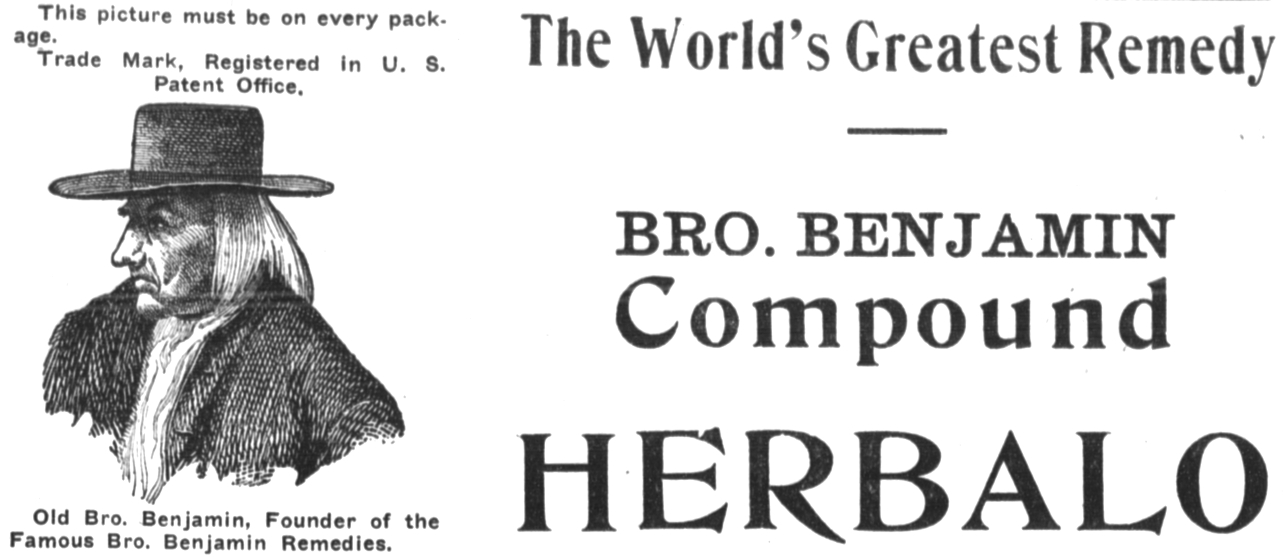 One of the few differences between the Great Fer-Don and Brother Benjamin was the latter claimed to be a Quaker offering Quaker medicines created by "Old Brother Benjamin" (who coincidentally had the same name, apparently). The Quaker image was even part of his trademark, as seen in the ad shown to right. But before Ferdon reinvented himself as the Great Fer-Don he had also pretended to be a trustworthy Quaker and called himself "Brother Paul," so even that part of Benjamin's shtick was stolen.
Both of them emphasized in their fake news-ads they had removed really disgusting things from the bodies of clients, and everyone in town could come over and take a good close look at bottled collections of them. In the case of the Great Fer-Don it was jars of tapeworms of epic lengths; Benjamin showed hundreds of gallstones supposedly removed from a single patient. Give them credit for being the Don Drapers of their day – they knew precisely how to use turn-of-the-century morbid curiosity to draw in the rubes.
Every night in 1909 the Great Fer-Don peddled his patent medicines at an old-fashioned medicine show and in 1912 Brother Benjamin likewise drew crowds in the early autumn to his temporary stage at the big vacant lot at Third and B streets (think the current location of Luther Burbank Savings). A man from Red Bluff recalled these shows in a "good ol' days" section of the Oakland Tribune in 1941:
| There were always two or more black face performers who put on skits and sang songs, as well as musical numbers. Between intermissions, attendants would pass through the crowd selling different kinds of medicine products that were guaranteed to cure everything from a corn to appendicitis and warts on the back of the neck. One products that stands out in my memory was Brother Benjamin's Herbalo, which sold for $1.00 per bottle, and every time the hawker made a sale he would yell out, Sold out again, Doctor. Some times a so-called doctor with the show would establish a local office temporarily to treat the sick, much to the annoyance of local reputable practicing physicians... |
Technically, they were selling Bro. Benjamin's "Herbalo Blood Purifier Stomach-Liver & Kidney Renovator" plus other custom liniments and whatnot, but the real money came from steering seriously ill members of the audience to his phony doctors set up in a Fourth street office across from the courthouse.
Like the Great Fer-Don previously claimed his "European Medical Experts" could handle the most serious medical problems, Bro. Benjamin boasted his team would "positively cure" a long list of ailments from asthma to diabetes to tumors. "Wednesday a large monster parasite over 100 feet long was removed from a leading lady of this vicinity," one of his Press Democrat ads announced, and "Thursday a cancer was removed and is on exhibition at the concert ground every night." Undoubtedly the "doctors" were using sleight-of-hand (better known today as "psychic surgery") where the practitioner's fingers magically appear to enter the body and pull out bloody diseased bits, all without breaking the skin. "No knife, and no pain," promised Benjamin's advert.
 We don't know what Benjamin charged for these "cures," but Ferdon was caught sometimes bilking the sick for the equivalent of an average worker's entire annual wage. One ad of Benjamin's listed the names of several local people who supposedly had been treated by his "Medical Specialists;" of those who can be identified, all had lower-income jobs, such as laborer, waitress, and candy salesman.
Brother Benjamin apparently did not get into serious legal trouble – or at least, nothing can be found in the newspapers. Perhaps that was because he kept a lower profile; Ferdon's downfall came after he tried his con in larger towns such as Sacramento and Seattle. It looks like Benjamin kept to the backwaters of California.
Benjamin J. Bruns – his real name – seems to have stopped touring in 1914, although he kept manufacturing Herbalo at least through the end of the decade from his hometown of Cincinnati. After he left Santa Rosa the Hahman drugstore advertised Benjamin's tonics were for sale there, and similar newspaper ads can be found from pharmacies elsewhere. It was probably harmless stuff - at least, harmless compared to that "Marvelous Specialist" scam our newspapers helped promote. Again.
IT IS TO LAUGH, SAYS BENJAMINBro. Benjamin, who has been herewith with the Marvelous Medical Specialists for the fast four weeks, meets with many laughable and peculiar experiences in his travels--notably arguments his detractors and envious competitors put up to try and stay his onward victorious career.
Benjamin and the Marvelous Specialists represent all that is new and late in the discoveries of medicine and surgery, hence those who are back numbers and cannot make the wonderful cures these Scientists are famous for, stoop to some ridiculous depths to try and decry the good work done by the Medical Specialists.
Some physicians claim that it is impossible for more than two or three gall stones to be in the gall gladder. Now such a statement is absurd and any physician who claims to be such knows better, and when he makes such a statement, he simply holds himself up to ridicule to all intelligent people.
Benjamin laughed when the statement was repeated to him and said he was for a physician that said that, as he himself had seen over 400 gall stones cut out of the gall bladder of a subject at a post mortem at the Cincinnati hospital, one of the largest and best hospitals in the United States and owned by the city of Cincinnati. It only goes to show that even envious physicians do not hesitate to make the most absurd statements to try and harm the good work done here by these wonderful specialists.
They have scores of friends here, made by their marvelous cures. They have done their work in the most stubborn case.
What is remarkable about the Medical Specialists is the marvelous results they bring about in such a short time.
From Mr. J. M. Lucas, 734 Third street, Santa Rosa, traveling salesman, these specialists removed over 200 gall stones with their secret medicines--and no operation. He has been ailing over three years and is loud in his praise of the good work done in his case in such a short time.
Mr. M. H. Inman, Route 6, box 607, well known in Santa Rosa, is emphatic in his testimony of the good results obtained in his case, removing 182 gall stones without an operation.
From Mr. P. A. Lawson, Route 4, box 10, ailing over four years, these specialists removed over 200 gall stones with their secret remedies.
When we can give testimonials in your own city from such well known and prominent people as ...[ten names, with J. M. Lucas repeated]...all prominent and well known in Santa Rosa; Mrs. Josephine McCrone of Lodi, who was cured of a complication of diseases, and scores of others from people here and in other places, even the most skeptical must concede that we are as we claim and can perform the cures we advertise.
It is the same story wherever these Marvelous Experts go. Seemingly impossible cures and wonderful work. Space forbids giving the many hundreds and thousands of testimonials they have, and they are still pouring in every day.
Many other names might be mentioned to show what work the Specialists are doing in our city, names of people who have tried other doctors and other medicines without avail but who are now being cured. Hundreds are taking advantage of the presence of these Medical Marvels at their office.
Our office hours at 609A Fourth St. upstairs, are from 10 to 12 mornings, 2 to 4 afternoons, only a few days more. The big free show continues every night at 7:45, at Third and B street, opposite the Columbia theater, another week.
The Bro. Benjamin Medical Specialists have their own private waiting rooms and offices and everything is absolutely confidential. They positively cure asthma, dropsy, epilepsy, St. Vitus dance and nervous disorders, lung trouble, incipient consumption, diseases of women and children successfully treated and cured without operation, old chronic diseases of the stomach, blood, liver and kidneys, diabetes, gravel, piles, hemorrhoids, incipient Bright's disease, rheumatism (acute, chronic, muscular and sciatic), hip joint disease, rupture, hernia, goitre, diseases of the eye, ear, nose and throat--in fact, what has puzzled you and your doctors gives way to the wonderful medicines of these specialists. Cancer, tape worms, tumors and gall stones removed; no knife, and no pain. These specialists speak all languages.
- Santa Rosa Republican, October 1, 1912
MARVELOUS CURES BY THE BRO. BENJAMIN SPECIALISTSTHEY REMAIN IN SANTA ROSA ONE MORE WEEKOVER 150 GALL STONES REMOVED FROM MR. W. E. COOK, PROMINENT IN SANTA ROSABro. Benjamin and the Marvelous Specialists remain in Santa Rosa another week owing to the insistent demand of people from far and wide.
They are greeted every night by large and enthusiastic crowds of our best citizens at the show grounds... the free show at Third and B sts., attracts the largest crowds every night and under the blaze of electricity, a really novel and clever program is presented which abounds in mirth, melody and music and causes enjoyment to young and old, and will be talked of for months after Bro. Benjamin leaves...
- Press Democrat, October 6, 1912
