What's the origin of the name, "Kawana Springs?" It's far easier to say where it didn't come from than to pinpoint its source or meaning. For example, if you think "Kawana" is an Indian word, you may be right - except the Indians who coined it were 3,000 miles away.
Let's start with the simple part: "Springs" is part of the name because it once was a mineral spring resort, with a hotel and bathhouse. A 49er named John S. Taylor had poor luck gold hunting but found his fortune here, homesteading 1,400 acres at the base of that mountain which came to have his name. John was quite the entrepreneur; he planted a large vineyard, raised livestock, and mined a small vein of coal that was discovered on his land. He saw the opportunity to cash in on the harness racing craze and built "Taylor's Driving Park" at his place, where the 1861 Sonoma County fair was also held. He owned most of the downtown block between Fourth and Fifth streets directly across from Courthouse Square. John Taylor was a rich and interesting guy about whom more should be written.
Taylor also saw $$$ in the stinky creek on his property. Mineral spas and resorts were a big deal on the East Coast and in Europe; people believed the water relieved arthritis and aches if you bathed in the stuff, and even that it could cure kidney disease and other ailments if you drank lots of it. He built a small hotel for guests and when that one burned in 1870, Taylor built a grander, two-story place with hot and cold running boy-does-that-smell-awful.
It's unclear what ambitions John Taylor held for his mineral water resort. He rarely advertised in the Northern California newspapers (at least, judging from the healthy sample of 19th century papers available online through the Library of Congress) and was leasing the operation out as early as the 1880s. Unlike owners of some other local hot spring retreats he didn't bottle his "curative" waters for sale. Then there was the potential problem with name confusion: Taylor called his place "White Sulphur Springs," and when he started there were already "White Sulphur Springs" in Solano (Vallejo) and Napa (St. Helena).
Why was everyone naming their place "White Sulphur Springs?" Because the original W.S.S. in West Virginia was recognized as the standard of excellence for resorts in the latter 19th century. It was the playground for the Washington D.C. elite; presidents took the waters there and Euro royalty, too. "White" apparently was intended to indicate the sulphurous water was clear and not sickly yellow, and it provided an opportunity for other West Virginia hot springs to exploit the name with sound-similars; there were nearby Blue Sulphur Springs, Green Sulphur Springs, Red Sulphur Spring and Salt Sulphur Springs. The water was apparently identical, or nearly so. (A 1870s analysis of Taylor's water found it contained bicarbonate, iron, magnesia, and, of course, sulphur.)
By the turn of the century, whatever days of sun Taylor's hotel enjoyed were certainly past. No ads can be found beyond 1899, although we know it remained open because it was still mentioned in the schedules for stage stops. When the 1906 earthquake hit, Taylor's White Sulphur Springs hadn't yet opened for the summer season. The hotel and bathhouse apparently escaped without serious damage, but not so the creek - the mineral water stopped flowing after the earth shifted. The place opened again for the 1906-1907 winter season, but that was it.
Come 1910 and the Press Democrat announced a pair of local men were going to reopen the resort, but not as White Sulphur Springs:
It was deemed advisable to change the name of the resort from White Sulphur Springs on account of the fact that there are already two resorts of that name in the state. Luther Burbank was appealed to in the matter of the selection of a name. He chose "Kawana," and his choice was accepted. The management would have liked to have named the place "Burbank Springs," but Mr. Burbank preferred not inasmuch as he had declined many offers for the use of his name for other places. |
 Thus it came to be dubbed "Kawana Sulphur Springs," the ads shamelessly touting it was "Named by Luther Burbank." More on Burbank and the Kawana angle in a minute.
The article and ads pointed to a new direction for the spa. It was promoted as the "Headquarters for automobilists and traveling men," and a clubhouse building was added. The ads also promised "Its waters are unsurpassed," but without the natural mineral spring working they had to be trucking the water in, or dousing the plain well water with chemicals. Two years later, ads announced "Kawana" (no Sulphur, no Springs mentioned) was under new management.
Kawana-anything disappears from the newspapers until 1927, when a Santa Rosa paper reported the "old Kawana Hotel, at White Sulphur Springs...has been untenanted for several years" as part of a news story about its very interesting recent tenants. It seems a professional bootlegging outfit had gutted the inside of the old hotel and constructed a three-story, 1,400 gallon still for making hootch. Police found the operation only after it was ready to move on, with a hapless steamfitter on the premises to dismantle the enormous rig. Officers were quoted as saying it was the largest bootlegging plant ever found in Northern California.
Old John Taylor was 99 years-old by that time, and the news about his old place must have been quite a shock. He died less than three weeks later and according to Gaye LeBaron's columns, his daughter, Zana, had the hollowed-out building demolished rather than attempt to repair the heart-breaking damage. In 1931 the ranch became a game reserve stocked with quail, deer and pheasant under a deal with the Sonoma County Sportsmen's Club. Zana fixed up the old bathhouse and lived there until her death in 1970. The year before, however, she discovered that the 1969 earthquake had jogged loose the creek's plug, and up to 1,000 gallons/day of mineral water was again filling the creek. An AP wire service story about this appeared in newspapers nationwide. Alas, the water soon again stopped.
Back to Burbank and "Kawana:" Note that the article stated Burbank "chose" the Kawana name "selection," which strongly implies someone else - the new tenants or John Taylor, probably - gave him a list of possibles after they couldn't get rights to use "Burbank Springs." But where did Kawana come from? First, Kawana is a family name in Japan, Hawaii, and elsewhere in the Pacific, and the Taylors had a Hawaiian connection because John Jr. was living there at the time. Maybe John Sr. heard the name and liked it.
Could Kawana be Native American? Some writers have claimed so, explaining it meant "healing waters" or similar. An anthropologist thought it possible it had Native roots, but "it sounded more like a fake Indian word that a PR person would invent."
If it were an Indian word, it doesn't come from the Southern Pomo dialect, where kawana means "turtle" (Barrett, 1908) and there are no turtles to be found in that section. And besides, Pomo locations weren't even named like that; a place would be called something like kawanakawi (turtle-water-place). Further, the "healing waters" nonsense is put to rest by the Taylor Mountain Park master plan, which determined "no sacred sites are known to be located on the property."
A final option will seem like a stretch, but hear me out. Recall John Taylor named his place White Sulphur Springs after the classy resort in West Virginia. The route taken to reach that famous place in the 19th century was the road known as the Kanawha Turnpike, which followed old Indian trails from Richmond to the Kanawha River Valley. (Believe it or not! Kanawha was considered in 1861 for the name of the new state that would be West Virginia.) Note that Kawana and Kanawha have only the second and third syllables flipped. How likely was it that Taylor would want another name very closely linked to the original resort? And would Taylor have even known about the White Sulphur Springs-Kanawha connection? Of the latter we can be certain: He was born in Pittsylvania County, Virginia, which is at its farthest fifty miles from the old Kanawha Turnpike. He must have traveled it at least once during his boyhood, and certainly knew well the Kanawha name.
So there you have it: "Kawana" was a clever variation - or perhaps, the slight misremembering of an 82 year-old man - of a name created by the Piscataway, Delaware, or Shawnee tribes of modern-day West Virginia. Or it's Hawaiian. Or maybe it was mashed-up mumble of vowel sounds created by a marketing whiz who also dreamed up the phony "healing waters" legend. But this much is certain: You can search every inch around Kawana Springs and not find a single kawana.
Obl. Comstock House connection: Daughter Zana Taylor, who returned to the ranch and remodeled the old bathhouse, was a close friend of Anna May Bell, the young woman who was something of a godchild to Mattie and James Wyatt Oates. The Taylors threw more than one party in Bell's honor at their home at 512 Mendocino Ave (currently the Trek Bicycle Store). Zana's many doings at the Oates house can be found in our archives.
 |
| Detail of White Sulphur Springs postcard, c.1896. Courtesy Sonoma County Library |
UPDATE: There isn't much left of the old White Sulphur Springs/Kawana resort, so it's no great loss at the present time (2013) there is no public access to it without special permission. No sign of the hotel remains at all except for a few low stone retaining walls which terraced the grounds, as seen in the1896 postcard above.
 The original gazebo, shown at right, still has the cradle-sized fountain basin from which the mineral water bubbled to the surface. The decorative icicles and fish scale shingles are typical of the Carpenter Gothic style popular in the 1880s. Note the railing is low enough to serve as a seat; those who believed drinking the warm mineral water was healthful would sip as much of it as they could bear over the course of a day.
The bathhouse shown below is believed to have been built in 1876 and is surprisingly small, about 1200 ft. in a "T" floor plan. In front is a raised concrete fountain that probably offered another chance to drink the foul-smelling water before it was piped inside. Not shown to the left of the bathhouse is a stone-lined catchment with a rough pile of cemented stones in the center. The size and shape suggest a hot tub although its original use is unknown. Near the bathhouse is a dilapidated structure that may have been an automobile barn built around the 1930s which will not be preserved.
The county's plan for the area includes plans to convert the bathhouse into a small visitor center and possibly build a facsimile of the hotel as a bed and breakfast inn/hotel. Plans for the surrounding Taylor Mountain Park include an outdoor classroom/amphitheater, large picnic areas, camping grounds, a dog park, Frisbee golf park, and more.
TO REOPEN SPRINGS NEAR SANTA ROSAUnder Name of "Kawana Springs" the Old White Sulphur Springs Resort to Be Made Popular PlaceUnder Name of "Kawana Springs," the well known summer resort known for years as "White Sulphur Springs," owned by John S. Taylor, and which has been closed for a long time, is to be reopened and an endeavor made to regain the old time popularity the place once had and to add to its attractiveness.
The springs property, with the addition of twenty acres of fine timbered woodland, making the grounds forty acres, instead of twenty, has been taken over by "The Kawana Springs, Incorporated," headed by M. N. Winans and Thornton P. Preston. Mr. Winans is a well known insurance manager, who has made his home in Santa Rosa for some time, and enjoys an extensive acquaintance throughout the state, and Mr. Preston needs no introduction, as the former proprietor of the Hotels Lebanon and Overton in Santa Rosa, with a legion of friends among the traveling public.
Messrs. Winans and Preston have been negotiating for the acquisition of the Springs property for several weeks and have finally arranged the details. The big hotel building will be refurnished throughout and the grounds will be made most attractive. Another building in close proximity to the hotel will be fitted up as a clubhouse, and the bathhouses will all be remodeled and improved. In fact the gentlemen mean to have everything as neat and comfortable as possible for the accommodation of the large number of patrons they expect to entertain their this summer [sic]. Already they have a good-sized list of applications for accommodations and they expect to be ready to open the Kawana Springs resort on May 2.
Nature has been lavish and the place affords so many possibilities for the spending of a delightful vacation outing there, as well as its offering in the way of medicinal springs whose waters have been found to contain excellent curing qualities for various ailments. The analysis made by Dr. Winslow Anderson shows the Springs to be very valuable in the treatment of kidney diseases.
In addition [illegible microfilm] will also cater to the people of Santa Rosa and their friends by providing an excellent cuisine and other attractions. The Springs are located about two miles from the Court House and are of easy access over a well kept road, just a nice spin in an automobile or drive by carriage.
It was deemed advisable to change the name of the resort from White Sulphur Springs on account of the fact that there are already two resorts of that name in the state. Luther Burbank was appealed to in the matter of the selection of a name. He chose "Kawana," and his choice was accepted. The management would have liked to have named the place "Burbank Springs," but Mr. Burbank preferred not inasmuch as he had declined many offers for the use of his name for other places. It is needless to say that everybody wishes Messrs. Winans and Preston the greatest possible success in their big undertaking, and they mean to leave nothing undone to achieve success and make their place deservedly popular. The resort will be open winter and summer.
- Press Democrat, April 13, 1910
KAWANA HOTEL RAIDED: GIVES UP BIG STILL
A plant for the manufacture of illicit liquor, declared to be the largest ever uncovered in the north Bay region, was seized in a raid conducted by County Detective Pemberton and members of the sheriff's office late Tuesday, when the old Kawana Hotel, at White Sulphur Springs on Taylor mountain, was raided.
A still with 1400-gallon capacity was discovered in the place, along with 50 gallons of "jack," and boilers, mash tanks, cooling coils and other equipment. Two smaller stills were also taken in the same raid--one with a 250-gallon capacity and the other with a 150-gallon capacity.
George Darnell, 50, the only man at the place, was seized as operator. Darnell claimed that he was a steamfitter from San Francisco, and had been hired to clean up the works and dismantle the place. The mash tanks bore out his testimony, as they were clean and the still was not in operation.
Threaten Tear Bomb
Darnell at first barricaded himself in the attic and was only forced to come down when the officers threatened to throw tear bombs into his hiding place. Although they had no bombs with them, the ruse worked.
The main still was three stories high, and the seven 200-mash tanks were so connected up that the fermented mash could be pumped directly into the still. The plant was estimated to be worth $10,000.
In the opinion of the officers, the place belonged to a group of wholesale San Francisco bootleggers, who made the pure alcohol in the plant and turned it into gin for the San Francisco trade.
Short Time Only
Officers also believed that the plant was set up for only a short time in each place, a quantity of alcohol made and the plant dismantled and moved to another place before officers found it.
Pemberton has had the place under surveillance for some time, spending several nights in the vicinity in order to make sure of the activities before he staged the raid.
Kawana Springs was a well-known resort in the old days, but has been untenanted for several years, except for two or three short openings by minor companies, who could not make the place pay.
- Santa Rosa Republican, March 2, 1927

"Change doesn't happen overnight," the saying goes, but in truth, it seems to. Surely you can recall many times when you've been surprised to notice a tipping point has "suddenly" tipped - a trend becomes commonplace, or nearly everyone accepts a notion that isn't very old. My favorite example is this image which was created for the Today Show, comparing St. Peter's Square during the announcement of Pope Benedict in 2005 and the announcement of Pope Francis in 2013. In the earlier photo, only a single person can be seen with a mobile phone. In 2013, it appears everyone in the crowd is taking a snapshot with their phone or tablet. If you had asked the 2005 crowd if they expected to be at the same event eight years later taking pictures with their smartphone, they would have first asked, "What is a smartphone?" followed by, "why wouldn't I be using a regular camera?" (As news photos tend to disappear over time, you can also find it here, here and here.)
 (RIGHT: Crowds waiting for the ferry at the Monte Rio Landing, 1910. Photo courtesy Sonoma County Library)
It appears the Russian River resorts reached such a tipping point in the summer of 1910 when there was a jump in the number of visitors. "Already thousands of campers are at the different places and daily more are arriving. After the Fourth of July it is expected that a great many more pleasure and recreation seekers will journey to the famous river," commented the Santa Rosa Republican. "The trains coming from the resorts on Sunday carried about 18 coaches and two engines, the coaches being crowded."
The Russian River resort scene had been growing steadily for more than a decade, with a new place or two opening every year. If you wanted to get away for a few days to swim and paddle around in shallow water or even just lounge away like a sloth in a tent-cabin, it was the best spot in the Bay Area. Although many resorts were more or less the same, some filled a particular niche. Mirabel Park was popular with groups holding Sunday picnics, Camp Vacation (near Bohemian Grove) had tennis courts, and so many Santa Rosans descended upon Rio Nido that it seems much of the town was there at some point over the summer, judging by the frequent notices that appeared in town papers. That history was discussed in an earlier offering, "When we Summered in Lost Places," and all that continued, as shown in items below.
So what made 1910 different? For starters, it was the first season after the Northwestern Pacific (NWP) line finally connected with the narrow gauge railway coming up the coast. This meant someone in San Francisco could reach the most popular resorts at the west end of the river - Camp Vacation, Monte Rio, and that year's new hot-spot, Monte Cristo - without taking the NWP to Fulton and changing to the slooooow river local that crawled along with over a dozen stops along the way. This was also the year that electricity came to the resorts, so roughing it was no longer quite so rough.
But the special sauce drawing the crowds, I believe, was live music. For the first time (at least, that I've encountered in the papers) a resort was promising there would be great dancing. "The Santa Rosa band will furnish music for the dance, and this is a sufficient guarantee of the excellence of the terpsichorean revelry," blurbed the Republican newspaper about the opening of Monte Cristo. "The dancing platform is one of the best on the entire river, and has ample floor space to accommodate large numbers of dancers."
As everyone familiar with local history knows, the Russian River scene exploded in the years around WWII as the top Big Bands in the country performed at the resorts, with jitterbug dancing and hot jazz making the area a showcase for the best in popular music. In order for that to happen, however, visitor's attitudes needed to first shift away from viewing the resorts as less a get away place into a go to destination. "The bungalows on the river and the cottages at the seaside are the strong attractions now," wrote the Press Democrat's gossip columnist in 1910, striking a prophetic note. "Summer is on."
RAILROAD IS MAKING FILLWill Form New Depot Site at Monte Rio
Work on the big fill at Monte Rio, where the broad gauge and narrow gauge trains will meet, is progressing rapidly. A large gang of workmen are employed at the present time, and the railroad company has run a trestle out over the slough where the fill is to be made, so that it will be an easy matter to dump in earth and arrange for reclaiming a valuable spot.
The new depot site will be on this spot where the fill is being made, and the Northwestern will reach the depot with a graceful curve on the east, while the North Shore train will come in on the west side of the depot. There is considerable work to be done there before the new depot site will be ready.
Other improvements are being carried out at Monte Rio and Rio Campo and a work train is being also used. Things are lively there now, in preparation for the coming vacation season. The railroad companies expect to do a great business this summer in hauling visitors to the redwood section.
All of the resorts along the river are planning improvements, and are anticipating entertaining the largest crowds in their history during the coming months. There is no question but the redwoods section about Guerneville is the most popular places in the entire state for summer outings.
- Santa Rosa Republican, March 1, 1910
ELECTRICITY FOR RESORTS"Rionido" Makes First Contract For Juice
The Russian River Light and Power Company has begun stringing wires on its poles recently set leading from Sebastopol to Monte Rio. This will furnish electric current for all the resorts on Russian river which require it. The wires will all be placed and ready for the turning on of the current on June 1st. The actual work it is estimated can be done in about fifteen days.
From Monte Rio the wires will be run at once to Occidental, when the work of setting the poles has been carried out. Contracts have been entered into with the Westinghouse Electrical Company for the transformers required and the secondary work is to be done by the Metropolitan Electrical and Construction Company of San Francisco.
Rionido, the pretty summer resort which was formerly known as Eaglenest, is the first of the summer resorts to have electric lights. Manager Ellis, of the Russian River Light and Power Company, states that he will have the wires into Rionido in a few days. Thomas C. Mellersh, manager of Rionido, is determined to have his resort the most up-to-date in the county, and will spare neither pains nor expense to make it so. The formal opening of Rionido occurred on Tuesday, June 10, when the dining room was thrown open to the public...
- Santa Rosa Republican, May 14, 1910
Nestling amid rosebushes and a picturesque woodland is the country home of the Frank Woolseys at Mt. Olivet. The Woolsey ranch has for years been noted for its hospitality and its welcome to visitors. It is ideally located, specially for such a delightful gathering as took place there last Sunday afternoon, when Mr. and Mrs. Frank Woolsey and their charming daughters, the Misses Louise and Helen Woolsey, entertained a large company of friends at tea and the accompanying pleasures of an outing in the country. They also entertained a few friends at luncheon prior to the larger gathering. The invited guests from this city either drove out in automobiles or went by train, the latter stopping conveniently at "Woolsey"...
"Monte Cristo," the Frank Leppos county home on Russian river, was thrown open last Monday by Mrs. Leppo for the entertaining of the ladies composing "The Spreaders." The club members were delightfully entertained and returning to town gently pleased with the outing.
- "Society Gossip" column, Press Democrat, May 22, 1910
OPENING BALL MONTE CRISTOFrank Leppo Arranges For Comfort of GuestsThe formal opening of Monte Cristo, Frank Leppo's splendid new summer resort on the Russian river, will be one of the events of the season in that section. The Santa Rosa band will furnish music for the dance, and this is a sufficient guarantee of the excellence of the terpsichorean revelry.
All the arrangements for the pleasures of a large attendance have been perfected by Mr. Leppo, and he has left nothing undone which could in any manner add to the pleasure or comfort of his guests. Busses will be run from Monte Rio's hotels to the new resort, in order that patrons may be in attendance at the dance and those who wish to go from this city to attend can find accommodations at the Monte Rio hotels.
Monte Cristo is one of the prettiest places on the river, and all who have visited it are delighted. There are many handsome cottages on the grounds, and it has leaped into popularity with rapid strides from the first.
Indications point to a large crowd being present at the dance, and that they will have a jolly time is a foregone conclusion. The dancing platform is one of the best on the entire river, and has ample floor space to accomodate large numbers of dancers. Mr. Leppo will give his personal supervision to the grand opening ball, and he knows how to conduct elaborate affairs.
- Santa Rosa Republican, June 17, 1910
Mr. and Mrs. Harry L. Hall and Mr. and Mrs. Ney L. Donovan are spending the week-end at Monte Cristo, the country place of the Frank O. Leppos, and attended the ball in the evening.
Mrs. James W. Oates and her guests Miss Myrtle Hamell and Mrs. Martel and Mrs. Blitz W. Paxton were among the visitors at Monte Cristo on Saturday and spent a delightful day.
From all accounts the picnic of the Irene Club at Rionido must have been one of the most enjoyable ever. It occurred last Wednesday and the members left this city on the morning train and carried with them well-filled luncheon baskets. The lunch was made up on innumerable dainties for each member contributed to the feast. I was assured by one of the Irenes after this manner: "The Irenes can cook and don't you forget it." Delighted! Cooking is a very useful and necessary accomplishment. The exhilarating weather, the swimming and the hiking and the pleasures of the outdoor life were all features of this never-to-be-forgotten outing at Rionido. At noon everyone was perfectly ready for the meal, which was spread in the dining room at the bungalow of Mrs. Charles A. Wright, Mrs. Wright being a charter member of the Club. During the enjoyment of the many courses of menu there was much laughter and merriment. some of the members returned home in the evening while others remained overnight with friends and returned the following day.
- "Society Gossip" column, Press Democrat, June 19, 1910
ALONG THE RUSSIAN RIVERThousands of People Camped at the Resorts
The year 1910, from all present appearances, is going to be one of the most profitable that the owners of resorts along Russian river have ever had. Already thousands of campers are at the different places and daily more are arriving. After the Fourth of July it is expected that a great many more pleasure and recreation seekers will journey to the famous river.
The popularity of the river as a place of amusement is easily attested by the fact that nowhere in California may the same amount of travel be found for such a short run. The trains coming from the resorts on Sunday carried about 18 coaches and two engines, the coaches being crowded. From one end of the river to the other people come to seek places to spend the summer months. As a place of recreation it would be hard to find one that could surpass it. San Francisco go there by hundreds to enjoy the bathing. Each day sees the river crowded with bathers. Extra precautions are being taken this year to prevent casualties. Expert swimmers have been stationed along the different places and they keep a constant look out over the people.
Not only is it a place for bay cities people, but Sonoma county [garbled typesetting] parties it would be hard to surpass. Many board the train from the cities along the route and attend the dances there on Saturday evening and spend Sunday bathing and boating. Many new boats have been added to the supply by the different resorts and at times the river is crowded with the little craft. Passengers in their raillery have often said that the resorts are so close together and the trains so long that the engine is at one station before the rear coaches have passed another.
A number of resorts are making preparations for the Fourth of July. Hundreds of people will go to that section to enjoy the two days' vacation and adequate quarters will be provided. Many of the camps will celebrate with exercises, while a majority will confine their sports to a grand ball in the evening.
- Santa Rosa Republican, June 25, 1910
Socially this week has certainly been the calm before the storm. After those memorable seven parties in nine days people have been taking a breathing spell. The bungalows on the river and the cottages at the seaside are the strong attractions now. Summer is on.
- "Society Gossip" column, Press Democrat, July 10, 1910



Seriously ill? In late 19th century Sonoma County there were faith-healers, physicians and quacks. And then there was Mrs. Preston, who was something of all three combined.
From 1876 until her death in 1909, Emily Preston practiced medicine by mail and from her home on the Russian River, two miles outside Cloverdale. Or rather, she didn't "practice medicine," as claiming to do so could have got her into a world of trouble, seeing as she had no medical training whatsoever. Instead, she saw patients and diagnosed their sickness, then sold them homemade medicines. Completely different thing, right?
 (RIGHT: Mrs. Emily Preston. Undated photo courtesy Sonoma County Library)
Madam Preston was not a huckster or a complete spiritualist nutcase like Fountaingrove's Thomas Lake Harris, but she did believe God communicated with her via otherworldly "photographs" and messages written on "walls of light." Probably thousands of people believed she had cured them via her hotline to God, some devoting their lives in her service. On the large ranch owned by Emily and husband Hartwell, followers built the community of Preston. At its peak c. 1895-1900, there were up to 200 residents with a school, post office, general store, train station, lumber yard, a water system, bottling works and a church where she preached the "Religion of Inspiration." There was also Emily and Hartwell's 18-room Italianate home and a 20-room convalescent hospital (both completely destroyed in a 1988 fire, along with most other buildings). In summer the community adjourned for two months to a camp near Preston Lake, where people from Cloverdale joined them for their Fourth of July festivities. Everyone was likewise welcome at Madam Preston's sermons at the camp's Church of the Wildwood, where she read to them what she saw mystically written in the air.
Also called the "Preston Colony," the village (Emily Preston, mayor) and its Prestonites existed to serve the little industry founded by Madam Preston. They filled mail orders for medicine and accommodated a steady parade of pilgrims seeking a consultation from Madam during her Monday office hours, where she offered patients a glass of cordial as she stared at them for several unspoken minutes to diagnose their sickness. Some of the afflicted would stay on for treatment at the Preston hospital/sanitarium or seek boarding at nearby resorts, maybe in a Cloverdale hotel when all Preston beds were filled. Mrs. Preston also kept an office in San Francisco where she saw patients. But most who sought her help did so through writing, and she believed her divine powers allowed her to "diagnosticate [sic] cases at a distance."
We know nothing about Mrs. Preston's true diagnostic skills, but we do know a fair amount about her treatment methods, which were spelled out in her pamphlet, "Price List of Medicines and How to Use Them." Before discussing that topic, it must be said that apparently many who sought her help were considered hopeless cases by the doctors of that time, and many believed they were better for her treatment. Some of that improvement may be due to bed rest at her country sanitarium with lots of exercise, fresh air and clean water, or convictions that her spiritual powers included miracle cures. But if their health actually improved, it certainly wasn't due to her remedies.
By the time began she treating patients in the 1870s, her school of allopathic medicine was mostly considered backward and downright dangerous, not far from the distain held for the Middle Ages view that bloodletting was a cure for what-ails-you. People became ill, she believed, because some of their blood circulation had stopped (!) or there was inflammation deep within the body. The cure-all was to create a running sore over the affected area and keep it oozing for 2-4 weeks "according as your strength and nerves will allow." It was also good to do this when you were healthy, just in case, you know.
This technique was called "blistering," and Mrs. Preston's main therapeutic tool was her homemade iodine-based liniment. The patient was instructed to rub this stuff on a spot twice a day until blisters form and rupture, then cover it with a "pad" (an oil silk bandage that the Prestons also sold). "The Liniment penetrates the skin and draws the impurities of the body to the surface in the form of a running sore," the pamphlet explained. "By applying the Liniment on the parts affected, you draw the disease from the inside to the surface. And when you have made sores enough to cleanse and purify the system, you will feel the benefit derived from the treatment...in chronic cases where the disease is located, it takes many sores before you get much relief."
Preston's catalog included other items, including cough medicine, "vagina balls," "gin and garlic," "fasting paste," and some sort of lotion available by the gallon. But the remedies usually centered on that liniment; she even recommended that it be mixed with "sweet oil" (olive oil) and swallowed to cure stomach aches. Rub it all over the body once or twice a week as a preventative (which must have given the Prestonites a unique coppery complexion). The Price List also recognized it wasn't very comfortable having a seeping wound for weeks: "While using the Liniment, if you feel the need of a tonic, take the Wine Cordial, or Blood Medicine, according to the directions on the bottles." The Prestons would sell you a jug of their fortified wine at $3.50 per gallon. Honest, reverend, I'm a faithful teetotaler but this is medicine.
The liniment treatment was no harmless placebo, despite Mrs. Preston's promise that "You can make sores on your arms, legs, feet, or anywhere on the body, and they won't hurt you." It was a strong formula that could leave scars; Nathan Bowers, the son of Preston colonists, wrote in 1966 "My body, more than sixty years later, still carries the marks where blisters caused by her liniment went so deep as to leave permanent scar tissue." Mrs. Preston also promised, "While using the Liniment, the privates and eyes are liable to become sore. Poultice them with scraped potato, or onion poultice, and then wash them with hot water. It is only the disease coming out, and need cause no alarm." Nathan's father followed directions and went blind - the green onion poultice drew the lens from his right eye.
Yet despite the scarred child and partially blinded father, the Bowers family did not leave Preston. The community and the place were dear to them, as was hearing Madam Preston's sermons. Some of her followers would have been happier if she dropped the pose of Physician and/or Mystic Seer to simply become Madam Reverend Mayor, and Mrs. Preston likewise knew she was undermining her religious message and endangering the colony's future by being branded as a fake twice over. She wrote in frustration about her critics in 1902:
If everybody would look at what we are trying to do, and how we are trying to live, and what our object in life is, they would not want to ridicule or make fun of us. They would say, "I would like to know how that is. I would like to feel that on me." |
So why didn't she do everyone a favor and dial down the crazy talk, particularly the bit about seeing the words of God written in light? She didn't really believe that, did she?
Emily Preston was born in upstate New York in 1819. This was at the peak of the Second Great Awakening, a period in American history marked by intense religion passion, much of it spurred by the belief that Christ was about to return. New evangelical cults formed overnight; even common folk were primed to debate merits of the latest -ism and weigh the meaning of new epiphanies and visions. And nowhere in the country was this movement more supercharged than the "burned-over district" of Western New York, which spawned Mormonism, Millerism (an apocalyptic cult that led to the Seventh-day Adventist Church), Spiritualism (as in seance communication with the dead) and others. Growing up in a world where the supernatural happenings were commonplace, it seems less odd that she believed Jehovah was texting her.
 (RIGHT: "The covered bridge spanned the Russian River at Preston from 1872-1931. Preston's commercial district was located west of the river, next to the Northwestern Pacific railroad tracks. The Preston residences, school and church were located across the bridge on the east side of the river." Description and photo courtesy Sonoma County Library)
Mrs. Preston was confident that her "Free Pilgrims Covenant Church" would survive her death, and left $125,000 to sustain it. Alas, when she died in 1909 her will was undated and unwitnessed; relatives easily had it thrown out. The property went for auction and sold for $19,000, the buyer being Emily's grand-niece who kept everything as it was, aside from later selling off some land around the edges.
The colony of Preston endured. There were still weekly meetings at the church to sing and pray. There were still jobs at the bottling works. But over the years people drifted away. People died. The train station closed. The post office closed. The bottle works closed. Meetings at the church ended in 1935. Three years later, a reporter from the Press Democrat visited Preston and described the old mansion:
We pushed open the gate and walked through the ruined garden. The house is white and colonial-looking, with a porch clear around it, and dark green trimmings. It looks as if it died long ago everywhere leaves and debris and loneliness. Beyond it tumble-down outbuildings that must have been servants’ quarters. Not a soul, not a sound. We were startled to find three bright silk cushions piled on the step, as if just set there - we went closer and saw they were oriental pottery work. We walked up to the front door and knocked. No answer. We peered through a hole in the shutter and saw a stuffy Victorian parlor, completely furnished, with a paisley shawl on the table and an old-fashioned phonograph with a brass loudspeaker. We knocked and called, but still no answer...now, all quiet, all fallen away. Nothing left but the ghostly, shuttered house, the century plants, the wind in the eucalyptus. |
In 1943 a couple bought the property to open a camp and summer school for boys. They unlocked the doors and found her clothes still in the closets, books on the shelf, pill roller on the table. Also gathering dust were 85 boxes of letters addressed to Mrs. E. Preston, Preston, Sonoma Co., California. Madam just stepped out for a spell, and surely would be back soon.
SOURCES AND NOTES: Almost everything in this article specific to Mrs. Preston is drawn from Holly Hoods' extraordinary thesis, "Preston: History of a Late-Nineteenth Century Religious Community in Sonoma County, California," which is available at SSU, at the Healdsburg, Cloverdale and central county libraries and at the Healdsburg Museum. It contains much interesting material not covered here, such as how Mrs. Preston answered critics who pointed out that she was functionally illiterate, despite spending decades reading the words of God writ large before her eyes. An appendix includes a reproduction of the 1903 edition of "Price List of Medicines and How to Use Them." Hoods' research is also summarized at the web site for the Preston Historical Research and Restoration Fund, which is welcoming donations to restore the church and other buildings not destroyed in the 1988 fire. There is a 2005 Press Democrat article about the restoration project. Most information about the Preston Colony comes from "Recollections of 19th- and 20th-Century Communal Life at Preston Ranch," a project edited by W.M. Sefton. Particularly valuable are transcriptions from local Healdsburg and Cloverdale newspapers. The recollections include descriptions of what happened to Preston after Madam died, including the formation of an artist's colony in 1969. Warning: Details concerning desecrations of the cemetery are not for the squeamish. Hoods commented in 2000 that therapeutic blistering "has fallen out of favor in the United States within the last 100 years," citing an entry in the 1903 edition of Chambers's Encyclopedia. This was the same printing plate as first used in the 1888 edition (and which continued to be reprinted at least through 1912), so it reveals nothing about 20th century opinions on blistering. Evidence instead shows that the medical community had largely rejected the method even before Mrs. Preston began her medical practice. In an 1869 rebuttal to allopathy, "blood-letting, blistering, cauterizing, physicking, poisoning, freezing, and starving" were denounced as quackery. Iodine was used medically in the late 19th century as a counter-irritant (1870 reference) and in liniment. A lengthy review of iodine uses in an 1876 handbook of therapeutics specifically warns against iodine solutions strong enough to cause scarring. No references, even Chambers, could be found that describe Preston's method of using liniment to keep an open sore running for weeks. |
MADAM PRESTON IS DEAD AT COLONY SHE FOUNDEDSudden Passing of Famous Woman Yesterday
Dr. Emily Preston, familiarly known as the founder of the Preston Colony near Cloverdale, is dead.
This noted woman was called from life very suddenly yesterday morning shortly after eight o'clock. Death found her as she was gazing out from the little lattice window of the kitchen of her stately residence, upon the delightful landscape dotted here and there by its beautiful homes and its trees and flowers. At the time she was going about her simple household duties. A sudden attack of heart failure and she was gone.
Four-score years was her life span and when the silver cord was snapped the life went out without a murmur and without a struggle. She was prepared for the rest that came to her. Hers had been a busy life, one devoted to the work of making those about her happy and well.
While no arrangements have been made for the funeral she will be laid to rest in the picturesque cemetery at Preston near by the little church in which on every Sunday morning, rain or shine, winter or summer, she was wont to meet and preach to her followers. She will rest beside the loved ones who have gone before.
Madam Preston ministered to the ailments of the body and of the soul. She taught that a pure mind and pure living are essential to the cure of bodily ailments and the administration of her remedies is said to have produced in many people wonderful cures. While not parading as a healer in the way in which most people accept the term, it was acknowledged by her followers that she was possessed of spiritual gifts of healing. Some ranked her as prophetess, and the use of her herb medicines for bodily ills was accompanied by faith. Her religion found many followers. They came from many sections of the state, and from other states, and in addition she had a large correspondence. There are thousands of people in the cities of this country and throughout the state who knew Madam Preston, either personally or by reputation. She was said to be a woman of some eccentricities, but be that as it may she was a good woman with one of the kindest of hearts. Those who knew her well testify to this.
Madam Preston had lived at the Preston health resort for many years. She was a native of New York state. The little, plain old lady was often seen about the Colony grounds and in Cloverdale, where she had many old friends. She took an active interest in the advance of the country about her and was the inspiration for many years of the fine Preston Colony exhibits at the Coverdale Citrus Fairs. On a number of occasions the writer met her and chatted with her in the pavilion during the arrangement of the Colony exhibit.
From friends at Cloverdale yesterday it was learned that she had not been feeling well and had complained of pains in the region of her heart. As if realizing that the shadows were soon to lengthen over the landscape of her life, she predicted that she would pass away in the manner in which she did. Coroner Frank Blackburn went up to Preston and held an inquest over the remains and the verdict was in accordance with facts related.
- Press Democrat, January 23, 1909
MAD. PRESTON PASSES AWAYDied Suddenly on Friday at Colony She Founded
Dr. Emily Preston, founder of the Preston colony above Cloverdale, and familiarly known to thousands of people as Madam Preston, died there quite suddenly on Friday. She was stricken with heart failure and death came to her in the kitchen of her residence as she was going about her usual household duties. For some days the deceased had not been feeling well, and complained of pains about the heart. This was the only suggestion of illness which she suffered, and she had not been confined to her apartments.
Coroner Frank L. Blackburn went up to Preston Friday evening and held an inquest. A verdict of death from heart failure was returned. It is stated that Madam Preston had predicted to her friends that her death would occur just as it did, and she seemed to realize that the end was approaching for her.
The deceased woman led a splendid life, and while ministering to the physical ailments of the people, she never neglected their spiritual welfare for an instant. She conducted services regularly each Sabbath day, preaching the gospel to her followers in the pretty little church edifice at Preston, where many were wont to gather and listen to her exposition of the Scriptures. Her religious cult drew many persons to Preston, and the devoted followers of the woman claimed almost supernatural powers for her in the curing of human ailments. Her medicines were compounded by herself, and were principally made from herbs, and the good woman is credited with many splendid cures.
All over the State, and even beyond the confines of the State, she was known as a healer. While many hundreds have visited her place above Cloverdale, many thousands have heard of the remarkable woman, and have corresponded with her.
The deceased was eighty years of age, and a native of New York. She had resided at Preston, which she founded as a colony, for many years past. She was actively interested in everything pertaining to the welfare of the vicinity of her home, and each year she and the other ladies of Preston made an exhibit at the Cloverdale Citrus Fair. She took more than a passive interest in this annual festival, and always attended to view the exhibits. There are many who will mourn her demise.
- Santa Rosa Republican, January 23, 1909
In the years straddling the turn of the last century, it seemed everyone in Santa Rosa was coming and going to the Russian River during the summer months. For many of them, however, the appeal of the river area had less to do with water activities than the siren call of rocking chairs in rented cabins, croquet and bowling and billiards with friends from town, hotel service, and for some above all, eating.
View Russian River train stops and resorts c. 1900-1909 in a larger map |
Much has been written about the river scene from the mid-1920s onward, but info about the first decade of the river resorts is scarce, although they were a central part of Santa Rosa life in early 20th century summers. Where exactly were these places, and what were they like? Why would someone prefer to go to Camp Vacation instead of Summerhome Park? After picking through out-of-town newspaper ads, railroad timetables, maps and atlases and all those "personal mention" columns tracking local residents, I present (what I believe to be) the first cross-referenced map of the Russian River byways during that era.
My early confusion centered upon the tangled names. Some spots were known by two or more - the Olivet train stop became Woolsey and Trenton became Laguna, for instance - and making matters worse, the Santa Rosa newspapers were sometimes sloppy about accuracy. Before Eaglenest became Rionido, then later Rio Nido, it was also in the papers as Eagle Nest, Eagle's Nest and Eagle's Nest Camp. And don't even ask about Camp Six.
It's also tricky to judge the popularity of any of these places. A new get-away popped up almost every summer during those years, while the paint was still almost fresh on the oldest resort, only about a dozen years old. Time spent anywhere on the river was still a novelty, something to talk about with your neighbors and friends, and the next time you went maybe you'd try another place that you'd heard good things about.
 Today it's hard to imagine the Russian River wasn't always a tourist destination, but most thanks for transforming a no-man's-land of redwood stumps into a primo resort area goes to north coast railroad baron A. W. Foster, president of the Northwestern Pacific (NWP). Mr. Foster is best remembered as a heartless supervillain in the 1905 "Battle of Sebastopol Avenue" (although it's more likely that history has given him a bum rap). As logging was winding down in the mid-1890s, Foster saw an opportunity to cash in on the growing popularity of Sunday excursion trips and vacation rentals, as best told in the often-quoted (but rarely credited) book "Redwood Railways" by Gilbert Kneiss:
To Foster, however, belongs much of the credit for opening up the Russian River country as a vacation land. Informal camping in the forests and two-week rocking-chair sojourns at American plan, pitcher, basin, and thunder-mug resort hotels had long been common. Foster was thinking in terms of summer homes and traffic for the Guereneville Branch where logged out country had left rusty rails. He bought some of the cut-over land, now green an bushy with second growth...[soon] Guerneville converted itself from a hard-drinking, bullwhacking lumber camp to a village of parasols, mandolins, and ice-cream sodas. |
It's not the job of this Santa Rosa-centric blog to tell the story of railroads, but I wish more history was available on how Foster and his railway developed this area. Did the NWP plan and build the resorts, then selling or leasing them once profitable? The intriguing thread tying most of the resorts together was Santa Rosa's industrious Cnopius family, who were apparently managing nearly all of them at different times between 1896 and 1906. Did they work for Foster? Mrs. L. C. Cnopius (no first name found, sorry) was particularly key to the progress, and her importance was even noted in San Francisco obituaries. Mrs. Cnopius is also known here for being the last direct victim of the 1906 Santa Rosa earthquake.
 TOP: Section of the Camp Vacation dining room, 1908. Note the hungry fellow peering through the window
RIGHT: Boating at Camp Vacation, 1907
MIDDLE: NWP Locomotive No. 99, "Coffee Grinder"
BOTTOM: Boarding the eastbound passenger train at Guernewood Park, probably 1909. Note the pile of luggage at the far end
Dining room photo courtesy UC/Berkeley, all others courtesy Sonoma County Library
CLICK or TAP any image to enlarge
The first resort to open was Mirabel Park, which soon became a particularly popular spot for large groups - unions, churches, fraternal organizations - to hold day-long Sunday picnics. So great was Mirabel's appeal that it threatened the overall success of the area. In the 1900 San Francisco papers it was reported that "many families fear to take [Russian River trains] owing to the dread of coming in contact with Sunday picnics," although the railway assured the public that "this road has had no trouble on this score." Still, they promised to herd picnickers into separate train cars: "In the future, therefore, no one traveling on the California Northwestern Railway on Sundays will come in contact with Sunday picnics."
Mirabel Park was also somewhat unusual in this era for having a "villa" offering actual boarding rooms. More common were partially-furnished bungalows for rent or sale, should you have the overwhelming urge to buy a tiny shack with no running water or electricity. And these cottages near the river did not sell cheap; ads from real estate brokers listed them for $400 up, about three times more than a place in Camp Meeker.
Bungalows were suited for anyone spending the season on the river or planning to entertain friends, as many people did. But most people vacationing for a few days or so stayed at one of the tent hotels, adults $2/day, $10 per week, children under ten half-price. An advertisement for Camp Vacation describes the accommodations: "To sleep beneath a tent, to pass the day in the open air and have nothing else to do is to camp with luxury. Camp Vacation makes this easy for all. It is a hotel under canvas. Regular hotel service is furnished, but the guests live in tents. The tents are provided with wooden floors, are well furnished and are taken care of by those in charge."

Meals were included in the deal, and the all-you-can-eat grub seemed to be as much an attraction as the Great Outdoors. In a September, 1908, San Francisco Call how-I-spent-my-summer-vacation writing contest, 8th grader Ruth Moore told of her good times at one of the tent hotels:
My vacation was spent in the beautiful redwood groves of Sonoma county...we arrived at Montesano station about 3 p. m. and lugged our heavy baggage up hill, over stumps, rocks, brush and other obstructions to our camping grounds. Then our troubles were over. Nothing to do but eat, sleep and seek pleasure.... ...When I first arrived at the camp I did not have a very big appetite, and I was surprised to see my friends eat. Their table manners seemed to have been left at home. They grabbed everything in sight with both hands. They would drink out of the bucket in preference to using a cup and wipe their mouths on the tablecloth. But in about three days I was just as bad. I simply could not get enough to eat, and how good everything did taste. I never did get enough of hot cakes and maple syrup any morning... |
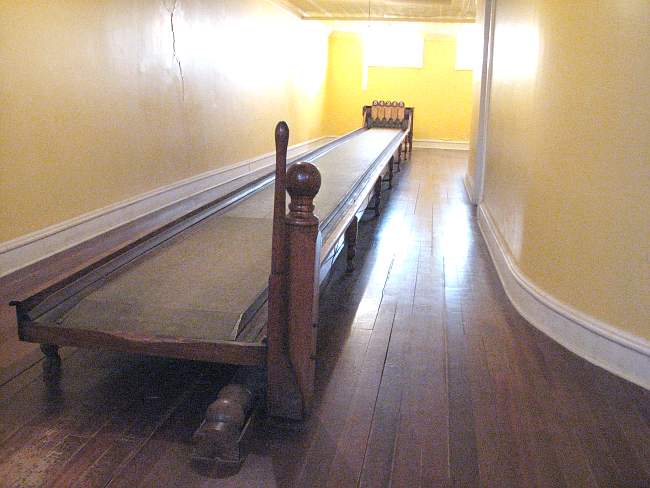
For Santa Rosans and other locals, the most popular resorts - or at least, the most often mentioned in the newspaper columns - were Camp Vacation, just across the river from Bohemian Grove, and Eaglenest, location of modern-day Rio Nido. The latter included bungalows and a true resort hotel, complete with a "box ball" bowling alley (a cross between a half-length 9 pin bowling lane and and a looooong coffee table, often found in arcades at the time - photo here). Besides four miles of beaches, Camp Vacation offered tennis courts, and it's worth noting that tennis and box ball bowling were among the few genteel sports where women could compete against men.
 But maybe the best part of those months was having the entire lower river available as your personal playground. When passenger and freight trains weren't scheduled, the railway used the tracks to offer a kind of trolley service using an ancient steam engine and open railway car recycled from the old timber days. Meeting your friends at a particular swimming hole by catching a ride on the "Coffee Grinder" - which looked like an oversized toy, and puffed away at less than ten miles per hour - added to summer's delight.
Even the James Wyatt Oates family joined the river stampede, in their own way. The couple escorted a
This chapter of the resorts ended in late 1909, when the NWP line finally met the narrow gauge railway that came up the coast. After that the railroad began promoting the "Triangle Trip" Sunday excursion trains from San Francisco, a 150-mile ride with a little stopover at Monte Rio. A day out of the city sitting on trains while watching some nice scenery, then home for dinner. Oh, look, there's a beach. Those trees look tall. Gee, I wish there was only some way I could stop thinking about work.
NO PICNIC CROWDSTo Interfere With Regular Sunday Travel.
The California Northwestern Railway is making heavy preparations for handling next season's business, and among other things will give special attention to its Sunday travel. The section which this road traverses is more than attractive for short Sunday trips, but many families fear to take them owing to the dread of coming in contact with Sunday picnics. While it is true this road has had no trouble on this score, it is determined to eliminate from the minds of the public all idea of this contact. Although the picnics up the road to Mirabel Park, etc., have in the past been kept separate from the regular travel, there will be none whatever this coming year, and those attending Schuetzen Park will be run on separate boats and trains. In the future, therefore, no one traveling on the California Northwestern Railway on Sundays will come in contact with Sunday picnics.
- SF Call, November 11, 1900
I hear that box ball in the bowling alley at Eaglenest has been a fascinating pastime for a number of our society women who have been spending a portion of their vacation there during the past few weeks. So interested did they become, some of them, in the sport, that quite a little good-natured rivalry was aroused as to who could make the highest score. I know one lady who made a record score, but social excommunication is threatened if the newspaper divulges the name. Some of the best players, however, are members of the Irene Club and some of them have been guests of Mrs. Charles A. Wright at her bungalow at Eaglenest.
- "Society Gossip" Press Democrat, August 9, 1909
Colonel and Mrs. Oates, Mrs. Dorothy Farmer and Miss Hazel Farmer were included in a house party at Rule Ranch as the guests of Charles H. Rule. Colonel Oates will return the first of the week, but the ladies will remain for several days longer. The hospitality of Rule Ranch is always very cordial.
- "Society Gossip" Press Democrat, September 19, 1909
CHANGE NAME OF STATIONCamp Vacation Will be Known as Rio Campo
Camp Vacation as the name of a railroad station on the Northwestern Pacific is a thing of the past. In future the place will be known as Rio Campo and unless the name of the popular resport which was created by Lewis C. Cnopius is maintained, the name of Camp Vacation will disappear forever. To the efforts of Mr. Cnopius and the late Mrs. Cnopius Camp Vacation owes its great popularity as a resort and its wide reputation over the state.
With the changes that come and go. the railroad company has determined to call the station at the place Rio Campo, and with the completion of the bridge near that place there will be no other stops on this side of the river for the trains will continue their journey across the bridge and on down to Monte Rio.
With the coming summer season the loop completed by this bridge will make the redwoods section even more popular than it has been heretofore. Annually thousands of visitors spend their vacations in this delightful section.
The rails are laid on the Monte Rio side of the river, and everything is in readiness to connect the same when the officials give orders for the same.
- Santa Rosa Republican, September 21, 1909
A century ago there were scores of tiny communities in Sonoma County that appeared on no map, yet everyone knew where they were. Explored here earlier was Hinton, which was large enough to have its own post office for a time; nearby was Vine Hill, Trenton and Peachland. And then there was a string of farms south of Santa Rosa known as Bellevue.
You've passed the ghost of Bellevue countless times without knowing it. (See map.) When driving south on Highway 101, the Hearn Ave. exit leads to "auto row" along Corby Ave. After the last car dealership, the road takes a sharp turn to the west. That's Bellevue Avenue, a desolate mix of gritty homes and industrial buildings near the highway, but nicer a few blocks further down the street where Elsie Allen High School can be found. On the east side of the freeway there's the other part of Bellevue Ave. off of Santa Rosa Avenue; this spur is part of a modern subdivision, with landscaped streets, a park, and a grade school, a world apart from its poor relation on the other side of the freeway.
It was the construction of the highway that split Bellevue, the state of California seizing land for the road under eminent domain. The last we hear of Bellevue is in a 1957 Press Democrat article about a jury trial where an 84-year-old Bellevue farmer and the state fought over the fair market value for his place. The state's attorney argued it wasn't worth much because it was only good for truck-farm agriculture; witnesses for the farmer said it had potential for an industrial and/or subdivision site, and, of course, that's exactly what the two wings of Bellevue became.
The 1908 item below jokes that residents of the "lively settlement" of Bellevue were having so many children that they might rename the community after President Theodore Roosevelt, who held nutty concerns about "race suicide" unless "old Colonial stock" white Americans kept their birthrates up. As discussed in an earlier essay, Teddy's views weren't really Nazi-ish, but awkwardly expressed encouragement of American exceptionalism.
MAY CHANGE NAME TO "ROOSEVELT CORNERS"
Bellevue, the lively settlement just south of Santa Rosa, is establishing new records with alarming frequency. They not only raise splendid fruit, large poultry and many fine eggs from the flocks there, but in other lines they also excel. Wednesday night Mrs. Harry J. Barnett presented her husband with twins--two handsome baby girls, and the proud father is receiving congratulations on the momentous event in a dignified manner. Eleven children have been born in that vicinity within less than a year and the residents declare there is nothing resembling race suicide in that section. It is in serious contemplation to change the name of Bellevue to "Roosevelt Corners," in honor of Teddy and his race suicide theories. The mother and daughters are doing nicely, and Mr. Barnett is certainly the happiest man in seventeen states over the important event.- Santa Rosa Republican, October 15, 1908
 1907 was the year California fell in love with the automobile, and you can probably even pinpoint the exact moment: 7PM on February 18, when 254 automobiles began their parade down Van Ness avenue to promote the first San Francisco Automobile Show. "Sirens screeched, whistles resounded and the odor of gasoline was wafted over the city," the SF Call newspaper reported the next day. Led by a band playing "My Merry Oldsmobile," it was a fine parade - that is, until the drivers came in sight of the exhibition hall and went nuts. "When the Coliseum loomed into view the ten-mile an hour limit was forgotten and a general race followed, in which the band wagon was left in the rear."
(RIGHT: San Francisco Call illustration of the 1907 procession on Van Ness avenue - CLICK to enlarge)
Nothing since the 1906 earthquake had shaken San Francisco more than that exhibition. Society swells turned out in furs and diamonds (yes, they dressed for an auto show) among the 5,000 that crowded the hall to see cars like the 40 horsepower Winton that "eats up the hills," and the Heine-Velox, "The Car With No Superfluous Parts and Everything Get-at-able." By 1907 San Francisco had one car for every 133 residents, far more than Chicago or New York City, and four times the national average per capita.
Car culture in Santa Rosa and Sonoma County reflected the rest of the San Francisco Bay Area, judging by the 1907 newspapers. Auto brokers ran the first display ads of the latest models for sale, and someone buying a car was newsworthy only if it was an exotic model, such as Attorney Leppo's remarkable White Steamer (if you don't mind watching a short commercial, there's quite a good video by Jay Leno about this exact car). But horseless carriages were mostly in the papers because of the ever-increasing number of accidents and mostly fruitless efforts to curb speeding.
Santa Rosa's speed limits in 1907 were 10 MPH on streets and 4 MPH when turning corners, but the laws were unenforceable; there were no radar guns in that era, and many (all?) cars even lacked speedometers. Unless someone was blatantly driving like a lunatic, all they could do was post speed limit signs and fine "chauffeurs" - still the name in 1907 for anyone behind a steering wheel - for other violations, such as not using lights after dark, or obviously racing. One speedster nabbed was Joe Sharp of Petaluma, who was taken to jail and fined $25, apparently more for insulting the arresting police officer than driving like the reckless drunk he was.
Today the little Russian River village of Hilton is forgotten, and even its precise location is difficult to pin down. It was somewhere near the intersection of modern-day River Road (which follows the old train tracks) and Westside Road (which was the old River Road). Hilton doesn't appear in the 1897 atlas or 1900 county map, and the usually-reliable official post office latitude and longitude coordinates are wildly off mark for Hilton, placing it in the middle of a remote Petaluma hayfield. The new owners of the Hilton Park Campground at 10750 River Road believe the village was at their site. The community was named for Hilton Ridenhour whose family owned the large ranch that sprawled across both sides of the river at that location. The Hilton post office was created in 1894, and closed in 1953. |
Although autos were now a common sight on the roads, spooked horses remained problem. The year before, someone speeding on the road to Sebastopol caused a horse to bolt and dump a family out of its buggy. And a year before that, a local doctor's car hit a wagon carrying a family of five, the physician's lawyer unsuccessfully arguing that auto regulations were unfair. Now in 1907, a man threatened to sue another doctor because his auto caused the farmer's skittish horse to run away near the little village of Hilton.
Despite the slow speeds of these old cars in normal operation,
No review of old auto news would be complete without an update on the doings of local speed devil Fred J. Wiseman, who was involved in a terrible accident that year. While taking a young woman on a spin through Golden Gate park one Sunday afternoon, the steering gear fell off - not an unusual problem, back then - and the car tipped over, pinning the woman beneath. Confusion followed as to whether she was from Santa Rosa or a girl who lived in the earthquake refugee camp and known as the "Princess."
ATTORNEY LEPPO GETS IMMENSE WHITE STEAMER
Attorney James R. Leppo of this city is the proud possessor of one of the finest automobiles that has been brought to this city. It is a 1907 White Steamer costing $3000 and equipped with a twenty horse power steam engine, top, baggage rack on the back and in fact all the latest improvements and conveniences for comfort and travel...The machines are very fast, having made the trip from San Rafael to Petaluma last night in forty minutes.
- Santa Rosa Republican, June 10, 1907
DR. JESSE PURCHASES HIGH POWER AUTOMOBILE
Dr. J. W. Jesse has purchased a handsome new automobile, a Dragon, and is justly proud of his car. It is the auto which was exhibited by the handlers at the San Francisco Automobile Show, and was the same machine which was voted the most popular car of the great show of autos. Dr. Jesse's car is a four cylinder of thirty horse power, and he will keep it principally for long distance calls, His present car is only eighteen horsepower and with the higher speed car the doctor will be able to get over the ground more rapidly than at present. It was a Dragon car which took up the duties of "pilot" for the endurance run to Lakeport Friday, after the Moon car, the official pilot, had broken down. The Dragon was also the second car to pass through this city in the run. The body of the car is blue and the upholstering is of black leather. The machine was secured through George C. Schelling.
- Santa Rosa Republican, August 3, 1907
WOMAN THROWN OUT OF AUTO
The skidding of an auto as it turned the corner of Fifth street and Mendocino avenue Thursday afternoon resulted in an injury to Mrs. Craig, who was running the machine. She was thrown out and severely bruised, and one ankle sprained. She was assisted to Dr. J. W. Jesse's office and her injuries treated, after which she again took the machine and drove off as unconcerned as if nothing had happened.
- Press Democrat, September 20, 1907
RECKLESS DRIVERS MUST USE CAUTION
The reckless driving of automobiles through the streets of Santa Rosa is to be stopped. Chief of Police Rushmore intends to ask the city council to cause signs to be placed at the various roads entering the city, calling attention to the fact that slow speed must be observed. While the warning is said to be for the information and guidance of out of town chauffeurs, a number of whom are known to exceed the speed limits permitted by the ordinance. Those in town are expected to obey the regulations.
- Santa Rosa Republican, June 18, 1907
WARNING GIVEN THE CHAUFFEURS
Sign Boards Will Be Erected at All the Entrances to the City Limits of Santa Rosa
There have been a number of complaints as to the rate of speed maintained by chauffeurs in driving through the streets of Santa Rosa. This refers particularly to out of town chauffeurs.
Chief of Police Fred Rushmore said Monday that it was his intention to ask the City Council for their sanction to have signboards warning chauffeurs that they must not exceed the speed limit provided in the city's ordinance. These signboards, which are directed by the State law, will be erected at the entrance to the city limits in each direction. The warning should induce the drivers of machines to come through town on "slow speed."
- Press Democrat, June 18, 1907
Great Day for Autos--Sunday was a great day for autos. Scores of outside machines, each bearing a merry party, passed through town.
- Press Democrat, June 18, 1907
THE WRONG GIRL
Fred Wiseman in an Auto Accident on Sunday
The San Francisco Call has this story about an automobile accident in which Fred J. Wiseman, formerly of this city, participated:
"Alice Ferguson, a pretty 18 year old girl of Seventh and Harrison streets, who is known in the refugee camp in which she lives as 'Princess of the Camp" was the victim of an automobile accident yesterday afternoon in Golden Gate park. She was pinned under the body of the automobile in which she had been riding when a break in the steering gear caused the heavy machine to leave the road and turn completely over. It was at first believed that her skull had been fractured. It was found later that this was not the case and she recovered sufficiently to be taken to her home.
"Miss Ferguson was riding into the city along the south drive in Golden Gate park when the accident occurred. She was in a car belonging to J. W. Leavitt and driven by F. J. Wiseman, a chauffeur. When Mrs. Catherine Ferguson received word of her daughter's mishap she was on the point of writing to Alice urging her not to ride in automobiles. Mrs. Ferguson supposed her daughter to be in Santa Rosa, where she has been visiting Wisemans mother for some weeks."
A telephone message was received at the Press Democrat office on Monday from Mr. Wiseman in which he stated that the Call had made a serious mistake as regards the identity of the young lady. Mr. Wiseman stated that Miss Alice Ferguson, who was with him at the time of the accident, is the daughter of a well to do real estate man in San Francisco and is far from being the "princess of a refugee camp." There is a girl, Mr. Wiseman stated, by the same name who has the distinction of being the "princess." Mr. Wiseman stated that Miss Ferguson is quite well known here, and has visited Santa Rosa on several occasions, hence the desire to have the mistake corrected. The reports of the accident in the other morning papers did not dub Miss Ferguson as the "princess of the refugee camp."
- Press Democrat, September 10, 1907
ANOTHER LAMPLESS AUTO IN TROUBLE
Officer Skaggs drifting along the dark streets Sunday night heard a loud "honk" in the distance. There was no illumination on the scene and such being contrary to the statutes made and provided, Skaggs bot [sic] "busy." When he had stopped the lampless auto he learned that it was driven by a prominent citizen of this municipality. The gentleman insisted that the lamp was out of order, but the officer with a match quickly had it aflame.
The lampless run through the dark streets of Santa Rosa will cost the auto man five dollars. Recorder Bagley says that a second offense will cost the unlighted gas wagon man fifty golden dollars.
- Santa Rosa Republican, October 28, 1907
HINT TO CHAUFFEURS WHO ARE DISOBEYING THE LAW
Must Show Lights and Not Drive Too Fast
...[T]he State automobile law...is being violated by a number of chauffeurs and the police have received instructions to rigidly enforce it and also the law regarding the speed limit, which it was learned last night is ten miles an hour straight driving and four miles an hour when rounding corners. A number of warnings have been given, both as regards the speed limit and the lights and one complaint has already been filed and others will be if there is any further disobedience of the law.
Several chauffeurs have run their machines with only one lamp lighted and one or two drivers of the chug chug machines have gone without any lamp displayed. They also exceed the speed limit. The law is going to be enforced here so chauffeurs had better govern themselves accordingly or suffer arrest and fine.
- Press Democrat, October 24, 1907
JOE SHARP UNDER ARREST
Attempted to Make Race Track of Third Street
Joe Sharp, a well known young man of Petaluma, attempted to make a race course out of Third street Monday afternoon. He was in playful mood and did not take kindly to the remonstrance of Police Officer John Boyes when that minion of the law requested a little less recklessness on the part of the driver. He used a lot of language that would be very rude coming from a Sunday school scholar, and told the officer in no uncertain tones what he thought of everything in general and people who wore the blue in particular.
Sharp's language became such that Boyes finally decided to put him in the steel tanks to cool off, and the officer stood more foul language from Sharp than he was justified in taking. Because a man misbehaves, does not give him the privilege of abusing a police officer when he takes him into custody.
When landed at the police station Sharp wanted to be released on bail, and he was thrown into the tanks to await the arrival of Police Judge Bagley.
Sharp had declared his intention of resigning as a member of Officer Boyes' driving club because of the limit to the speed insisted on by the officer.
Later in the afternoon Sharp was admitted to bail in the sum of twenty-five dollars. He had been drinking heavily.
- Santa Rosa Republican, November 11, 1907
DEMANDED DAMAGES
Dr. Bonar Held Up by Angry Rancher on Saturday
Dr. R. M. Bonar was held up by an irate farmer Saturday as he was returning from a professional visit to Hilton in his auto. Deputy County Clerk Ben F. Ballard was with him on the outgoing trip, and they noticed a man chasing a runaway horse. The farmer stopped Dr. Bonar on his return and demanded that he pay $15 damages for scaring the animal and causing it to run away. The physician refused to part with his good money and forced the man to let him pass, [and the farmer told the doctor] that he might take the number of the car and bring suit if he felt he could make out a case.
- Press Democrat, May 5, 1907