His name was James Dalzell Brown. Should you dig up your great-grandparents (and please do not do that simply on my account) and asked them who the "bank wrecker" was, they would not have hesitated to spit out his name. Had they lived in Petaluma around 1910, there might have been some cussing along with the spit.
Before plunging forward, a short prologue and apology: This is part II of the previous article, "DREAMS OF AN EMPIRE OF OIL" which covered Petaluma's ill-fated oil and gas boom through part of 1910. Players introduced there are discussed in greater depth below, so Gentle Reader might wish to review it before continuing (the article's not that long).
This article, however, is very long and I do apologize for that. But this is an incredible story which has never been told, even though Brown was a criminal with plans extraordinaire. (Honestly, I don't understand why there hasn't been a book, movie or documentary mini-series about this guy and his gang of pirates.) To make this easier to read in more than one sitting there's an option of hopping past the Petaluma oil saga and going directly to the part about Brown's crazy schemes.
The takeaway from this story should be that Petaluma was lucky it didn't become the West Coast hub for oil and natural gas in 1909. Undoubtedly Brown and his boys would have exploited the town and anyone who mistakenly trusted them - and we know they would've done so because a pair of them did manage to scam a few Petaluma residents, as you'll discover at the end of this article.
And let's note Petalumans of a vintage age might also recall there were indeed productive oil wells operated by Shell Oil east of Petaluma. Those projects began several years after the events described here and did not involve any of the same companies or people. Researchers interested in exploring that history should seek out references to the Ansonia Oil Co. between 1921 and 1928.
So let's now pick up where part I ended: In 1910 Petaluma's elation over striking oil began to crumple in September after the town's papers printed a letter from the State Mining Bureau. Cassius Webb, acting as the attorney for Ramona Oil, asked them how much the oil field was worth so Consolidated Oil could start paying dividends within a couple of months.
The Bureau's response was brutal. First, it was their view there was "little or no chance" of hitting large quantities of oil. Some of the company's expectations were "entirely ridiculous" and "it would require considerable time to put the property in paying condition." Webb's claims seemed "intended to deceive the most ignorant" and it was the Bureau's opinion the project had "all the earmarks of deliberate fraud."
The rest of this article can be read at the SantaRosaHistory.com website. Because of recurring problems with the Blogger platform, I am no longer wasting my time formatting and posting complete articles here. I will continue to create stubs for the sake of continuity, but will be publishing full articles only at SantaRosaHistory.com.
- Jeff Elliott
It cut through the summer night sky like a star fallen to earth, its blue-white flame casting deep unnatural shadows for miles. "I have lived in Petaluma for forty-five years. It was the grandest thing I ever saw," said Frank Lippitt.
"Put me down as saying we are just on the verge of a new era of prosperity," Richard Skinner told the Petaluma Morning Courier. "The striking of gas will put Petaluma before the world as the ideal manufacturing center." Forget the eggs, forget the chickens; soon there will be oil rigs on every farm and field and everyone in town will be as rich as the McNears. Richer.
This is the first of three articles on the Sonoma County speculation oil boom in the early 20th century. Although this installment covers just a single oil field near Petaluma, during those years petroleum prospecting companies were sprouting overnight with their "experts" rushing everywhere, signing oil leases on lands from Occidental to Bennett Valley to Two Rock. So also forget the hops and the grapes, the dairies and the orchards - no more Redwood Empire but rather an Empire of Oil.
But these particular stories are really not about the search for oil. They are about stock swindles and fraud scams - crimes which not only occurred here, but apparently were endemic to oil prospecting all over the country at the time. Then there are related mysteries about how much the local bigwigs and newspaper editors knew about what was really going on and chose to keep quiet. As found below, the Petaluma Daily Morning Courier seemed particularly eager to keep a lid on news that may have raised eyebrows.
Andy Ducker and his family had a 363 acre sheep ranch three-quarters of a mile east of (what's now) Petaluma Adobe State Park. It was never explained what set the wheels in motion but we can assume in 1907 Andy told someone about the thick black gunk seeping out of the ground in a few places. In August a man named Larrimore showed up and he signed a lease to allow drilling on part of his property. If they didn't strike oil at least he'd get a free water well out of the deal, the 68 year-old rancher said.
Within weeks, prospects were starting to look like a sure thing. "At a depth of only about sixty feet the men have come across strong indications of oil," wrote the Argus-Courier. "Blue soil, which has a strong petroleum smell is being brought up by the auger and there is such a flow of gas that one man was put out of commission on Tuesday."
The rest of this article can be read at the SantaRosaHistory.com website. Because of recurring problems with the Blogger platform, I am no longer wasting my time formatting and posting complete articles here. I will continue to create stubs for the sake of continuity, but will be publishing full articles only at SantaRosaHistory.com.
- Jeff Elliott
Whatever else is in your family history, you can count on this: Your great -great (-great?) -grandpa probably was a wild little terrorist.
Several articles have appeared here earlier describing the bedlam of Hallowe'en in the years around 1900-1910, as boys prowled the streets in search of opportunities to inflict damage. Most common was removing front yard gates (sawing them off, if necessary) and hiding them some distance away. Other popular vandalisms included throwing paint on buildings, trampling gardens and dismantling a wagon or buggy. One year the Santa Rosa Republican suggested “parental floggings” and Petaluma had “special officers in plain clothes and bicycle police” on patrol. Still, it was worse in other places and some newspapers took to printing tallies of Hallowe'en deaths, which were usually caused by pranksters being shot as prowlers.
Hallowe'en tricks like gate stealing began appearing in the papers in the mid 1890s, but before that Hallowe'en hooliganism was rare; Oct. 31 was all about parties, costumed or not, and there was often dancing as most of these soirées were for young adults. Kids apparently kept to themselves after dark, whispering frightful stories about haunted places and divining their futures with Hallowe'en charms. ("...if you swallow a thimbleful of salt repeat a verse of poetry and go backward into bed, you will see your fate." - Petaluma Courier, Oct. 29, 1884.)
But these kids in late Victorian America weren't any better behaved than the ones who followed - they were probably worse. The only difference was that they conducted their mayhem on April Fool's Day instead.
 |
| San Francisco Call, April 2, 1900 |
The worst was probably on April 1 in 1897, when about twenty boys ransacked Santa Rosa High School, trashing furniture and lab equipment. They were caught only because they were stupid enough to ring the school bell, drawing the attention of police.
The Petaluma Argus wrote in 1884 that "a mob of young hoodlums" with boys as young as eight were roaming the streets, ripping off front gates, trampling flowers and terrifying residents with tic-tac noisemakers (a homemade gizmo described in depth in one of the earlier Hallowe'en items). The town was being held under siege by its own children: "...A house cannot be left vacant for a short time without having number of windows broken out by boys, and during the fruit season trees are broken and fruit destroyed through pure deviltry."
In the same issue Carrie Carlton, the Sonoma Democrat's correspondent in Petaluma, wrote that April 2 was "the day that the Petaluma small boy feels the bad effects of late hours, having sat up until midnight or thereabouts trying to accomplish the big job of unhinging all the gates in town and piling them up promiscuously where least likely to be found; the day that lone women may be seen walking forlornly through the streets looking for that which is lost and cannot be found..."
Most of the April Fool jokes popular back then are still familiar. The victim is tricked into eating soap/something else that tastes foul (or inhaling something that causes a sneeze). A prank letter lures victims into an embarrassing comedy of errors. Coins are glued to sidewalks, or a dollar bill is tied to a string. A load of manure is ordered to be delivered to the victim's home. A pat on the back means the victim now wears a sign reading, "kick me" (or worse). There is a frightening surprise - an exploding cigar, a mouse in the sugar bowl.
Some of the old tricks are long out of fashion. A passerby is asked to help by picking up a package, unaware that the box is attached to a fire hydrant or other immoveable object. As it was apparently the habit back then to kick hats lying on the sidewalk, jokesters put bricks underneath. And in the horse and buggy days it was considered funny to con a victim into running a time-wasting errand. The latter probably faded in popularity after it was widely reported in 1886 that a guy named Tom Rogers sent a message to the doctor in Kaufman, Texas concerning a woman gravely ill three miles out in the country. The doctor made the trip and discovered he hadn't been called. Boiling with rage over the stupid prank, he returned to town and viciously stabbed Rogers to death.
April Fool's Day wasn't limited to kids, although the age cutoff for gate theft and noisemaking seemed to be about 18. Most famous among the local grownup pranksters was “Doc” Cozad, who once phoned lots of men and told them to don their best suit and rush to the Press Democrat office because the paper wanted photos of prominent citizens. (For April Fool's Day in 1907 the tables were turned when some of Santa Rosa's movers-and-shakers surprised him with a perfectly choreographed prank).
What's surprising is how often adults seemed to attempt actual crimes only to claim, "April Fool!" when caught, like the fellow in Philadelphia who was interrupted during an armed robbery and claimed he was just kidding. On April 1, 1876, a man went to the Santa Rosa Bank to deposit a roll of $20 silver coins in a wrapper from the Savings Bank of Santa Rosa. When the roll was weighed it was found to be slightly lighter than expected, so it was unwrapped and revealed to be simply an iron bar. "Serious results might have followed this very trick," commented the Sonoma Democrat. In 1910 two autos in Santa Rosa were stolen and driven away for joy rides. Although the cars weren't returned until one of them got stuck on a country road and had to be towed back to town, "a visit to the police station was threatened, but nothing came of it," according to the Press Democrat. Try any of those stunts today and see if the "hey, it was just April Fool!" excuse still works.
Hallowe'en and April Fool's Day switched places as the most riotous children's holidays near the turn of the century, and April 1 mostly settled down to being more of an excuse for a party or dance - although I'll bet guests sometimes eyed the refreshments suspiciously, wondering if the eclairs might actually be filled with soap. Aside from ads for such get-togethers, the newspapers most often declared the day passed without incident except for "usual" April Fool pranks.
Likely the last truly original trick happened in 1932 when an Argus-Courier staff writer received an important call. He dutifully took notes and at the appointed time, used a handkerchief to cover his desk telephone and sat back, patiently waiting for the phone company to blow all the dust out of the line.
 |
| San Francisco Call, April 2, 1901 |
April Fool. —Everybody was on the look-out on Saturday last, April fool’s day, to victimize any person or persons that came within their jurisdiction. Several very good jokes were perpetrated, the best one of which was the sending of a number of parties to the stable of James P. Clark to see a certain blooded animal which bad been lately imported here. Jim showed the "thoroughbred” to all who applied, and the joke was fully appreciated.
- Sonoma Democrat, April 8 1871
An April Fool Joke.All Fools’ Day came as usual and was numbered in the past. Many pranks were played on unsuspecting individuals and which were innocent in their character, but one person whose name has not yet been called to mind, thought to take advantage of an innocent custom and turn an honest penny at the time of creating merriment by the joke. So the said unknown individual procured a bar of iron of the dimensions of a twenty-dollar silver roll and wrapped the same carefully and neatly up in a paper having the card of the Savings Bank of Santa Rosa upon it, and passed it in to the cashier of that institution, who in turn passed it to Mr. Prindle and he to Mr. Gray, and he to Mr. Hopper. Mr. Hopper took it to the Santa Rosa Bank to deposit it when it was placed upon the scales and found to be some two or three dollars light. Then Mr. Hopper unrolled the paper and the bar of iron was exposed to open day, and Hopper was hopping mad. Mr. Gray returned it to the Savings Bank, and there the joke ended. This is carrying a joke rather beyond the limits, and serious results might have followed this very trick.
- Sonoma Democrat, April 8 1876
About one o’clock Sunday morning the fire bell commenced ringing, causing the few people who were awake at that hour to hurry out in the streets in order to ascertain where the fire was. The bell had only rung a few times, however, when it suddenly ceased, and a conviction slowly dawned upon the minds of the alarmed ones that they had been sold. "April fool!"
- Sonoma Democrat, April 7 1883
Carrie Carlton’s Letter. Petaluma, April 1st.The day that the Petaluma small boy feels the bad effects of late hours, having sat up until midnight or thereabouts trying to accomplish the big job of unhinging all the gates in town and piling them up promiscuously where least likely to be found; the day that lone women may be seen walking forlornly through the streets looking for that which is lost and cannot be found; the day that the principal of our public schools generally gets the biggest dose of April Fool! And just here we are reminded by the presentation of another of those ominous little notes that have been fluttering down upon us all the morning, that it is the day in which you are immensely fooled as to the amount of money you owe people...
- Sonoma Democrat, April 5 1884
Malicious Mischief.It has been the habit for several years past, in this city, on the eve of April 1st for a mob of young hoodlums to parade through the principal residence streets and commit misdemeanors that should not be allowed to go unpunished. On Monday evening last a large number of boys, ranging from eight years up to eighteen, were out until a late hour taking gates from their hinges and carrying them several blocks from where they belonged. They also rang door bells, played tic-tac and similar tricks. There is nothing funny or smart in any of these April fool jokes and this sort of nonsense has been allowed to go unpunished so long that the boys pay no regard to personal rights or property of others. No one objects to boys having all the fun they want so long as they confine themselves to harmless sports, but when a band of young hoodlums go around unhinging gates, tramping through flower gardens and indulging in like malicious mischief it is time that they be stopped. There is certainly a law against this sort of mischief and it should be enforced. It would be a very salutary lesson if a few of the boys engaged in this business were arrested and fined. If parents will allow their children to run around at night and indulge in all sorts of mischief unrebuked, it would be fitting for the City Marshal to attend to that branch of precocious youths' educations. A house cannot be left vacant for a short time without having number of windows broken out by boys, and during the fruit season trees are broken and fruit destroyed through pure deviltry. It is a poor protection to persons trying to beautify their premises to allow every small boy in town to steal gates and carry them away and tramp among the flowers like a wild animal. There was once an ordinance in this city compelling boys under eighteen years of age to keep off of the street after eight o'clock, evening, but it must have been repealed as the boys are out in full force every night long after that hour.
- Petaluma Weekly Argus, April 5, 1884
“April fool's” day was an inglorious one for many. It was from morning till night that people could be seen doing decoy errands or carrying attractive placards on their backs. These idiotic jokes might have provoked a little fun in the days of the royal jester, but in this age of civilization it is amazing how many unhung sots there are who made themselves conspicuous figures on the first of the month by their silly, chestnutty and daft perpetrations.
- Healdsburg Tribune, April 4 1895
SOME WERE WISE OTHERS FOOLISHSOME APRIL FOOL JOKES HAVE BEEN PERPETRATED ON THE UNWARYMany Citizens Saw to it That Their Front Gates Were Moved to a Place of Safety
On Thursday evening many citizens mindful of the coming of the April fool joker removed the front gates leading into their yards to a place of safety until the time when the old time declaration, “April Fool’s Day is past," etc., should arrive and the danger of molestation should have passed. Others forgot the advent of the joker and in consequence they may find their gate in somebody elses back yard.
Early Thursday evening some jokers must have been at work in the vicinity of the High School building, judging from the appearance of a buggy on the porch over the basement entrance to the building. No one seemed to know how it got there.
A well known citizen on Humboldt street chancing to go into his yard for a moonlight stroll discovered that had unawares become a florist. On the front lawn a sign had been reared bearing the legend, “Pansies for Sale.”
At Fifth and Humboldt streets some one found a chair suspended from a pole.
On Humboldt one of the street cars left outside the barn was propelled by hand power at a quicker clip down the track that the equine strength usually forming the motive power could have done.
A great many people and the officers on the outside beats kept on the lookout for the enacting of jokes which partook of too serious an aspect. It is reasonable to suggest that after the first few moments after the discovery of a missing gate or what not, the discomfiture of feelings will give way to the realization that “boys will be boys.”
- Press Democrat, April 1 1904
The usual trick April fool packages decorated the sidewalks in the business streets on Thursday and quite a number of local people "bit." The brick in the hat was also very much in evidence.
- Petaluma Argus-Courier, April 1, 1909
A well known local man ate some soap on Monday under the impression it was candy. Another man tried in vain to talk through the telephone which had been doctored up so that he could not get central. Numerous other pranks were played.
- Petaluma Argus-Courier, April 1, 1909
APRIL FOOL JOKE TURNS ON JOKERSome time last night two automobiles were found to be missing by their respective owners. A hunt was made for the machines. It transpired that after all the supposed theft was an April fool joke. Two jubilant youths took the cars for the joke of the thing, invited friends to accompany them and drive out into the country. The joke was turned on one of them, at least. His machine “got stuck” out on the Sonoma road, and a telephone message had to be sent to town for some one to come out and haul the car in. At first a visit to the police station was threatened, but nothing came of it.
- Press Democrat, April 2 1910
POLICE HAVE ORDERS TO ARREST DISTURBERSChief of Police Boyes has issued orders to his officers to see that the law is strictly obeyed in regards to the interference of private property particularly on April Fool's eve. The practice of past years in removing gates, etc., will not be tolerated and the police department wish the public to take heed to this warning as it will he strictly enforced. A great many complaints have been received regarding this practice and the officers are going to put a stop to it.
- Press Democrat, March 30 1917
Most folks are content to put their name on the mailbox and leave it at that. Paul T. Hahman put his moniker on his doorknob - well, his initials, actually.
 The Hahman home at 718 McDonald Avenue is currently on the market for the first time in ages. The exterior and most of the interior is beautifully preserved, in part because the house has had so few owners. The original family lived there for the first 42 years and the listing agent says the current owners have been there for three decades. That's 72 out of the 107 years - more than two-thirds of its existence.
The monogrammed knob is a cute touch by architect Brainerd Jones. The 1910 Hahman House is the fourth Shingle Style design that Jones created in Santa Rosa and is the most conventional. Where the 1902 Paxton House, 1905 Comstock House and 1908 Saturday Afternoon Club were in the Eastern Shingle Style that tried to be both rustic and elegant, the Hahman House is more like an example of the Prairie School – an American Foursquare with Craftsman features. Still, it must have seemed shockingly modern amidst McDonald Avenue's pretentious Victorian mansions.
What the Hahman House most closely resembles is Jones' 1908 Ellis-Martin House at 1197 East Washington St, Petaluma - which coincidentally is also for sale. Although the Petaluma house was smaller (4,450 vs. 3,435 square feet) they share the same general massing and details, inside and out. There are corbels under the eaves and window boxes with brackets and rafter tails wherever possible and his trademark "Union Jack" pattern in small square windows. Both houses have high redwood wainscoting throughout the downstairs, a staircase with a fine oak newel post and handrail along with tight spacing between the balusters to ensure a small child could not squeeze a head through. (By contrast, the balusters at Comstock House are wide enough apart that a cat can launch itself between them to pounce on an unwary victim.)
 |
| 1910 Hahman House and 1908 Ellis-Martin House. Photo credits Coldwell Banker, Century 21 |
There are a couple stories of interest about the Hahman House. Harriet and Paul Hahman had two young daughters, Margaret and Henrietta who they took over to the property in 1909 for a ground-breaking ceremony. "They were each presented with spoons and told to 'Dig!' which they proceeded to do as if their little lives depended on it," the Press Democrat reported. "These spoons will be suitably engraved and in the after years may be handed down as family heirlooms."
The Hahmans also had the exceptional good taste to hire local master craftsman Frank S. Smith to create a complete set of living room and reception hall furniture intended to harmonize with the house. The furniture - described in the Santa Rosa Republican article transcribed below - took a year to make.
Paul T. Hahman was a pharmacist and and ran Santa Rosa's main drug store next to the Empire Building (picture here). He was part of James Wyatt Oates' circle and has often been mentioned here. My favorite story happened about a month after the Hahmans moved into their nice new house, when the town’s veterinarian staggered into the drug store asking for help, having accidentally swallowed a pill containing enough poison to kill several people. Paul gave him an emetic plus some sort of “hypodermic” as most of the doctors in town rushed to the scene, probably partially out of curiousity to see whether the antidote would work.
Paul's parents were Feodor and Henrietta Hahman. In the 1850s Feodor and his partners ran a store in the old Carrillo adobe and then - for reasons which have never been clearly explained - platted out a town they called Santa Rosa (see "CITY OF ROSES AND SQUATTERS").
 |
| Hahman Home at 718 McDonald Avenue (This Photo and doorknob: Jennifer Knef/Coldwell Banker) |
FURNITURE FOR HAHMAN HOMEDesigned and Made by Decorator F. S. Smith
Frank S. Smith has just completed and delivered to Paul T. Hahman one of the handsomest sets of furniture which graces the homes of the City of Roses. Mr. Smith is a decorator, and does special works in furniture and draperies. The set which he has manufactured for Mr. And Mrs. Hahman is artistic and handsome in every way. The entire work was done in Mr. Smith’s small workshop on his premises at 1209 Ripley street.
The furniture made by the Santa Rosan was for the reception hall and living room of the handsome Hahman residence. A reception chair, cozy arm chair, table and tabouret were designed and made for the reception hall. The furniture for the living room included a mammoth Davenport, two large rockers, one large easy chair, a window chair, pedestal tabouret and large table with drawer.
Mr. Smith claims for this set of furniture that there has been nothing made where the identical lines are carried out and still secure the uniform lines are carried out and still secure the uniform lines as in the pieces he has turned out for Mr. Hahman. It was designed and made exclusively for the Hahman home, and to harmonize with the other furnishings and draperies of the residence. Mr. Smith manufactures furniture of different designs for each particular home. He has made an elegant dining room set for Senator and Mrs. Thomas Kearns of Kenwood.
All of the furniture for Mr. Hahman is upholstered in a silk damask of conventional figure, in two tones of brown. The elegant Davenport is 78 inches long and 30 inches deep. All of the furniture is equipped with sunken leather casters, which prevents scratching the polished floors of the home. It is all made of heavy quarter sawed oak and finished with a handsome piano polish, which makes it have an appearance of elegance seldom found in furniture.
– Santa Rosa Republican, April 7, 1911
Mr. and Mrs. Paul T. Hahman are moving into their handsome new home on McDonald avenue. Friends who have inspected the residence pronounce its arrangement calculated to prove most comfortable in all respects.
- Press Democrat, February 27 1910
Ground was broken for the erection of the Paul Hahman residence on McDonald avenue last week. The Misses Margaret and Henrietta Hahman, the cute daughters of the family, assisted materially in the work. They were each presented with spoons and told to “Dig!” which they proceeded to do as if their little lives depended on it. These spoons will be suitably engraved and in the after years may be handed down as family heirlooms.
- Press Democrat, September 12 1909
Mr. and Mrs. Paul T. Hahman were visitors in Petaluma yesterday, consulting Architect Brainerd Jones regarding plans for a new home to be erected at once on McDonald avenue.
- Press Democrat, June 5 1909
It was the grandest, most beautiful house ever built in Santa Rosa, and a century ago this was a town with no shortage of grand and beautiful homes. Its design was bold in a controversial new style; there were few buildings anywhere on the West Coast that looked like this.
And the parties! Hundreds attended one swank affair in 1903, with an orchestra on the balcony and San Francisco chefs in the kitchen. Elaborate evening gowns and diamonds glimmering in myriad electric lights, the rooms perfumed from honeysuckle, azaleas, carnations and roses - overall an ostentatious show of wealth by the scion of an old Sonoma County family with enough money to act like aristocrats.
Then years passed and other families moved in. There were no more orchestras at famous parties. The style of the house was no longer so remarkable and the reasons it was once considered so revolutionary were forgotten. Then in 1969, when the building was only three score and seven, it disappeared.
Why it came down will make you want to scream.

Before diving into all things architectural, this is also the second and final part of the story about Blitz Paxton, the man who commissioned this grand home for his family. His past is dredged over at length in part I, "The Wars of the Paxtons," but in brief: His parents were among the wealthiest in Sonoma County, building a Healdsburg mansion known today as Madrona Manor. Blitz had a brief first marriage that gave birth to two children. After their divorce, Blitz and his ex-wife would battle over alimony and child support, even after the children became adults. All told they were in court for eighteen years - probably the longest running legal fight in county history. It would be easy to damn Blitz for not aiding his kids - especially as he was claiming to be broke even while hosting a party with three hundred guests - but it's not as simple as that. Read the story.
 Six years after that divorce, Blitz hit the reset button and married again in 1900. His bride was the former Jane Marshall, part of a large well-to-do family involved in many kinds of agriculture in western Marin and Sonoma - the little community of Marshall on Tomales Bay is named for them.
Jane had a five year-old boy from her first marriage, aptly named, "Marshall." It's unknown whether Blitz formally adopted his stepson, but Marshall's last name was officially changed to Paxton and he always identified Blitz as his father on legal documents. (As a little Believe-it-or-not! factoid, the Paxton males had the worst luck with their eyes. Blitz had some unspecified but apparently serious "poor eyesight" issue, his son from the first marriage became totally blind in a childhood accident and Marshall was blind in his left eye.)
Son Blitz Jr. was born a year after they married and by all accounts the four of them made a happy family. Junior and Marshall grew up to be seemingly well-adjusted people (Blitz Jr. was a popular Santa Rosa policeman in the 1930s), so apparently Blitz wasn't fighting child support for his older kids because he was unwilling or incapable of being a parent.
Jane and Blitz seemed to be best friends with Mattie and James Wyatt Oates; rarely was Jane mentioned at a social event without Mattie being named as well, and the party with 300 guests was in honor of the young woman who was something of a godchild to the Oates. Wyatt was Blitz' attorney throughout the prolonged court fight, and the only time either of the boys can be spotted on a vacation away from their wives was when the pair of them took off on a week-long fishing trip.
Santa Rosa had some gala weddings in the 1890s but never, ever, had the town seen anything like the Paxton house parties before the Great 1906 Earthquake - it was as if we had our very own branch of the Astor family determined to relaunch the Gilded Age. "Elegance Never Surpassed in this City," gushed the headline in the Santa Rosa Republican after the 1903 housewarming. "One of the most brilliant social functions ever given in the 'City of Roses'” swooned the Press Democrat.
The papers also praised the "artistic beauty" of the home with its huge reception hall and a balcony on the broad staircase large enough to fit a small orchestra. "The magnificent home is ideal, as the spacious apartments and halls being well adapted for receiving so many guests. Then, again, the handsome and costly furnishings add much to the effect of everything."
Two words kept popping up whenever either Santa Rosa newspaper mentioned the Paxton's house: "Elegant" and "costly." It was never mentioned how much was required to build and outfit the enormous place but it must have been a fortune - and mostly it must have been Jane's fortune through inheritance.
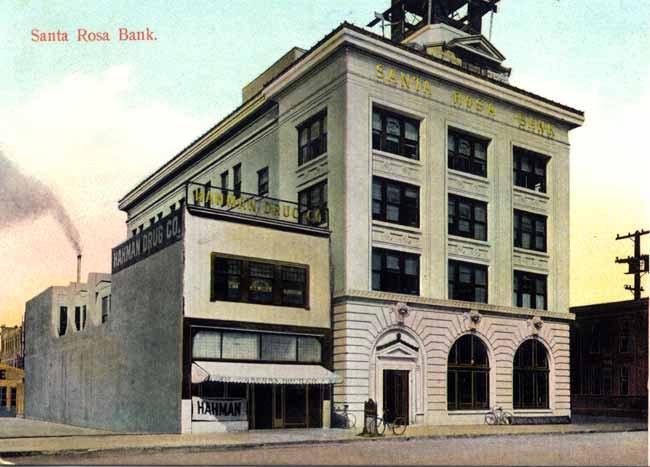
Through newspaper coverage of the many child support lawsuits we know Blitz owned some stocks of iffy value, and in the 1890s his main source of income was an allowance from his mother. Prior to his 1900 marriage he was named president of the Santa Rosa Bank co-founded by his father (despite having no apparent experience in banking) where his salary was $175/mo - a good executive salary for the day, but hardly enough to underwrite a mansion.
And soon after they were married, Blitz was spending like never before. He purchased four lots on the corner of Carrillo street and Healdsburg avenue (later renamed Mendocino ave.) and bought a sideboard of carved Flemish oak imported from Italy. It cost $750, which was worth nearly two years' income for the average American household.
Now all he needed was a house for his Italian sideboard and young family. "Plans are being prepared for the residence by a San Francisco architect," the PD mentioned a few months later, in March 1901. The paper had it half-right; the home was being designed by a former San Francisco architect who had lately returned to his childhood hometown of Petaluma. His name was Brainerd Jones.
 |
| "Illustrated Portfolio of Santa Rosa and Vicinity," 1909 |
If you were looking for someone to design your showy, damn-the-cost mansion in 1901, Brainerd Jones would probably be your last choice; the 30 year-old architect had a thin résumé and non-existent portfolio.
Jones had no formal training aside from basic drafting classes; his experience consisted of some carpentry work and apprenticeship with the MacDougall Brothers firm, which mostly churned out undistinguished designs for banks, municipal buildings and such. At the time Blitz hired him apparently the only work produced out of his Petaluma home-office were blueprints for two cottages and a modest house, none of which were yet completed. But he had one great advantage: He came of age as an architect in San Francisco during the 1890s, which was possibly the most exciting time and place in the history of American architecture.
Up to then West Coast architecture imitated what was popular in the East and Midwest, usually with a lag of several years. We built "Colonial Revival" homes of various kinds although our part of the country had no past as a British colony; we copied the mansard roofs of the "Second Empire" style even though France was nearly on the opposite side of the globe. But mainly in Victorian America, we all shared the notion that fine architecture had to be "picturesque" in some way. That often meant some kinds of ornamentation and led to the great popularity of the "Queen Anne" style, with elaborate finish work, faux details, witch-hat turrets and the like.
A few high-end architects in the Northeast were headed in the opposite direction, however, designing mansion-sized homes in a style devoid of most decoration and meant to look naturalistic. Later dubbed "Shingle Style," these houses were broader than tall, with strong horizontal lines. There was more window space than ever used before and there were open interiors, which transformed hallways and vestibules from places you pass through into spaces where you live. It was absolutely radical architecture in the 1870s-1880s (and some of it looks pretty modernistic even today) but it quickly faded in the wake of a renewed interest in classicism. It left a mark, however, as elements began to show up in Queen Anne designs, and it led directly to the "Craftsman Style" and "Prairie Style" of architects like Frank Lloyd Wright. (For more background, see my history of the East Coast Shingle Style, "Behind the Design" with illustrations and footnotes.)
As the scene was fading on the East Coast, a few mavericks who had worked for the firms most associated with Shingle Style moved to San Francisco (in Richard Longstreth's excellent "On the Edge of the World" there's a fun picture of many of them getting drunk together in 1890). They had been thoroughly radicalized by their exposure to those new artistic ideas and were not shy about expressing their opinions on the sorry state of architecture. Classicism was boring and designing something in that style was little more than an exercise in draftsmanship; the ultra-popular Queen Anne houses were "architectural monstrosities." As San Francisco was then jammed with Queen Annes - each of them competing to be more adorable and whimsical than the Queen Anne next door - these guys were in no danger of being overwhelmed with work from the city's hoi polloi.
Whenever they had a pliable client they designed buildings based on the principles of the East Coast Shingle Style but took it even further. Because the San Francisco Bay Area weather was so much milder than the Northeast, a house could be more harmonious with its setting by incorporating the outdoors into living areas. Local materials - particularly western cedar shingles and old growth redwood - were abundant and of such quality they didn't have to be painted or varnished for protection. And they placed high value on craftsmanship, insisting it should be on display and not hidden away - after all, a building should be constructed as carefully as if it were a piece of fine furniture. Much later, their kind of architecture was named the "First Bay Tradition."
(Begin opinion rant: I hate this term because it's used to lend credibility to claims a "Second Bay Tradition" grew from it around the 1930s. In my view there's hardly any connection either architecturally or philosophically; the latter was just early California Modernism and not even that closely linked to the region, except for its continued use of redwood.)
For an apprentice architect like twenty-something Brainerd Jones, 1890s San Francisco was a heady clime. We don't know if he actually bumped elbows with any of the rebel architects but it really doesn't matter; their new kind of architecture one of the hottest topics to discuss (read: argue about) in local magazines dedicated to the arts. Jones obviously knew what they were building and liked it, as he used his big commission to make a bold statement in their style.
The Paxton House was a deconstruction of a well-known example of the new West Coast Shingle Style: The Anna Head School for Girls in Berkeley. A few years later, Jones would again fold other elements into the design of Comstock House.
"Anna Head" was a famous day/boarding school for young women and this building was completed in 1892, one of the earliest major projects in the style. It was designed by Soule Edgar Fisher, a local architect who fell in with the East Coast firebrands (he's in the drinking photo mentioned above). Amazingly, the building still exists - albeit in poor condition; it's on Channing Way and now part of UC/Berkeley. A modern photo shows it has been altered somewhat and is partially concealed by ivy.


The first thing to notice is they have the same massing - a wider than usual building with a heavy roof. This view of the Paxton House clips off the southern end, but in other images below it can be seen there was a significant gabled extension projecting out from the main building. Although the face of both buildings is anything but flat, they share deep eaves and a second floor slight overhang which creates a shadow to emphasize the horizontal lines. Both used decorative corbels to lend an illusion of support for projecting walls.
Even if all the similarities were coincidental, they shared an unusual design for the entrances, with the front door recessed several feet and steps coming up sideways, from the left. The porch landing is concealed by a parapet, and we know from the family photos the Paxtons used this as part of their main outdoor living area.
Both buildings harkened back more to the original Eastern Shingle Style of the 1880s than the newer, anti-Queen Anne designs. The front face (and possibly the original sides and back) of the school was shingled with white cedar so it would age to gray, just like the mansions in the Northeast. We don't know if the Paxton House had those shipped in or used the cheap, easily-available brown cedar from the Pacific Northwest, but Jones did specify that Comstock House was to be shingled with the white variety. (It wasn't originally, but when we reshingled in 2010 we used white cedar for the walls and brown cedar for the roof.) Both also had decorative Queen Anne touches; look closely at the modern photo of Anna Head and note there are diamond-shaped shingle medallions on the walls. Jones reinterpreted the cross gable next to the massive chimney as a Queen Anne turret.
Brainerd Jones' interpretation added two features that would have been met with high approval by the new wave architects. He extended the landing into a porch room enclosed on three sides, which another family photo shows the Paxtons enjoying. Jones also changed the cross gable to the right of the door into a gable with a massive bank of windows. Presumably this was the reception room that dropped the jaws of visitors.
For Jones his design was an artistic statement but not a manifesto. For the rest of his life he worked within whatever style pleased his client; the same time Paxton House was under construction they were also building his design for the Lumsden House (now the Belvedere) next door, and that is a completely unremarkable Queen Anne.
Two years later Jones revisited his ideas with the contract to design (the home that would become known as) Comstock House. Mattie and Wyatt Oates might even have suggested he mirror the home of their best friends, two doors down; they certainly must have made a striking pair, even with the unremarkable Davis House sandwiched between.
With Comstock House Jones again borrowed from the Anna Head School, this time adapting its gambrel roof and real cross gable. He also copied exactly the Tudor-style row of lead glass casement windows with diamond panes, all under a prominent second floor overhang. He borrowed the use of small dormer windows popping out of the roof and reinterpreted the oriel and bay windows on a larger scale - Comstock House has four bays, each over ten feet wide. What Jones' design for the Oates did not have was a speck of Queen Anne influence, even lacking the herringbone shingle work used as trim on the school and Paxton House.
So now we come to the painful part of the story: What happened to Brainerd Jones' masterpiece?
"There used to be a house just like yours on the corner," a long-time resident of our neighborhood told us shortly after we moved into Comstock House. "Except it was bigger."
Bigger was right. Although the building is gone, its footprint can be seen on the old fire maps. Guesstimating from the irregular shape, Paxton House was between 6,500 and 7,000 square feet - and that's not even counting whatever was above the second floor.
But what happened to it? Strangely, nobody recalled. There was no memory of it being torn down or catching fire, although many people remembered it well: "I used to bicycle around the U-shaped driveway in the '60s," a woman told me. "I walked past it every day when I was going to school," someone else remembered. "It was such a pretty house." Some thought it might have been destroyed by the 1969 earthquake(s) and that seemed to be as good an answer as anything else. The mystery deepened after I visited the Building Department and found there was no demolition permit issued for 747 Mendocino avenue; it was as if the place really had been spirited away overnight.
From the newspapers it was known the Paxtons sold the house in 1920 to the Slusser family, who passed it on to their daughter. (Blitz and Jane stayed in the area for about a dozen years before retiring in Los Angeles.) I could have traced ownership beyond that through a title search but there didn't seem to be any point as long as there was no record of demolition.
The only remaining lead was that the address used to be 739 Mendocino avenue instead of 747. I had asked about this on my visit to the city office, but was told the records should be linked as long as the property was not subdivided since. This time I returned and asked directly for #739. After a bit the clerk returned with a single sheet of microfiche - and there was the whole sad story. The house was demolished in 1969 alright, but not because of damage from the October 1 quake.
In January, the city building inspector posted a notice of hazardous conditions and ordered PG&E to shut off power, stating "the building was in very poor condition...making it unsafe for occupancy." Santa Rosa sent the owner a letter declaring the home a public nuisance, listing four reasons:
1. Abandonment and lack of maintenance
2. Obsolescence, dilapidated condition, deterioration, damage and decay
3. Faulty wiring
4. Unsafe venting of gas appliances
The following month it was an item on the City Council agenda and the owner given thirty days for abatement. In June, the city sent a notice that since no abatement work was done, demolition was ordered. The building was torn down on June 30 with the owner billed $1,600.
So the magnificent building was just left to fall to ruin - there was nothing in the records showing the man who owned it corresponded with the city about making efforts at repair or even attended the times it came before the Council. He just walked away from it.
That owner was Ted Snyder. He was among the county's movers 'n' shakers in those days, living near the Santa Rosa Country Club and president in the 1960s of the Healdsburg Chamber of Commerce, the county chambers of commerce association, the Healdsburg Republican Club, head of the Knights of Columbus and probably active in even more clubs and civic groups the newspapers didn't mention. For awhile in the early part of the decade he was co-owner of an important sawmill near Healdsburg but that was liquidated; later he identified himself as a real estate broker, but it's not clear he was ever associated with an established realty office or even had a license.
It would be easy to blame Snyder alone for the destruction of this gem because he apparently did nothing at all to save it. But the real burden of shame lies on the city of Santa Rosa, who gave this grand structure no more consideration that it would a dilapidated backyard shack.
The City Council considered no other options. No architect or historian was sought to report upon such a major building's significance; it was enough that Senior Inspector G. R. Martin deemed it obsolete. From today's perspective, that might well be deemed irresponsible.
In a better world the Council could have required Snyder to simply provide an abatement plan ("unsafe venting of gas appliances," really?) or with his continued failure to respond, even used powers of eminent domain for the city to take it over and restore it to code for use as municipal offices or something. Aside from "faulty wiring" it does not appear the building was in irreparable shape - and it's safe to bet that just meant it still had knob-and-tube wiring, which remains perfectly safe as long as it isn't tampered with.
But that was the late 1960s - early 1970s, which for historic architecture preservation was the darkest of the Dark Ages. That Snyder did nothing and the city did nothing and the grand house which was laid to waste is merely part of an indictment of that era, which witnessed so much of America's heritage demolished in the name of redevelopment and urban renewal. It was a modern age and time to clear out the old and make way for the new, which was always better because. In this case, however, it wasn't just any nondescript house - it was something uniquely historical and still beautiful. It could have long remained our city's jewel, had anyone in the city cared.
 |
| Detail of front view of Paxton House 1910 |
 |
| Rear view of Paxton House, 1910 |
 |
| Southern view of Paxton House, 1910 |
 |
| Blitz Paxton and Blitz Jr. 1902 |
 |
| Jane, Blitz Jr. and Marshall Paxton, 1904 |
 |
| Blitz Paxton and two unidentified women, 1910 |
Blitz W. Paxton has leased the residence of Mr. and Mrs. D. B. Hart on Mendocino street and will soon occupy the same. Mr. and Mrs. Hart expect to travel extensively during the present summer.
- Press Democrat, June 2 1900
Quiet Wedding Saturday
A wedding of considerable interest to Santa Rosans and to Sonoma county people occurred on Saturday in San Francisco at the bride’s residence on Washington street. The contracting parties were Mrs. Jennie Bates and Blitz W. Paxton, the well known president of the Santa Rosa Bank. The hour of the ceremony was half past 12 o'clock. Relatives and friends witnessed the ceremony, which was a pretty one. The Rev. William Martin, pastor of the First Presbyterian church of this city, was the officiating clergyman. An elaborate wedding breakfast was served. When Mr. and Mrs. Paxton return to this city they will reside for the present at the Hart residence on Mendocino street which Mr. Paxton has leased. Their wide circle of friends extend congratulations. Mrs. Paxton is a member of a prominent Sonoma county pioneer family and was formerly Miss Jennie Marshall of Petaluma. Mr. Paxton is the son of Mrs. Paxton of Healdsburg and for years has been prominently identified in banking and commercial circles in this state. Their friends here are glad that they have decided to make the City of Roses their future home and will accord them a welcome when they arrive.
- Press Democrat, June 6 1900
Blitz Paxton's home in Santa Rosa will shortly be adorned with a magnificent
sideboard of carved Flemish oak. The sideboard is one of the handsomest that has ever been seen on this coast, and comes direct from Italy. It cost Paxton $750.
- San Francisco Call, November 5, 1900
To Build a Handsome Home
In the near future another handsome residence will adorn the pretty suburbs of Santa Rosa. President Blitz W. Paxton of the Santa Rosa Bank has purchased a large lot adjoining that occupied by the Walter E. Davis residence on Healdsburg avenue, located on the corner of the avenue and Carrillo street. Plans are being prepared for the residence by a San Francisco architect.
- Press Democrat, March 14 1901
W. H. Lumsden has purchased a lot from Frank P. Doyle on the southwest corner of Mendocino and Carrillo streets upon which he will shortly erect a neat residence. The sale was made through the real estate agency of Davis & Crane.
- Press Democrat, March 22 1901
The palatial residences being built on Healdsburg avenue and Carrillo streets by Blitz Paxton and William H. Lumsden are nearing completion. Both houses are fine ornaments to the residence portion of the City of Roses.
- Press Democrat, November 12 1901
The plasterers have very nearly completed their work upon the handsome new residence of W. H. Lumsden on Carrillo street. Bagley & Bagley were the sub-contractors for this part of the work
- Press Democrat, December 13 1901
Blitz W. Paxton has just finished his costly and elegant home on Healdsburg avenue with the help of Contractor Kuykendall. This is an elegant mansion and a big improvement to the city. Just across Carrillo street from the Paxton mansion is the large ten thousand dollar home of W. H. Lumsden. which with the Paxton home are the handsomest dwellings built in Sonoma county this year. Simpson & Roberts has the contract for Mr. Lumsden’s house.
- Press Democrat, February 2 1902
A BRILLIANT EVENT MANY GUESTS AT THE MAGNIFICENT PAXTON RESIDENCE WEDNESDAY NIGHTReception Held by Mrs. Paxton and Mrs. Marshall Waa Amid a Scene of Radiant Beauty
One of the most brilliant social functions ever given in the “City of Roses” was the reception at the Paxton mansion on Healdsburg avenue on Wednesday night for which several hundred invitations were sent out by Mrs. Blitz Wright Paxton and her mother. Mrs. Marshall.
The hours of the reception were from eight to eleven. During the hours there was a constant stream of guests passing through the handsomely decorated hails and reception rooms to greet the hostesses and to mingle socially. From the balcony on the broad staircase the strains of sweet music mingled with the sweetest perfume from the honeysuckle, the carnations and the roses, which burdened the air delightfully.
For the giving of a function like the one that charmed everybody on Wednesday night the magnificent home is ideal, as the spacious apartments and halls being well adapted for receiving so many guests. Then, again, the handsome and costly furnishings add much to the effect of everything.
During the reception the scene was one of much brilliancy. Many elaborate evening gowns were worn by the ladies. The light from a myriad of electric globes through silken shades shone softly on the gay throng. Exquisite taste was displayed in the adornment of the house from top to bottom. Pink and green were predominant colors. The always graceful bamboo radiated from the arches and nooks in halls and reception rooms, while here and there beautiful rose clusters and banks of pink honeysuckle were arranged in perfect keeping with the decoration scheme. The great showy blossoms displayed their magnificence of color to perfection. The festoons were entwined in soft greenery and the decorations were greatly admired.
The entertainment provided by the hostesses could not have been more lavish or more graciously extended. In fact nothing could possibly have added to the pleasure of the evening. In one room, transformed into a radiant bower, delicious punch' was served by a bevy of charming girls.
Master Marshall Paxton, wearing a neat suit of white, received the cards of the guests on a silver tray. Mrs. Paxton and Mrs. Marshall were assisted in receiving by Mrs. James W. Oates, Mrs. Samuel K. Dougherty. Mrs. William Finlaw and Mrs. William Martin. The young ladies who assisted in serving were the Misses Martha Hahman, Bess Riley, Bess Goodwin, Marie Farmer, Jimmie Robertson, Mab McDonald, Jessie Robertson, Edith McDonald, Zana Taylor, Ella Holmes, Bessie Porter and Miss Edith Lewis of Petaluma.
The elaborate supper, in which the art of the competent chefs from the metropolis was exemplified, was served in the dining room. The room was adorned in pink and green. The dellicates were served at daintily arranged tables. Herbert Vanderhoof’s orchestra supplied the music during the reception. The guests were delighted with everything and the event will long remain memorable in Santa Rosa’s social world. In addition to the people present from this city a number of invitations were sent to other cities and the out of town guests were present.
- Press Democrat, June 11 1903
BRILLIANT AT HOMEElaborate Social Function at the B. W. Paxton ResidenceMrs. Paxton and her Mother, Mrs. Mary E. Marshall, Held a Reception Wednesday Evening -- Elegance Never Surpassed in this City.
Never was there a more brilliant social function given in this city than the reception at the handsome Blitz Wright Paxton home on Healdsburg avenue Wednesday evening. The hostesses were Mrs. Paxton and her mother, Mrs. Mary E. Marshall, and the hours for the reception were between 8 and 11 o'clock. The guests, several hundred in number, passed and repassed in a constant and brilliant stream through the spacious reception rooms during this period.
Combined with the elegance and varied beauty of the costumes worn by the feminine portion of the company and the soft brilliancy of the electrical effects, was the beauty of the home furnishings, the whole enhanced by floral decorations, the most perfect that nature could produce and art devise. Pink and green were the dominant shades, both in the floral adornment and in the electrical tints. Fragrant azaleas and honeysuckle, carnation and roses entered into the decorations with exquisite effect and the graceful bamboo formed an artistic background, its drooping ends bending from doorway and arch. From fern and floral bower of marvelous beauty on the balcony above the reception hall, the softest music floated. Thus were all the senses charmed music, fragrance and artistic beauty being combined. The music was furnished by Vanderhoof's orchestra.
The entertainment provided was most elaborate. In one room a company of daintily gowned young girls presided over the punch bowl. The supper room was magnificently appointed and the repast was a triumph of the caterer's art. Chefs and caterers from the metropolis had the affair in charge and the refreshments were served at dainty tables.
Assisting Mrs. Paxton and Mrs. Marshall in the reception of the guests were Mrs. Samuel K. Dougherty, Mrs. James Wyatt Oates...
...Mrs. Paxton's costume was of white brocade satin covered with an overdress of most exquisite hand lace. The corsage was low and to the skirt was attached a court train. Her hair was dressed becomingly high and adorned with an aigette [a feathered headdress]. Her ornaments were diamonds, many and brilliant. Mrs. Marshall was costumed in black satin, with an overdress of gauze. A train also finished her gown and her corsage was slightly low at the neck [and] like her daughter her ornaments were diamonds.
- Santa Rosa Republican, June 11 1903
Real Estate TransfersBlitz W Paxton to Jane M Paxton: Oct 4, ’01, Lots 4, 5, 6, S 30 ft Lot 3, Walter S Davis' Add to Santa Rosa; $3500
- Press Democrat, December 31, 1904
THE PAXTON TEA A BRILLIANT AFFAIRNEARLY THREE HUNDRED GUESTS CALL TO MEET MISS ANNA MAY BELL OF VISALIAElegant Paxton Home on Healdsburg Avenue Transformed Into a Veritable Bower of Beauty
The elegant Paxton home on Healdsburg Avenue was the scene of a brilliant reception Thursday afternoon in honor of Miss Anna May Bell of Visalia. Almost three hundred guests called between three and six o'clock to meet the popular girl in whose honor the affair was given.
Miss Bell is a relative of Col. and Mrs. James W. Oates of this city. She has spent much of the present summer here, where she has many friends. She is a charming girl with friendly, cordial manners that make her a great favorite wherever she goes and the reception of Thursday afternoon was one of the most successful of a large number of functions that have been planned in her honor this summer.
The house was a veritable bower of beauty. The decorations were entirely pink. The reception hall and parlors were decorated with La France and Duchesse roses and amaryllis blossoms. The dining room was fragrant with great clusters of beautiful pink carnations attractively arranged and placed where they showed to advantage. Master Marshall Paxton stood in the doorway and ushered the guests into the reception hall, where they were received by Mrs. Blitz Wright Paxton, the hostess, assisted by Mrs. J. W. Oates, Mrs. T. J. Geary, Mrs. M. H. Dignan, Mrs. Wm Martin, Mrs. Mark McDonald, Mrs. Frank Doyle, and Mrs. James Edwards. Mrs. Paxton looked charming in a handsome silk gown trimmed with heavy pearl lace. Miss Bess Riley, Miss Jessie Robertson, Miss Zana Taylor, and Miss Bessie Porter served ices and cakes in the beautifully decorated dining room. Music was furnished during the afternoon by C. Mortimer Chapin and Mrs. Berry.
- Press Democrat, September 15, 1905
All was quiet that midsummer evening in 1912 Santa Rosa, except for two dozen guys trashing the Chinese neighborhood on Second street.
The men were not thugs from a San Francisco Chinese crime gang, although just a few months earlier the community here worried that a Tong war underway in the city would escalate and draw "highbinder" assassins to Santa Rosa. Nor was the havoc caused by a mob of local drunks looking for trouble. Descending on Second street that night was an official posse of lawmen and sworn citizens conducting the first opium raid in Santa Rosa.
 (RIGHT: 1908 Sanborn map section showing Santa Rosa's Chinatown highlighted in blue)
A lengthy account of the raid appeared in the Press Democrat (transcribed below) and offers a glimpse of the small Chinatown near the intersection of Second and D streets, rare because it was never mentioned in the local newspapers except for occasional calls for it to be torn down and replaced with a park, hospital or something Burbank-related.
The excuse for terrorizing the community and ransacking their homes was the new law outlawing opium use in California - apparently the first time personal possession of drugs or drug paraphernalia was criminalized in U. S. history. The law was passed in 1909 and appealed up to the state Supreme Court, where it was upheld in 1911. Shortly after that Chinatown raids began in larger cities across the state. The posse raid in Santa Rosa was coordinated to start jointly with raids in Sebastopol and Petaluma Chinatowns.
Even though opium possession was only a misdemeanor subject to a $100 fine the posse gave no quarter in their quest, frisking the residents and tearing into everything they found. From the Press Democrat account, "Some half dozen places were entered, doors were locked and the Chinese occupants quickly herded into one room, and then the search began. Boxes, drawers, sacks, tins, paper packages, clothing, beds, and in short everything was overhauled and a thorough search made. Doors that were locked and for which keys were not delivered up at once, were burst open. So were trunks and boxes...pretty much of a litter remained after the officers had done their work."
The incident also revealed no improvement in anti-Chinese bigotry; the PD article ran through all its old racial epithets - "Celestials" being the kindest of them - but the most loathsome comment in the paper was this: "They all gave some kind of a name. There were Chows, Gows, Ons, Gees, Sams, Harrys and goodness knows what else. For all the officers knew some of those names may have been aliases, too. No one cared particularly anyway. The names all sounded alike."
The reporter further added his/her pissy little judgements of their lifestyle: They "do not smoke very good tobacco," smells in some bottles "were not over-appetizing" and "the lard in preparing the evening meal had not been of the freshest variety." In fact, many in the posse may have been there just to snoop and later snark about the quality of Chinese lard or such; while the party included every active and retired cop in town, other members had no apparent reason to be involved, including State Senator Herb Slater, undertaker Frank Welti and 20 year-olds Arley Gard and Ernest Clay.
In truth, the purpose of the whole business - from the federal import ban also enacted in 1909 down to the raids after 1911 - was meant to harass the Chinese community. The import ban only affected the smoking form of opium favored by Chinese - the opium-based "nerve tonics" predominantly used by whites were still legal.
Smuggling the four-ounce cans over from China proved easy; in her oral history with Gaye LeBaron, Song Wong Bourbeau (born 1909 in Santa Rosa) recalled "they ship them over just like you would ship a dozen eggs." All the ban accomplished was to quickly drive up the price tenfold; by 1912 a night's smoke cost around seven dollars, roughly half a working man's weekly wage and a couple of years later it would double again (MORE). To his credit, former U.S. Congressman from Santa Rosa Duncan McKinlay proposed to tax opium at $5 per pound, believing it was impossible to stop the smuggling trade.
Nor did the Santa Rosa police care about opium smoking before the new law made arrests so lucrative - although they did intervene when white youth were found using the drug, as shown in an example here. And while Santa Rosa had raided Chinatown before, then it was for gambling; in 1910 a series of raids busted Chinese men for playing stud poker (a charge which must have caused guffaws at card tables in saloons and fraternal clubs around town). But those fines brought in less that $250, while in that single opium posse raid the city cleared over $1,000. So it's no surprise that another posse hit the Santa Rosa opium dens in May 1913, this time making more arrests. Likewise in that search they gave "seven places on Second street...a most thorough overhauling." Because breaking stuff up is just something a posse has to do, as everyone knows.
HIGHBINDER SCARE IN SANTA ROSA CHINATOWN LAST NIGHT
Santa Rosa's Chinatown on Second street between Main and D streets was pretty badly scared Wednesday night. Talk of "Highbinder" was in the air, following the receiving of a telephone message from "My flen in Napa" by Wong Mow, one of the local Chinese merchants.
The word was passed around like wildfire. Chinese pickets were stationed here and there on the lookout app along the block in front of the Mongolian quartets, and Chief of Police Boyes was notified. The Chief instructed the patrolmen on the meats to make frequent visits during the night to Chinatown.
The message received by Wong Mow about half past 7 o'clock word that a party of Chinese highbinders from the warring companies in San Francisco were headed for Santa Rosa and were of the number who shot and killed a man in Marysville. The news was sufficient to put Chinatown all on the lookout.
At one o'clock this morning a Press Democrat representative visited Chinatown. The "lookouts" were still on duty. They were crouching down in the darkness of the shadow of buildings ready to sound an alarm...
...There are many San Francisco Chinese taking refuge here at the present time. A dozen queueless ones arrived here Wednesday night. They have been drifting in for a week...
- Press Democrat, March 21, 1912
STILL IN FEAR OF HIGHBINDERSCelestials in Local Chinatown Perturbed Over News of Tong Slayings in Other Places
The excitement in Santa Rosa's Chinatown following the highbinder murders in other cities was increased when the news of the slaying was told there yesterday, and last night the "lookouts" were still on duty. The local Celestials fear that the bad men may visit here.
The casual passerby along the block on Second street occupied by the Chinese quarters last night would not have noticed anything out of the ordinary except for the lookouts crouching in the dark shadow of some building. But the advent of a reporter or policeman known to some of the Chinese merchants was sufficient to draw a crowd of Chinese eager to learn if any news of the approach of the highbinders was forthcoming...
- Press Democrat, March 23, 1912
QUONG SING PROUD MAN ON SATURDAY
Quong Sing, the local merchant, was a happy man on Saturday, when he paraded at the head of the New Cathay Boys' Band from San Francisco. This band is composed of thirty-seven young Chinese who rendered some splendid selections during their march through the streets. These lads have only been playing five months, but they handle their instruments and their music like seasoned veterans. In the band are two lads of eight and nine years, who play the alto horns. Quong Sing is proud of the new China and the boys who were here on Saturday. He was instrumental in bringing the band to this city.
- Santa Rosa Republican, May 4, 1912
POSSES RAID CHINATOWN AND SEVEN ARRESTS MADERaids Also Made in Petaluma and SebastopolMore Arrests in Petaluma and Sebastopol--Opium and Yen She Found and a Number of Outfits on Wednesday Night
There was considerable excitement, quiet excitement at that, in Santa Rosa's Chinatown Wednesday night. The same can be said of the Chinatown of Sebastopol and that at Petaluma, for in all three places raids were made for opium, yen she and smoking outfits. In all three places both drugs, a number of pipes, hoy toys and other contrabrand articles were unearthed. Five Chinamen, a Chinese woman, and a white man were arrested and landed in jail by the officers, and their cases will come up for hearing in Justice Atchinson's court. One man was arrested in Sebastopol, and shortly before twelve o'clock he joined the motley crew behind the bars. Four arrests were made in Petaluma.
The raid in Santa Rosa's Chinatown, located on Second street, between Main and D streets, was headed by Chief of Police John M. Boyes and the officers of the department and of the Justice court, and special deputies aided by Chief Inspector Fred A. Sutherland of the State Board of Pharmacy of California. Sheriff Jack Smith and his posse, had charge of Sebastopol, and Deputy Sheriff Rasmussen and Chief of Police Ed Husler in Petaluma. Deputy Inspector W. T. White of the State Board aided in Sebastopol and Deputy A. J. McDonald of the State Board aided in Petaluma.
For some time the officers and the chief inspectors of the State Board have been aware of presence of the drug and its use in the Chinese quarters in the places named. The inspectors have obtained evidence, and not long since Chief Inspector Sutherland bought a dollars' worth at one of the places raided on Second street. Consequently the raid was planned for Wednesday night at half past nine o'clock in Santa Rosa, Sebastopol and Petaluma.
On Second street in this city at the word of command given by sign by Chief Boyes, the posse that had previous divided up entered the Chinese quarters very quietly, no one knowing what was about to transpire. Some half dozen places were entered, doors were locked and the Chinese occupants quickly herded into one room, and then the search began. Boxes, drawers, sacks, tins, paper packages, clothing, beds, and in short everything was overhauled and a thorough search made. Doors that were locked and for which keys were not delivered up at once, were burst open. So were trunks and boxes. A number of packages of Yen She, some tins of opium, pipes and smoking outfits and other accessories in the smoking of the weed were discovered by the various posses and were carefully piled up, and later this evidence was taken to the police station.
Then the Chinamen were each given a "frisk," or a search, and taken. At times, this was quite amusing, most of the Celestials taking the bantering in good part. Their language, too, had there been an interpreter present, might have savored of the profane. If it did not then, it will when they come to pack those boxes again and clean house, for pretty much of a litter remained after the officers had done their work. They all gave some kind of a name. There were Chows, Gows,Ons, Gees, Sams, Harrys and goodness knows what else. For all the officers knew some of those names may have been aliases, too. No one cared particularly anyway. The names all sounded alike.
Prior to entering the places the officers had provided themselves with search warrants, but none of the Chinese thought to ask for them, anyway. These warrants were procured so that everything might be legally done. It was after midnight before the raid ended here, the search occurring considerable time. Some of the scents discovered in the places during the overhauling of some of the ancient receptacles were not over-appetizing. More than one of the posse pressed into service can testify to that. Those "Chinks," some of them at any rate, do not smoke very good tobacco, either; and the lard in preparing the evening meal had not been of the freshest variety.
Another thing revealed during the search of several of the Second street "joints," was that the Chinese evidently do not put much faith in banks. A surprising lot of money was unearthed, and left of course. There were stacks of twenties, tens and fives in gold, as well as silver. The money will be put in another safe place by the Chinese today.
Attorney Rolfe L. Thompson will prosecute the offenders, representing the State Board. He was on hand at the raid Wednesday night, and at the police station when the prisoners were brought in.
Tried a Getaway
The white man, captured on a charge of having sold morphine, lives in this city, and has been a frequent habitant of the Chinese quarters. A warrant was in the pocket of Chief Boyes for his arrest, when he suddenly stepped into the very place where the Chief was assisting in the search. Police Officer George Matthews grabbed and handcuffed him. Later he tried a getaway but was captured by Attorney Thompson and Elmer Mobley, and was taken to the jail and locked up by Matthews.
The Santa Rosa posse was composed of Chief of Police Boyes, [21 other men named].
The Sebastopol Raid
As stated Sheriff Smith headed the raid at Sebastopol, and it was conducted along similar lines to the other places. Some Yen She and an opium outfit was taken from the place of Gong Gee. There was no excitement, and but a few Chinese were found at home. The idea prevailed there as here that in some manner the Chinese had got a "tip" as to what was about to happen. In Sheriff Smith's posse were [22 other men named].
Raid in Petaluma
Chief Hussler of Petaluma was assisted in the raid there by [5 other men named]. The net result of their work was the arrest of four Chinese and the capture of a considerable quantity of contraband materials and smoking outfits. Three of the Chinese were locked up and one released on $200 cash bail.
- Press Democrat, August 1, 1912
CHINESE PAY $450 FINESResult of Rain on Opium Dens Wednesday
Ten Chinamen appeared before Justice Atchinson Thursday, charged with having illicit drugs in their possession. This is the catch of the raids in Petaluma, Sebastopol and Santa Rosa, made on Wednesday night by the State Board of Health Inspectors.
The first to appear was Lou Yet of Sebastopol. He entered a plea of guilty and was promutly [sic] fined $100 by Justice Atchinson. The next were four Chinamen from Petaluma. They were considerably incensed over having to be tried here. They chattered and harangued for some time, but were unable to furnish the bail, and three of them were returned to jail to await developments. The other was dismissed. Attorney Gil P. Hall of Petaluma appeared for him on behalf of George P. McNear, explaining that he was only a cook and had just entered the place for a chat.
The five arrested here were promptly arraigned. They had little to say, but appeared to be very distressed. Sam Wo Lung was fined $200 on two charges. Wong Quong was fined $100 and Dock Yen $50 and fifty days in jail. Two others were dismissed for lack of evidence. One was a man and the other a woman. Harry Tong was returned to jail until such time as he could raise the money to pay his fine of $100.
Clint Rickliff, Ed Gautier and Earl Bumbaugh, the three white men captured in the raid on the Chinamen, are to be tried by Justice Atchinson also. These men are all known to be fiends and it is possible they will be sent to some asylum for treatment.
- Santa Rosa Republican, August 1, 1912
THREE LONE CHINAMEN REMAIN NOW
There are three lone Chinamen in the county jail at the present time as the left-overs from the recent opium rains in the county. All the other defendants have had their cases disposed of and something over $1,000 has been paid in fines. One of the Chinamen will serve 200 days in jail and the two others are in for one hundred days each. They will have to go a long time without their smokes.
- Press Democrat, August 8, 1912
OPIUM SMOKER IS CAPTUREDOfficers Gard and Ragain Arrest Sam Wo Lung While Engaged in Enjoyable Smoke
Officers Gard and Ragain made a very clever capture of an opium smoker and his entire outfit, including the yen shee, which he was heating on his needle preparatory to taking a smoke at 2 o'clock Thursday morning.
The victim of the raid was Sam Wo Lung, who was recently acquitted of having opium in his possession when captured in the last raid conducted under the direction of the State Board of Health. He is considered one of the leaders here and his capture with the goods on him is considered quite a victory for the officers.
When searched at the police station it was found that Sam Wo Lung was well provided with ready cash and he put up $100 cash bond with proper grace and returned to his place, 620 Second street, minus his pipe and outfit. A charge will be placed against him under the State law in Justice Atchinson's court.
- Press Democrat, October 16, 1912
CHINESE GAMBLERS CAUGHT IN A RAIDPolice Visit Doon Kee's Place Thursday Morning and Capture Six Visitors Playing American Game With the Stakes
Police Officers N. G. Yeager, A. G. Miller and G. W. Matthews made a raid on Doon Kee's place on Second street this morning about 2 o'clock and arrested nine Chinese found in the room. Six of the number were engaged in playing Studhorse porker [sic] and were greatly surprised at the interruption.
Officer Matthews was the first to reach the table and secured the cards and stakes, while Officer Miller secured the Chinese money being used for chips. All in the room were taken to police headquarters. Several denied they were playing, but none would say who the players were, so all were informed tht they would have to put up a cash deposit of $10 each to secure their liberty.
Doon Kee arrived on the scene, and after some parleying, secured the name of those who were not playing and they were immediately released while $10 cash bail was put up for each of the other six by Doon Kee.
The six charged with gambling were Ah Wong, Ah Ching, Ah Sing, Wong Kim, Sam Kee and Moon Kee.
- Press Democrat, December 1, 1910
ARREST CHINESE FOR GAMBLINGOfficers Make Third Raid Early Tuesday Morning and Gather in Fifteen Orientals
In their third raid upon the Chinese gamblers the police shortly after 2 o'clock this morning arresting 14 inmates of Doon Kee's gambling house. Last Thursday morning at about the same hour 12 Chinese were arrested and later six were fined $10 each for gambling.
Three of the same men were caught this morning and in their case $20 cash bail was demanded, while the other 11 were allowed their release upon $10 cash bail. A woman will also be charged with being in the place, making a total of $180 bail pending their hearing.
- Press Democrat, December 6, 1910
CHINESE CONTRIBUTE TO THE DISTRICT FAIR
Charlie Quong Sing, the pioneer Chinese merchant of Santa Rosa, whose smile and "Nice day, eh?" and "Anything new?" (the latter when he meets a newspaperman) have become regular salutations of everyday life in Santa Rosa, called at the Chamber of Commerce rooms on Wednesday and handed in a donation of two dollars and a half for the district fair.
He counseled Director Walter Price to tell Mr. Dunbar and the committee to call around at the place on Second street a day or two before the fair starts and he will go around with them among "the boys" and they will contribute more money to help the fair along.
- Press Democrat, August 7, 1913