They were an odd couple, yet clearly devoted to each other. She had poise and grace, the embodiment of Victorian America gentility. He presented Southern courtliness if you were on his good side, but woe to anyone who rubbed his thin skin the wrong way. She was around six feet tall, towering over other local women in her only verified photograph. Besides being short-tempered he was also just short, five feet, seven and five-eights inches, and that probably counted the lift gained from the elevator shoes drawn in a caricature. She was Mattie Solomon Oates; he was husband James Wyatt Oates. In 1914 she died and afterwards he fell apart like a building that lost its cornerstone.
Mattie and Wyatt had no children; her legacy is (the home that would become known as) Comstock House and the Saturday Afternoon Club building down the street, where she was chairman of the building committee. Both were examples of the nascent Arts & Crafts movement and were bookends to the magnificent Paxton House that lay between them. Never again would architect Brainerd Jones have such a free hand to create not one but three buildings close together, while making an artistic statement using a cutting-edge style.
Much has already been written here about Mattie; all that's left to do is tie her story together, while daubing in missing details about her early life and death.
Mattie was born in San Francisco September 11, 1858. Her father was Perrin L. Solomon, a Mexican War veteran and U.S. Marshall for the Northern District of California until he was removed from office in 1861, presumably because of Confederate sympathies. He died when Mattie was six; the only sibling who lived past infancy was sister Mary ("Fannie") who died when Mattie was ten, and she kept a watercolor of Fannie the rest of her life. Her widowed mother lived with Mattie for 46 years until she died in 1910. (More about the family.)
Her lengthy obituary in the Santa Rosa Republican (transcribed below) is to be trusted; Wyatt was the publisher of that paper until shortly before she died. In her debutante years she was a "member of the naval social set in San Francisco" as well as a "member of the old southern set," despite having never lived outside of San Francisco. The obit states Mattie was introduced to Wyatt by John B. Milton, a young naval officer; Mattie in turn introduced Milton to the woman he would marry. The Miltons and Oates remained close as John rose to admiral and he was a pallbearer at Mattie's funeral.
There must have been considerable romantic intrigue beneath those dry facts, however; it appears Mattie was engaged to another guy when she met Wyatt in 1880.
In 1880 Wyatt was moving back and forth between San Francisco and Tucson, Arizona where he had a legal practice. In August of that year an item appeared in the Bay Area papers announcing Mattie's engagement to Navy Lt. Emeric. Shift forward three months to the huge society wedding of her close friend Anna McMullin. Several papers listed all the guests and both Mattie and Wyatt were there - but no Lieutenant Emeric. (Guests were listed alphabetically, so we don't know if Mattie and Wyatt were together.) A few weeks later, in mid-December, an announcement appeared in Arizona and local newspapers that she was now engaged to James Wyatt Oates. They married August 11, 1881 and moved to Santa Rosa, where Wyatt was a law partner with a man he knew from college.
In Santa Rosa, Mattie was defined by she did - and particularly what she did not. The Oates' were never part of the McDonald avenue clique (although Mr. and Mrs. Mark McDonald Jr. were good friends), living among the professional class in the Cherry street neighborhood before Comstock House was built. The town had dozens of "ladies' clubs" where women got together to gossip over cards; she belonged only to a single card group which included husbands and the Saturday Afternoon Club, with its focus on the intellectual life. In 1907 she made a witty presentation on “The Laws of California as related to Women and Children” the Press Democrat printed in full. Wyatt probably had a hand in writing some of it, but her character shines through.
She had a mentoring relationship with several young women, some of whom lived with the Oates' for months on end; among those were Addie Murphy, daughter of the president of the First National Bank in San Francisco, and particularly Anna May Bell, who was treated like their godchild and ended up inheriting much of Mattie and Wyatt's estate. For these protégées Mattie threw lavish parties and her friends did likewise. While Santa Rosa was still recovering from the 1906 earthquake, she and her neighbor Jane Paxton hosted the first post-disaster galas in honor of Anna May's clockwork-like summer visit.
The Oates seemingly had few friends their own age except those who were parents of Mattie's youthful crowd. In 1903 some young men formed a dancing club called "The Bunch," renting lodge halls around town for monthly dances. From the beginning Mattie was listed as a "patroness" for the events, which presumably can be translated as, "the chaperone who paid for almost everything." Attending these dances were the same twenty-somethings who came to Mattie's protégée parties plus young marrieds, such as Mr. Shirley Burris and his wife and Florence Edwards with husband James. Shirley was the owner of an auto dealership and the recreational driving buddy of Wyatt; the Edwards became among the Oates' closest friends.
 (RIGHT: Mattie Oates and Brainerd Jones, detail from photo of the 1908 ground-breaking for the Saturday Afternoon Club (full image)
She became a semi-invalid after her first heart attack in 1911 and her death certificate would later date the beginning of her illness to that year and name the cause as “dilitation of heart” – an old-fashioned name for enlarged heart (cardiomegaly). From that point on it was a prolonged deathwatch. What few mentions of her in the society columns over the next few years usually concerned her failing health. The last time she held a dinner party at her home was in August, 1913. Predictably, it was in honor of Anna May, now married with a small daughter.
Mattie Oates died at home July 25, 1914, age 55. Besides the lengthy obit in the Republican, the Press Democrat columnist wrote an unusual personal tribute: "Mrs. Oates was a very beautiful woman and I never will forget the first time I saw her. It was many, many years ago when I was a small, impressionable girl. I was sitting on our front steps and out of a carriage that drove up before the house stepped Mrs. Oates. Never will I forget the vision of loveliness she was that day. Despite the soft trailing satin gown she wore and the dainty gloves, she stopped to make friends with me and my remembrance is that a very dirty little specimen, I was that day, for I had been busily engaged in the mysteries of mud pie making...Through her last long and trying iilness she fought bravely and cheerfully. Even to the last her thought was those dear to her and to them continually tried to speak words of encouragement."
Her coffin was placed in the holding vault at the Rural Cemetery, where it would remain until after Wyatt died seventeen months later, still lost in melancholy and likely more than a little mad. At his deathbed request both their bodies - along with the previously buried remains of all her relatives - were cremated together with their ashes thrown to the winds.
Mattie's presence is still felt in Comstock House; the seven-foot clawfoot tub reminds us of her tallness, as does the unusually high bathroom mirror. And sometimes in the back hall at night, in autumn when the house is very quiet, the drafts swirling from upstairs carry the faintest scent of something floral and old, lilacs and rose petal. Certainly it's a whiff of some lost crumb from the previous owner's potpourri sachets, but I instead like to think it's a fading hint of Mattie's' perfume. For that instant in the quiet and dim light, the year is 1905 and here again it is that passing moment between gaslight and tomorrow.

 |
Front seat, left to right: Shirley D. Burris, Florence Edwards. Rear seat: Shirley's wife Evelyn Blanche Burris or Bernice Riddle (both age 22), with Shirley's 49 year-old mother Laura Burris in the middle. Mattie Oates at far right and enlarged inset. Only the identity of the pair in the front seat can be confirmed with certainty. (PHOTO: Sonoma County Library) |
IS THAT MATTIE OATES? The proof might lie in the mums.
After reading about James Wyatt Oates' death and strange directive for mass cremation, fellow local history bloodhound Neil Blazey began looking into some of the curious corners of Oates' life, including the dearth of pictures of Mattie. Although several images of husband Wyatt are around (five so far, including an early drawing found last week), the only known picture of Mattie was part of the Saturday Afternoon Club group photo, shown above. Her will mentioned an oil portrait bequeathed (along with other family items) to her closest living relative, cousin William W. Pepper, but a hunt for his descendants went nowhere.
Then Neil happened to read this little item in a Press Democrat description of the 1908 Rose Carnival:
| Mrs. Shirley D. Burris was at the wheel of the next car. With her rode Mrs. George R. Riddle, Mrs. James W. Oates and Mrs. K. W. Burris. The auto was adorned with pink chrysanthemums. |
The vast majority of autos in the Rose Carnivals of that era were decorated, not surprisingly, with roses. Chrysanthemums are typically available only in November or December; to have them in the spring - and enough to decorate an auto no less - was unusual, and probably quite expensive. Neil also recalled having once spotted a car covered in chrysanthemums among the hundreds of Rose Carnival pictures online via the Sonoma County Library. (Myself, I would not recognize a mum if it came up and bit me.)
Neil is confident the woman in the corner is Mattie Oates; my wife Candice, who has a very sharp eye for faces, believes it is not. I am strongly inclined to agree she is the same woman as in the group photo (which was taken exactly three months later) although the differences in lighting and her expressions make it impossible for me to cast an unequivocal vote.
But complications abound, starting with the library identifying this photo as from 1912, not 1908. The Library, however, has no information otherwise about the image including where it came from. There was a car with yellow paper chrysanthemums in 1912, but the 1908 parade entry was the only possible match from that era with real mums. The 1912 car had butterfly ornamentation not seen in this picture.
Also undermining the 1912 dating is the clothing. Other women in the 1908 photos are similarly wearing white dresses with high lace collars. Looking at the 1912 clothing ads in both papers plus the photo of the parade queen shows all women with their necks exposed and open collar, even sometimes a bit of decolletage.
The 1908 newspaper described three women riding in the car whose age seems to match the women in the back seat: A woman in her twenties plus two older ladies. The 1912 paper mentions only young women in the car with paper mums and newspaper accounts of the carnivals in the intervening years do not allow the possibility that the photo was taken on any of those occasions.
Add all this up and it's 1908: 3 and 1912: Zip.
The final complication is that the two people in the front seat are not mentioned in the paper, yet are the only two who can be positively identified. Mr. Shirley Burris was the husband of the woman driving the car in the parade and Florence Edwards was part of the Oates' tight social circle that included Mr. and Mrs. Shirley Burris.
Still all in all, "the mosaic of information" (as Neil poetically wrote) lends a very high probability that it's Mattie. What do you think?
MRS. JAMES W. OATES PASSES TO THE UNKNOWNBeloved Woman Enters Eternal Rest Saturday Morning
One of Santa Rosa's most estimable and lovable women passed to eternal rest early on Saturday morning, when Mrs. James W. Oates eyes were closed in the sleep that knows no waking this side of eternity. Gently falling into peaceful rest, as a child drops off to slumber after hours of play, the deceased's life passed out, and gave surcease from earth's pain and suffering. Her death has left a void in the hearts of the people of Santa Rosa, which can never be filled, and her life will be a precious memory to all who knew her until the end of time shall come to them.
For many years Mrs. Oates had been a resident of Santa Rosa. She was the daughter of Mr. and Mrs. Solomon, prominent residents of this state. She was a gentle woman, and possessed of admirable qualities of heart and mind, and endeared herself to all with whom she came in contact. She had a wide circle of friends, her activities having touched all classes of society, and she will be greatly missed by the entire community.
For several years past Mrs. Oates had not been well, the last sickness and death of her mother, Mrs. M. S. Solomon, having proved a great blow to her. Her waning strength flitted slowly, and the efforts of physicians and the best of care and attention proved futile in staying the hand of disease, which had marked her for its bright victim. To her mother, Mrs. Oates was the personification of devotion, and throughout the long illness of the mother Mrs. Oates gave her every attention. Following the monther's death the health of Mrs. Oates broke perceptibly but she was the center of an admiring throung of friends, and her presence was always desired by those who knew her.
As hostess of the hospitable Oates residence the deceased entertained lavishly, and her guests were always delighted with a visit to her home. She was of the stately Southern women type and was much admired by her many friends.
Mrs. Oates was one of the first presidents of the Saturday Afternoon Club of this city, and to her untiring energies is greatly due the magnificent club house erected by the organization in this city. She was always assisting in all of the events which the club arranged, even when her strength did not permit, and never lost her interest in that splendid organization of women of this city. In her zeal for its welfare she went to extreme lengths when they were to her detriment.
In his bereavement Colonel Oates has the sympathy of a wide circle of friends. The hand of affliction has been laid heavily upon him in the removal of the partner of his life's joys and sorrows, and it is a severe blow.
Death came to Mrs. Oates just after the midnight hour, when another day was beginning with all its bright prospects. To her it was the closing of a life well spent, and in which her good deeds were daily done. It can be truly said of her that she never let her left hand know what the right did, and her charities were many and done without ostentation. Many have been the recipients of her bounty, and her words of good cheer have smoothed out seemingly impassable obstacles in the pathway of others. She was genuinely happy in assisting others less fortunate than herself in the possession of this world's goods. She was reared a Christian and devoted herself to the work of the church, being a member of the Presbyterian church of this city and one of its regular and devoted attendants. She supported the church and its institution at all times, and her voice was lifted in praise of the Master.
Mrs. Oates will be missed from her accustomed walks of life among the people of Santa Rosa, and it can be truthfully said of her that the world is better for her having lived therein.
Mrs. Oates was the daughter of Major and Mrs. Perrin L. Solomon, her father having been a Mexican war veteran, and he was a United States marshal for California under President Buchanan. He held many positions with honor and credit. Major Solomon passed away in San Francisco in the year which closed the civil war, 1864 [sic]. Four children were born to Major and Mrs. Solomon, three of whom died in infancy.
Mrs. Oates became the bride of Colonel James W. Oates on August 11, 1858, [sic] and their married life was of almost thirty-three years duration. It was one of loving helpfulness and closest communication of mind and soul. Mrs. Oates was a decidedly talented woman, and of a high intellectual order. She was born in San Francisco on September 11, 1858. As Miss Hattie Solomon [sic] she was a member of the naval social set in San Francisco, and had one of the most charging of young girlhoods and woman hoods. She was a member of the old southern set, noted for its courtliness and chivalry, and associated with the Maynards, McMullins and Gwynns and enjoyed a most beautiful girlhood. One of the pallbearers at the funeral will be Admiral John B. Milton of San Francisco. Admiral Milton was a young naval officer in San Francisco when Colonel Oates reached that city from his southern home, and shortly after the gentlemen had met, Admiral Milton told Colonel Oates he desired to introduce him to a charming young lady friend, and it was thus that Colonel Oates was presented to Miss Mattie S. Solomon, and subsequently wedded her. By a singular coincidence, not long after Admiral Milton had introduced Colonel Oates to the lady who was to become his wife, Miss Solomon in turn introduced Admiral Milton to a young lady friend, and they were inter married. The lady friend was Miss Hattie Steele. The friendship thus formed was maintained to the end and Admiral Milton has been solicitous for the welfare of Mrs. Oates in her recent illness, making daily inquiries by phone to ascertain her condition. The quartette were the closes kind of personal friends since early manhood and womanhood. Admiral Milton is now retired from active service.
The great friendship of Admiral Milton and his wife, extending over these many years, demonstrated the durability of the ties Mrs. Oates always wove about those with whom she came in contact. Everybody loved her for her sweet disposition and her beautiful character.
Funeral services will be held on Sunday afternoon from the Oates residence on Mendocino avenue at 2:30 o'clock, and Rev. Wills G. White will return here from Carmel to conduct the services. Her remains will be deposited temporarily in the receiving vault until the concrete vault on the Oates lot is prepared and they will be tenderly deposited in a flower lined tomb beside her mother. There will be services at the cemetery. The pallbearers will be Blitz W. Paxton, Elwyn D. Seaton and Charles A. Hoffer of this city; Charles H. S. Rule of Duncan's Mills, William E. Woolsey of Berkeley and Admiral John B. Milton of San Francisco.
- Santa Rosa Republican, July 25 1914
The death of Mrs. James Wyatt Oates occasioned general grief and deepest sympathy is being extended to Col. Oates. For years in Santa Rosa Mrs. Oates led in club and social circles. Her natural charm, her tactful disposition and her kindliness endeared her to all. Mrs. Oates was a very beautiful woman and I never will forget the first time I saw her. It was many, many years ago when I was a small, impressionable girl. I was sitting on our front steps and out of a carriage that drove up before the house stepped Mrs. Oates. Never will I forget the vision of loveliness she was that day. Despite the soft trailing satin gown she wore and the dainty gloves, she stopped to make friends with me and my remembrance is that a very dirty little specimen, I was that day, for I had been busily engaged in the mysteries of mud pie making. Until her ill health prevented Mrs. Oates was an acknowledged social leader. Her entertainments were always brllliant and well appointed. The beautiful home where she presided with so much grace and ease will, indeed, be desolate without her. In club affairs she gave freely of her ability, her money, and her strength. In civic, literary and musical affairs she was always the first to aid and assist, Her work for bettering those less fortunaite than herself was continual Without ostentation she gave freely, particularly in helping children and unfortunate sick women. She not onily gave but always added, "Any time I can help, please let me know."
Through her last long and trying iilness she fought bravely and cheerfully. ‘Even to the last her thought was those dear to her and to them continually tried to speak words of encouragement. Mrs. Oates was a devoted member of the Presbyterian church and worked in the past diligently in its upbuilding. She will be greatly missed and her kind words and works will never be forgotten.
- Society Gossip, Press Democrat, July 28 1914
Colonel and Mrs. James Wyatt Oates charmingly entertained Wednesday evening complimentary to Mrs. S. T. Dunlap of Los Angeles and Mrs. William Martin of San Anselmo. Covers were laid for twelve around a table that was beautified with an artistic decoration of Dresden bouquets set in cut glass vases. A tempting course menu was served. The guests were: Senator and Mrs. Thomas Kearns, Mrs. J. D. Galllvan, Salt Lake, Dr. and Mrs. Jackson Temple, Mr. and Mrs. C. A. Wright, Mrs. S. T. Dunlap, Mrs. William Martin and Hilliard Comstock. Little Sue Dunlap accompanied her mother from Los Angeles and has been much admired by Santa Rosa friends.
- Society Gossip, Press Democrat August 24 1913
Mrs. James Wyatt Oates, who has been confined to her house for a fortnight, is much better, Mrs. Oates' indisposition was caused by over-exertion, and a complete rest quickly restored her.
- Society Gossip, Press Democrat October 26 1913
Miss Mattie Solomon, who was the guest of the Misses McMullan, of San Francisco, last winter, is soon to be married to Lieutenant Emeric, formerly of the United States steamer Tuscarora, now on detached service.
- Oakland Tribune, August 5, 1880
Lucky Fellow.The San Francisco Chronicle says: The marriage of James W. Oates, of Tucson, Arizona, to Miss Mattie Solomon, of this city, has been announced to take place either during the latter part of April or the first of May...Mr. Oates has been practicing law and at the same time engaged in mining interests for the past ten months.
- Arizona Daily Star, December 17, 1880
OATES-SOLOMON.The Marriage in San Francisco of Miss Mattie A. Solomon to Mr. J. W. Oates.
The event of the week in society circles in San Francisco was the marriage on Thursday evening last of Miss Mattie A. Solomon of the Bay City to Mr. J. Wyatt Oates of Santa Rosa. The ceremonies took place at half past eight o’clock at St. John’s Presbyterian Church on Post street. The interior of the edifice was elegantly decorated and the dresses of the ladies magnificent. Misses Rebecca McMullen, Alicia Morgan, Adele Martel! and Lillie Gurke acted as bridesmaids and Messrs. Horace G. Platt, Arthur Shatluck, C. J. Swift and R. B. Haffold as groomsmen. Miss Solomon, the bride, is the daughter of Mrs. W. S. Solomon and is well known in San Francisco. She has been one of the leaders in society circles, where she made for herself numberless friends by her uniform courtesy and gentle manners. The groom, J. Wyatt Oates, of the firm of Whipple & Oates of this city, though not long a resident here, is well known to all our citizens. He is a gentleman of scholarly attainments and a lawyer of ability. He is a graduate of one of the first colleges of old Virginia. He practiced his profession with merited success for several years in Alabama, and he moved to this State about two years ago. Subsequently he was a resident of Arizona until he came to Santa Rosa and entered into partnership with Hon. E. L. Whipple who was a schoolmate of his in the Eastern States. At the conclusion of the ceremonies on Thursday evening an informal reception was held at the residence of the brides parents. On the morning following the happy couple left on a wedding tour of several weeks. Mr. and Mrs, Oates will return to reside in this city.
- Sonoma Democrat, August 13, 1881
We don't know exactly when Mattie Oates had her first heart attack, but it might have been the night of the fire. Two weeks later, the Press Democrat's weekly society column noted, "The many friends of Mrs. James Wyatt Oates will hear with regret that she is ill with a trained nurse in attendance. The attack which was very serious at first has yielded to good care and attention."
While there was no damage to her home from the August, 1911 chimney blaze, it was undoubtedly a terrifying experience for the 53 year-old woman. Her death certificate would later date the beginning of her illness to that year and name the cause as "dilitation of heart" – an old-fashioned name for enlarged heart (cardiomegaly) – which is often related to a big spike in blood pressure. As in: What happens to you when someone is banging on your door in the middle of the night and screaming about your house being on fire.
From that point onward, Mattie was an invalid. Over the following months the society columns in both Santa Rosa newspapers chronicled her better days ("she is making rapid progress towards recovery") and her setbacks ("a specialist from San Francisco...held little hope for her recovery"). Yes, the columnists sometimes mentioned the health of other society matrons, but never with such obsessive interest.
Until the fire and heart attack, 1911 had been a good year for the Oates. They hosted at least three dinner parties at their home (which would later become known as Comstock House) and had house guests, including the beloved woman who was something of a godchild to them, the former Anna May Bell, who brought along her baby daughter. Wyatt stepped down as president of the Sonoma County Automobile Association after two years and was lauded for his service. And being the car-crazy fool that he was, he bought them a new car – a Hupmobile two-seater, with a peppy 20 horsepower engine.
But after her heart attack, every Oates sighting in the papers concerns her health and convalescence. The couple spent several weeks in Southern California during the 1911-1912 winter to escape the Northern California rains and visit friends. The gossip columns reported that Mattie was feeling better but Wyatt was bored; of Santa Barbara, he wrote to the Press Democrat, "The tourist crop is not yet quite ripe, and as they have no other here, it is very dull." Once back in Santa Rosa she had another relapse.
The Oates were slowly fading from public view; this item combines their doings in 1911 and 1912 because even the obsessive society column health updates ended after about a year. In 1912 Anna May visited again and in midsummer there was a small dinner in Mattie's honor at a downtown restaurant. That was the last mention of either of them for the rest of the year.
Not all was despair and deathwatch for James Wyatt Oates, however; at this same time the career of his protégé was launching, as covered in the following item. The path ahead for Wyatt and Mattie led into twilight – but for Hilliard Comstock, on the horizon was a bright dawn.
The many friends of Mrs. James Wyatt Oates will learn with regret of her late indisposition. A relapse following a sever attack of lagrippe has confined Mrs. Oates to her room the greater part of the past week.
- "In Society" column, Press Democrat, January 15, 1911
Colonel and Mrs. James Wyatt Oates are delightfully entertaining Mrs. R. G. Harrell of Fresno. Mrs. Harrell has visited Santa Rosa previously and made many friends who welcome her return as she is a most charming woman of the Southern type. Miss Bess Woodward is also a guest at the Oates home during her mother's Eastern trip.
- "Society Gossip" column, Press Democrat, March 5, 1911
An informal evening was enjoyed at the beautiful home of Colonel and Mrs. James Wyatt Oates Saturday when a few young friends dropped in to enjoy a game of cards. The reception and living rooms were gracefully decorated with roses, intermingled with greenery. "Spoff," a new card game, was played during the evening, after which a chafing dish supper was served. Miss Bess Woodward, who has been the guest of Mrs. Oates for the past few weeks, was the motif for the delightful evening.
- "Society Gossip" column, Press Democrat, April 30, 1911
Mr. and Mrs. Samuel Keeler Dunlap of Los Angeles, accompanied by their small daughter, Sue Elizabeth, are the guests of Colonel and Mrs. James Wyatt Oates. Mr. Dunlap will remain over Sunday, but Mrs. Dunlap, who will be remembered as the popular Miss Anne May Bell and Sue Elizabeth will stay for several weeks. Much interest is being manifest over the small girl as in the whole twenty months' span of her short life, she has not visited Santa Rosa. Sue Elizabeth bids fair to rival her mother in popularity and it is whispered baby parties will be quite au fait for this little miss.
- "Society Gossip" column, Press Democrat, June 11, 1911
Colonel and Mrs. James Wyatt Oates are entertaining a week-end house party in honor of Mrs. Samuel Kerry Dunlap of Los Angeles. The guests are congenial friends who have been entertained in the past at the Charles Rule ranch. Today a motor trip will be made to Bithers' Grove, near Healdsburg, where a quiet afternoon will be spent. The guests will be Miss Morrell, Mrs. Dorothy Farmer, Miss Hazel Farmer, Mrs. E. F. Woodward, Miss Bess Woodward, the guest of honor, Mrs. Dunlap, little Sue Elizabeth Dunlap and Charles Rule.
- "Society Gossip" column, Press Democrat, June 18, 1911
Larkspurs of the soft pastel shades, beautified the dining table upon the occasion of a dinner given by Colonel and Mrs. James Wyatt Oates Wednesday evening in honor of Mr. and Mrs. Francis Blair Hull, of Jackson, Mississippi, and Mrs. F. S. Sanberg of Los Angeles. Covers were laid for twelve guests, who enjoyed the charming hospitality that is always extended from the Oates home. An elaborate menu was served. The guests were: Mr. and Mrs. Francis Blair Hull, Dr. and Mrs. S. S. Bogle, Mr. and Mrs. Charles A. Wright, Mrs. E. F. Woodward, Mrs. F. S. Sanberg, Miss Woodward and Judge Thomas Denny.
- "Society Gossip" column, Press Democrat, August 26, 1911
The many friends of Mrs. James Wyatt Oates will hear with regret that she is ill with a trained nurse in attendance. The attack which was very serious at first has yielded to good care and attention.
- "Society Gossip" column, Press Democrat, September 10, 1911
Mrs. James Wyatt Oates is still confined to the house, but is convalescent. Saturday she showed a material change for the better, a fact that will be welcome news to her many friends.
- "Society Gossip" column, Press Democrat, October 1, 1911
MRS. OATES BETTERUpon inquiry on Thursday it was learned that Mrs. J. W. Oates is improving slowly. The doctor says that if she continues to improve the way she is now and no complications set in, she will recover. This is good news to her many friends, who have anxiously awaited good tidings from her bedside.
- Santa Rosa Republican, October 12, 1911
The serious condition of Mrs. Oates caused the postponement of the Cup and Saucer Club and the Afternoon Bridge Club which were to have been entertained by Mrs. Ross Campbell and Mrs. T. T. Overton last Tuesday and Thursday, respectively. The parties will take place this week.
- "Society Gossip" column, Press Democrat, October 15, 1911
It will be with regret that the friends of Mrs. James Wyatt Oates will learn that her condition is considered very critical. Saturday a specialist from San Francisco was called in consultation, and he held little hope for her recovery. Mrs. Oates has been a central figure in church, philanthropic and social circles for many years, and it will be the sincere prayer from may hearts today that she will be spared.
- "Society Gossip" column, Press Democrat, November 8, 1911
It is with pleasure that the friends of Mrs. James Wyatt Oates hear of her daily improvement. She is now able to walk around her room and each day sees marked change in her returning strength. She is, however, still unable to see callers as it is deemed advisable for her to be as quiet as possible. It will be with great cordiality that Mrs. Oates will be welcomed back into social affairs, where she has always been a pleasant figure.
- "Society Gossip" column, Press Democrat, November 12, 1911
MRS. JAMES W. OATES DEPARTS FOR RULE RANCHMrs. James Wyatt Oates departed on the Guerneville branch train Monday for the Rule ranch at Jenner, where she will spend an indefinite time in recuperation. It will be good news to the many friends of the lady to know that she has so far recovered that she could undertake the journey to the country. Miss Bertha Levy accompanied Mrs. Oates and will be her companion at the Rule ranch. Mrs. Oates has recently had a critical illness and at times it was believed she was in the shadows. She is now doing nicely and it is believed that with a change of climate she will rapidly regain her health and strength.
- Santa Rosa Republican, October 19, 1911
MRS. OATES ON ROAD TO RECOVERYThe many friends of Mrs. J. W. Oates will be pleased to hear that she is making rapid progress towards recovery at the Rule ranch where she has been for the past week. Dr. S. S. Bogle returned from a visit to the ranch Monday, accompanied by Mr. Oates and both expressed their satisfaction at the progress Mrs. Oates is making. Miss Levy is with the patient and with the fine weather they are able to be out of doors considerable as Mrs. Oates walks about freely.
- Press Democrat, November 28, 1911
MRS. JAMES W. OATS MAKING FINE IMPROVEMENTColonel James W. Oates and Dr. S. S. Bogle returned to Santa Rosa on Monday in the latter's touring car from Jenner, near Duncan's Mills, where they had been to visit Mrs. Oates. Colonel Oates had spent all of last week with his wife at the Rule ranch, and Dr. Bogle went over Sunday to ascertain how his patient was getting along. The improvement that has come to Mrs. Oates in her brief stay at the hospitable Rule home is little less than miraculous. The lady is bright and cheerful, able to take short walks with her nurse, Miss Bertha Levy and recently enjoyed a trip to the beach in a surry to which Charles Rule had hitched a spanking team. Colonel Oates is decidedly happy at the improvement and his face beams with smiles as he tells his friends of the splendid change. Mrs. Oates spends much of her time in reading in the sun on the big porch. There has been an entire absence of fogs during her sojourn at the Rule ranch, and only the sunniest and balmiest of fall weather has prevailed. Dr. Bogle is likewise gratified at the improvement Mrs. Oates has shown. The report will certainly be good news to the many friends of the popular Santa Rosan. Mrs. Oates' stay at the Rule ranch is indefinite.
- Santa Rosa Republican, November 28, 1911
Mrs. James Wyatt Oates has so far recovered her strength and health that since her return from Duncan's Mills last Sunday, she has been able to see intimate friends. Mrs. Oates has had a long and hard struggle with a serious illness, so the fact that she will soon be able to participate in social affairs will be pleasant news to her hosts of friends.
- "Society Gossip" column, Press Democrat, December 10, 1911
Colonel and Mrs. James Wyatt Oates will leave Tuesday morning for Santa Barbara and other southern cities. This trip is being taken with a view of giving Mrs. Oates, who is convalescent from a long and serious illness, a complete change of climate. They will be absent two months but during that interval Col. Oates will make several flying trips home to attend to business matters. They take with them the good wishes of many friends who hope they will enjoy their holiday and that Mrs. Oates will return entirely restored to health.
- "Society Gossip" column, Press Democrat, December 31, 1911
CARD RECEIVED FROM COLONEL OATESA card was received here Monday from Colonel James W. Oates from Santa Barbara. Her many friends will be glad to know that Mrs. Oates stood the trip nicely and is improving rapidly. They will leave Santa Barbara on Wednesday for Los Angeles, where they will visit Mr. and Mrs. D. A. Dunlap. Miss Dunlap was formerly Miss Anna May Bell. Colonel Oates says he does not see much difference in the Santa Barbara climate than ours. "The tourist crop is not yet quite ripe, and as they have no other here, it is very dull," he adds.
- Press Democrat, January 9, 1912
COLONEL OATES IS HOME FROM THE SOUTHLANDColonel James W. Oates returned to town from Los Angeles on Saturday, and after spending a few days here, he will rejoin Mrs. Oates there. In various places in the southland Colonel and Mrs. Oates will spend the next couple of months. They will remain in Los Angeles for some time and then go to San Diego. They will visit Del Mar near Santa Barbara, and will again return to Los Angeles for another visit prior to coming to their home here. Colonel Oates states that his wife is gradually regaining her strength and is undoubtedly being benefited by the change of air and scene. He is feeling fine and has already gained eight pounds in weight.
- Press Democrat, January 21, 1912
COLONEL AND MRS. OATES SOJOURNING AT LONG BEACHColonel and Mrs. James W. Oates have gone to Long beach, where they will sojourn for an indefinite time. They have taken apartments at the Southern Home and expect to have a good rest and much recreation there. Mrs. Oates continues to improve in the southern climate, and will be completely restored to health upon their return to the City of Roses.
- Santa Rosa Republican, February 7, 1912
COLONEL AND MRS. OATES FROM SOUTHLANDColonel and Mrs. James W. Oates reached their home in the beautiful City of Roses on Wednesday and are glad to be back in this delightful climate. As Colonel Oates expressed it on his return, this climate has some snap to it, and is far the best he has found after all. The last ten days the Santa Rosans spent in the southland it was hot, sultry and dry, and decidedly enervating, and had a somewhat weakening effect on Mrs. Oates. On the whole Mrs. Oates is much improved from her extended outing, with the exception of a slight cold, which she recently contracted, and which bothers her somewhat.
Colonel Oates had the misfortune to have an affection [sic] in his eyes while at Long Beach and was in the hands of a specialist and nurse for several days. Heated compresses and medicines were kept on his eyes in a darkened room for several days, and for a time the condition of his eyes was serious. He is compelled to wear smoked glasses still from the effects of the poison which attacked his eyes. Fortunately the effects of the poison were overcome and there will be no permanent injury to his sight. Colonel and Mrs. Oates find it decidedly pleasing to be back again among their friends and occupy their own cozy home. Many Santa Rosans will be glad to know they have returned.
- Santa Rosa Republican, February 21, 1912
Mrs. James W. Oates has made rapid progress toward recovery this week, and has regained much of her strength lost by the relapse occasioned by the trip home from the southern part of the State. Flowers and frequent inquiries concerning Mrs. Oates' progress toward health continue to pour into the Oates home. Very few visitors are permitted to see the patient and those for a very brief space of time.
- "Society Gossip" column, Press Democrat, March 10, 1912
Mrs. James W. Oates had the pleasure of motoring into the country several times this week. After having been confined to the house since her return from the south which was several weeks ago, Mrs. Oates has greatly enjoyed getting out into the sunshine.
- "Society Gossip" column, Press Democrat, April 7, 1912
Mrs. Anna May Bell Dunlap of Los Angeles was the motif for an informal afternoon tea on Thursday given by Mrs. Blitz W. Paxton. A few intimate friends dropped in and enjoyed renewing friendships with Mrs. Dunlap, who is very popular socially in Santa Rosa.
Colonel and Mrs. James Wyatt Oates are entertaining Mrs. Dunlap, who arrived the first of the week to make a visit with them. Owing to the condition of Mrs. Oates' health the social functions in Mrs. Dunlap's honor will be of a quiet nature.
- "Society Gossip" column, Press Democrat, May 12, 1912
In the CountryMrs. J. W. Oates is spending some time with Mrs. E. F. Woodward and Miss Bess Woodward, at their country home near Woolsey. Colonel Oates motors out in the evenings and returns to town in the mornings. The country air is benefiting Mrs. Oates.
- "Local Social Doings" column, Santa Rosa Republican, February 21, 1912
Mrs. James Wyatt Oates was the complimented guest on Tuesday, when Dr. S. S. Bogle gave a dinner in her honor at the Overton Grill. Shasta daisies and sweet peas gracefully intertwined with maiden hair ferns, artistically decorated the large round table, where covers were laid for eight. An elaborate menu was served. As this is the first social affair Mrs. Oates has been able to attend for a long period of time, owing to a trying illness, it was an event of much pleasure to the friends invited to meet her. The dinner guests were: Colonel and Mrs. James Wyatt Oates, Mrs. E. F. Woodward and Miss Bess Woodward, Mrs. Dorothy Farmer, Miss Edith Runyon of Los Angeles and Ralph Farmer.
- "Society Gossip" column, Press Democrat, July 21, 1912
Looking back on it, James Wyatt Oates probably recognized the end of his world began that Christmas night in 1909, when his mother-in-law missed a step and fell. She would soon die as a result, and a few months later his beloved brother was gone. Next his wife's heart began to falter, leaving her a semi-invalid. By the time five Christmases had passed since the accident, Wyatt found himself with no family at all, except for a nephew in Alabama he didn't much like.
Until the accident, 1909 had been an uneventful year for Wyatt and Mattie Oates, marked only by his boyish enthusiasm for all things related to automobiles. There were no grand parties at the home that would become known as Comstock House, no anticipated trips away to visit friends in San Francisco or Southern California. When they were mentioned in the papers it was for a small dinner party or family outing, and it was almost always noted they were accompanied by her 75 year-old mother, Mrs. M. S. Solomon.
Maria S. Solomon had been a widow for 46 years and apparently had resided always with Mattie, her only living child. No photos survive and nothing personal is known about her except that she was very well liked. Both Santa Rosa newspapers gave her accident, fading condition and death the sort of coverage one would expect for a civic leader. In her honor the Saturday Afternoon Club canceled a meeting even though she was not a member. The Fork Club likewise postponed a get-together and when the card sharks of the Fork Club pass up a chance to win mismatched cutlery, you must be someone really special.
We know more about her husband, who died in 1863 when daughter Mattie was six. Perrin L. Solomon was a soldier at the very end of the Mexican-American War, serving as a Major in the Third Regiment of Tennessee Volunteers. They were in Mexico for six months and saw no combat. After that he joined the multitudes headed for the California Gold Rush, where he found a new career in law enforcement, taking in 1851 the role of marshal in a "people's court" vigilante murder trial. A couple of years later, he was the sheriff of Tuolumne County.
Perrin was described as "quiet, low-voiced man of easy and even elegant manners, whose coolness, tact, and desperate courage had proved equal to every emergency, and who had made several hairbreadth escapes" in a 1853 account of his capture of a desperado. Solomon and his posse of twenty men brought the man into the town of Sonora, where they were confronted by "...More than a thousand men, many of them drunk or half drunk...yelling like demons, [who] pressed close upon them." Through his "coolness and courage" Solomon saved the man from being hanged by the mob. In a similar incident, Solomon stopped a lynching by having a young lawyer distract the crowd with a grandiloquent speech as he and his deputies hustled the suspect away. From 1857 he served as the US Marshall or Vice-Marshall for the Northern District of California until he was removed from office in 1861, presumably because he was a Rebel sympathizer; Solomon was active in Tuolumne's Democratic party and even on the cusp of the Civil War, there was a contingent calling for compromise with the Confederacy and peaceful separation. He died in 1863 in San Francisco, where he was buried.
James Wyatt Oates never met Perrin Solomon, who passed away while he was still a 13 year-old boy in Alabama. But when his long-widowed mother-in-law died in 1910, the old lawman was probably much on his mind. The family owned a burial plot in the Laurel Hill Cemetery in San Francisco, which presumably was by Perrin's side. Should she join her husband there, or stay in Santa Rosa, where he and Mattie would eventually be laid to rest?
Oates had Maria Solomon's coffin placed in the temporary receiving vault at the Rural Cemetery, where it would stay for the next six years. Her daughter's body would be likewise stored in the crypt in 1914 because no grave was supposedly ready, although Oates owned a large and prominent plot at the cemetery.
What he originally planned to do with them is unknown, but after Wyatt himself died the following year, he left instructions that the entire family - including the long-buried remains of Perrin and Mattie's siblings who had died in childhood - be cremated together and their ashes scattered. It seems to have been an impetuous decision made just a few months before his death, around the time he amended his will to disinherit that unpleasant nephew in Alabama. The man who had been left with no family must have decided to take as many as he could with him into the winds.
MRS. SOLOMON IS INJUREDFell From Porch and Tore Ligaments Loose
Mrs. M. S. Solomon, mother of Mrs. James W. Oates, met with a bad accident on Christmas night, which will cause her to be confined to her apartments for some time to come. The lady suffered a fall, and struck on her right hip in such a manner as to tear loose many of the ligaments of that member, besides severely bruising and contusing the limb. Mrs. Solomon and Judge and Mrs. James W. Oates were guests at the home of Mr. and Mrs. Blitz W. Paxton at Christmas dinner. During the evening Mrs. Solomon stepped from a slight eminence on the porch of the Paxton home and was precipitated heavily to the ground.
Dr. S. S. Bogle was called and attended to the injuries, and Mrs. Solomon was placed under the care of a trained nurse.
- Santa Rosa Republican, December 27, 1909
MRS. SOLOMON MEETS WITH ACCIDENT
The many friends of Mrs. M. S. Solomon, who sustained a bad fall while leaving the home of Mr. and Mrs. Blitz W. Paxton on Christmas night, will be very glad to know that she is not as seriously hurt as was at first supposed. She was resting nicely on Monday and hopes in a few days to be able to be out again. At the time of the accident it was feared that there might have been a fracture of the hip bone. Dr. S. S. Bogle was summoned and ascertained that there was no fracture. Mrs. Solomon, who has lived for many years with her son-in-law and daughter, Colonel and Mrs. James W. Oates, is one of Santa Rosa's most highly esteemed women, and at the Oates residence since the accident the home has been besieged with anxious friends and many messages of inquiry have been received. Naturally Mrs. Solomon suffered very much from the shock caused by the fall.
- Press Democrat, December 28, 1909
Mrs. Solomon Better
Mrs. M. S. Solomon continues to improve from the effects of the fall she sustained on Christmas night, and her many friends are delighted to hear of the improvement.
- Press Democrat, December 30, 1909
Mrs. M. S. Solomon has almost entirely recovered from the effects of her bad fall on Christmas night.
- "Society Gossip," Press Democrat, January 10, 1910
The many friends of Mrs. M. S. Solomon continue solicitous for her welfare. She is still quite ill from her recent fall and a specialist from San Francisco has been required. Hope for speedy recovery is held out for her.
- "Many Social Events in City of Roses," Santa Rosa Republican, December 30, 1909
MRS. M.S. SOLOMON CONDITION CRITICAL
The many friends of Mrs. M. S. Solomon will learn with much regret that her condition is very critical. A change for the worse occurred yesterday.
- Press Democrat, January 20, 1910
MRS. M.S. SOLOMON ENTERS INTO RESTGreatly Beloved Woman Passes Away at an Early Hour This Morning--Death Universally Regretted
Shortly after two o'clock this morning death came very peacefully to Mrs. M. S. Solomon at the home of her son-in-law and daughter, Colonel and Mrs. James W. Oates on Mendocino avenue.
The news of the passing of this estimable woman will be received with deepest sorrow by a legion of friends in Santa Rosa. To know Mrs. Solomon was to love her.
The esteem in which she was universally held was shown incessantly during his illness in the inquiries of friends and the great solicitation and hope that her life might be spared.
It will be remembered that on Christmas night Mrs. Solomon sustained a bad fall and injured her hip. At first it was hoped that the injuries were of a slight nature but later it developed that they were very severe. Intense pain manifested itself and it was soon realized that Mrs. Solomon's condition was serious.
Everything that human skill and loving attention could devise was done for her. Several days ago it was apparent that Mrs. Solomon long life was shortly to close. She relapsed into unconsciousness and the slumber that lengthened on into the final sleep which has its awakening in the brighter and better world and the perfect life for which she was so well prepared.
The death of her mother is a terrible blow to Mrs. Oates and Colonel Oates. The ties that bound them together were most affectionate. For twenty nine years Mrs. Solomon's home had been with her son-in-law and daughter, her husband having preceded her to the grave many years ago...In the hour of bereavement the family is remembered in tenderest sympathy.
- Press Democrat, January 21, 1910
MRS. M.S. SOLOMON'S FUNERAL ON SUNDAY
The funeral of the late Mrs. M. S. Solomon will take place on Sunday afternoon at 2 o'clock from the residence of Colonel and Mrs. J. W. Oates, on Mendocino Avenue, and it will undoubtedly be very largely attended by her friends.
Temporarily the casket will repose in the vault at the cemetery and there will be no interment on Sunday afternoon.
Seldom has there been a more general expression of regret than that felt at the passing of Mrs. Solomon, and yesterday the Oates residence was besieged by friends desirous of extending their condolence with those bereaved.
- Press Democrat, January 22, 1910
The death of Mrs. M. S. Solomon has cast a gloom over everything of a social nature in this city. She was dearly beloved by all who knew her and there exists a general feeling among her hosts of friends that no pleasure can be experienced close upon her death. Owing to the love the officers and members of the Saturday Afternoon Club hold for her, although not a member herself, that club postponed the meeting it had scheduled for today. Mrs. C. C. Belden, for like reason, postponed entertaining the Fork Club from next week to the week following, and other affairs that were expected for next week, the week but one before the beginning of lent, will not occur. Many friends of the deceased and of Mr. and Mrs. James W. Oates have called at the Oates residence and offered their services in any way they may be used in this hour of bereavement, and they are thoroughly appreciated by Mr. and Mrs. Oates.
- "Many Social Events in City of Roses," Santa Rosa Republican, January 22, 1910
LOVING TOKENS OF DEEP SYMPATHYLarge Gathering of Friends at the Funeral of the Late Mrs. M. S. Solomon
Scores of magnificent floral tributes, each bearing its message of devotion and loving sympathy, surrounded the casket containing the mortal remains of the late Mrs. M. S. Solomon, as it reposed in the spacious drawing room at the residence of Colonel and Mrs. J. W. Oates on Sunday afternoon, at the time of the impressive funeral services.
There was a very large gathering of old friends of the deceased despite the heavy storm. In the company were those who had known and loved Mrs. Solomon for many years. Then there were those of younger years to whom she had been friend and counselor and always deeply interested in their welfare. It was a very sad afternoon for all.
The funeral service was conducted by the Rev. William Martin, and at its conclusion the beautiful casket was conveyed to the cemetery and there placed in the receiving vault. The active pallbearers were...
- Press Democrat, January 25, 1910
A long road lay ahead for James Wyatt Oates in 1909, and he was determined to drive every last mile of it.
Santa Rosa was quite the car-crazy town that year. Someone's purchase of a new auto merited an item in the Press Democrat, the same as for a birth announcement; when the latest models arrived for sale it was important enough for a full article (it probably didn't hurt that the downtown dealerships were increasingly buying large ads in the paper). And for years to come, Santa Rosans would still be talking about the 1909 California Grand Prize Race, which drew thousands of visitors to town and was won by local hero Ben Noonan. But probably no one here was burning with auto fever more than the 59 year-old attorney with the fine house on Mendocino Avenue.
Prior to his buying a car, Mattie and Wyatt Oates could be counted upon to host spectacular parties at their home. In 1908, two hundred guests showed up for an engagement party, and there were at least four major parties at (what would become known as) Comstock House in 1907. But in 1909 there was only a small dinner party and a couple of weekends with house guests. Mattie Oates and her mother did host a debutante party for a trio of young women, but it was held at the Saturday Afternoon Club and not at the Oates' home, as in years past.
Although their social calendar was nearly blank that year, Oates' name appeared in the papers far more than before, as the "Colonel" took family and friends daytripping. Off to the Petrified Forest, Healdsburg, Inverness, Mendocino County. Their house guests "were taken on a number of excellent auto trips in Judge Oates' splendid machine" and always, "the Colonel's fine touring car ran like a charm."
Thanks to Oates' weakness for bragging, we know exactly the make and model of his ride: It was a 1909 Chalmers-Detroit "30" touring car, with a top speed of about 50 MPH and boasted about 25 miles per gallon. (Pictured below is the 1910 model, which differed only slightly.) The surprise here is that Oates chose a mid-price, mid-performance vehicle - even Chalmers-Detroit offered models that were faster, larger, or more luxe in other ways. The "30" was, however, reliable; the roadster version won a race that year for being the only car that crossed the finish line without problems. Still, one might have expected Oates to pick something flashier; it's a bit like discovering your teenage son, who just won't shut up about the latest and greatest ends up passing by a tricked-out Corvette for a sensible Honda SUV.

The new car brought entry into a new social circle, most prominently friendship with 43 year-old widow Dorothy Farmer (think Farmer's Lane). That summer Mrs. Farmer purchased a Packard in Los Angeles and drove all the way to Santa Rosa with her 22 year-old daughter, Helen. No easy feat, that, in the day when roads were horse trails; expect to find more about the remarkable Dorothy Farmer in future pages.
It was also probably gratifying that Oates, an outsider by nature, was elected president of the Sonoma County Automobile Association that year. As the primary aim of the group was to lobby for better roads, Oates finally had the opportunity to follow his famous brother into politicking, albeit in a small way.
The Association's meeting was held at a redwood grove easily reachable by autos (natch) and the highlight was a surprise drop-in by Ben Noonan in his race car. "When Noonan stepped from his machine he was immediately surrounded by a band of the younger element present," the PD reported. There under the "glorious shade of stately redwoods and alongside a sparkling, babbling brook," three generations shared their madness for motorcars and the bright future for same.
Col. and Mrs. Oates have received their new automobile. They anticipate enjoying my much pleasure out of the machine.
- "Society Gossip" Press Democrat, October 3, 1908
Colonel J. W. Oates is just longing for sunshine so that he can get out his Chalmers-Detroit touring car. He is promising himself all kinds of good rides.
- "Autos and Drivers and Other Notes" Press Democrat, January 24, 1909
Colonel James W. Oates and a party of ladies drove to Healdsburg on Thursday in Mr. Oates' Chalmers-Detroit.
- "Auto Notes" Santa Rosa Republican, March 19, 1909
Colonel James W. Oates and party spent Sunday at the Petrified Forest and on Porter Creek. They drove in the Colonel's handsome touring car.
- "Busy Times With Automobiles" Press Democrat, April 27, 1909
Several days ago Colonel and Mrs. James W. Oates and Mrs. M. S. Solomon enjoyed a drive and outing in their fine touring car, visiting the Petrified Forest and other places of interest in that section. The Oates' take much pleasure out of their machine.
- "Society Gossip" Press Democrat, May 2, 1909
PROMINENT PEOPLE ARE GUESTS OF JUDGE OATES
Judge and Mrs. James W. Oates are entertaining Captain and Mrs. John B. Milton, of Mare Island, the visitors having come to the City of Roses to view the pretty Rose Carnival. Captain Milton is commander of the "Independent," the receiving ship at Mare Island, and a man prominent in naval affairs. He and Judge Oates are friends of many years' standing, and are linked together by peculiar circumstances which cements this friendship the more firmly. They became particular friends back in 1879, when Captain Milton first came to the Pacific coast from Annapolis, and Judge Oates was then residing in the metropolis. Mrs. Oates, then Miss Mattie Solomon, introduced Captain Milton to Miss Hattie Steele, and he wooed and won the heart and hand of that lady. She is the granddaughter of Commander Steele. Captain Milton, in turn, introduced Judge Oates to Miss Mattie Solomon, and the gallant judge lost no time in wooing Miss Solomon and asking her to be the partner of his joys for life. The reunion of these four people here at the Oates home is one of the joyous occasions of their lives and they are enjoying it right merrily. Captain Milton and his wife are affable people, and are making friends of all they meet in the City of Roses.
- Santa Rosa Republican, May 8, 1909
Colonel Oates and the Rev. George T. Baker enjoyed a drive to Healdsburg the other night in the Colonel's fine touring car.
- "Busy Times With Automobiles" Press Democrat, May 29, 1909
Colonel and Mrs. James W. Oates and Mr. And Mrs. Shirley Burris had a very delightful trip into Lake and Mendocino counties last Saturday and Sunday. There was not the slightest hitch to and the pleasure and the Colonel's fine touring car ran like a charm.
- "Busy Times With Automobiles" Press Democrat, June 5, 1909
Talk about feeling good, then Colonel James W. Oates was the man after the wires had flashed the news that the Chalmers-Detroit car had won the great Indiana trophy race. Colonel Oates has a Chalmers-Detroit of exactly the same make an model of the one that carried off the honors.
- "Society Gossip" Press Democrat, June 20, 1909
HAD WEEK-END PARTY AT JUDGE OATES' HOME
Judge and Mrs. James W. Oates entertained some friends at a week-end party at their handsome home on Mendocino avenue last week. Miss Madge Fairman of San Francisco, Miss Sadie Morrell of Duncan's Mills, and Charles H. S. Rule of Duncan's Mills were the guests. They had a delightful time in the City of Roses with their charming hosts, and besides the hospitable entertainment at the Oates home, were taken on a number of excellent auto trips in Judge Oates' splendid machine. The guests spent Friday, Saturday and Sunday at the Oates home.
- Santa Rosa Republican, July 12, 1909
At their picturesque home on Mendocino avenue Saturday night Colonel and Mrs. James Wyatt Oates had a very charming and unique affair. If was very informal, too, and was in the nature of a "Bohemian Evening." One feature was a Spanish supper. The menu was composed of many dainties and the idea of the party was carried out down to the colors, very cleverly by Mrs. Oates, who is always equal to any occasion when it comes to delightful entertaining. Her gusts on this occasion were loud in their praises of her hospitality. The decorations were also in keeping with the general scheme. Mrs. Rogers of San Francisco, wife of an army officer, who has been here for a visit with Mrs. Edward F. Woodward, and also with Mrs. Dorothy Farmer and Mr. Spitz of Los Angeles, were the guests of honor. The guests lingered long at the tables enjoying the good things and the entertaining conversation. Then the remainder of the evening was devoted to music and other forms of entertainment.
- "Society Gossip" Press Democrat, August 9, 1909
Colonel and Mrs. James W. Oates and Mr. And Mrs. Shirley Burris will drive in the Colonel's big touring car to Inverness today. They will return this evening.
- "Society Gossip" Press Democrat, August 15, 1909
BRILLIANT PARTY AT THE CLUBHOUSEMrs. Oates and Mrs. Solomon Entertain in Honor of Three Popular Young Ladies
At the Clubhouse on Tenth street last night there was a large and brilliant party given by Mrs. James W. Oates and her mother, Mrs. M. S. Solomon.
The function was in honor of Miss Catherine Rockwell, Miss Margaret Metcalf and Miss Hazel Farmer, and they certainly must have felt much complimented at the attention shown them.
The hospitality shown by the hostesses was very delightful, and all their guests spent a very enjoyable evening. Dancing was the principal feature of entertainment.
- Press Democrat, August 27, 1909
SONOMA COUNTY AUTO ASSOCIATION MEETINGHon. James W. Oates Elected President-Basket Picnic Enjoyed
Sunday was a bid day for the autoists from all over the county, as the annual election of officers and a basket picnic was held by the Sonoma County Automobile Association at Bice's redwood grove, three milse southeast of Healdsburg, and to it came automobiles from every part of the county...
[..]
...After luncheon had been served the business meeting was called to order by Dr. J. H. Seawell of Healdsburg, vice president of the association. Attorney J. Rollo Leppo is on a vacation and was not able to be in attendance. Secretary Don Prentiss had the top of a large rock for his table and sat on the ground. Hon. James W. Oates was the only nominee for president for the ensuing year, being nominated by Dr. S. S. Bogle and seconded by Attorney Edward M. Norton of Healdsburg. Dr. Harry Leppo moved the nominations be closed and the motion was seconded by Sheriff John K. Smith. The question being put, it was unanimously carried and the secretary was instructed to cast a ballot to elect Judge Oates unanimously.
Answering a general call from the members for a speech, Judge Oates spoke to those assembled with a few well chose words, admonishing them that it is the duty of all to co-ojerate [sic] for the betterment of good roads. He stated that California has reached that point where the question of good roads is the paramount issue of our time. He said the question was of as much concern to the farmer as any one else, and in fast more than to the autoist, as the automobile could go where the good roads are, while the farmer must travel the road in his immediate vicinity. The speaker called attention to the bill that passed the last legislature, providing for the people to vote on the question of bonding the state for $18,000,000, with which to build connecting highways between all county seats in the state...
[..]
...Great satisfaction was fe;t and expressed by the members that Judge Oates accepted the office tendered him and all feel that he will inject much interest into the good road question during his term in office.
- Santa Rosa Republican, August 30, 1909
AUTOISTS HOLD REUNION UNDER STATELY REDWOODSAnnual Meeting of the Sonoma County Association
Beneath the glorious shade of stately redwoods and alongside a sparkling, babbling brook, in a dell replete with natural embellishments to make it an ideal picnic ground, the Sonoma County Automobile Association met on Sunday morning to hold its annual meeting [to] name its new officers...
[..]
...Colonel Oates, the new president, was called upon for a speech. His reply was brief and well chosen. He told of the important factor the Association had been and would be in the promulgation of the doctrine of good roads and in bringing a successful outcome of it all. He thanked the Association for the honor done him in electing him president, and asked the hearty co-operation of all the members, and interest that would increase the membership and bring together all in one common aim for the betterment of good roads, and the accomplishment of legislation that would be for the benefit of all concerned...
[..]
...Ben Noonan drove a party of friends to the picnic grounds in his great racing Stoddard-Dayton "No. 12." When Noonan stepped from his machine he was immediately surrounded by a band of the younger element present, headed by Harrison Leppo. They immediately took possession of Mr. Noonan and he was soon answering many questions propounded by Leppo, Jr. Not foolish questions either. It is doubtful if a more intelligent lad for his years on the matter of auto mechanism can be found anywhere. He and Louis Norton, son of the Healdsburg attorney, share honors.
- Press Democrat, August 31, 1909
Colonel and Mrs. James W. Oates and Mrs. Solomon drove to the suburban home of Mr. and Mrs. Blitz W. Paxton, near Healdsburg, the other day. They were much interested in watching the harvesting of the hop crop.
- "Society Gossip" Press Democrat, September 12, 1909
If Comstock House was haunted, I expect it would be the ghost of Mattie Oates. This was first and foremost her home; she was clearly the client that architect Brainerd Jones' had to please, even though husband James Wyatt wrote the checks (his main concern was "there will not be a parlor in the whole house and there will not be a room in which I can't smoke," he repeatedly said). Yet of all the 20th century owners, she had the shortest time to enjoy living here - just nine years, with about a third of her tenure confined as a invalid.
 Such little of her remains aside from the house itself. She left no immediate family. We have a blurry picture of her in a group photo of the Saturday Afternoon Club. She once said she wanted Virginia creeper to "run in profusion over the trees," and the vine still climbs the great oak behind her old home. The only physical artifact is her nearly worn-to-dust copy of the Jewel Cook Book, which we found on a bookshelf in the study (interestingly, none of the Comstocks recalled seeing it before).
Even her presence in that book is tenuous; her name is softly written on an endpage, and there are pencilled notes on a single recipe for drawn butter. Other than that, it appears the book was rarely used, except a dog-eared page for apple dumplings and a recipe for corn muffins torn from a San Francisco (?) newspaper. The book falls open to the page on making pancakes. All basic stuff that suggests the kitchen was somewhat uncharted territory for Mrs. Oates. Which makes it even more surprising to find an item in the April 25, 1909 Press Democrat "Society Gossip" column that she gave a presentation to the Saturday Afternoon Club on "Economics of Modern Cookery." As the first section of the Jewel Cook Book discusses how to shop wisely and prepare meals economically, it's a safe bet that these very pages were used to prepare her speech.
Aside from the remarkable fact that a 120-year-old personal book of hers has even survived, it's not unusual to discover she had such a volume. Probably every home in Victorian America had a copy of this book or another like it; they were often given as wedding presents to new brides (not in this case however; the Jewel Cook Book was published in 1890, and Mattie and Wyatt married in 1881). These books showed you how to prepare hearty grub for the hard-working family, and also served as a reference on how to take care of your household. They offered recipes for gravy and how to remove gravy stains; how to cure bacon and how to cure a headache.
The Jewel Cook Book - or more properly, "Jewel Cook Book: A Compendium of Useful Information Pertaining to Every Branch of Domestic Economy. A Manual for Every Household, Also a Book of Knowledge and Guide to Rapid Wealth" - is a bit more interesting than other housekeeping/cookbooks from that era.* One of the three co-authors was chemist, and there is a lengthy section with recipes for cure-alls, ointments, perfume, toothpaste and whatnot. But what really gave the Jewel Cook Book added value was its section on how to make all kinds of brewed and distilled liquor.
 The book also offers many examples of hilariously bad advice. Douse your family in kerosene as a mosquito repellent ("the odor is not noticed after a few minutes, and children especially are much relieved by its use"). If someone is struck by lightning, "shower with cold water for two hours; if the patient does not show signs of life, put salt in the water, and continue to shower an hour longer." And then there's the contradictory instructions about treating a bite from a rabid animal: "The only safe remedy in case of a bite from a dog suspected of madness is to burn out the wound thoroughly with red-hot iron," the authors suggest on page 272. Then in the "Book of Knowledge" section, it's stated "Spirits of Hartshorn is said to be a certain remedy for the bite of a mad dog...an old friend and physician tried it in cases of Hydrophobia and always with success."
Alas, the book is not specific about its "Guide to Rapid Wealth," unless that was a wink towards the section on cooking up moonshine. Otherwise, it's hard to imagine how anyone would get rich quick by peddling homemade cosmetics or writing ink. Yet they did offer one interesting idea for a home business - I wonder why it never caught on?
New Method of Embalming--Mix together five pounds dry sulphate of alumine, one quart of warm water, and one hundred grains of arsenious acid. Inject three or four quarts of this mixture into all the vessels of the human body. This applies as well to all animals, birds, fishes, &c. This process supersedes the old and revolting mode, and has been introduced into the great anatomical schools of Paris.
| * Victorian American housekeeping/cookbooks are hard to find today, despite the immense numbers that were sold. These books were printed on cheap paper and poorly bound; with regular use, it's likely most fell apart in the lifetime of their original owners. A digital copy of the Jewel Cook Book is available for online reading via Utah State University, but I am unable to find another paper copy for sale anywhere. This 1890 book is not to be confused with the "Jewel Cook Book Containing Choice Cooking Recipes" published in 1900 by a stove company or "Jewel Cook Book: Recipes for Good Eating" published in 1940 by the Jewel Tea Co. |
It was an unusual sight, that foggy morning in mid-August, 1908. Dozens of women, most of them elderly and all of them clearly well-to-do, judging by their fine clothes and elaborate hats, were standing together in a vacant lot. More unusual was that this group of women jointly owned the property - or rather, it belonged to the corporation they had formed to buy it. And more remarkable still, one of the few men on hand that morning was a noted architect with building plans for a meeting house designed under the direction of these same women. None of this might have been noteworthy in San Francisco, Berkeley, or other places where emergent voices for women's rights and suffrage were loudly heard; but this was taking place in little Santa Rosa, California. It was the ground breaking for the Saturday Afternoon Club. The day must have been deeply gratifying for Mattie Oates, who is seen over the shoulder of architect Brainerd Jones in the only known surviving photograph of her. It was almost four years to the day since construction had started on her fine new home up the street, and here she was again working closely with Jones in her role as chairman of the building committee. Husband James Wyatt Oates had drawn up the papers of incorporation that had made this all possible.
The event must have been memorable for Brainerd Jones as well. From where he stood for the photographer, he could see three of his best creations lined up in a row: The Lumsden House (now the Belvedere), the Paxton House, and Mattie's home, which would become known as Comstock House. For the Lumsdens he had built a very pretty Queen Anne - but for the Paxton and Oates families he had created what were probably the most adventurous designs of his career. These homes were in the Eastern Shingle Style/First Bay Region Tradition that strived to be simultaneously rustic and elegant. And now with the similarly brown-shingle clad Saturday Afternoon Club, he made a final statement in an architectural style that he apparently never used again. A few years later in 1913, Jones would design a building for the Petaluma Woman's Club that had similar dimensions, but was rendered in a far more conservative style.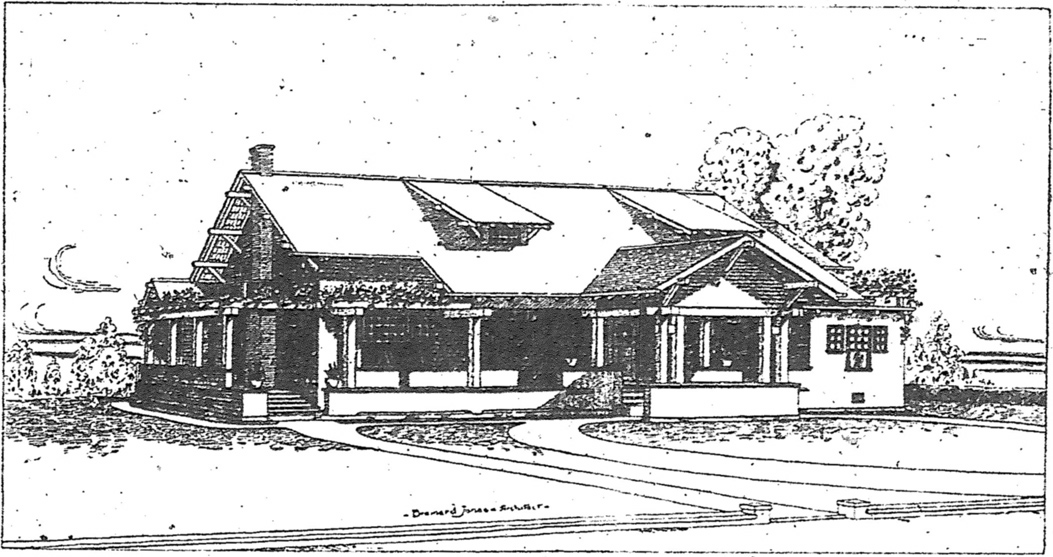 (RIGHT: Brainerd Jones' drawing of the Saturday Afternoon Club appeared in both newspapers. A different sketch also appeared in the August 13 Santa Rosa Republican, but the microfilm is such poor quality that it's not included here. CLICK or TAP any image to enlarge)
Only the Saturday Afternoon Club could have built such a place. The town was awash in "ladies' clubs" in that era, most with the sole function of planning afternoon card parties and get-togethers held at member's homes; a Press Democrat columnist guessed there were about 100 women's clubs, lodges and societies then in Santa Rosa. But no cards were shuffled at meetings of the Saturday Afternoon Club, where women might discuss a member's report on military tensions in Asia or listen to an amateur soprano from the club's Etude section warble through a program of Schubert lieder. One of the few personal details we know about Mattie Oates concerns a witty presentation on "The Laws of California as related to Women and Children."
The Saturday Afternoon Club was a group firmly in the traditions of the club movement, which was founded after the Civil War and took off around the turn of the century. Members were typically older women from the leisure class who sought intellectual challenge and culture. Such lofty aspirations made them easy targets for satirists and jokesters; think of the scene in "The Music Man" where the mayor's insufferable wife and her dowdy friends clumsily pranced and posed in an ode to a Grecian urn. The Club was founded in 1894 under the leadership of Jeanette Cochrane, a farmer's wife who found Santa Rosa to be a cultural sinkhole under the sway of dullards, at least as compared to her former home of Santa Barbara. There she belonged to a small "woman's club" that discussed literature and lobbied for civic improvements. The Club here certainly pursued literary matters with gusto, but until WWI it was not very active in civic affairs, perhaps because Santa Rosa had a busy "Woman's Improvement Club" that was tirelessly working for the town's betterment, such as coordinating with the S.P.C.A. to raise watering troughs to make them more humane for thirsty horses and cleaning up the Rural Cemetery. Rarely were members of that group singled out by the newspapers, but the names that did appear were almost always prominent members of the Saturday Afternoon Club, suggesting there was substantial overlap between the groups.
Central to the success of the Saturday Afternoon Club was its clubhouse, and that almost wasn't built, according to a 1994 Gaye LeBaron column. After the land was purchased from Mark McDonald Jr. for $800, all the banks in town refused to give them a construction loan, saying it was "crazy" to to take a risk on a social club, even one that included the wives of every prominent man in town. A wealthy aunt of club member Laura Cragin finally put up the entire $4,375, with another $100 tossed in for architect Brainerd Jones. Yet curiously, none of those interesting details were mentioned in either Santa Rosa paper at the time, which together printed over three dozen approving items about the Saturday Afternoon Club's mission to establish a clubhouse. Nor is Mrs. Cragin seen in the group photograph at the ground breaking. For having brokered a deal that saved the club's bacon, you'd think that she'd at least be rewarded by a snapshot of her throwing a shovelful of dirt.
 |  | ||
| |||
BEAUTIFUL CLUB HOME AUSPICIOUSLY OPENED
Pretty Scene Thursday Evening at Handsome Structure
The opening of the pretty club home of the Saturday Afternoon Club last evening marks an epoch and a decided step in advance for the City of Roses. The new home will be the center of intellectual and social development, and the scene of many pretty parties and entertainments in the future, as well as the place where splendid musical talent will be heard...
...Mrs. James S. Sweet, the president of the club, made the address of welcome to the assembled guests, and told of the beginning and completion of the work, of the sweet resignation of Architect Brainerd Jones when the ladies proceeded to "prune" his plans, of the painstaking work of Contractor J. B. Durand and his corps of subcontractors....
...Mrs. Robert Potter Hill, former president of the State Federation of Women's Clubs, and Judge James W. Oates made addresses during the evening. Each of the speakers made a talented address, the ladies bringing greetings from the organizations which they represent, and speaking of the pleasures which they had at being present on so auspicious occasion and of the beneficial influence the erection of the Saturday Afternoon Club structure would have on other cities.
Judge Oates was happy in his remarks, and his advice to the ladies on getting rid of the pest known as "knockers" touched a responsive chord in the audience. Judge Oates has been the legal light who has piloted the ladies through the shoals on which they might have wrecked their enterprise, and to him especial credit is due, and which was mentioned by Mrs. Sweet in her opening address. Judge Oates is always heard with pleasure by the people of this city, with whom he is a great favorite, and his well modulated voice was heard to advantage last evening. The speaker suggested that all the members of the male persuasion of the audience should assist the ladies in every way to make their laudable endeavors all the more successful and brilliant. The achievement of the energetic ladies followed the crashing blow which devastated this city less than three years ago, he remarked, was all the more pronounced because of its accomplishments in the face of such an adversity and calamity. Never in the history of the world, declared Judge Oates, had such a blow fallen on a city as Santa Rosa had suffered...- Santa Rosa Republican, December 18, 1908
WORK ON CLUB HOUSE PROGRESSING WELL
Architect Brainerd Jonea was here from Petaluma yesterday looking after the Saturday Afternoon Club's new club house on Tenth street. He expressed himself as well pleased with the manner in which the work is progressing and of the work being done by the contractor. The brick work in the terrace was also commented upon favorably by the architect.
Contractor J. B. Durand has the club house under cover so that the rain will not interfere with the force of men engaged on the job. He sees no reason now why the contract will not be completed well within the specified time limit.- Press Democrat, October 18, 1908
CLUB HOUSE UNDER WAY
Ladies Pleased with New Structure Being Erected
The new structure being erected for the Saturday Afternoon Club on Tenth street is rapidly being pushed to completion. Contractor J. B. Durand has a force of men busy shingling the sides of the structure, and it will soon be enclosed. Some delay has been occasioned in the structure of the roof, as the heavy timbers for that portion of the structure have been ordered direct from Oregon. They will be here at once, and it is expected to have the roof on the structure before the rains set in.
The ladies of the club frequently visit the new structure and are well pleased with what is being done there. The club house, when completed, will fill a long felt want on the part of the ladies of Santa Rosa, and will give them a place where their musicals and other high class entertainments can be staged with proper effect.- Santa Rosa Republican, September 18, 1908
CLUB LADIES BREAK GROUND
Saturday Afternoon Members Start Building
An exceedingly pretty and impressive, tho' informal ceremony took place at 8 o'clock this morning at the site of the Saturday Afternoon Club House on Tenth street near Mendocino Avenue. The building contractors began work at that hour and the members of the club assembled to break ground. The ceremony was begun by the presidents of the organization, Mrs. Finlaw, the "mother president," turning the first shovelful of earth, and starting the work that will go on till a beautiful and artistic club home is completed. Mrs. Finlaw made a short and appropriate address to her sister members and co-laborers and relinquished the shovel to her successor in office. This was followed down the line presidents, who are Mrs. J. W. Oates, Mrs. A. C. McMeans, Mrs. Mark McDonald, Jr., Miss Lulu Leppo, Mrs. T. J. Geary, Mrs. W. E. McConnell, Mrs. James R. Edwards and Mrs. J. S. Sweet, the present presiding officer. Then the vice presidents took a hand, and this finished the official list and the members--the high privates--did their allotted part in preparing for the foundations.
There were present Judge James W. Oates and Professor J. S. Sweet, also Contractor J. B. Durand and Architect Brainerd Jones. John Ross, the photographer, posed the lady builders in an attractive bunch and took several pictures. The shovel will be preserved as a thing sacred in the club house.- Santa Rosa Republican, August 17, 1908
AWARD CONTRACT FOR CLUB HOUSE
Saturday Afternoon Club's Handsome Home on Tenth Street Will Soon Be Under Way
The contract for the erection of the handsome club house on Tenth street for the Saturday Afternoon Club, has been finally awarded to Contractor J. B. Durand of this city. Work will be commenced at once and will be finished as rapidly as possible.
A description of the building and the sketch of the same by Brainerd Jones, the architect, was published in the Press Democrat some weeks ago. The building will cost in the neighborhood of $5,000. An application for a building permit has been filed with the City Council, and will of course be granted.
The chairman of the building board is Mrs. James W. Oates. The members of the club will be glad to know that the work of construction is to be commenced and will be delighted when the building is ready for occupancy. Mrs. James S. Sweet is the president of the Saturday Afternoon Club.- Press Democrat, August 14, 1908
HANDSOME CLUB HOUSE TO BE ERECTED BY THE SATURDAY AFTERNOON CLUB
After some delay incident to certain alterations in the original plans, on Thursday morning the contract was signed with J. B. Durand to erect the elegant new home for the Saturday Afternoon Club on Tenth street, near Mendocino avenue.
This building is the first to be devoted exclusively to club purposes in this city and marks an epoch in the history of Santa Rosa. The ladies of the Building Committee have displayed much energy and business ability in their efforts toward providing the Club with suitable quarters, and they are to be congratulated on the consummation of their undertaking.
The plans, which were drawn by Brainerd Jones, are in the Chalet style of architecture. The exterior is to be wholly in shingles and with its spacious port-cochere, pergolas and porches, forms a very pleasing picture.
The large auditorium, lighted by electricity, will be floored with polished maple. Opposite the stage is a large fireplace and over this is a gallery thirty-six feet in length. From the stage open two dressing rooms provided with all conveniences. The kitchen is to be furnished with a gas range, instantaneous water heater, etc. The auditorium will be wainscoted to the height of seven feet to the plaster line. A unique feature of the finish is the use of stained shakes to ceil the roof under the main rafters.
The acoustic properties have been carefully considered by the architect and the building is admirably adapted to lectures and threatening, while the dancing floor will be unsurpassed in the city. All in all, the new building will be an ornament to Santa Rosa and a credit to the enterprising members of the Saturday Afternoon Club.
[..]- Santa Rosa Republican, August 13, 1908
When the ladies of the Saturday Afternoon Club elect which set of the several plans they are wrinkling their fair brows over, they will begin to build a club home that will be an ornament to Santa Rosa and a joy forever to club women who will dwell therein. The idea uppermost in the minds of the members of the organization is a pretty and commodious club house. It will not be costly nor elaborate in its adornments, but will be simple, artistic and genteel. Club homes are now considered necessary in social and fraternal organizations. The Elks in this city built themselves a splendid place where the cultured members of the order meet and enjoy the social features of their order. It is their rallying point and their home. The local Native Sons are now building a costly temple and it will be their fraternal and social home. Finely equipped club rooms will be a part of construction where the members will gather.
The Saturday Afternoon club house may be a rustic bungalow, wide eves, ornamental galleries, French windows, giving onto grace 11 balconies and terraces, approached by a broad driveway, sweeping in a half circle up through a porte cochere or roofed entrance at the front. The interior will be a large club room, capable of seating several hundred persons, elevated gallery at one end, with ornamental balcony where one may sit and enjoy refreshments and the literary menu from the floor below at the same time. Piano and other musical instruments will be provided for the Etude Section. Flowers and greenery will grow around and over this artistic structure and it will be a home indeed to the Saturday Afternoon Club of Santa Rosa. At the next meeting, the club will choose the plan and the building will begin.- "Pencil Gatherings Among the Social and Other People" Santa Rosa Republican, June 1, 1908
SATURDAY AFTERNOON CLUB FILES ARTICLES
The Saturday Afternoon Club filed its articles of incorporation with the county clerk Thursday afternoon. The ladies are enthusiastic over their project and there were many signers of the club's roll, each taking one share of stock in the proposition. The club is capitalized at $10,000 and the stock is valued at ten dollars per share...- Santa Rosa Republican, March 15, 1907
...A big step in the advancement of club life in our little city was taken on last Monday afternoon, at a special meeting of the Saturday Afternoon Club, held at the home of Mrs. Dr. C. H. Thompson. The object of the meeting was to discuss and decide upon the advisability of purchasing a lot and erecting a modern, up-to-date club house that would not only afford a great deal of pleasure to the members of the club, but would also yield them a good revenue by being rented to other clubs and individuals for social functions and various other purposes. The meeting was largely attended in spite of the inclement weather and the ladies were most enthusiastic and earnest in discussing the proposed plan, and after carefully considering the important question and looking at it from all sides, a vote was taken upon it that resulted in a unanimous decision in favor of building a club house as soon as possible and also an order to file articles at once and incorporate the club under the name of "The Saturday Afternoon Club." Judge J. W. Oates has kindly offered his legal advice and assistance in their future business transactions and the ladies appreciate this generous offer and realize how valuable and helpful Judge Oates can be to them in carrying out such a big undertaking.- "Our Social Affairs, by Madam Trice", Santa Rosa Republican, March 9, 1907
DECIDE ON CLUB HOUSE
Saturday Afternoon Club Will Have Handsome Home
At the meeting of the Saturday Afternoon Club held Monday evening, the members determined to incorporate, purchase the proposed site for their handsome club rooms and erect a large and commodious structure thereon, The meeting was one of the most enthusiastic ever held by the ladies and when it came to a vote on the proposition there was a unanimity of sentiment favoring the club house. Mrs. James R. Edwards, president of the club, presided at the meeting.
The lot which will be purchased by the ladies is one owned by Mark L. McDonald, Jr. It is located on Tenth street facing Joe Davis street, and location for their club house [sic]. The close to Mendocino avenue [sic], and the members believe it will be an ideal election of directors [sic] resulted in the selection of the following to serve in that capacity [sic]...
...The club has decided to incorporate under the name of "The Saturday Afternoon Club," and the articles will be prepared at once and filed. At subsequent meetings of the club the arrangements for the building will be undertaken and architects will be asked to submit plans for the structure. The members can be depended on to erect one of the most beautiful and cozy structures for their occupance that is contained in the City of Roses.- Santa Rosa Republican, March 5, 1907
LADIES TO BUILD FINE CLUBHOUSE
Special Meeting of the Saturday Afternoon Club to Be Held on Monday Afternoon
There is to be an important meeting of the Saturday Afternoon Club, both sections, on Monday afternoon at the residence of Mrs. Dr. C. H. Thompson, on Mendocino avenue, for the purpose of discussing incorporation, for the purchase of a lot at Tenth and Joe Davis streets, and the erection of a club house. It is hoped that all the members will be present and take part in the discussion. Most of the members are very enthusiastic over the probable purchase of the lot and owning their own club house. Mrs. James R. Edwards is the president of the Saturday Afternoon Club. While many lots have been considered it is certain that the club house will be located in or near the location mentioned, which is the locality in which the Saturday Afternoon Club had its origin and development.
[..]- Press Democrat, March 3, 1907
ORIGIN OF THE LADIES' CLUB
How Saturday Afternoon Club Came Into Existence
The Saturday Afternoon Club, Santa Rosa's foremost organization in music and literature, whose handsome club house was dedicated Thursday evening, was founded by five prominent ladies of this vicinity. Many years ago a meeting was held at the resident [sic] of Dr. William Finlaw, on Mendocino avenue, the ladies present being guests Mrs. Dr. Wylie, on McDonald avenue. The idea of forming the club was broached and discussed by these ladies, and from that inception the stately edifice has arisen to crown their splendit efforts.
The ladies were Mrs. Martin Cochrane of Kenwood, Mrs. William Finlaw, Mrs. A. C. McMeans, Mrs. Mark L. McDonald, Sr., and Mrs. J. G. Wylie.
The first officers of the club were Mrs. Finlaw, president; Miss Nellie Porter, vice president; Mrs. McMeans, secretary; Mrs. McDonald, Mrs. Wylie and Mrs. Cochrane, committee on constitution and by-laws. At the next meeting of the ladies, which was held at the residence of Mrs. Finlaw, the constitution and by-laws of the club were presented and adopted.
Miss Nellie Porter, who was chosen vice president of the club, was to have been president of the club, was to have been present at the original meeting, but was unavoidably detained. She was chosen an officer in her absence.- Santa Rosa Republican, December 18, 1908