Divorces are too easy to get and sought on a whim. A divorce harms the community more than the divorcing couple, so only an elected official can decide whether a bad marriage should be dissolved. The public has a right to know any and all accusations and embarrassing details about a couple seeking divorce. A wife or husband might lie about what happened during their marriage unless they face cross-examination in open court.
That snide little handbasket of equivocation, intimidation and false assumptions didn't come from clergy nor sanctity-of-marriage moralists; these were arguments made by top California judges in the mid-1910s, who viewed an option to bypass their judgeships as a threat to their authority.
What angered them was that married couples were using a new state law which made divorce less costly - not to mention being faster than waiting months for their date to come up on a Superior Court docket, usually jammed up with criminal and civil proceedings.
This alternative way of obtaining a divorce was decades ahead of its time - the concept of family court simply didn't exist during the early part of the century (California didn't get around to serious marriage reforms until the Family Law Act of 1969). And besides deserving a place in our history books for that reason it should be mentioned as part of the struggle for women's rights, as the conflict starkly pitted the powerful all-male judiciary vs. a class of (almost entirely) female plaintiffs.
By now Gentle Reader has probably guessed that this divorce option wasn't available for very long, and the whole episode was quickly forgotten - this is the first time it has been discussed since then, as far as I can tell. One reason it vanished from memory was probably because almost all of the events played out in Sonoma County, then still politically a rural backwater.
Forgotten, too, is this Believe-it-or-Not! nugget: In 1915, a Santa Rosa woman served as a Superior Court judge. It was the first time that had ever happened in the history of the United States.
The rest of this article can be read at the SantaRosaHistory.com website. Because of recurring problems with the Blogger platform, I am no longer wasting my time formatting and posting complete articles here. I will continue to create stubs for the sake of continuity, but will be publishing full articles only at SantaRosaHistory.com.
- Jeff Elliott
On January 17, 1920, Prohibition came to Sonoma county, as it did the rest of the land. While San Francisco marked the event by carousing and debauchery excessive even by Barbary Coast standards, the milestone passed with little notice up here. At midnight some bozo on Western avenue in Petaluma began shooting in the air and managed to knock out a PG&E powerline, likely pitching that side of town into darkness. With church bells clanging in celebration, residents suddenly without lights probably wondered if the end of the world had come - and many in wine-making, wine-loving Sonoma county were nervous that it had.
This article is part of a series on the 1920s culture wars, an era with numerous parallels to America today - particularly now that the nation is as divided as it was during the ignoble experiment which was Prohibition.
Much has been written about Prohibition; there's a substantial number of books and internet resources on the topic although all seem to share the same flaw - events before it started are given short shrift and then it's quickly on to Chicago gangsters, bathtub gin and the jazz age. You know: The fun stuff.
But take a step further back and a bigger picture emerges: Fear and loathing of alcohol was the moralistic glue holding together the various threads in America's culture wars. Many preachers howled liquor must be scourged from the earth via a rigorous crackdown by law enforcement, which was a militant stance shared with the revived Ku Klux Klan - and while you were at their lecture, the boyz in the hoods also had a few other things to tell you about hatred and white nationalism. The Women’s Christian Temperance Union didn't just demonize demon rum; the group had a “purity lecturer” who addressed their 1913 convention in Santa Rosa, where she spoke about “social immorality” and “race betterment” (eugenics, in other words).
Here I've written dozens of articles about doings regarding alcohol both trivial and notable, such as the anti-suffrage propaganda that women would vote as a bloc to ban alcohol and that the first speakeasy in the county was the Electric Hotel in Forestville. Below the main stories are arranged to show how the Prohibition movement gained steam in Sonoma county; the article following this one takes us to the start of Prohibition and shows the early impact it had here. Spoiler alert: Prohibition generally turned out to be a good thing for Sonoma county.
The rest of this article can be read at the SantaRosaHistory.com website. Because of recurring problems with the Blogger platform, I am no longer wasting my time formatting and posting complete articles here. I will continue to create stubs for the sake of continuity, but will be publishing full articles only at SantaRosaHistory.com. - Jeff Elliott
Dear Valley of the Mooners: The state will soon build a lockup there for morons who are outcast women, which is to say they are really prostitutes. P.S. Most of them will probably have chronic cases of venereal disease. P.P.S. It will be your patriotic duty to cooperate fully to show you support our troops.
This odd proposition came up during the winter of 1917-1918, as California fully ramped up homefront efforts for fighting World War I. Under the so-called “American Plan,” it was decided our draftee soldiers in training camps needed to be protected against booze and sex workers, so the Navy established "dry zones" around Mare Island and other military bases. Liquor could not be sold within this five-mile radius and brothels were likewise closed under military order. President Wilson expanded this further by declaring shipyards, munition factories, and schools with military prep programs to likewise be temptation-free.
As explained in part one, this led to tens of thousands of women accused of prostitution nationwide being swept up in vice raids and held under "quarantine" without due process. To hold them, the state was proposing to build a secured building at the Sonoma State Home at Eldridge big enough to imprison 300 such women.
Why they pitched the "moron" angle is less clear. In the early 20th century "moron," "imbecile" and "idiot" were accepted quasi-medical terms (although the methods used to classify people as such were complete and utter bullshit). As the institution near Glen Ellen was still widely known by its old name as the California Home for Feeble-Minded Children, maybe it was thought there would be fewer objections from locals if the women supposedly were of lower than average intelligence.1
There was plenty of local pushback against establishing such a "moron colony" at Eldridge even after the projected number of inmates was reduced by two-thirds. Nonetheless, by the summer of 1918, 110 "weak-minded girls and young women who have been an embarrassing charge upon [San Francisco]" were quartered there.2
When the federal government abolished liquor in the Dry Zones, it helped pave the way for passage of Prohibition after the war ended. Similarly, the interest in keeping prostitutes locked up continued unabated - although the excuse was no longer protecting the troops from disease in order to keep men "fit to fight." As also explained in part one, the new call was to abolish prostitution in California by reforming the women - even if it was against their will (and likely unconstitutional).
The loudest voices calling for enforced reform were the women's clubs. In April, 1919, they succeeded in having the legislature pass an act establishing the “California Industrial Farm for Women” which was “to establish an institution for the confinement, care, and reformation of delinquent women.” Any court in the state could now commit a women there for six months to five years. But where would this "Industrial Farm" be located? The state only considered two locations - both in the Sonoma Valley.
One possibility was the big chicken ranch of J. K. Bigelow between Glen Ellen and Sonoma (today it's the Sonoma Golf Club, and the sprawling clubhouse is the "cottage" the Bigelows built in 1910). The other option was the old Buena Vista winery, where Kate Johnson, a philanthropist and noted art collector, had built a 40-room mansion in the 1880s. The state chose Buena Vista and began bringing in women after winning a 1922 test court challenge over a single inmate.
 |
| A slightly different version of the colorized postcard shown in "THE MAKING OF A CRAZY CAT LADY." Bartholomew Park Winery |
Battle lines formed. Women-based organizations - the clubs, League of Women Voters, the W. C. T. U. and other temperance groups - enthusiastically supported the "Industrial Farm" (it was also called the "Delinquent Women Home" and every variation in between; here I'll simply refer to it as the "Home"). On the other side were politicians and bureaucrats (all male, of course) who thought the property could be put to better use, or just objected to the idea of spending taxpayer dollars trying to rehabilitate women of ill repute.
The attack on the Home locally was led by the Sonoma Index-Tribune, grasping at every opportunity to bash the place as a misguided experiment by do-gooders who foolishly believed they could domesticate feral humans. A scrapbook of clippings from the I-T during the 1920s can be found in the museum for the Bartholomew Park Winery (which traces its history back to Haraszthy's original Buena Vista vineyards) and I am indebted to the winery - as well as the anonymous soul who originally assembled the scrapbook - for sharing that invaluable resource with me.3
The Index-Tribune's bias was so unfettered we can never be certain how much of what they reported as fact was true - and alas, it was the only newspaper regularly covering doings at the Home. Sometimes the fake news is obvious; the I-T once claimed the monthly cost was $509.59 per inmate, but from later testimony and articles elsewhere we learn it was really in the $80-90 range, and was only that high because of building construction and other start-up costs.
A popular theme in the Sonoma paper was that the women were dangerous, depraved criminals. When the W. C. T. U. proposed incorporating some of the inmates from the women's ward at San Quentin (almost all women at the prison were in for non-violent crimes, mainly check kiting and forgery), the Index-Tribune played up the "unthinkable" threat they would bring to the community:
| ...We have had ample opportunity to judge the farm already, and do not hesitate to say that as a penal institution it is a failure, because it is a menace to the community and a nuisance to local officers...to bring 50 San Quentin inmates here, unconfined, without guards and a prison wall, is unthinkable. Surely the people of the surrounding country are to be thought of, despite theorists of the W.C.T.U. Perhaps if these good women knew how the handful already at the farm have acted, they would hesitate to pass their sob-sister resolutions. Perhaps if they were informed that there has been leaks, escapades and communication with companions on the outside, they might understand something of the danger such an institution is in our midst... |
That editorial appeared in September 1922, when the Home had been accepting women only about four months and had thirty inmates. The I-T rushed to declare it already a failure, although the only reported trouble had occurred the week before. The paper would still scream about that incident years later, and as with all other damning news from the Index-Tribune, their version should be presumed slanted.
Two women escaped, were caught and returned. They became belligerent and started a riot. The ringleader was arrested, handcuffed (a later rehash would say she was “hog tied”) and taken to the county jail in Santa Rosa. While enroute, "the prisoner, who is a drug fiend, hurled the vilest epithets at the officer." Deputy Joe Ryan was immediately called back to the Home to arrest another riotous inmate, and the two women were sentenced to 40 days in the Sonoma county jail.
Six months later the Sonoma paper reprinted a Sacramento Bee report about another escape under the headline, "THREE WOMEN’S PRISON MILK MAIDS FLEE":
| ...[the] aesthetic atmosphere, created to comfort the women jailed because of commission of the sin that has come down the ages, now includes "lowing herds winding slowly o’er the lea.” At least, a herd of milk cows recently was installed at the home, there to replace a herd of milk goats. Perhaps the break for liberty taken from them was actuated by resentment over the transfer of the lowly but picturesque milk goat for the more impressive bossy. Or mayhaps the duty of parking a cow on the farm and relieving her of her fluid treasure proved more arduous to the three “sisters of sin” than being maid to the goats. This is not officially explained. It is officially admitted, however, that the maids three have gone...Anyway, the first big break has been staged at the prison farm. As far as is known, this is the first break from jail in California by three women. |
The Index-Tribune felt compelled to append an editor’s note: "The Bee was misinformed as to this being the first break. There is such a gap between the honor system and discipline at the prison farm that there is a jail break every week."
As the I-T had not been reporting all those weekly "jail breaks," the editor was either admitting such events weren't newsworthy or didn't happen. Either way, it opens the question: What was really going on at the Home?

Rarely mentioned was that a small hospital was built next door when the Home opened. The original 1919 Act specified that women only could be released "with reasonable safety and benefit to herself and the public at large," which meant treating - and hopefully, curing - any venereal diseases. As discussed in part one, the best medical protocols in that era involved weeks of painful shots using solutions which had to be prepared under very precise conditions. Thus it's safe to assume that the hospital's (20? 30?) beds were filled at any given time.
The Act also called for the inmates to be given "industrial and other training and reformatory help," but aside from milking those cows - and before that, goats - there was no mention of other work, aside from a later comment in the I-T about them "painting flower boxes and pots," which could be just gratuitous snark from the editor. Nor was any formal education or training ever mentioned.
Before the place had a single inmate, Superintendent Blanche Morse was interviewed by the Press Democrat. “We are going to give the inmates work to do," she said, "but we are not going to apply the institutional idea and make them do it to bells and march-time. Each woman will help around the house in some way.” To her and other women's advocates at the time, the inmates would be transformed once they were lifted out of their abnormal environment. That meant placing these women - who came from San Francisco and other big cities - in the countryside to learn farm chores along with traditional domestic skills like sewing, laundry and housecleaning in a communal women-only setting.
 (RIGHT:) Blanche Morse portrait used in the San Francisco Call 1911-1912
Blanche Morse was the guiding force of the Home from the beginning. When the Home opened she was 52 years old, a former Berkeley librarian, middle school principal, and feminist with a decade of positions in several East Bay and state women's groups. In 1911 she was a speaker and organizer on the historic suffrage campaign tour to gain the right to vote in California. Her complete lack of any background in penology or social work or administration might seem to make her unqualified to handle the unique problems of the women sentenced to the Home, but she still probably looked like the ideal person to many in 1920 - because of her activism with the Mobilized Women.
The "Mobilized Women’s Army" was a coalition of Bay Area women's groups that organized in Berkeley just after the U.S. entered WWI in 1917. Its objective was to locally enforce "Americanization," which was another creepy project of the Wilson Administration akin to the American Plan - but instead of unconstitutionally locking up women accused of moral crimes, Americanization sought to encourage citizens to spy on their foreign-born neighbors and intimidate them into behaving more like "real Americans."
It was Blanche Morse who organized efforts to compile a list of every single immigrant in the Bay Area via a house-to-house survey - a list which would have been invaluable to the government and industrialists after the war during the "Red Scare" years, when both sought to crush Bolshevism and labor activism dominated by first-generation immigrants.
And just as the American Plan gained more steam once the war was over, the Mobilized Women's mission became a well-funded program to push cultural assimilation. It was the Mobilized Women's "American House" in Berkeley that clearly became the model for the learn-by-osmosis rehabilitation efforts at the Delinquent Woman Home at Buena Vista. There foreign-born women were shown American-style houswifery, which, as one scholar put it, meant "in order to be better citizens, immigrant women should learn to dress, shop, cook and clean in new, better, and more 'American' ways."4
It's unknown whether Morse's delinquent women similarly adopted "American ways" and became prostitutes no more. That is, if they were prostitutes to begin with; according to the Sacramento Bee, of the 54 inmates there at the end of 1922, only 17 were prostitutes and the rest were addicts/alcoholics. The law gave courts broad leeway to sentence any woman to the Home for having any connection at all with prostitution or merely being considered a "common drunkard." One woman was reportedly 67 years old, and all were charged with simply vagrancy.5
Much was later made by critics about the 67 year-old; "When do ‘wild women’ cease being wild?” taunted the Index-Tribune, although she could well have been a bordello's madam - and the law specifically mentioned, "any women...keeping a house of ill fame." Others would accuse Morse of padding the rolls. A member of the State Board of Control shared with the I-T a letter where he made the unlikely charge that federal prisons were in cahoots with Morse, and wardens were lending her convicts in order to polish up her budget:
| ...The institution never had many of the class of women for which it was intended, namely prostitutes or street walkers. When criticism arose because the institution was costing about $1100 per capital per year, the superintendent ‘borrowed’ a number of narcotic addicts who were under federal conviction, thinking that by increasing the inmates the per capita rate would be decreased... |
Hammered by critics, by the end of 1922 - when the Home had been active only about seven months - a bitter fight was already underway to keep it open for even another year.
The Sacramento Bee came out strongly against it, as did bureaucrats and politicians with influence and oversight responsibilities. Themes emerged: The women should be treated in regular state hospitals or imprisoned; the property should be used for a more deserving cause; if the women's clubs wanted the Home so badly they should pay for it and make it their charity. On the other side, the state League of Women Voters vowed to fight closure and many women's clubs demanded the project even needed to be expanded. Some clubs pledged to raise money.
Governor Richardson's recommendations for its 1923 budget was chopped down to about twenty percent of what he asked, which clearly wasn't enough to continue operations. Morse went to Sacramento ready to surrender. Then this happened:
| Just after Miss Blanche Morse, superintendent of the Sonoma prison farm for Delinquent Women, had finished telling the joint legislative committee holding hearing upon the Richardson budget that she was about to recommend temporary suspension of the institution, word was flashed over the wires telling of the total destruction of the home by fire. |
"Sonoma Valley’s beautiful landmark, The Castle, for 40 years nestled against the Buena Vista hills, is today a blackened ruins, for the building, since 1921 used to house women delinquents of the state of California, suddenly broke into flames Monday night at 6:15 and burned to the ground..." read the lede in the Sonoma Index-Tribune on March 17, 1923.
The fire began while the 65 inmates were starting supper and was well underway before a member of the Sebastiani family saw it from their house and called the fire department.
All managers were away that evening with Blanche Morse and the Home's business manager in Sacramento and the farm manager off duty, leaving only a groundskeeper and attendants to cope with a life-threatening emergency. Everyone sought shelter in the hospital; even though it was made of brick, there must have been fear and panic as the immense building next to them blazed away for three hours. All of their clothing and personal items in their top floor dormitory were lost.
The Sonoma and Boyes Springs fire departments responded. The Index-Tribune wrote, "...When the fire departments arrived they found the farm water supply of little value owing to repairs which were being made to the reservoir, so the Sonoma engine therefore pulled water from a nearby creek. Despite four streams playing on the building it burned like tinder."
 |
| A later view of the mansion at Buena Vista, probably c. 1920. Photo courtesy Sonoma County Library |
The I-T rushed to suggest inmates had set the fire. A few years later the paper fleshed out the rumor in more detail: "It was common talk in Sonoma that an inmate boasted she had set the fire — the last of three conflagrations in the building — had locked the door where the flames were started and thrown the key out of the window..." Today it seems commonly believed that it was indeed arson.
But less than three weeks earlier there had been a major fire because of a "defective flue" (no details were ever provided). So serious was the incident that the Sonoma firemen had to chop several holes in the roof to get it under control. Repairs were ordered and the very day of the big fire, a local contractor was working on the problem flue. It seems far more likely the building was destroyed because a workman accidentally did something (knocked loose creosote buildup?) which caused a chimney fire the next time the fireplace was used.
Although the old mansion was destroyed, the state still owned the land and its valuable hospital. Led by indomitable Mrs. Aaron Schloss - the feminist who almost singlehanded turned California clubwomen into a formidable political bloc - the women's club organizations immediately began to lobby hard for a new building so the Home could resume its purpose.
The pushback was fierce, critical of not only rebuilding any facility for women at Buena Vista but continuing the project at all. Gilbert B. Daniels, State Board of Control chairman said, “If it is the last thing I do, I’ll oppose that farm. It is a fad.” The director of the State Department of Institutions called it a boondoggle and a failed experiment. And as always, from the Index-Tribune's columns plentiful sexism oozed: The law only passed originally because legislators were "stampeded by the petticoat brigade" and the only people who wanted the Home to reopen were "women theorists and job chasers."
But even though the governor wanted to give it funding for another year at least, the California Industrial Farm for Women ceased to exist on June 30, 1923.
Over the next two years many ideas of what to do with the hospital were floated. The Sonoma County Federation of Women’s Clubs wanted it to be a children's TB sanitarium. A veteran's home was suggested as well as an orphanage for children of WWI vets run by the American Legion, which was proposed by Jack London's sister Mrs. Eliza Shepard, state president of the women’s auxiliary. In 1924 it unofficially became sort of an annex of the nearby Sonoma State Home at Eldridge, when they housed 35 epileptic boys at the hospital.
The women's club movement was split; some moved on to lobby for new female quarters at San Quentin (it was built in 1927).6 But in 1925, there was a last push by some clubwomen to revive a woman-only institution at Buena Vista.
A bill was introduced to construct an actual prison building for a "California Women's Reformatory." Housed there would be women felons, drug addicts, and "women committed under the provision of the act establishing the California Industrial Farm for Women." A group from Sonoma county went to the capitol to lobby against it; some, like Eliza Shepard, thought such a place was a good idea, but just didn't want it in our county. The party rehashed all the old horror stories about inmates escaping and causing havoc - until a legislator produced a letter from Sonoma City Marshal Albertson "denying that wild women had ever given anyone trouble."
A test vote easily passed in the Assembly and according to the I-T, "Senators had apparently pledged support to not antagonize 'the army of women lobbying for this bill' and hoped the governor would veto it." He obliged, and that was that.
Whatever anyone's opinion of the Home's purpose, its ending was tragic, particularly the terrible loss of that building, which was the largest and most palatial home ever built in Sonoma county. It's also a shame we don't know what really went on there, except through the spittle-flecked pages of the Sonoma Index-Tribune. Blanche Morse was required to keep detailed reports on all the inmates, so there are probably reams of data in the state archives. Maybe there's a grad student out there looking for an interesting thesis topic.
Morse certainly thought it was successful; during her testimony on the day of the fire she said, "so far 60 per cent of those who had been freed had made good in the occupations to which they were sent."
"...I believe that if a 15 per cent average of those who make good can be maintained in the future we will be doing extremely well...I do not think it reasonable to expect a woman who has lived the life of the streets for twenty years to completely reform in one year.”
For the 65 women who were at the Home following the big fire, however, there would be only incarceration - and worse. Before winding up this dismal coda to our story, remember the women were sent there for up to five years only on the fuzzy charge of vagrancy after having been denied their basic constitutional rights. Nor had a county “lunacy commission” been convened to determine whether any of them were mentally unfit.
As they couldn't remain confined in the small hospital for long, the plan was to gradually resettle them at Eldridge. Two days after the disaster, four of the inmates sent there escaped and had to be recaptured by long-suffering Deputy Ryan. The same day he was called to the hospital, where the women were said (by the Index-Tribune) to be rioting. Five of them were carted to the Napa State Hospital. A five year commitment to an asylum would be no fun, but it was the women taken to Eldridge who most deserve pity.
By 1923, the Sonoma State Home had become virtually a factory operation of forced sterilization under superintendent Dr. Fred O. Butler, a firm believer in eugenics (see, "SONOMA COUNTY AND EUGENICS"). Between 1919 and 1949 about 5,400 were sterilized there - “We are not sterilizing, in my opinion, fast enough,” Butler said. And in his early years there was also a marked shift in the types of patients arriving at Eldridge: Instead of the “feeble-minded children" of the old days, a large proportion of the inmates were now female "sexual delinquents."7
Just as the legislature in 1919 gave the state broad powers over delinquent women, they also authorized forced sterilization of inmates, including any "recidivist has been twice convicted for sexual offenses, or three times for any other crime in any state or country" (emphasis mine). A later amendment extended it to include, "...those suffering from perversion or marked departures from normal mentality, or from diseases of a syphilitic nature." In other words, there can be no doubt that all of the Buena Vista women were sterilized - the only question is whether Butler also performed some of the other horrific experimental genital surgeries which were described in part one.
There's never been a book written about the Home, or even an article (well, until now). Was it was successful rehab program far ahead of its time or just a misguided social experiment by do-gooders? Or something in between?
What's certain, however, is it ended up badly for almost all of the women. Picked off the streets on some misdemeanor - soliciting, drunkenness, homelessness - they expected a fine and a few days in county jail. Instead they were sent to state prison (albeit a beautiful prison) indefinitely. And then after a few weeks or months a few found themselves confined to the madhouse, while most of them discovered the punishment for their minor crimes would be going under Dr. Butler's eager knives.
1 This era was the start of America's faith that an "IQ test" objectively measured intelligence with scientific precision, although we now recognize the exam was filled with cultural and racial bias - see my discussion here. Using such quack methodology, a 1917 study by the San Francisco Dept. of Health claimed about 2 out of 3 prostitutes examined were "feeble-minded" or "borderline."
2 Building a Better Race: Gender, Sexuality, and Eugenics from the Turn of the Century to the Baby Boom by Wendy Kline; University of California Press 2005, pg. 47. Although I could find no newspaper articles mentioning the 110 women arrived, Kline is the authority on Eldridge for that era and had access to the institution's records.
3 Sonoma Index-Tribune clippings in the scrapbook sometimes were reprints of articles from the Sacramento Bee and Bay Area newspapers, but all clips are consistently negative about the Home. An op/ed in the January 13, 1923 I-T suggests the other regional newspaper, the Sonoma Valley Expositor, was in support of the Home, but nothing from that paper was included in the scrapbook. Scattered issues of the Expositor from the early 1920s only can be found at the state library in Sacramento.
4 Gender and the Business of Americanization: A Study of the Mobilized Women of Berkeley by Rana Razek; Ex Post Facto/SFSU; 2013 (PDF)
5 From the March 17, 1923 Sonoma Index-Tribune: "Senator Walter McDonald of San Francisco declared that he did not believe the women were being treated fairly in that they can be sentence to the home for a term not to exceed five years, while men charged with vagrancy, the charge under which all commitments have been made to the home, can receive only six months in the county jails of the state."
6 A Germ of Goodness: The California State Prison System, 1851-1944 by Shelley Bookspan, University of Nebraska Press, 1991; pg. 81
7 op. cit. Building a Better Race, pg. 54
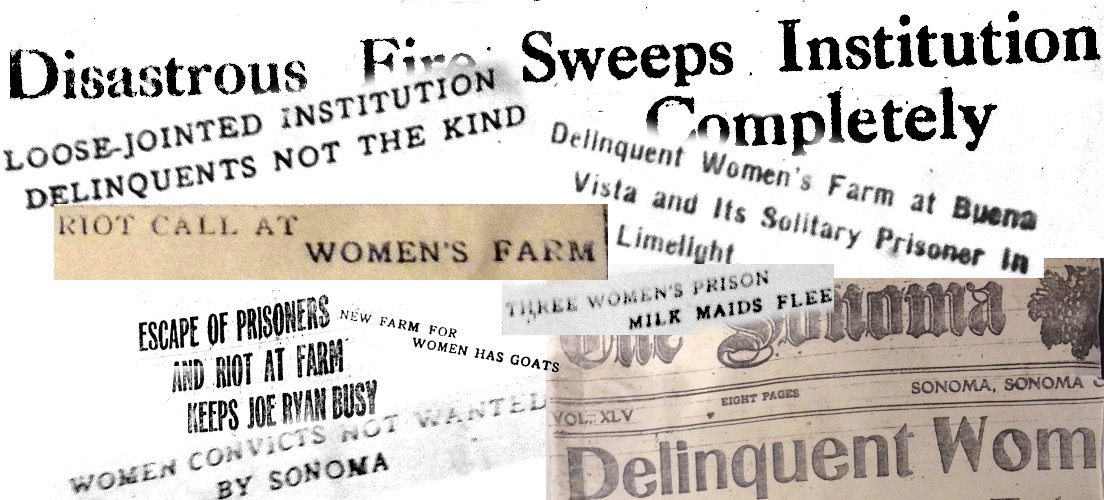 |
| Collage of Sonoma Index-Tribune headlines, 1922-1925 |
MANAGERS ASKED TO COOPERATEWould Establish an Institution for High Grade Morons at the Estate of the Sonoma State Home.
Representatives of the Probation Committee of San Francisco appeared before the board of managers of the Sonoma State Home at their meeting at Eldridge on Wednesday and asked the board for co-operation in the providing of cottages and a place for about three hundred delinquent women from the bay cities. They belong to a class designated as morons.
This step is said to be in the nature of an emergency measure on account of the unusual conditions that have arisen incident to the health protection of soldiers in camp in and around San Francisco. But long before the recent conditions that have arisen this matters was discussed at Eldridge.
The board of managers took no definite action in the premises other than promising whatever co-operation th«y could give. The delegation appearing before the board of managers wanted cottages built on the home grounds in some suitable location. There is no fund available for such buildings in the hands of the state at the present time and even though there was an available fund it is doubtful if the home estate is the proper place for an additional institution as that suggested.
- Press Democrat, November 16 1917
MUCH BUILDING AT STATE HOMENew Cottages for Female Delinquents to Be Rushed to Completion at an Early Date: New Laundry Building and Bakeshop Are Also to Be Built Right Away.
The Sonoma State Home at Eldridge will be the scene of much building for several months for there are a large cottage and the new laundry and the bake shop to he erected.
Work on the new cottage, which will house one hundred, has been commenced and it will be rushed to completion. As stated it will be used, for the present at any rate, as a moron colony, to which young women delinquents, will be committed from San Francisco and the other big centers. The matter was explained in these columns several days ago. From Manager Rolfe L. Thompson it was learned Wednesday that the work ot this building is to be rushed to completion right away.
The board of managers on Wednesday selected the sites for the laundry building and the bake shop. The two latter buildings will supply a long felt need at the home. They are very necessary buildings.
The State Board of Control has placed Business Manager William T Suttenfleld in charge of the construction work on the buildings. He is a splendidly capable man and is always so busy working for the interests of the institution and the state that one more little burden makes little difference to him. “Bill” has been at the Sonoma State Home for almost a score of years.
- Press Democrat, March 14 1918
OPPOSITION TO MORON COLONYMany People in Sonoma Valley and the Town Object to Having the Colony Located With the Sonoma State Home for the Feeble Minded.
The people of the Sonoma valley and the old Mission Town of Sonoma are not taking very kindly to the idea of locating the “Moron Colony” at the Sonoma State Home for the Feeble Minded. Many protests are being heard and it is likely that a largely signed petition will be presented to the authorities, asking that the plan be not carried out.
In last Saturday's Sonoma "Index-Tribune,” editorially, there was a strong protest against the additional institution being located in the Sonoma valley.
As stated in the Press Democrat some days ago the board of managers literally had the location of the colony at the home thrust upon them is an emergency measure, backed by the state and national administration, it was said.
There is considerable objection to having the moron colony established in connection with the feeble minded home, in addition to having it in the valley at all. The late medical superintendent. Dr. William J. G. Dawson, was bitterly opposed to having an institution for the care of socially outcast young women at Eldridge and shortly before his death again expressed his views.
There is said to be one ray of hope for the objectors and that is the one cottage that is to be built will only provide temporary relief for a very few of the young women who are to be removed from the big centres, particularly from the borders of army cantonments, as one building will afford only little room for conditions that are said to exist. It is knowm that the board of managers were reluctant to take in the new institution the grounds of the home, even as an emergency measure, but the showing made by the state authorities was so strong as a necessary war emergency measure that they withdrew their opposition.
- Press Democrat, March 19 1918
OBJECT TO LOCATION OF STATE HOME
The Sonoma Valley is still seething in protest against the establishment of the home for moron women and girls at Eldridge. Dr. A. M. Thompson, president of the commerce chamber, voices his protest in the following words:
"My protest not only goes against the location of the new institution in the Sonoma Valley, but particularly having it at the home for the feeble-minded. The late Dr. Dawson, the medical superintendent for many years, held the same views as I do--that the feeble-minded home had its problems to take care of without having any new ones."
- Petaluma Courier, March 22, 1918
MAKES PLEA FOR FEEBLEMINDEDSenator Slater Leads Opposition to Proposed New Penal Institution or Farm For Delinquent Women and Urges More Room for Unfortunates
"Before we take on a horde of other dependents I believe the State should take care of those who are already dependent and must and should have attention first." said Senator Slater before the Finance and Ways and Means Committee last night, when the proposed new penal institution or farm for delinquent women was discussed.
“At the Sonoma State Home for the Feeble Minded we have a waiting list of 447, and many of these cases are deserving in the fullest sense. In fact many of them heart-breaking in their need right now. Take the $250,000 you are asking for this women's farm vision and build more cottages to house the dependents waiting, and who have been waiting for years to get the help and protection the State should offer.
"If the finances were available the new project, over which I have no quarrel as to its probable good, might be considered. But the State must stop somewhere when we are at our wits ends over taxes and finances, and particularly when we have hundreds of feeble-minded and other dependents who are crying for aid. Let’s care for these first. That is my idea, and I am sincere in my expression on this subject,” said Slater. Senators Ingram. Sharkey and others, and Assemblymen Salahnn. Stanley Brown, Stevens,. Madison and others agreed with Slater.
- Press Democrat, March 2 1919
Club Women From Various Parts Of County Assemble At Interesting Petaluma SessionThe other speakers from abroad were Miss Blanche Morse of Berkeley, former corresponding secretary of the State Federation, and at present executive secretary of the State Industrial Farm Commission...Miss Morse, who will be the superintendent of the Industrial Farm which is to be situated in this county at "The Castle” the Kate Johnson estate near Sonoma, told of the needs for the home and the plans of the commission in reference to it. She met the objections raised in connection with the project and asked the cooperation or at least the interest of the Sonoma county women in the scheme when once it is under way.
- Press Democrat, October 3, 1920
S. F. POLICE HEAD AT NEW STATE HOMEIndustrial Farm For Women, Near Sonoma, Not to Be Like a Prison; There Will Be No Bars.The following article about the new industrial farm for women located near Sonoma appeared in Monday's San Francisco Bulletin. It was written by Dolores Waldorf:
A prison that is not a prison, a jail without bars, an institution that spurns the stigma of the name, stands in the hills of Sonoma county today, waiting for its first inmate. It is to be known as the California industrial farm for women, a place where delinquent women over 18 years of age may make a fight to regain a normal view of life and where they may prepare themselves to face the world after their term ha* been served. The sentences will vary from six months to five years.
The house and surroundings were inspected Saturday hy Police Judges Sylvain Lazarus and Lile T. Jacks, Chief of Police Daniel O'Brlen and Captain of Detectives Duncan Matheson. They expressed their approval in emphatic terms and seemed to think that it offered the solution to one of the greatest problems before the criminal courts today.
In 1919 the legislature passed a bill providing for such a place and appropriated $150,000 to start work. Nothing could be done until the board was chosen, however. and in 1920 the governor appointed...
680 ACRES IN FARM
Since then men have been steady at work carrying out the plans. The Kate Johnson home, two miles east of Sonoma was purchased for $50,000. This included 680 acres of land mostly under cultivation. The house itself is a huge, rambling mansion with spacious rooms and great hallways. Though the whole place has been completely renovated new plumbing installed and modern conveniences added in the laundry, there is an air of ancient and settled serenity about it. The house will accommodate about seventy women.
Captain of Detectives Duncan Matheson, who attended to the purchasing and remodeling of the home, said of it during the inspection Saturday: “In choosing, a place, we had to think of two things Isolation and cheerfulness. Who couldn't he cheerful with these hills around them?"
Miss Blanche Morse, recently ot Berkeley, and an active worker in all suffrage and reform movements, has been appointed superintendent of the farm.
SANS THE LOCKSTEP
“We are going to give the inmates work to do," she said, "but we are not going to apply the institutional idea and make them do it to bells and march-time. Each woman will help around the house in some way.” Miss Jessie Wheelan of the Southern California hospital for the insane, is to have charge ot the indoor work.
- Press Democrat, December 20, 1921
Heading back a century to visit Santa Rosa in your time machine? Remember this: Use swear words in front of women or children - or anywhere on the street where they could be within earshot - and you might spend weeks in jail or pay a stiff fine.
The Santa Rosa newspapers of the late 19th/early 20th centuries often reported men (VERY rarely women) being arrested for vile, obscene, profane or otherwise offensive language in public - and even in private, when the cusser was also accused of assault or another crime. Punishment was twice as severe as public drunkenness, and some spent months in the city jail for letting fly.
This topic has been visited here before in the context of cussing being a more serious offense in 1907 than parents starving their children or someone brutally whipping an animal. Another example like that from 1893 finds drunken "Windy Jim” tried to strangle his landlady in Healdsburg, only to be stopped by her son stabbing the guy with a fork and just narrowly missing his eye. But it appears ol' Windy got three months in the county slammer not for the choking but for the indecent language that she - as a woman - was forced to endure while he was trying to kill her.
It was never made clear what words were offensive. Was "damn" okay without a preceding "god"? What about compound phrases with "hell," "bastard," and "bitch?" Was "arsehole," "bollocks" or "shite" acceptable if the person saying or hearing it was from the UK? (Full disclosure: While we were reshingling the house, under the original 1905 tarpaper someone had written, "arsehole Baker" on the side of the house, "Baker" presumably being the shingle subcontractor.)
An assortment of items can be found transcribed below, but there were many hundreds of arrests reported in the newspapers over the years. These are a few of my favorites:
 In 1913, Joe Goess was arrested in the town of Sonoma for language that was "said to have been particularly flagrant." When brought before the judge, "young Goess turned on the justice and unloaded some unseemly language." He was locked up without bail.
When Robert Butts’ hounds got loose in 1916, neighbor McIntosh took a few shots at them when they came on his property. Mr. Butts did not like that and went over to have words with his neighbor, where he "used some uncomplimentary language towards Mrs. Mclntosh in the absence of her husband." Butts was charged with disturbing the peace although there was apparently no one else present. In 1922 a Cotati man named James Codioni was fined $50 for making obscene phone calls, with the interesting twist that it was telephone company employees who nabbed him and marched him down to the police.Santa Rosa's obscenity law is really old, dating back to original town ordinances of 1867. Sandwiched between a ban on riding horses on the sidewalk and mildly discouraging prostitution was §5, which outlawed "...[within] the hearing of two or more persons, any bawdy, lewd or obscene words or epithets."
 It appears no one was charged under the law for over ten years (although I really doubt that) when Charles Hall was arrested in 1877 for "using language calculated to cause a breach of the peace." Nothing more was reported about the case, possibly because the accusation was bogus; the guy accusing him was in serious trouble for brandishing a deadly weapon, having been turned in by Hall.
Obscene language charges began tapering off during the Roaring Twenties, and from then on were most frequently bundled together with more serious offenses, such as the arrest of a group of underage kids for rowdiness and drinking. It also remained a justification for divorce in those pre no-fault years often paired with accusations of spousal physical abuse.
Curiously, I've never read of anyone charged during those years with the related crime of obscene graffiti - although during the mid-1930s, Petaluma was itching to catch and arrest the vandals who kept painting dirty words on the "big hen" statue at the end of the town, seen here in 1936 with its most recent defacement not quite scrubbed clean. (Photography by John Gutmann)
UPDATE: Someone on Facebook commented that these laws were a shout out to the "politically correct crowd." It's a lot more complex than that. I'm sure every town in the country had similar obscenity ordinances to appease its religious moralists, and some places enforced the law strictly and others mostly ignored it. It was sometimes exploited as a means of revenge, as per Mrs. McIntosh in 1916. But the obscenity laws were also sometimes used to deal with bad situations where no laws were yet on the books which were directly applicable - see the 1907 story about the drunk parents starving their children. That said, Santa Rosa seems to have turned the law into a cash cow during the 1900s and 1910s, with the local police dragging offenders into court to pay hefty fines or face months behind bars.
Justices Court.— Mr. L. Howard was arraigned before Justice McGee on Wednesday, charged by Chas. Hall with exhibiting a deadly weapon. He was found guilty. Sentence postponed until Monday, October 29. Howard then had Hall arrested under a city ordinance, for using language calculated to cause a breach of the peace. Trial set for Saturday, the 27th.
- Sonoma Democrat, October 27 1877
Police Court Docket for Tuesday: John Cummings, for using vulgar language, ten days; James Miller, drunkenness, five days; H. Beck, vulgar language, ten days; M. Quin, drunkenness, five days; Wm. Vail, drunkenness, $5.
- Sonoma County Daily Democrat, May 7 1890
HE USED INDECENT LANGUAGE."Windy Jim” Stinson Sent to the County Jail for a Term of Three Months.
Wednesday night a week Marshal Leard and his deputy, L. A. Norton, took into their custody the ex-policeman Jim Stinson, better known as “Windy Jim," at the instance of his landlady, Mrs. C. J. Lelouarn, in whose presence he used profane language. The prisoner made no resistance of arrest and marched to the bastile with little concern. He objected, however, to being confined in jail like an “ordinary” criminal and sent out a couple of men to hunt up sureties for his appearance in court, but they were not to he found and he had not ampIe funds on hand to put up cash bail, consequently he was compelled to go behind the bars. The next day he was arraigned before Justice Coffman on the charge, and when the testimony of the plaintiff and her two little sons was heard he was assigned to the county jail for three months without the alternative of a fine.
Stinson came here about three years ago from Petaluma, where, it is rumored, he was tendered an invitation by the citizens to make his residence elsewhere. Shortly afterward he look up his quarters at Mrs. Lelouarn's house in North Healdsburg, but only until lately did he compensate the lady for his board and lodging, when he furnished her with a few groceries occasionally. Mrs. Lelouarn is a widow, the mother of three young children and is a cripple. She depends on washing and housework for a livelihood. A week before Stinson’s arrest she alleges that he assailed her. That afternoon she had been at work for Mrs. A. L. Paul, assisting her in moving and when she returned home she found that Stinson had barred her out by fastening the door. When she forced it open the monster grasped her by the throat and she might have been strangled had not her son, Henry, come to her assistance with a table fork, with which he punctured the flesh over Stinson’s ieft eye. Of late Stinson had been drinking heavily and the neighbors say that such disturbances were of frequent occurrence. His absence from Healdsburg is generally hailed with delight.
- Sonoma County Tribune (Healdsburg), January 19 1893
Was Disturbing the Peace
Officer Boyes arrested a young man on Main street Saturday night upon a charge of disturbing the peace and using vulgar language in front of the Salvation Army headquarters. The fellow ran at the approach of the officer, but the latter caught him as he was disappearing down an alley in Chinatown and locked him up at the police station.
- Press Democrat, June 9 1901
USED BAD LANGUAGEMan Arrested for Improper Behavior on Wilson Street Monday Night
George Bates was arrested on Wilson street Monday night and was locked up on a charge of using profane and indecent language in the presence of women and children. Bates will have to explain his conduct to Police Judge Bagley this morning.
- Press Democrat, June 26 1906
WAS FINED $30George Deacon Punished for Using Bad Language on the Street
Thursday morning George Deacon appeared before Police Judge Bagley to answer to the compfalnt that he used disgusting language on Third atreet on the previous evening. A fine of $30 was imposed with an alternative of fifteen days in jail. Deacon paid the money after spending a few minutes In Jail.
- Press Democrat, August 17 1906
Bad Language on the Streets
On the complaint of S. Graham George Chester was arrested by Policeman Yeager on Sunday night charged with using vulgar and offensive language on the streets. Chester gave bail for his appearance before Police Judge Bagley.
The use of improper language, particularly when women and children are passing, is altogether too prevalent, and the officers mean to take steps to make examples of the offenders in this respect.
- Press Democrat, September 10 1907
MAN IS FINED FOR USING PROFANITY
Walter Petross paid a fine of $10 in the City Recorder’s court Wednesday for indulging in the use of profane language on the street Tuesday evening in the vicinity of the Nickelodeon. This shall serve as a warning to other profanity hawkers.
- Press Democrat, February 13 1908
Arrested for Disturbance
James Aker, a lad who used profane language and created trouble on the lake Sunday, is locked up In the county jail pending a hearing for disturbing the peace. As he has been in trouble on a number of occasions it is probable that he will serve some time in jail before being liberated.
- Press Democrat, May 24 1910
VILE LANGUAGE LED TO A THRASHING
Sheriff J. K. Smith was called to Cotati Saturday evening to arrest a couple of men whom, it was claimed, had assaulted a man there when he visited their camp, they being members of a hay baling crew from Stockton. On his arrival Sheriff Smith was informed that the visitor to the camp had used vile language in the presence of women and children, and failed to heed the warning to stop, and was then given a trouncing by members of the crew. The Sheriff hunted him up and informed him that it stood him in hand to drop the matter or he might find himself getting a worst defeat In th« courts. That ended the incident.
- Press Democrat, August 20 1911
USED VULGAR LANGUAGE BEFORE LITTLE CHILDREN
Joe Goess, a young man of Sonoma, was arrested there on Sunday afternoon by Deputy Sheriff Joe Ryan on a charge of using vulgar language in the presence of women and children. The alleged offense occurred on Main street, and is said to have been particularly flagrant. When spoken to about his conduct by Justice Campbell, young Goess turned on the justice and unloaded some unseemly language. Justice Campbell took the young into custody and turned him over to Ryan, who locked the offender in jail. His examination took place Monday.
- Santa Rosa Republica, April 28, 1913
SIXTY DAYS IN JAIL FOR INSULTING WOMEN
Monday was a busy time with City Recorder W. P. Bagley. There were thirteen cases in his court that day. Four drunks were dismissed, but one returned later and will face his fate Tuesday. One drunk had his case continued while two others paid fines of $5 each and two went to jail for three days each. One driver who stopped his auto on the wrong side of the street had his case continued, while one vagrant went to jail for five days and another was dismissed. A man who insulted women on the street appeared with an attorney, but it did not prevent him getting sixty days in jail for the offense.
- Press Democrat, May 20 1913
THE VULGAR TALK TO BE STOPPEDPolice Will Endeavor to Check Behavior That is Devoid of ManlinessChief of Police J. M. Boyes and his department are determined to put a stop to the practice that has become altogether too prevalent in Santa Rosa on the part of some persons who seem to take delight in using vulgar and unseemly language on the sidewalks or in public places.
The only way to reach the offenders will be to arrest one or two and make examples of them in the police court. The language complained of is generally used, possibly not intentionally, at times when ladies are in hearing distance. There is nothing manly in such conduct as this, and complaints have been made.
- Press Democrat, August 8 1913
Charged With Using Improper Language
Robert Butts, charged with disturbing the piece [sic] by J. O. McIntosh, was arraigned before Justice Marvin T. Vaughan Saturday, and his case continued to be set. Butts was released on $250 bail pending a hearing. It is claimed that when Butts’ hounds got loose and trespassed on the McIntosh place, Mr. McIntosh fired at them, but failed to kill any of them. It is claimed that Butts learning of this went to the home and used some uncomplimentary language towards Mrs. McIntosh in the absence of her husband, which resulted in the complaint being sworn out.
- Press Democrat, March 26 1916
Who knew? The actors in those century-old silent movies were actually cussing up a storm. The lip readers knew about it, of course, and some were in high dudgeon as a result, demanding censorship. And who can blame them? While watching the hero profess his undying love to his maidenly ingenue, for example, it would be a bit disconcerting to discover he was actually swearing like a lumberjack on Saturday night.
Santa Rosa learned about photoplay profanity in a 1910 Press Democrat editorial, where Ernest Finley called it "one of the strangest stories of the year," apparently because he was astonished that such a thing as lip reading existed.
But it is a bit of surprise (at least to me) to find that salty language was common in films so early. Movie cussing was well known and acknowledged as a problem during the roaring part of the 1920s, and headed the list of "Don'ts and Be Carefuls" compiled by the studio execs in 1927. Some films - particularly "What Price Glory?" released the previous year - made no effort to rein in the actors; a review at the time noted, "Victor McLaglen takes the honors in acting and unbridled profanity, and the film leaves no doubt as to what words are being used." (Those interested in exercising their lip reading skills can practice on this clip, starting at around the 5:15 marker.) Movie controversy of the 1920s is off-topic here, but for anyone wanting more info there's a cinema blog that has an enjoyable discussion with clips from other movies. I'll only add that, wow, Gloria Swanson really had a mouth on her.
The PD didn't publish the original wire service story, but it's pretty easy to find in other newspapers, given its sensational nature. It seems Mrs. Elmer Bates of Cleveland, a "noted deaf mute instructor and lecturer," visited a half-dozen theaters and found "shocking language was used in all the shows visited."
Mrs. Bates made a tour of the downtown shows yesterday accompanied by a reporter who wrote down the picture talk, and at times the language was so vile that she had to stop...Curses, vile names and vile comments are indulged in by the performers while being photographed, often without the least semblance of relation to the play being performed. The profanity and obscene language seem to be addressed by members of the companies to one another on the spur of the moment. |
Mrs. Bates tried to get the mayor to do something, but he passed the buck to the Humane society. (Meaning the American Humane Association, not today's Humane Society of the United States; the Association's activities include the protection of children as well as animals.) The Association told her it wasn't for them and she should take it up with the movie studios. Her protest presumably faded there.
Obl. Believe-it-or-not twist to the story: Mrs. Bates' husband was Elmer E. Bates, a famous Cleveland sportswriter. He was best known for covering the disastrous 1899 season of the Cleveland Spiders (later renamed the Indians) when the National League team lost 134 games, which still stands as the worst performance in baseball history. Had Mrs. Bates visited the ballpark with her husband during those games, I'm certain she would have heard language far, far more ripe than anything shown in one-reel melodramas and slapstick flickers.
MOVING-PICTURE PROFANITY
One of the strangest stories of the year comes from Cleveland, Ohio. The deaf-mutes of that city have protested against certain of the moving pictures exhibited in the theaters there. None but deaf mutes can detect anything wrong with those pictures, but to them they are objectionable. By reason of their affliction, the deaf become proficient in what is known as "lip reading." This proficiency enables them to derive more enjoyment and profit from moving pictures than their neighbors get who are endowed with good hearing. That is, if the actors stick to the text of the play. But it has become a common thing for the performers whose "stunts" are photographed for the moving films to vary the text to suit their own moods and minds, and where the practice is allowed they have numerously lapsed into profanity and obscenity, meanwhile keeping up all the "stage business" so that to any but a lip reader their acting is correct. But to the deaf mutes the silent profanity is as real as vocal profanity is to the rest of mankind, and the mutes in Cleveland ask that the city authorities have the reels censored by a lip-reader before they are exhibited in public.
- Press Democrat editorial, December 25, 1910
What a different world it was in 1908; when word spread that a homeless family was living in a tent by the creek, Santa Rosans were tripping over each other trying to be the first to offer them help. Ignore the cynics who note that the outpouring of concern and generosity didn't start until a few days before Thanksgiving, although this family apparently had been homeless for some time.
A newspaper mention of the Dougherty family's plight caused the mobilization of "near to a dozen relief expeditions," according to the Press Democrat, that went in search of the 11-member family living near the E street bridge. Carrying "baskets and bundles of provender," the rescuers turned up nought. The PD reported, "Far into the night the good Smaritans [sic] tramped the streets, ringing doorbells and looking for tents full of hungry children, but none was found. Some of the earnest workers were making calls nearly a mile away from either E street bridge, and said they had covered all the territory between"
The destitute Doughertys turned up in the following days and were moved into a vacant home, as was another homeless family of eleven that had been camped south of town.
SEEK IN VAIN FOR THE DESTITUTE FAMILY
The published report that a destitute family of eleven persons was living in a tent near the E street bridge caused the formation of near to a dozen relief expeditions Tuesday evening, each expedition bearing baskets and bundles of provender to the supposed scene of the suffering. But no destitute family was found, and the relief expeditions resolved themselves into peripatetic indignation meetings. There are two E street bridges and every house near either of them was made the subject of inquiry. Far into the night the good Smaritans tramped the streets, ringing doorbells and looking for tents full of hungry children, but none was found. Some of the earnest workers were making calls nearly a mile away from either E street bridge, and said they had covered all the territory between. But they all carried their bundles back home again, unless they are hunting yet.
Tom Butts went home at 9 o'clock. He was serving on one of the impromptu charitable committees having been impressed.
It was learned Wednesday that a family who had been residing on the Cotati road two miles south of town, with nine children, the youngest 8 months old, with father and mother both sick, had been taken to the Sampson Wright farm Monday where they are being cared for.- Press Democrat, November 26, 1908
WHO WILL HELP FAMILY WHOSE NEED IS GREAT?
The Dougherty family, which was located on the creek bank here some time since, and whose needs were published in this paper, are still in distress. The family has been moved out into a little house just opposite Willow Grove station, on the electric railroad, and have insufficient clothing and bedding to keep them comfortable. They also need provisions and fuel. Any one having clothing, particularly for children, and some bedding which they can spare, will do a great kindness by sending it to the family. Any parcels left at the Peniel Mission, at Fifth and A streets, will be taken to the family at once. The mission will be kept open all day Saturday to receive articles from the people.- Santa Rosa Republican, December 4, 1908
Spitters beware: A new state law made spitting on the sidewalk - or anywhere else - a misdemeanor in 1907. Press Democrat editor Ernest L. Finley, quite the stickler to the law when it came to clean sidewalks, made sure readers were fully informed immediately about California penal code §372a.
Any item about expectoration is another welcome opportunity to plug my all-time favorite story, about the 1905 Santa Rosa motorist who was given a speeding ticket, then a few days later forced the selfsame cop to arrest himself for spitting on the sidewalk. At night. And during a downpour.
It might be just as well for some people to remember that it is now a state prison offense, punishable by both fine and imprisonment, to discharge mucus from the nose or mouth or spit upon any sidewalk of any public street or highway, or upon any part of any public building or railroad train, streetcar, stage, ferryboat, steamboat, or other vessel or vehicle used for the transportation of the public.
This is a law that should be rigidly enforced, for expectoration in public places is not only unhealthful but also disgusting in the extreme.
One of the most nauseating thing in the world is to have a man come into a street car or public office and spit slimy rings all around himself on the floor. No man of any culture or refinement would do such a thing, of course, and some of those who do would doubtless be considerably surprised if told they do not possess even the first instincts of a gentleman. Yet the following is as true today as it was when it was first written:
"The man who expectorates on the floor need never expect to rate as a gentleman."- Press Democrat editorial, April 2, 1907
National news stories are off-topic here, but that 1905 Press Democrat headline, "Dr. Brown Would Drown the Idiots", is irresistible, and also lends the opportunity to briefly discuss Sonoma County's shameful role in the 20th century eugenics movement.
 Like many other states, California had an institution for children that were diagnosed as "feeble-minded" (more about that offensive term below). Founded in 1883 by a pair of civic-minded women, the facility shuffled between four South Bay and East Bay towns until the state agreed to buy a ranch near Glen Ellen. With a band playing a cheery tune at the train stop, the first 148 children arrived in 1891 at what was then called The California Home for the Care and Training of Feeble-Minded Children. By 1904, the Home had 541 "inmates" and a staff of 70, making it the largest employer in the county. The state was also pouring money into the institution to expand it rapidly. (More on the history of the institution proper can be found in a November 19, 2000 Gaye LeBaron column available by searching the Press Democrat web site archives. The Home is still often referred to interchangeably as "Eldridge," which was the name given to the train stop.)
"It was with the idea of providing a home for the purely custodial cases as well as undertaking the training and development of the epileptic feeble-minded that the management in the past ventured its memorable struggle...from its former inadequate quarters to the present unrivaled location," the PD noted in a 1904 promotional insert that contained a full page on the Home, partially seen at right. But wait -- read that section again: why the mention of the epileptic feeble-minded?" That's because, according to a 1904 Census Bureau report, (PDF) about 18 percent of those institutionalized as feeble-minded were actually epileptic -- by far the largest category of those considered "physically defective."
Jack London visited the Home (which was adjacent to his ranch) in the summer of 1905, later writing a short story, "Told In the Drooling Ward." Written from the viewpoint of a "high-grade feeb" (who sounds more like a cousin to Huck Finn), the story follows the attempted escape from the institution by two boys with epilepsy. London's character described the world of the "epilecs" at the Home:
"You see that house up there through the trees. The high-grade epilecs all live in it by themselves. They're stuck up because they ain't just ordinary feebs. They call it the club house, and they say they're just as good as anybody outside, only they're sick. I don't like them much. They laugh at me, when they ain't busy throwing fits. But I don't care. I never have to be scared about falling down and busting my head. Sometimes they run around in circles trying to find a place to sit down quick, only they don't. Low-grade epilecs are disgusting, and high-grade epilecs put on airs. I'm glad I ain't an epilec. There ain't anything to them. They just talk big, that's all." |
"Club house" or no, these children with epilepsy were still captives, warehoused until age 18 as "feeble-minded" alongside others with severe cognitive disabilities, such as microcephaly. What "training" they were given at the Glen Ellen facility is not apparent; photos from a few years later show inmates tending crops in fields surrounding the grounds. Contemporary pictures of East Coast institutions show girls sewing or doing needlepoint, and boys working in tailoring or leatherwork.
The children also may have faced a greater risk of harm from the institution itself than their disability. The late Victorian era believed that there was a dangerous form of epilepsy -- search Google books for "epileptic insanity" and you'll find it discussed in hundreds of articles and book chapters in medical literature between the 1880s and the 1920s. Although there was no scientific proof that epileptic insanity was an actual physiological disorder, some authors at the time confidently reported that it accounted for 10-30 percent of all epilepsy cases. Some also claimed that everyone with epilepsy was, by definition, mentally unstable; a 1883 text on insanity stated, "There are those who, as soon as they find the slightest indications of epilepsy in the person under investigation, instantly jump at the conclusion that, ergo, that subject cannot be of sound mind."
The rest of this article can be read at the SantaRosaHistory.com website. Because of recurring problems with the Blogger platform, I am no longer wasting my time formatting and posting complete articles here. I will continue to create stubs for the sake of continuity, but will be publishing full articles only at SantaRosaHistory.com.
- Jeff Elliott
 Sunday funnies weren't the only entertainment threatening the morals of youth; penny arcade peep shows led directly to a life of crime and prison, according to this 1905 Santa Rosa Republican editorial.
It's a strange commentary for a couple of reasons. There apparently were no peep shows in Santa Rosa at the time, so the issue was only of concern to small town moralists liking to tut-tut over big city vice. It was also old news; the Hearst papers had indeed made a stink about peep shows, but that was six years earlier. Was this cribbed from "The Big Book of Op/Eds" to fill a couple of column inches on a slow news day?
These peep shows are an interesting topic, however, and worth a digression, here. The images were viewed on a Mutoscope, where the customer turned a crank to rotate a Rolodex-like drum with flip-card photographs. (Those primitive machines are not to be confused with Edison's Kinetoscope of the same 1890s vintage, which had the images on a loop of fragile 35mm film threaded through rollers.) Although Mutoscopes also served up minute-long vignettes of current news, comedy shtick, and sporting events from before the turn of the century, Mutoscopes were most often associated with saucy mini-dramas with titles such as, "The Way French Bathing Girls Bathe," "The Dairy Maid’s Revenge," and "How Bridget Served the Salad Undressed."
The ongoing controversy about the Mutoscope content was perfectly captured in the 1905 etching, "Fun, One Cent" by artist John Sloan, seen at right (click to enlarge). Here young women, not boys, are gawking at titillating images; the Hearst papers also complained that even small children were able to watch the little movies, and as seen here, stepstools were available for those too short to reach the viewer. An excellent paper, "Children at the Mutoscope," describes more about the scandalous scene portrayed:
"Another girl wears a look of mild shock, while three others peer into eyepieces. A predominant tone of amusement, however, is created by the broad smile worn by a laughing woman at the center of the image. She watches not the naughty peep-show but the face of her shocked companion. She appears to be an experienced older viewer introducing schoolgirls to the arcade. Sloan’s representation is not one of panic or indignation, but of almost-quaint celebration, relating a pedestrian pleasure gleaned from an entertainment that is only mildly risque. Fun for a penny is, if not altogether harmless, part of everyday urban life" |
The rugged Mutoscope viewers remained popular at least until the WWII era, and were hauled around to even to the most rural parts the nation by carnivals and traveling shows, giving three generations of Americans their first peek at "dirty" moving pictures. Perhaps the occasional circus or fair that visited Santa Rosa had a sideshow tent with a few worn Mutoscopes, where the local boys and girls could pay a penny, crowd around the machine, and watch "The Corset Model."
One of the San Francisco papers has started a crusade against the so-called "penny palaces" where indecent moving pictures are exhibited and children - boys and girls - are permitted to go unrestricted by their parents and drink the poison that starts young lives on the downward path of crime. The United States Government has some very strict laws about the use of the mails for questionable literature and pictures, and now and again some bold offender pays the penalty. There should be just as much and in fact more care exercised by the authorities in permitting such pictures to be exhibited in the arcades in the various cities of the State where such institutions seem to flourish. If restrictive laws are not made and enforced society will in the end pay the penalty, for every precaution taken in the interest of training the children of the land into clean, wholesome-minded, useful citizens is so much saved from the prison maintenance account.
- Santa Rosa Republican op/ed, May 11, 1905
WIFE SLAPPED HUSBAND'S FACE ON FOURTH STREET
An incident which created considerable amusement for spectators occurred early Tuesday morning near the Republican office. A woman whose husband failed to cease swearing when she attempted to stop his flow of profanity struck her husband a severe blow across the mouth. This had the desired effect and the woman proceeded to her hotel. The parties arrived here Monday evening, and had trouble shortly after their arrival. The husband had been drinking heavily and this led to a tirade on the streets, which the woman stopped by use of vigorous force. The husband counted a number of witnesses to the blow, evidently figuring on an action for divorce.- Santa Rosa Republican, October 11, 1904OBJECTED TO GUEST AT TEACalled Her Evil Names so She Has Him Arrested For Disturbing the Peace
Because Peter King objected to his wife's guests at tea and told the lady in terms more forceful than elegant a warrant has been issued for his arrest on the charge of using profane and vulgar language in the presence of women. Miss Myrtle Genther swore to the complaint against King in Justice A. J. Atchinson's court on Monday morning.
Mrs. M. McCombs was the victim of King's words assault as well as Miss Genther, it is alleged. In fact, Miss Genther was only secondary. Mrs. McCombs, according to the story of the ladies, had been assisting Mrs. King with some sewing. Her hostess insisted that she remain to tea and did so. This is alleged to have angered Mr. King, who spoke insultingly to the guests and later to Miss Genther.- Santa Rosa Republican, July 18, 1904