It cut through the summer night sky like a star fallen to earth, its blue-white flame casting deep unnatural shadows for miles. "I have lived in Petaluma for forty-five years. It was the grandest thing I ever saw," said Frank Lippitt.
"Put me down as saying we are just on the verge of a new era of prosperity," Richard Skinner told the Petaluma Morning Courier. "The striking of gas will put Petaluma before the world as the ideal manufacturing center." Forget the eggs, forget the chickens; soon there will be oil rigs on every farm and field and everyone in town will be as rich as the McNears. Richer.
This is the first of three articles on the Sonoma County speculation oil boom in the early 20th century. Although this installment covers just a single oil field near Petaluma, during those years petroleum prospecting companies were sprouting overnight with their "experts" rushing everywhere, signing oil leases on lands from Occidental to Bennett Valley to Two Rock. So also forget the hops and the grapes, the dairies and the orchards - no more Redwood Empire but rather an Empire of Oil.
But these particular stories are really not about the search for oil. They are about stock swindles and fraud scams - crimes which not only occurred here, but apparently were endemic to oil prospecting all over the country at the time. Then there are related mysteries about how much the local bigwigs and newspaper editors knew about what was really going on and chose to keep quiet. As found below, the Petaluma Daily Morning Courier seemed particularly eager to keep a lid on news that may have raised eyebrows.
Andy Ducker and his family had a 363 acre sheep ranch three-quarters of a mile east of (what's now) Petaluma Adobe State Park. It was never explained what set the wheels in motion but we can assume in 1907 Andy told someone about the thick black gunk seeping out of the ground in a few places. In August a man named Larrimore showed up and he signed a lease to allow drilling on part of his property. If they didn't strike oil at least he'd get a free water well out of the deal, the 68 year-old rancher said.
Within weeks, prospects were starting to look like a sure thing. "At a depth of only about sixty feet the men have come across strong indications of oil," wrote the Argus-Courier. "Blue soil, which has a strong petroleum smell is being brought up by the auger and there is such a flow of gas that one man was put out of commission on Tuesday."
The rest of this article can be read at the SantaRosaHistory.com website. Because of recurring problems with the Blogger platform, I am no longer wasting my time formatting and posting complete articles here. I will continue to create stubs for the sake of continuity, but will be publishing full articles only at SantaRosaHistory.com.
- Jeff Elliott
Dear Luther Burbank: Will you please allow us to honor you by putting your name on our new elementary school? Sincerely, The Board of Education.
That was the gist of their February 1906 request, according to the Press Democrat, and a few days later an article followed about Burbank granting permission, "...but not without many misgivings as to my ability to hold up the reputation of such a fine institution. My deep interest in all children, as well as Santa Rosa in general, will be my apology for accepting this honor."
Sure, old Luther poured on the faux humility a bit too thick, but he really did have a genuine affection for children, although he was never a parent. He wrote and spoke often about education and the importance of nurturing children (including some quirky ideas, such as they shouldn't begin schooling until age ten). Burbank was famously impatient with adults who dropped by his Santa Rosa garden seeking an audience, but he always gave children his full attention, hoping to spark a lifelong love of nature. And for some reason he oddly felt compelled to entertain them by performing headstands and somersaults.
Why they wanted to name school after Burbank was obvious: In the Press Democrat article he was called a "great scientist" and "Santa Rosa's eminent citizen." The year before, Burbank had been awarded a grant of $10,000 a year by the Carnegie Institution. As the prestigious Institution was known for funding only the pursuit of pure scientific research, Burbank suddenly was cast as a celebrity and a genius of world-class importance instead of merely a nursery man who produced novelty flower and vegetable seeds. (The deal ended bitterly for Burbank in 1909 amid a growing number of scientists calling him a charlatan - see the four part "BURBANK FOLLIES" series for more.)
The rest of this article can be read at the SantaRosaHistory.com website. Because of recurring problems with the Blogger platform, I am no longer wasting my time formatting and posting complete articles here. I will continue to create stubs for the sake of continuity, but will be publishing full articles only at SantaRosaHistory.com.
- Jeff Elliott
Should you find yourself in 1876 Santa Rosa, don't expect too much. The pretty little courthouse in Courthouse Square wasn't yet built; neither was the McDonald mansion. It was a frontier village of no particular interest except for one thing - it had the only iron bridge in the West.
I don't usually give away the ending of an article, but bridges aren't the most riveting topic for most, and I fear Gentle Reader might otherwise drift off to other entertainments. So here's my Executive Summary:
Santa Rosa's current downtown plan calls for demolishing the city hall complex and restoring Santa Rosa Creek to a natural condition. With the creek exposed the roadway will have to be rebuilt as a bridge. It would be appropriate to model it's appearance after the "Iron Bridge," Santa Rosa's most famous 19th century landmark and early tourist attraction.
When the Iron Bridge was built the local newspaper commented that Santa Rosa was "a city of bridges." Today there are dozens of places where city streets cross over our many creeks. If the city is serious about creek restoration, it could re-embrace that old slogan and draw better attention to the more important bridges that stretch above them.
Until the first train entered town in 1871 and stopped at today’s Railroad Square, travel to Petaluma and points south could be iffy during bad winters.
The first bridge over Santa Rosa Creek was built in 1859, after a year of twisting arms at the Board of Supervisors - they didn't want to spend any money on "improvement" until the county was completely debt-free (oh, how things have changed).
Up to that point, there were fords on the creek where the banks were worn down enough for a wagon or stagecoach to cross the usually shallow waterway. Even after that first bridge was built, attorney T. J. Butts recalled some avoided using it:
| I was in Santa Rosa when the first iron bridge in the state was built over the creek on Main Street. It had been the custom up to that time for farmers to drive down the bank and ford the creek when coming to town instead of crossing the old wooden bridge. When the matter of building the new bridge came up before the Board of Supervisors, one old gentleman, who was a well-known man in this town and was a trustee of one of the colleges here went before the Board to protest against the bridge, and in his speech he said: “We don’t need no bridge and if you put that bridge thar, whar are ye goin’ to set yer tire, and whar are you goin’ to water yer critter?” |
The Santa Rosa newspaper assured readers the wooden bridge was high enough "the water can never actually rise to the bridge." They were wrong. Two years later in 1861, a big storm took out the middle pilings causing a dangerous sag, while approaches on both sides were washed away. The same thing happened again in 1864.
A replacement was built in 1865 and the Sonoma Democrat promised it would be a "bridge that will withstand the floods, and be an ornament to the place rather than an 'eye sore,' such as was the old one." But wooden bridge II had its own problems and by 1868 it was also unsafe, the deck having holes and planks worn thin.
Each round of repairs cost nearly as much as (and in one case, possibly more than) the cost of building a new bridge. And after Santa Rosa was officially incorporated in 1868 the question of who owned the bridge was first raised; neither the town nor the county wanted to pay for expensive maintenance and repairs. A judge finally decreed that it belonged to the town in 1875, after the Petaluma road was reborn as "Santa Rosa Avenue" and new additions on the other side of the creek were unofficially dubbed “South Santa Rosa." (I swear, if there's ever a version of Trivial Pursuit Santa Rosa, I'm gonna slap a paywall on pages like this and really clean up.)
By then the bridge was in such rough shape only pedestrians were allowed, the horse-drawn traffic going over the new (1872) bridge on Third street just west of the railroad tracks. While Santa Rosa was hand-wringing over what to do about repairs, into town came Mr. R. Higgins, a salesman with impeccable timing.
The rest of this article can be read at the SantaRosaHistory.com website. Because of recurring problems with the Blogger platform, I am no longer wasting my time formatting and posting complete articles here. I will continue to create stubs for the sake of continuity, but will be publishing full articles only at SantaRosaHistory.com.
- Jeff Elliott
It was an unusual sight, that foggy morning in mid-August, 1908. Dozens of women, most of them elderly and all of them clearly well-to-do, judging by their fine clothes and elaborate hats, were standing together in a vacant lot. More unusual was that this group of women jointly owned the property - or rather, it belonged to the corporation they had formed to buy it. And more remarkable still, one of the few men on hand that morning was a noted architect with building plans for a meeting house designed under the direction of these same women. None of this might have been noteworthy in San Francisco, Berkeley, or other places where emergent voices for women's rights and suffrage were loudly heard; but this was taking place in little Santa Rosa, California. It was the ground breaking for the Saturday Afternoon Club. The day must have been deeply gratifying for Mattie Oates, who is seen over the shoulder of architect Brainerd Jones in the only known surviving photograph of her. It was almost four years to the day since construction had started on her fine new home up the street, and here she was again working closely with Jones in her role as chairman of the building committee. Husband James Wyatt Oates had drawn up the papers of incorporation that had made this all possible.
The event must have been memorable for Brainerd Jones as well. From where he stood for the photographer, he could see three of his best creations lined up in a row: The Lumsden House (now the Belvedere), the Paxton House, and Mattie's home, which would become known as Comstock House. For the Lumsdens he had built a very pretty Queen Anne - but for the Paxton and Oates families he had created what were probably the most adventurous designs of his career. These homes were in the Eastern Shingle Style/First Bay Region Tradition that strived to be simultaneously rustic and elegant. And now with the similarly brown-shingle clad Saturday Afternoon Club, he made a final statement in an architectural style that he apparently never used again. A few years later in 1913, Jones would design a building for the Petaluma Woman's Club that had similar dimensions, but was rendered in a far more conservative style.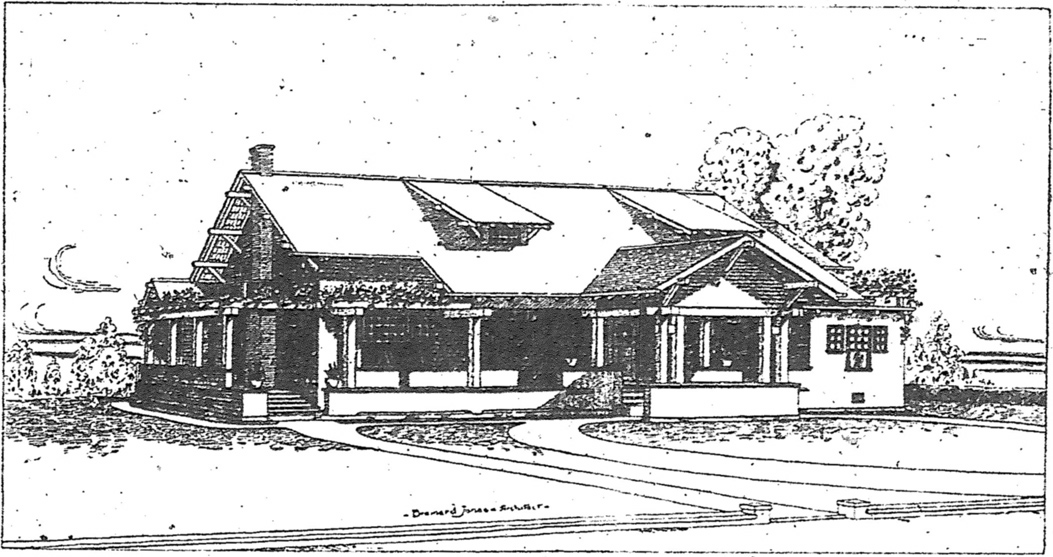 (RIGHT: Brainerd Jones' drawing of the Saturday Afternoon Club appeared in both newspapers. A different sketch also appeared in the August 13 Santa Rosa Republican, but the microfilm is such poor quality that it's not included here. CLICK or TAP any image to enlarge)
Only the Saturday Afternoon Club could have built such a place. The town was awash in "ladies' clubs" in that era, most with the sole function of planning afternoon card parties and get-togethers held at member's homes; a Press Democrat columnist guessed there were about 100 women's clubs, lodges and societies then in Santa Rosa. But no cards were shuffled at meetings of the Saturday Afternoon Club, where women might discuss a member's report on military tensions in Asia or listen to an amateur soprano from the club's Etude section warble through a program of Schubert lieder. One of the few personal details we know about Mattie Oates concerns a witty presentation on "The Laws of California as related to Women and Children."
The Saturday Afternoon Club was a group firmly in the traditions of the club movement, which was founded after the Civil War and took off around the turn of the century. Members were typically older women from the leisure class who sought intellectual challenge and culture. Such lofty aspirations made them easy targets for satirists and jokesters; think of the scene in "The Music Man" where the mayor's insufferable wife and her dowdy friends clumsily pranced and posed in an ode to a Grecian urn. The Club was founded in 1894 under the leadership of Jeanette Cochrane, a farmer's wife who found Santa Rosa to be a cultural sinkhole under the sway of dullards, at least as compared to her former home of Santa Barbara. There she belonged to a small "woman's club" that discussed literature and lobbied for civic improvements. The Club here certainly pursued literary matters with gusto, but until WWI it was not very active in civic affairs, perhaps because Santa Rosa had a busy "Woman's Improvement Club" that was tirelessly working for the town's betterment, such as coordinating with the S.P.C.A. to raise watering troughs to make them more humane for thirsty horses and cleaning up the Rural Cemetery. Rarely were members of that group singled out by the newspapers, but the names that did appear were almost always prominent members of the Saturday Afternoon Club, suggesting there was substantial overlap between the groups.
Central to the success of the Saturday Afternoon Club was its clubhouse, and that almost wasn't built, according to a 1994 Gaye LeBaron column. After the land was purchased from Mark McDonald Jr. for $800, all the banks in town refused to give them a construction loan, saying it was "crazy" to to take a risk on a social club, even one that included the wives of every prominent man in town. A wealthy aunt of club member Laura Cragin finally put up the entire $4,375, with another $100 tossed in for architect Brainerd Jones. Yet curiously, none of those interesting details were mentioned in either Santa Rosa paper at the time, which together printed over three dozen approving items about the Saturday Afternoon Club's mission to establish a clubhouse. Nor is Mrs. Cragin seen in the group photograph at the ground breaking. For having brokered a deal that saved the club's bacon, you'd think that she'd at least be rewarded by a snapshot of her throwing a shovelful of dirt.
 |  | ||
| |||
BEAUTIFUL CLUB HOME AUSPICIOUSLY OPENED
Pretty Scene Thursday Evening at Handsome Structure
The opening of the pretty club home of the Saturday Afternoon Club last evening marks an epoch and a decided step in advance for the City of Roses. The new home will be the center of intellectual and social development, and the scene of many pretty parties and entertainments in the future, as well as the place where splendid musical talent will be heard...
...Mrs. James S. Sweet, the president of the club, made the address of welcome to the assembled guests, and told of the beginning and completion of the work, of the sweet resignation of Architect Brainerd Jones when the ladies proceeded to "prune" his plans, of the painstaking work of Contractor J. B. Durand and his corps of subcontractors....
...Mrs. Robert Potter Hill, former president of the State Federation of Women's Clubs, and Judge James W. Oates made addresses during the evening. Each of the speakers made a talented address, the ladies bringing greetings from the organizations which they represent, and speaking of the pleasures which they had at being present on so auspicious occasion and of the beneficial influence the erection of the Saturday Afternoon Club structure would have on other cities.
Judge Oates was happy in his remarks, and his advice to the ladies on getting rid of the pest known as "knockers" touched a responsive chord in the audience. Judge Oates has been the legal light who has piloted the ladies through the shoals on which they might have wrecked their enterprise, and to him especial credit is due, and which was mentioned by Mrs. Sweet in her opening address. Judge Oates is always heard with pleasure by the people of this city, with whom he is a great favorite, and his well modulated voice was heard to advantage last evening. The speaker suggested that all the members of the male persuasion of the audience should assist the ladies in every way to make their laudable endeavors all the more successful and brilliant. The achievement of the energetic ladies followed the crashing blow which devastated this city less than three years ago, he remarked, was all the more pronounced because of its accomplishments in the face of such an adversity and calamity. Never in the history of the world, declared Judge Oates, had such a blow fallen on a city as Santa Rosa had suffered...- Santa Rosa Republican, December 18, 1908
WORK ON CLUB HOUSE PROGRESSING WELL
Architect Brainerd Jonea was here from Petaluma yesterday looking after the Saturday Afternoon Club's new club house on Tenth street. He expressed himself as well pleased with the manner in which the work is progressing and of the work being done by the contractor. The brick work in the terrace was also commented upon favorably by the architect.
Contractor J. B. Durand has the club house under cover so that the rain will not interfere with the force of men engaged on the job. He sees no reason now why the contract will not be completed well within the specified time limit.- Press Democrat, October 18, 1908
CLUB HOUSE UNDER WAY
Ladies Pleased with New Structure Being Erected
The new structure being erected for the Saturday Afternoon Club on Tenth street is rapidly being pushed to completion. Contractor J. B. Durand has a force of men busy shingling the sides of the structure, and it will soon be enclosed. Some delay has been occasioned in the structure of the roof, as the heavy timbers for that portion of the structure have been ordered direct from Oregon. They will be here at once, and it is expected to have the roof on the structure before the rains set in.
The ladies of the club frequently visit the new structure and are well pleased with what is being done there. The club house, when completed, will fill a long felt want on the part of the ladies of Santa Rosa, and will give them a place where their musicals and other high class entertainments can be staged with proper effect.- Santa Rosa Republican, September 18, 1908
CLUB LADIES BREAK GROUND
Saturday Afternoon Members Start Building
An exceedingly pretty and impressive, tho' informal ceremony took place at 8 o'clock this morning at the site of the Saturday Afternoon Club House on Tenth street near Mendocino Avenue. The building contractors began work at that hour and the members of the club assembled to break ground. The ceremony was begun by the presidents of the organization, Mrs. Finlaw, the "mother president," turning the first shovelful of earth, and starting the work that will go on till a beautiful and artistic club home is completed. Mrs. Finlaw made a short and appropriate address to her sister members and co-laborers and relinquished the shovel to her successor in office. This was followed down the line presidents, who are Mrs. J. W. Oates, Mrs. A. C. McMeans, Mrs. Mark McDonald, Jr., Miss Lulu Leppo, Mrs. T. J. Geary, Mrs. W. E. McConnell, Mrs. James R. Edwards and Mrs. J. S. Sweet, the present presiding officer. Then the vice presidents took a hand, and this finished the official list and the members--the high privates--did their allotted part in preparing for the foundations.
There were present Judge James W. Oates and Professor J. S. Sweet, also Contractor J. B. Durand and Architect Brainerd Jones. John Ross, the photographer, posed the lady builders in an attractive bunch and took several pictures. The shovel will be preserved as a thing sacred in the club house.- Santa Rosa Republican, August 17, 1908
AWARD CONTRACT FOR CLUB HOUSE
Saturday Afternoon Club's Handsome Home on Tenth Street Will Soon Be Under Way
The contract for the erection of the handsome club house on Tenth street for the Saturday Afternoon Club, has been finally awarded to Contractor J. B. Durand of this city. Work will be commenced at once and will be finished as rapidly as possible.
A description of the building and the sketch of the same by Brainerd Jones, the architect, was published in the Press Democrat some weeks ago. The building will cost in the neighborhood of $5,000. An application for a building permit has been filed with the City Council, and will of course be granted.
The chairman of the building board is Mrs. James W. Oates. The members of the club will be glad to know that the work of construction is to be commenced and will be delighted when the building is ready for occupancy. Mrs. James S. Sweet is the president of the Saturday Afternoon Club.- Press Democrat, August 14, 1908
HANDSOME CLUB HOUSE TO BE ERECTED BY THE SATURDAY AFTERNOON CLUB
After some delay incident to certain alterations in the original plans, on Thursday morning the contract was signed with J. B. Durand to erect the elegant new home for the Saturday Afternoon Club on Tenth street, near Mendocino avenue.
This building is the first to be devoted exclusively to club purposes in this city and marks an epoch in the history of Santa Rosa. The ladies of the Building Committee have displayed much energy and business ability in their efforts toward providing the Club with suitable quarters, and they are to be congratulated on the consummation of their undertaking.
The plans, which were drawn by Brainerd Jones, are in the Chalet style of architecture. The exterior is to be wholly in shingles and with its spacious port-cochere, pergolas and porches, forms a very pleasing picture.
The large auditorium, lighted by electricity, will be floored with polished maple. Opposite the stage is a large fireplace and over this is a gallery thirty-six feet in length. From the stage open two dressing rooms provided with all conveniences. The kitchen is to be furnished with a gas range, instantaneous water heater, etc. The auditorium will be wainscoted to the height of seven feet to the plaster line. A unique feature of the finish is the use of stained shakes to ceil the roof under the main rafters.
The acoustic properties have been carefully considered by the architect and the building is admirably adapted to lectures and threatening, while the dancing floor will be unsurpassed in the city. All in all, the new building will be an ornament to Santa Rosa and a credit to the enterprising members of the Saturday Afternoon Club.
[..]- Santa Rosa Republican, August 13, 1908
When the ladies of the Saturday Afternoon Club elect which set of the several plans they are wrinkling their fair brows over, they will begin to build a club home that will be an ornament to Santa Rosa and a joy forever to club women who will dwell therein. The idea uppermost in the minds of the members of the organization is a pretty and commodious club house. It will not be costly nor elaborate in its adornments, but will be simple, artistic and genteel. Club homes are now considered necessary in social and fraternal organizations. The Elks in this city built themselves a splendid place where the cultured members of the order meet and enjoy the social features of their order. It is their rallying point and their home. The local Native Sons are now building a costly temple and it will be their fraternal and social home. Finely equipped club rooms will be a part of construction where the members will gather.
The Saturday Afternoon club house may be a rustic bungalow, wide eves, ornamental galleries, French windows, giving onto grace 11 balconies and terraces, approached by a broad driveway, sweeping in a half circle up through a porte cochere or roofed entrance at the front. The interior will be a large club room, capable of seating several hundred persons, elevated gallery at one end, with ornamental balcony where one may sit and enjoy refreshments and the literary menu from the floor below at the same time. Piano and other musical instruments will be provided for the Etude Section. Flowers and greenery will grow around and over this artistic structure and it will be a home indeed to the Saturday Afternoon Club of Santa Rosa. At the next meeting, the club will choose the plan and the building will begin.- "Pencil Gatherings Among the Social and Other People" Santa Rosa Republican, June 1, 1908
SATURDAY AFTERNOON CLUB FILES ARTICLES
The Saturday Afternoon Club filed its articles of incorporation with the county clerk Thursday afternoon. The ladies are enthusiastic over their project and there were many signers of the club's roll, each taking one share of stock in the proposition. The club is capitalized at $10,000 and the stock is valued at ten dollars per share...- Santa Rosa Republican, March 15, 1907
...A big step in the advancement of club life in our little city was taken on last Monday afternoon, at a special meeting of the Saturday Afternoon Club, held at the home of Mrs. Dr. C. H. Thompson. The object of the meeting was to discuss and decide upon the advisability of purchasing a lot and erecting a modern, up-to-date club house that would not only afford a great deal of pleasure to the members of the club, but would also yield them a good revenue by being rented to other clubs and individuals for social functions and various other purposes. The meeting was largely attended in spite of the inclement weather and the ladies were most enthusiastic and earnest in discussing the proposed plan, and after carefully considering the important question and looking at it from all sides, a vote was taken upon it that resulted in a unanimous decision in favor of building a club house as soon as possible and also an order to file articles at once and incorporate the club under the name of "The Saturday Afternoon Club." Judge J. W. Oates has kindly offered his legal advice and assistance in their future business transactions and the ladies appreciate this generous offer and realize how valuable and helpful Judge Oates can be to them in carrying out such a big undertaking.- "Our Social Affairs, by Madam Trice", Santa Rosa Republican, March 9, 1907
DECIDE ON CLUB HOUSE
Saturday Afternoon Club Will Have Handsome Home
At the meeting of the Saturday Afternoon Club held Monday evening, the members determined to incorporate, purchase the proposed site for their handsome club rooms and erect a large and commodious structure thereon, The meeting was one of the most enthusiastic ever held by the ladies and when it came to a vote on the proposition there was a unanimity of sentiment favoring the club house. Mrs. James R. Edwards, president of the club, presided at the meeting.
The lot which will be purchased by the ladies is one owned by Mark L. McDonald, Jr. It is located on Tenth street facing Joe Davis street, and location for their club house [sic]. The close to Mendocino avenue [sic], and the members believe it will be an ideal election of directors [sic] resulted in the selection of the following to serve in that capacity [sic]...
...The club has decided to incorporate under the name of "The Saturday Afternoon Club," and the articles will be prepared at once and filed. At subsequent meetings of the club the arrangements for the building will be undertaken and architects will be asked to submit plans for the structure. The members can be depended on to erect one of the most beautiful and cozy structures for their occupance that is contained in the City of Roses.- Santa Rosa Republican, March 5, 1907
LADIES TO BUILD FINE CLUBHOUSE
Special Meeting of the Saturday Afternoon Club to Be Held on Monday Afternoon
There is to be an important meeting of the Saturday Afternoon Club, both sections, on Monday afternoon at the residence of Mrs. Dr. C. H. Thompson, on Mendocino avenue, for the purpose of discussing incorporation, for the purchase of a lot at Tenth and Joe Davis streets, and the erection of a club house. It is hoped that all the members will be present and take part in the discussion. Most of the members are very enthusiastic over the probable purchase of the lot and owning their own club house. Mrs. James R. Edwards is the president of the Saturday Afternoon Club. While many lots have been considered it is certain that the club house will be located in or near the location mentioned, which is the locality in which the Saturday Afternoon Club had its origin and development.
[..]- Press Democrat, March 3, 1907
ORIGIN OF THE LADIES' CLUB
How Saturday Afternoon Club Came Into Existence
The Saturday Afternoon Club, Santa Rosa's foremost organization in music and literature, whose handsome club house was dedicated Thursday evening, was founded by five prominent ladies of this vicinity. Many years ago a meeting was held at the resident [sic] of Dr. William Finlaw, on Mendocino avenue, the ladies present being guests Mrs. Dr. Wylie, on McDonald avenue. The idea of forming the club was broached and discussed by these ladies, and from that inception the stately edifice has arisen to crown their splendit efforts.
The ladies were Mrs. Martin Cochrane of Kenwood, Mrs. William Finlaw, Mrs. A. C. McMeans, Mrs. Mark L. McDonald, Sr., and Mrs. J. G. Wylie.
The first officers of the club were Mrs. Finlaw, president; Miss Nellie Porter, vice president; Mrs. McMeans, secretary; Mrs. McDonald, Mrs. Wylie and Mrs. Cochrane, committee on constitution and by-laws. At the next meeting of the ladies, which was held at the residence of Mrs. Finlaw, the constitution and by-laws of the club were presented and adopted.
Miss Nellie Porter, who was chosen vice president of the club, was to have been president of the club, was to have been present at the original meeting, but was unavoidably detained. She was chosen an officer in her absence.- Santa Rosa Republican, December 18, 1908
Luther Burbank was clearly peeved when the reporter asked for comment on whether his greatest achievement was actually a failure.
At issue was a government pamphlet released a month earlier, at the close of 1907. The topic was the prickly pear cactus, also known as genus Opuntia, also known as Burbank's most profitable plant creation ever. The government experts were envious, Burbank told the reporter, because he had beaten them in developing a fast-growing spineless variety that had ten times the nutritional value of the regular plant.
The spineless cactus was Burbank's moon shot - an odyssey with the goal of creating a hybrid that would be as important to mankind as his namesake potato. Worthless deserts would become valuable pastures and croplands; the fields once used to grow animal fodder like alfalfa could now feed the world's hungry. It was his longest running project (a photograph in the Library of Congress collection shows Burbank tending a cactus seed bed c. 1890) and one that he called "soul-testing."
The rest of this article can be read at the SantaRosaHistory.com website. Because of recurring problems with the Blogger platform, I am no longer wasting my time formatting and posting complete articles here. I will continue to create stubs for the sake of continuity, but will be publishing full articles only at SantaRosaHistory.com.
- Jeff Elliott
This survey of the 1907 Santa Rosa newspapers concludes with 75 posts. I'm dismayed that it's still taking about a calendar year to document 12 months in this history, particularly since 1907 was a year with few earth-shaking local events. My only excuse is that there were a few other distractions that competed for my writing and research time.
This was a year mostly remembered historically for the Bank Panic of 1907, which led some in Sonoma County to bury their cash in the backyard rather than trust it in banks. Locally, the big news of the year was that Santa Rosa legalized prostitution. As you might expect, the respectable citizens of the town went nuts; church meetings were held to express outrage, and at the end of the year Miss Lou Farmer won a lawsuit against a "female boarding house" in her neighborhood.
Luther Burbank's entanglements that year came to resemble a French bedroom farce, with no fewer than four suitors pursuing his attention. Besides the researcher from the Carnegie Institution, there was a biographer and a tag-team of writers from a Midwestern publisher who had a deal with Burbank for a 10-volume encyclopedia on his work. Where a Parisian comedy might have an unexpected act 3 plot twist, it was announced near the end of 1907 that plans were dropped for creation of a "Burbank Institute" in Sonoma County - although it's unclear if such an institution was actually in the works. What?
For the Oates family, this was probably their last golden year. There were at least four parties at Comstock House in 1907, and both Wyatt and Mattie were very active in their social circles.
As a final salute to 1907, shown below is the oddest newspaper advertisement of the year (CLICK to enlarge). Santa Rosa Republican editor Allan Lemmon seemed to panic when he had too little copy to fill his pages; layout might suddenly shift to double or triple spacing, and once a large display ad was presented in someone's handwritten scrawl.
Now on to 1908: The Comstocks arrive!
 |
When I launched this journal in 2007, my ambitions were modest. Here would be articles that mentioned Comstock House, of course, and maybe a few items about the Oates and Comstock families. Three or four posts per year. A half dozen, tops.
But when I actually began wading through the old Santa Rosa newspapers, I found myself increasingly pressing the "print" button on the microfilm reader to capture articles that had nothing to do with the house or its families. These were stories begging to be told again, like the tale of the woman who turned up alive after her family had purchased a coffin, published an obituary, and planned a funeral service. Or the time when salmon were so plentiful in Santa Rosa Creek that a man caught one with his bare hands near downtown, then boarded a trolley car with the fish tucked under his arm. And then there was the holiday season of 1904, when not one, but two, men dressed as Santa Claus caught fire from candles on their Christmas trees.
This blog quickly morphed into a year-by-year history of Santa Rosa as seen from the slow lane - which isn't a bad way to gain a deeper understanding about American history, either. Writing about the local impact of the Bank Panic of 1907, for example, I strayed into research about the underlying causes, and the heated political battle of the following year to prevent it from happening again. Perhaps most important, I discovered that it was a more interesting topic than I'd ever expected, and found myself wanting to share the insights I had gained.
As I approached the end of writing about 1907, I found myself playing a familiar game: If I had a time machine and could only choose two events to visit from each of these years, which would they be?
Some picks are obvious. I'd have to visit April 18, 1906 to witness the horrors of the great earthquake, if only to seek answers for some of the many unresolved questions about what really happened on that day. Another must-see would be the Battle of Sebastopol Avenue on March 1, 1905; a steam locomotive retrofitted for "fighting purposes" and a human tug-of-war with the body of one of the wealthiest men in town - what's not to like?
After these no-brainers, the game becomes contemplative. Would I prefer to witness an epic occasion, such as the elite banquet at Bohemian Grove for Teddy Roosevelt's infamous daughter, or enjoy the personal satisfaction of dropping by a grand party at Comstock House when it was only two years old, and the Oates' had a string orchestra tucked behind potted ferns in the library? When it all sifts out, however, the events that I'd most like to have witnessed were all very public and rarely historically remarkable; these were simply very sweet moments in the life of a small community.
I'd like to have been in downtown Santa Rosa on a summer's Saturday night in 1905, when the stores stayed open late, everyone dressed up, and a brass band gave a free concert on the north balcony of the Court House; I'd have liked to be there on July 21, 1906, when the Pavilion Skating Rink opened three months after the earthquake, and Santa Rosans packed the place, eager to blow off their nervous tension; I wish I was around on May 18, 1907 for the special children's Rose Parade, which was a nice symbol of renewal after the disaster.
My second favorite moment for 1907 was an event so modest that I nearly overlooked it: The quiet evening of December 12, when members of the community came together to read and reminisce about Mark Twain. Selections from his works were read by five local men, all accomplished public speakers; it would have been pleasant listening. But even more interesting is what other treats some of them brought to this literary potluck. Dr. W. A. Finley (father of Press Democrat editor Ernest Finley), spoke about Mark Twain's youth in Missouri, where he also grew up at about the same time. The evening ended with Attorney Dougherty reading one of the best sections from Innocents Abroad, introducing it with the story of when he met the author. Any anecdote that might begin, "I remember when I once had dinner with Livy and Sam Clemens..." cannot possibly disappoint.
The short item in the Press Democrat the next morning was headlined, "Pleasant Evening With Mark Twain", but I believe I'd have gone farther, and written that it was the finest evening that Santa Rosans had shared in a very long time.
PLEASANT EVENING WITH MARK TWAIN
Presbyterian Brotherhood Have Literary Night With American Humorist for a Subject
The first in a series of literary evenings given by the Presbyterian Brotherhood of the Presbyterian Church took place Thursday evening in the church parlors and proved a great success from every point of view. Mark Twain, his life and writings, was the subject considered. There was a large and appreciative audience present and the readings and stories were all interesting and enjoyable...Arthur Hendrickson read extracts from the adventures of Huckleberry Finn, which has furnished amusement for thousands.
Dr. W. A. Finley prefaced his reading of the description of "The Coyote," with some incidents regarding the humorist's early life in Missouri, and the scenes of many of his stories. Judge Seawell followed with a number of enjoyable selections from the writings of the humorist. The Rev. W. Martin told a number of personal stories of the writer and read extracts from his "Any Old Thing" and was followed by Attorney S. K. Dougherty who told of his being at the same hotel and table with Mr. Clemens and his wife in the White Mountains. He read selections from "Innocence Abroad," [sic] including the story of how the party refused to enthuse at the many wonders shown them by the guide and the latter's dismay at their conduct.- Press Democrat, December 13, 1907
In a 1983 Press Democrat column, Gaye LeBaron compared him to a real-life Indiana Jones, "Scaling the cliffs of Indian dwellings preserved for centuries in the dry desert air...such is the stuff from which anthropological adventures are made." When I recently mentioned his name to archeologists, 2 out of 4 dismissed him using the same description: "Pothunter," which is an insult that ranks at the bottom near "grave robber" (it means an amateur who vandalizes prehistoric sites searching for interesting and/or valuable artifacts). The man was Jesse Peter. He wasn't Indy, and it isn't fair to call him a pothunter, either.
From his death in 1944 until recently, his name was on the Santa Rosa Junior College Museum in homage to his driving role in its creation. Jesse Peter was known in the 1930s for his donations of interesting rocks and Indian relics to the Junior College and for leading some field trips to the pueblos of the Southwest with JC students, documented in some very Indiana-Jonesish photos in the school's collection. His day job was far less glamorous; he taught shop class at Santa Rosa Junior High, where his challenge was guiding pimpled Santa Rosa boys to use hammers for hitting nails and not their thumbs.
Teaching "manual arts" was a midlife career change for him. Born in 1885, he studied at UC/Berkeley, but never graduated. His father - also named Jesse - had been a miner, and he likewise spent his early adult years knocking around mining camps, starting in the Mojave Desert tungsten mines during the boom period when that ore was considered as precious as gold (think: Filaments for those popular, new-fangled lightbulbs). After that came at least five years in the Alaskan gold fields near Juneau. "Jess" also spent some time as a construction worker and contractor. He was good at these jobs and earned a living, but it was a bit of a drifter's life.
At the same time, Jesse Peter had another identity as a well-known and respected figure in the world of archeology. In 1933 and 1934 he was among the 75 "experienced men" nationwide invited by the National Park Service to join the prestigious Rainbow Bridge/Monument Valley Expeditions. The group trekked into the vast, 3,000 square-mile "Four Corners" region of the Southwest - then accessible only by horseback and mule - to document Navajo culture in the remote area and begin archeological research into the little-known Anasazi people. (There are thousands of photos from the expeditions available here, but participants are rarely identified.)
Closer to home, he documented over 200 archeological sites in the North Bay, more than anyone else of that era. He had an uncommon eye for seeing what other's couldn't; his most significant discoveries locally were probably the locations of the enormous obsidian quarry at Annadel State Park and the large Pomo village now covered by Santa Rosa's City Hall.
That Peter spent his last decade associated with the Junior College and the creation of its museum gives a nice arc to his biography - he was just about the same age as a SRJC student when he made his astonishing debut as an archeologist. In 1907, when he was just 22 years old, he donated to UC/Berkeley a collection of over 600 artifacts that he had excavated near Santa Rosa, apparently on his family's farm. These "finished and half-completed mortars, spear points, knives, and ceremonial instruments," according to a university newsletter, included "several pieces of types that have not been discovered before and are therefore of particular importance." Over three decades later, it was still described as one of the most important private archeological donations ever made to Berkeley.
Given his lifelong interest in the field, it may seem strange that Jesse Peter didn't become a professional archeologist, but you have to consider his time; had he finished a degree at the university he would have been a member of the class of 1907, when there were few career opportunities in archeology aside from college teaching or working as a museum preparator. There was also less stigma to being an "avocational" scientist in those days; another example from Peter's generation was John A. Comstock (eldest brother of Judge Hilliard Comstock), who became the acknowledged expert on California butterflies despite having no former education whatsoever. The difference between Comstock and Peter, however, was that Comstock published his research (always the academic yardstick of accomplishment) while nothing by Peter appeared in print - even as his field notes, maps, and artifacts were recognized as important and were being collected by the University of California and other institutions.
 (RIGHT: Jesse Peter in the 1930s. Photo courtesy Santa Rosa Junior College Museum.)
Peter's reputation is further diminished by our modern revulsion over the destructive nature of archeological practices of a century ago. In the photo seen to the right (CLICK to enlarge), he is counting tree rings to calculate the age of a log shaped by Native Americans. While modern scientists have the technology to bore tiny core samples into wood, it appears here that the hewn tip of the log was sliced off with a saw, destroying much of the worth of this object - and possibly the entire site - to future researchers.
And finally there's the "pothunter" label, which likewise has to be understood in the context of the day, when the belief was that important objects had to be taken away and preserved before they were grabbed by treasure hunters, accidentally destroyed by development, or ended up on someone's knicknack shelf. "Everyone picked up objects back then," an SSU anthropologist told me, "including the most well-known names. You can't point fingers."
MAKES GIFT TO UNIVERSITY
Jesse Peter, a former well-known young man of this city and a graduate of the high school here, has presented the University of California at Berkeley a valuable collection of prehistoric implements obtained by him principally from the deposits around the warm spring two and a half miles east of Santa Rosa on the Peters place. The specimens were found at varying depths ranging down to more than twenty feet below the surface. The collection includes more than six hundred pieces, of which many are rare objects not commonly represented in museums. It is of special value because all of the material has been obtained from a limited area and the facts relating to the discovery are all available.- Press Democrat, August 24, 1907
JESSE PETER'S GIFT TO THE UNIVERSITY
Archeological Remains Found Near Santa Rosa Are Given to Museum at Berkeley
The University of California Weekly News Letter acknowledges a gift from Jesse Peter of this city of archaeological remains unearthed near Santa Rosa. The letter says:
"Jesse Peter, of Santa Rosa, California, has presented to the Museum of Anthropology of the University a collection of archaeological remains from the vicinity of Santa Rosa. This collection comprises several hundred pieces, including finished and half completed mortars, spear points, knives and ceremonial implements. There are several pieces of types that have not been discovered before and are therefore of particular importance. Of special interest is a large series of chipped obsidian implements and charm stones, all found in a large spring where they were evidently for a long period deposited as offerings by the Indians of prehistoric times."- Press Democrat, February 2, 1908
Few events in American history had such a direct and immediate impact on Sonoma County as the Bank Panic of 1907. Although Ground Zero was the New York City financial district, the tsunami that rippled west from Wall Street hit the Pacific coast two weeks later. Everyone who read the papers knew the general history of recent events, and anticipated the worst was coming; it was like California was the last child in a long line of children waiting for to receive a doctor's shot with a big, scary needle. People in Sonoma County began literally burying their gold and silver coins in their backyards rather than trust local banks.
The local papers were sketchy on the details of what was happening out east, but it was clearly bad. Stocks were crashing; a bank run on one of the country's largest trust companies forced it to close, with thousands of depositors losing their savings. "FINANCIAL SITUATION IS PANICKY ALL OVER COUNTRY," was the Press Democrat headline on Oct. 24. These were not problems that touched most Santa Rosans, who kept their money in local banks; few in this farm town would have played the stock market. But then came news that must have terrified them: The local banks would soon be paying withdrawls in something called, "clearing house certificates" instead of money.
Only those who lived in the eastern U.S. during the summer of 1893 had probably seen such a thing before. Certificates were intended to provide some traction for the financial system when it was skidding towards a cliff. During such a severe crisis, the clearing houses - which were normally obscure waystations in the banking world where checks were exchanged between big banks - would be allowed to print these certificates and use them as if they were U.S. currency. At the end of the crisis, everyone could exchange this quasi-legal tender for cold, hard, cash. It's understandable that many were uncomfortable about this funny money; these certificates weren't backed by a precious metal, or even in the name of the United States Treasury, but were issued by unofficial, unregulated consortiums of regional banks - which might also close if there were a total banking meltdown. Skeptics probably buried their remaining coin more often that we'd expect.
 There was another unique problem with certificates in California and Nevada: People in 1907 were still accustomed to using gold and silver coins (minted in San Francisco) for regular business, not paper greenbacks (printed in Washington, D.C.) - in fact, a contemporary source pointed out that the public held different meanings for the words, "currency" and "money." It's understandable that some balked at being forced to accept nondescript slips of paper cranked out quickly at some local printing place. The enormous Goldfield mining camp shut down in November because workers refused to accept the clearing house scrip; troops were called to protect the scab miners who were sent in.
Criminals exploited the public's unfamiliarity with paper money; a farmer in Northern California was arrested after he tried to pay an immigrant worker with cigar coupons, telling him they were certificates. A certificate counterfeiting ring in Sacramento was busted, with one member confessing, "Why, it is the easiest graft I know. With $3.50 I can make $10,000 worth of those certificates and they will pass. All one has to do is get the paper, a little colored ink, make a stamp of the signatures and run off a batch as long as the paper and ink last." And in Arcadia, a crook robbed a victim of $3 in certificates, and when taken to court, used the defense that since the paper had no technical value, it couldn't be a felony to steal them.
Sonoma County bankers formed their own Clearing House Association with twenty member banks, printing their own certificates in $1, $10, $20, $500, and $1000 denominations (alas, I can find no images of any of these, and a collector's price guide suggests that they are quite rare). By mid-November, the county was using these certificates to pay its debts. But at the same time, the county was refusing to accept certificates in payment of taxes. If you didn't have the gold coin, you had to pay the taxman with a certified check from a bank. That's a vote of confidence in the clearing house, yessir.
In the end, the clearing house certificates probably saved the Sonoma County economy that year. The crisis hit just before the main local crops, hops and wine grapes, were to reach the market. If the banking system was still paralyzed, growers probably would have been forced to sell their crops at ruinous prices.
That wraps up the Sonoma County angle to the Bank Panic of 1907, but as I was researching the topic, I was dismayed that I couldn't find anything on the Internet with a clear explanation of why the crisis happened, although there are many disconcerting parallels to our recent financial firestorm. I also discovered there was an unsolved mystery concerning an apparent attempt to incapacitate (and potentially, murder) a senator in the United States Senate chamber. Lots more interesting stuff in part 2.
MOST SENSATIONAL DAY IN HISTORY OF STREET
- Press Democrat headline, October 23, 1907
FINANCIAL SITUATION IS PANICKY ALL OVER COUNTRY
- Press Democrat headline, October 24, 1907
FINANCIAL FLURRY HAS REACHED PACIFIC COAST
Governor Declares a Holiday for the Banks
- Press Democrat headline, October 31, 1907
GOVERNMENT FUND DEPOSITS
When money is "tight" on Wall street the United States government often relieves the tension by depositing government funds in the Wall street banks, so that these banks may in turn lend the money to their customers.
Congressman Burleson of Texas thinks that other parts of the country and other interests are as much entitled to this sort of assistance as Wall street and its money kings. He has begun a campaign to secure government deposits of ten million dollars of public funds in the banks of the west and south to be secured--not by stocks and bonds of finance, as is the case in New York--but by cotton, tobacco, and wheat to the value of forty millions--the goods to be stored in government warehouses as security before the money is loaned.
Such measures as this have often been proposed, but never before with such prospect of success as now. The turning of the light upon Wall street's dark places has had the effect of opening the eyes of the people to the fact that Wall street does not own the riches of the world or control the destinies of the nation. But Wall street has pulled the strings for a long, long while; and will not let go without making a fierce "roar."
There is a local application of all this, although it may not at first glance be apparent. Farmers here can find no present market for their hops and wool, because money is "tight." There is no particular reason why government money should be loaned to banks on paper security in order that the banks may loan it again on better security. The government can take that security as well as the banks can, and it will not be surprising if some such result as that now proposed by Congressman Burleson should in time work itself out.
- Press Democrat editorial, October 27, 1907
LOCAL BANKS TO STAND TOGETHER
Important Meeting Held Here Last Night to Consider Financial Situation
"All principal clearing house associations in the United States, including San Francisco, have gone on clearing house basis and will not ship money to correspondents. We suggest you organize locally for protection. Stamp your drafts on as payable only through San Francisco clearing house."
The above telegram ws received by all of the local banks yesterday from their respective San Francisco correspondents.
Last night a meeting of the banks of Santa Rosa, Sebastopol, and Guerneville was held to consider this telegram and what action was to be taken.
It was the sense of the meeting that local conditions are sound and satisfactory.
We are in the midst of marketing one of the most valuable crops in the history of the county, on which large advances have been made by the different banks, and on which returns cannot be immediately received owing to conditions existing as outlined in the above telegram.
Statements of the different banks show ample funds on hand to handle all necessary requirements, provided the money is not withdrawn from circulation or diverted to other localities.
All of the banks agreed to stand together for the protection of their depositors, and to care for local business.
Checks will be handled in the usual manner but cash will be paid only when actually necessary.
It is hoped that these conditions will not long be continued. Meanwhile, people should aim to handle their funds in a manner as nearly normal as possible, as this will hasten the resumption of the usual order of things.
- Press Democrat, October 31, 1907
NEW PAPER MONEY HAS APPEARED HERE
W. H. Grissim, of "The Swell" received a $10 Clearing House certificate, probably the first seen in Santa Rosa, over the bar Thursday evening in payment for a couple of drinks, It was tendered by a well known traveling man, who said he was given ten of the certificates when he left San Francisco for expenses as there was no cash available for the firm.
The certificates are printed in a neat manner on special paper carrying a certain water mark and are signed by the Secretary of the Clearing House Association in person while the President's signature is a facsimile printed on. The paper is worth face value through the clearing house and will be accepted by banks on deposits the same as a draft or check, but cannot be cashed in. They will be taken for collection.
People arriving from Sacramento on Thursday tell of the appearance there of a large quantity of paper money. The latter has never been acceptable in California, but it is said it has come to be so common in Sacramento as to pass without comment during the past week or ten days. It will probably become quite common all over the state as a result of the gold stringency.
- Press Democrat, November 8, 1907
CLEARING HOUSE FOR THIS COUNTY
Organization Effected at Meeting of Bankers Held in Santa Rosa Monday Night--Plans of Organization
Representatives from all of the twenty or more banks of Sonoma county were present here Monday evening at a meeting called for the purpose of completing organization which has been under formation for a week past.
As a result of the gathering the Sonoma County Clearing House Association was organized with President John P. Overton of the Savings Bank of Santa Rosa as president, and Cashier E. C. Merritt of the Union Trust-Savings Bank as secretary. All the cashiers of the various banks in the county were elected assistant secretaries, while the selection of a vice president was deferred until the next meeting.
Financial matters was discussed at some length and while everything was reported to be moving smoothly. It was decided that Clearing House certificates should be issued as occasion arises so as not to allow all the gold to work its way to San Francisco and other financial centers. This action is in accord with that of San Francisco, Oakland, Sacramento and other cities of the state as well as of the cities of other states.
San Francisco Clearing House receipts are being accepted by all the county banks for credit and exchange is being issued on San Francisco and New York as usual. Business is reported good and the deposits are larger than the withdrawals.
- Press Democrat, November 11, 1907
CLEARING HOUSE ASSOCIATION
The banks of Sonoma county have organized what is to be know as the Sonoma County Clearing House Association, the purpose of which is to allow the banks to afford proper assistance to their respective business communities by issuing clearing house certificates and to facilitate inter-bank settlements.
Every city in the country is now temporarily on a clearing house basis. There is no better money than a clearing house certificate. The certificates not only have behind them the strength of all the banks, but every dollar they represent is secured by the pledge of high-class securities far above their face value. They are as well secured as national bank notes, of which not one dollar ever did or ever will fail of redemption.
Except in California and Nevada, and to a less extent in Oregon and Washington, gold does not circulate at all in this country, and where people are accustomed to paper money the new form is accepted without question. The notes are not legal tender, it is true, but neither are national bank notes legal tender, and yet nobody refuses them. As between national bank notes and the clearing house certificates, one is precisely as good as the other. Some of our people, accustomed as we are to use gold and silver exclusively, are inclined to sniff a little at any paper money because it is new to them. But they need not worry. The certificates are as safe as gold, and except on this coast, are preferred as more convenient. It is merely a question of habit. If we should use the certificates a few months we might dislike to return to metallic currency.
But we are not likely to do so. We shall be back on a gold basis as soon as the great streams of gold now entering the country reach San Francisco and allow things to resume their normal state. Our banks are not out of gold. Far from it. And what is more, they do not intend to get out. In any large city there are a great many people who, whenever there is any talk about scarcity of money, will rush to the bank, draw out their gold, and hoard it. This is something that they will not be allowed to do this time, because such tactics are not fair either to the other depositors or to the business community as a whole.
As a result of he experience had during the past few weeks, when, for no good reason, there has been an unprecedented demand for money and in order to properly protect the country's business interests all the banks of the country have been compelled to get together and devise ways and means for providing additional circulating media. It is very probable that some form of legislation will be evolved to meet such conditions in future. There certainly should be. New conditions demand new methods, and the business of the country has now grown to such enormous proportions that the methods for so long in vogue are no longer adequate. When Bryan said there was not enough money in the country to transact the business of the country he knew what he was talking about. There is plenty of wealth, but not enough exchange media. This fact has now been demonstrated to the satisfaction of everybody, and Congress at its next session will be very apt, as it should, to enact laws providing the country with a more elastic form of currency than we possess.
- Press Democrat editorial, November 11, 1907
PAID IN CERTIFICATES
County Treasurer Murdock Kept Busy Wednesday Paying Claims
County Treasurer Glen Murdock was a busy man Wednesday when he paid off many claims against the county in the new clearing house certificates, issued by the Clearing House Association of Sonoma County, representing twenty banks. In all but a few instances the paper money was accepted cheerfully. Once in a while, because the person receiving the same, did not understand the situation, there was some reluctance at taking the certificates. Treasurer Murdock did his best in such cases to explain the matter to the satisfaction of the doubting Thomas. But for the purpose of accommodating patrons County Treasurer Murdock need not have opened payment on Wednesday had he so desired, owing to the fact that the legal holidays still continue.
- Press Democrat, November 14, 1907
THE PAYMENT OF TAXES IN BANKING CERTIFICATES
Somebody signing his letter "A Subscriber" but neglecting to give his name, asks why the city and county tax collectors will not accept certificates in payment for taxes. The county tax collector is receiving the certificates of the Association of Sonoma County Banks in payment of all taxes collected at his office. Under the advice of the city attorney, the city tax collector is not receiving these certificates. At the same time any taxpayer having certificates can take them to any bank in the county and receive a certified check for the amount of his taxes and the city tax collector will receive the same and deliver the receipt for taxes paid. An ordinary check drawn on any bank in the city, or for that matter, the county, will be accepted by the city tax collector if he is satisfied that the money to pay the check is on deposit. It seems that the failure to receive the certificates directly when they will be accepted indirectly is a technicality to considerable extent. Anybody having certificates of the clearing house of this county can pay any kind of taxes with them in the manner stated above.
- Santa Rosa Republican editorial, November 16, 1907
TEMPORARY DEPRESSION IS DUE TO WILD SPECULATION
- Press Democrat headline, November 17, 1907
PAID IN CHECKS; NO CASH ABOARD
Arrival of the Southern Pacific Pay Car in Santa Rosa Yesterday Morning--First Time in Years
The Southern Pacific pay car arrived in this city yesterday morning and it brought in a large supply of checks. It is a long time since the pay car came to town, the plan of late having been to send checks to the agents and have them in turn distributed to the men at the different stations.
In view of the financial stringency the men here and along the line had hoped that the pay car would bring cash as was the rule in the days ago. There was consequently some disappointment when checks were handed out. Of course there was no difficulty in cashing the Southern Pacific checks, only that some of the men objected to taking clearing house certificates in part payment when they came to cash them.
They pay car was so badly wrecked at Sacramento Wednesday night by the switching crew in the yards that it had to be left there for repairs, and a tourist coach was used to complete the trip for paying off.
- Press Democrat, November 23, 1907
HOW TO DETECT BOGUS PAPER CERTIFICATES
Now that "paper certificates" are becoming very plentiful, it is very good idea to learn to know the good ones from the bogus.
The "lines" or "threads" or "fibers," as seen in the ordinary government issues of paper money are not seen in the clearing house certificates, nor are they seen in ordinary checks with stripes both visible and invisible are seen in the latest suits made by Hodgson-Henderson Co., 517 Fourth st.
- Press Democrat advertisement, December 18, 1907
BURIED TREASURE WAS FOUND IN HEN HOUSE
While searching in the ground in the floor of the chicken house Sunday for the money, a son of the late John Wesley Sparks found about $140 that his father had buried there a few weeks ago. It was known that when the banks opened after the special holidays Mr. Sparks withdrew life savings and buried them. The money will be quite a help to the widow at this time.
- Santa Rosa Republican, February 11, 1908
Before the crisis, they said safeguards were in place to prevent it. During the crisis, they said some banks were too big to fail and needed an immediate bailout, or the U.S. economy might collapse. After the crisis passed, they said it had been caused by a few bad eggs and not underlying flaws in the system. They said that all the average people who ended up losing everything were to blame for their own misfortune because they were reckless and probably just as dumb as bugs.
Welcome to 2008. Welcome to 1907.
(This is the second part of an essay about the 1907 Bank Panic. Part I described its impact on Sonoma County, and explained how clearing house certificates worked and their impact on local economies.)
The usual take on what happened recently was that lenders were too easy with credit for risky subprime home loans, but we've since learned that the 2008 meltdown wasn't all that simple; insiders had created a new financial underworld that few really understood. They invented a complex game of credit default swaps, collateralized debt obligations, and toxic securities, to name just a few of the new cards they slipped into the financial world's playing deck.
History books usually explain that the crash of 1907 was caused by lenders who were too easy with credit for risky stock market deals, and once it began, events happened with the inevitability of falling dominoes. But the backstory of that crisis is as deep as the events that recently led to the collapse of Lehman Brothers and Bear Stearns. Only problem is, you can't find good information about causes of the 1907 crash online. There are a few books and papers on the topic (particularly "The Panic of 1907"), but these are either off-limits or available only as excerpts. (A short bibliography is included at the end.) None present a concise description of the root causes, and none continue the discussion into 1908, when Congress attempted to fix the problems.
So in sum, here's my take on the Bank Panic of 1907 and events leading to it, followed by a bit of a mystery story: One senator stood in the way of passage of the bill that would give banks new powers regarding the printing of "emergency currency," and he fell ill on the floor of the Senate. The story emerged that something had been slipped into a drink that was intended to incapacitate (and potentially, murder) him. If the near-collapse of the U.S. economy holds no interest for you, jump ahead to the "whodunit."
Looking back on it, the first surprise of the Bank Panic is that it took so long to happen. Every contributing factor was in place for at least a year prior, and many went back to the end of the last century:
 | MEET THE MEGABANKS In the dozen years before the panic, big businesses were on a merger frenzy, gobbling up other companies at an unprecedented rate, both up to that time or since; 93 corporations bought out 1,800 firms. While the smaller, pre-merged companies usually had relationships with local bankers, big conglomerates used big banks. As a result of this merger mania, banking became more centralized between a very few large institutions in New York, Chicago, and San Francisco. |
| A BANKING SYSTEM BUILT ON SAND America's Gilded Age ended in a trio of depressions during the 1890s, when thousands of banks failed nationwide. The ad-hoc state rules and regs that emerged afterwards appeared to stabilize the banking system; the markets were booming by early 1906, and only 53 banks collapsed that year. But it was a fragile network based on personal relationships between bankers and their back-scratching investments and deposits. The result was a banking world that worked smoothly only when there were no clouds in the sky; its inflexibility was revealed when calamity struck, such as a massive crop failure or... |
| THE 1906 EARTHQUAKE San Francisco was nearly destroyed in the Great Earthquake and Fire, but the impact of the disaster was also strongly felt in New York and overseas. To rebuild the financial epicenter of the Western United States, $50 million in relief money poured in from England and Europe. Faced with enormous insurance claims, some firms closed or paid a fraction of what was due, and the overseas insurers that did pay claims sent over literally boatloads of gold - another $65 million in bullion between April and September 1906 was shipped to America as cargo aboard regular passenger ships. (Attention Hollywood: Let's have lunch to discuss a movie about what could have been the greatest heist in the history of mankind.) In the wake of this enormous transfer of gold, a credit crunch spread across the Atlantic to New York, and from there on to the rest of the U.S. By the end of 1906, banks were gripping tight credit and cash. |
| TRUSTS ARE LIKE BANKS, ONLY DANGEROUS Why put your life savings in a boring ol' bank when you could open an account with one of the new trust companies and get much higher interest? In some states, the trusts held greater assets than the banks by 1907. No one seemed concerned that the trusts were held to looser regulations, such as only requiring 5% of the deposits kept as cash reserve. One of the largest, the Knickerbocker Trust Company in New York, had such shoddy business practices that few within the company, even management, knew details of their holdings, and the Directors rarely met. |
| THE CLEARING HOUSE RULES The keystone of the financial world was the clearing house, where large regional banks exchanged checks and bank notes. But it was more than a big room filled with bean counters and cashiers pushing wheelbarrows of money between vaults; the directors (presidents of member banks) formed the ultimate inner circle of the financial world. Members pooled their risk, and cheap short-term loans were routinely provided when any of institution needed help. During the weeks of the Bank Panic, the Treasury Dept. authorized the the clearing houses to print certificates that could be used as U.S. currency; once they had the ability to literally print their own money, certificates could be used for membership loans, making clearing house associates completely invulnerable to financial turmoil. The trust companies and the smaller banks didn't have such advantages, of course, and were forced to appeal for a clearing house loan (which meant the bank's owners might be forced to cede control), liquidate assets, borrow at high interest rates, or declare bankruptcy. |
The basic timeline of the crisis is well documented on the Wikipedia page. In short: The panic began on October 16, 1907, as a banker's stock manipulation scheme disastrously backfired. The banker couldn't make good on his debts and his brokerage house collapsed. A run on his bank followed, and the clearing house backed it up. It soon became known that the banker and his Wall St. partner had created a shaky financial empire via "chain-banking," where they would use their controlling shares in one bank as collateral to buy shares in further banks and trusts. The panic spread to these other institutions. When it came out that the Knickerbocker Trust was mostly financing the pair of scoundrels, customers lined up at their doors to withdraw their deposits. Knickerbocker's associated clearing house refused to stand behind them. The next day, a representative from one of the big banks walked into the lobby and cashed a check for $1.5 million. After another bank presented a $1 million check, the Knickerbocker closed. That was all during the first six days. (A brief discussion about media coverage of this period can be found in the previous essay.)
In the week that followed, almost every day a new crisis emerged that could have crumbled the foundations of the U.S. economy. Brokers at the New York Stock Exchange found no one willing to loan "call money" to keep the trading floor open; over four hours on Oct. 24, the interest rate on such loans shot from 6 percent to 100 percent. New York City had four days to raise $20-30 million or declare bankruptcy. And in each case, it was J. P. Morgan who came to the rescue, purchasing city bonds and constantly twisting the arms of bank and trust company presidents to come to the aid of their ailing brethren instead of hoarding their cash. At one point, he locked them in a room together and pocketed the key in his vest, refusing to let them out until they signed an agreement to cooperate. It's a cracking good tale and if you'd like to learn more, I recommend the well-told narrative in "The Panic of 1907."
When the dust began to settle on November 4, congrats were due Morgan and Treasury Secretary Cortelyou; only six of the national banks failed, and stocks were just down 37% from the last market peak of Sept. 1906. But survival came at a cost. At least four dozen banks and trust companies were closed, with their depositors losing everything. Money remained tight and the sudden shutdown of foreign investment had consequences, including partial blame for the Mexican Revolution of 1910. The banks that belonged to clearing houses emerged stronger and more powerful than ever before.
Most importantly, the 1907 panic destroyed all faith that there were adequate safeguards in the banking system to prevent another disaster. The bankers didn't want to work together to stop the crisis; rather, they sought to exploit it for short-term gain, or tried to weather it out by doing nothing at all, or stood paralyzed watching the disaster unfold, like innocents about to be stomped to death during Godzilla's Tokyo rampage. If not for the not-so-invisible hand of J. P. Morgan, the U.S. quite possibly could have led the world into the Greatest Depression.
Congress saw that some kind of central bank was needed, and a few months later passed the Aldrich–Vreeland Act, which became the groundwork for creation of the Federal Reserve System in 1913. More important in the short term was a new federal policy in case of another full-tilt bank panic; the country would temporarily switch to a government printed scrip. A little noticed provision in the Act, however, had the potential to change the entire banking system for the worse. To be deemed solvent, a bank would not need to have its cash assets in precious metals or government bonds; they could use any securities on hand. Thus (in theory), an institution might not have a single penny in its vaults, but be able to keep the doors open because it had old railroad stock certificates with a face value of millions of dollars on its books, even though the stock was actually worthless. The implications of this were staggering: If a stock certificate had a par value of $100, then it was worth $100 in scrip, which was worth $104 (including the guaranteed interest for certificates) in gold. In short, the Wall Street bankers would be motivated to create another crisis because resurrecting old stocks from the dustbins would make them enormously rich.
As the Act approached final debate on Capitol Hill, the only politicians concerned about this unprecedented change to the banking system were members of the tiny Republican progressive caucus of the Senate, led by Robert M. ("Fighting Bob") La Follette of Wisconsin. After he discovered that a last-minute provision had been slipped into the bill that specifically gave the banks power to include their worthless railroad bonds and stocks among their securities, he launched a filibuster on May 29, 1908.
 La Follette, who ran for the Republican presidential nomination later that year, believed that 97 wealthy men formed a "Money Trust" that secretly controlled the economy. Earlier that year he had read their names into the Congressional Record and spoke often about their cabal in speeches on the Senate floor and on the campaign trail. He argued that through their interconnected board of director memberships - primarily through Standard Oil and the Morgan banking houses - they conspired to manipulate markets, and even engineered the Bank Panic as a means to consolidate power. It's probably unnecessary to mention that La Follette has found a renewed following today on conspiracy web sites (example here). Although the interlocking directorships of the wealthiest companies was - and truly still is - an issue of great concern, the details of the 1907 panic prove the conspiracy-minded wrong; instead of acting in concert to manipulate the crisis, the elite bankers preyed upon each other with usurious interest rates, and ran to Morgan like frightened children begging daddy to fix.
La Follette personally filibustered for 17 hours, and another progressive senator followed for almost another two. While La Follette was taking a much-needed break, that senator flubbed his handoff to a third filibuster speaker. Senator Aldrich pounced on this parliamentary error, and the filibuster was over. The Aldrich–Vreeland Act quickly passed, but La Follette later claimed victory because he had exposed "another chapter to the record of the subserviency of Congress to special interests." Privately, President Teddy Roosevelt wrote that the filibuster was "pointless and stupid," and La Follette was "an entirely worthless Senator."
The Aldrich-Vreeland Act was repealed a couple of years after the Federal Reserve System came into effect, and was only invoked once, when over $300 million in emergency currency was circulated during the panic created by the start of WWI in 1914. Whether any banks took advantage of the stock par value loophole (or whether it even made it into the final law) is left for someone else to research. But there's an anecdote about La Follette's filibuster that's repeated by every biographer and often mentioned in books on the Senate's history:
During his marathon soliloquy, he maintained his strength via turkey sandwiches and numerous glasses of eggnog ordered from the Senate cafeteria. He tasted something foul in one glass. According to a recent book on the Senate, "He swallowed some and then screamed to his colleagues and the gallery, 'Take it away, it's drugged'...the moment made for great political theater." It is also sometimes mentioned that a subsequent chemical analysis discovered enough "ptomaine" (a general term at the time for a food contaminant) to have killed him if he had consumed the entire glass.
Did someone really poison La Follette on the floor of the Senate? Only a couple of general interest authors (and Senator Byrd in the definitive book on Senate history) go as far to speculate that it was done intentionally, and a few biographers propose that it was likely natural food poisoning, as it was over 90° in Washington DC and the drink consisted of milk and raw eggs, all handled and prepared before the age of modern refrigeration. Refreshing drink, thy name is salmonella.
But never is the basic story questioned, although there's not a single primary source from 1908 (that I can find) which mentioned anything concerning ptomaine tests, his flights to the bathroom, or remarks by La Follette, either quiet or screamed, about funky-tasting eggnog. Because the entire Washington press corps gave white-hot coverage to the filibuster - and hour by hour coverage at that, once it became clear that it could be a record-setting event - without mentioning any of those details, I was skeptical that it happened at all, and, frankly, have spent (too much) time working to debunk it. Here are the facts, you decide:
Reporters were united in praising La Follette's endurance. At the end of his 17 hour soliloquy, "his voice seemed to be almost as fresh as when he began," stated a wire story reprinted in the Wisconsin State Journal. "He was wonderfully fresh to the end," according to Walter Wellman, the Chicago Record-Herald correspondent who was apparently the best reporter on the scene. Other wire stories attest to his apparent unflagging energy during his marathon.
Not to say that he was robust health; he was bedridden for several weeks earlier in 1908 with the flu (which sounds more like pneumonia), and there were many mentions in the filibuster coverage that he was still recovering from an unnamed illness. "La Follette complained of his recent illness and during much of the day leaned strongly on the arm of a chair half sitting as he talked." (AP); "Senator La Follette, Weak From Long Illness, Keeps Senate In Session" (sub-headline on The Racine Daily Journal); "Mr. La Follette is not very well, and is, in fact, in poor physical condition for such a struggle." (Chicago Record-Herald). "He had come practically from a sick bed to make his fight" (Washington Herald).
The strongest case against the ptomaine ptale is that it's not mentioned in La Follette's 1913 autobiography, although he doesn't hesitate to belabor other illnesses that occurred at crucial junctures in his life. The story first appeared in a book published in 1912, written by a highly biased writer who viewed the political landscape as a starkly black-and-white battle between "reactionaries" against progressives, with La Follette as their great champion. After that, the story was forgotten for forty years, until his daughter and widow published a two-volume biography in 1953. This is the source cited by all modern authors, and worth quoting in full:
From time to time during the afternoon and evening Bob sent out messages to [his daughter] Fola, who was in the gallery, that he was "feeling tip top." Until late in the evening his strength was holding out far better than he had anticipated. At about 11:30, however, a discerning reporter noted that "it was apparent he was under a great strain. His words did not come anywhere near as easily as they had in the afternoon, and he embraced every opportunity for even a slight delay." Some time between ten and eleven o'clock, during the interval of a roll call, Bob had taken a large swallow from a glass of eggs and milk which had been brought to him on the floor. As it went down, he detected a vile, bitter taste. He handed the remaining three-fourths of liquid back to his clerk and said in a voice distinctly audible on that side of the floor, "Take it away," it's "drugged." Soon after that he had been stricken with a severe and painful dysentery unlike anything he had ever experienced before. Subsequently a chemical analysis of the remaining contents of the glass disclosed that it had contained enough ptomaine to have killed him had he taken all of it. At first the pain was so acute and he was in such distress that Bob thought "the jig was up" so far as continuing his speech was concerned. But by forcing several roll calls between 11:30 and 1:30 he managed to leave the floor for a few minutes and get back to his desk in time to resume speaking before each roll call was finished. |
The "discerning reporter" was from the New York Times, who indeed reported that La Follette appeared in distress. The source for the rest of the account was a letter from La Follette to his wife written a couple of days later, and now among his papers in the Library of Congress, so it should be considered his own version.
The first question is whether it's even possible that the story is true. It's impossible to say for sure because the "chemical analysis" is ancedotal, and a couple of important words are inexact; "ptomaine" was a generic Victorian term for any kind of food poisoning. It's also almost certain that he really didn't have "dysentery," which is a very acute condition and includes fever and bloody diarrhea; the Senator (or his wife) surely used the word to simply mean an epic bout of diarrhea.
If it was "ptomaine," the likey suspect was salmonellosis (salmonella), as guessed by a few biographers. But he claimed to have been sickened almost immediately; can food poisoning incapacitate someone within 60-90 minutes? Definitely not salmonella, which takes at the very least 6-12 hours to have effect. If La Follette had food poisoning he had to have been exposed to the toxins before the filibuster, or shortly after it began.
So could the eggnog have been "drugged," as he believed? Without (reported) fever or vomiting, the symptoms come down to diarrhea lasting a couple of very stressful hours, which could be easily explained by a powerful laxative slipped into the drink. Laxatives were considered a cure-all (even for cancer!) in that era, and every pharmacy had shelves filled with the latest name-brand cures as well as old-timey formulas. But the sort of violent, painful effect suffered by La Follette was hardly a selling point for most of these concoctions (one exception was an old formula called "Warburg's tincture," which was described as an "anti-malarial 'shot-gun' prescription" that would put you to sleep after a near-death experience on a commode - ingredients included aloes now banned by the FDA, alcohol, chalk, black pepper, and opium). And if you want to wander into an Agatha Christie scenario, the powerful Southeast Asian herb senna, which was used in tiny amounts in some of the old nostrums, could have been the culprit if enough was used.
But if something was placed in La Follette's drink, the most likely candidate was something probably found in every office on Capitol Hill: Magnesium sulphate, better known as "epsom salts." Normally used to soak aching feet and wrists sore from election year handshaking, it can also be mixed in a drink to create a strong, fast-acting laxative, albeit one with a quite bitter taste. It matches all the criteria, including the risk of death via respiratory paralysis if the senator had consumed the entire glass.
If epsom salts was the means, there were loads of people in the building that had personal and/or political motive to somehow force La Follette to sit down and shut up. The filibuster started on the beginning of the Memorial Day recess, when senators and their staffs were eager to flee the stifling Washington heat; the marathon session also prevented the cafeteria workers and all other Senate employees from going home. And, of course, there were the railroad lobbyists and their friendly senators who had vast riches to gain if the bill was passed. Like "Murder on the Orient Express," it's not hard to imagine that nearly everyone had some reason to do him in. But if I were detective Hercule Poirot, my first stop would be the medicine cabinet of bill author Senator Aldrich, who had remained on the floor throughout the entire filibuster, his keen eyes always "scanning the situation like an eagle," as noted by a reporter.
.
The Panic of 1907
Banking panics of the Gilded Age
Financing banking crises: Lessons from the panic of 1907
The Great Merger Movement in American Business, 1895-1904
The San Francisco Clearing House Certificates of 1907-1908
The 1907 Crisis in Historical Perspective (Harvard Center for History and Economics)
Robert M. La Follette, June 14, 1855-June 18, 1925, Volume 1
Robert M. La Follette and the insurgent spirit