Like robins in spring, the return of the Barlow boys to the Sebastopol work camps announced the arrival of summer.
 (RIGHT: Handwritten caption on photo: "A squad goes to a near by farm to pick berries." Photo early 1910s and courtesy Western Sonoma County Historical Society)
In the early Twentieth Century, California juvenile courts sentenced boys who committed minor crimes or deemed incorrigible to spend the rest of their youth at institutions not unlike a modern prison halfway house. One of these places, the Boys' and Girls' Aid Society of San Francisco, struck a deal with the Barlow family of Sebastopol; during summers the boys would camp on the ranch and pick berries and fruit for low pay. Soon other farmers wanted in on the sweet deal for ultra-cheap labor and it wasn't long before the Aid Society and similar institutions were sending up hundred of boys – some as young as seven – to work in West County fields and canneries every year. (For more background, see "SEBASTOPOL'S CHILD LABOR CAMPS.")
The year 1911 wasn't much different than previous years; at least four boys tried to escape and a pair of them made it as far as Sacramento – no easy task, considering their clothes were locked up at night and they probably had little or no money. The Santa Rosa newspapers predictably described the Aid Society children as being on "vacation" during their time here and boasted they were earning "splendid wages," without mentioning they were being paid a fraction of the rate formerly earned by the adult farmworkers they were displacing.
Some new details did emerge however; we learn the Barlow boys were sometimes working over eleven hours a day in the fields, which certainly puts a crimp in the ol' "vacation" portrayal. Thanks to a Press Democrat summary of the Aid Society's annual report, we find more than a dozen of the boys escaped or tried to escape from their facility in San Francisco during the year, so it wasn't just that they disliked their hands and arms being incessantly scratched by thorns all summer. The Aid Society placed employment above education and about two in three of the kids had a job, which suggests the Barlow boys were the leftovers, either too young to work or unemployable for some reason. Although they said "night classes are conducted for the benefit of these working boys and every boy is given an opportunity to improve his education," I'm certain a 12 year-old who spends all day sweeping factory floors is raring to be drilled on his multiplication tables after supper.
We don't know much about the boys individually except for the occasional anecdote, such as the two Santa Rosa kids who were sentenced there for truancy and stealing chickens in 1907. But we do know some interesting stuff about them as a group because a medical journal published a 1916 study of the "juvenile delinquents" at the Aid Society. We learn they were mostly a little taller and heavier and stronger than average for their age, with over half suffering dental problems – which is really no surprise as the kids were expected to pay for their own dentistry out of their earnings (clothing, too).
.
Measuring their physical traits is all well and good, but what the researchers really wanted to know was this: How smart were they? Linking criminality to low intelligence was one of the burning scientific questions of the day, and most of the boys were sentenced to the Aid Society for minor crimes – stealing, burglary, truancy and incorrigibility (children who committed serious crimes went to the Preston School of Industry at Ione, which was like a prison). To make sense of what they found, we have to first wade into the murky waters of the "IQ" test.

How do you estimate intelligence? At the turn of the century, you primarily measured the size and shape of someone's head; a pretty skull meant there were probably pretty brains inside, and a noggin that was small or shaped the "wrong" way meant the person wasn't too bright and probably wanted to steal your watch. There were other considerations (tattoos! long arms! "precocious" wrinkles!) but all came down to the nonsense that you could tell how smart, dumb, or inclined to criminality someone was by looking at their body.
French psychologist Alfred Binet was among a few pioneers in his field experimenting with a radical new approach: Evaluating how well someone answered questions and solved problems. In 1904 the French government hired him to develop a test to identify children with learning disabilities so they could be helped with special education. Over the next several years he refined his method with a colleague and the "Binet-Simon Scale" became the standard method of evaluating children, although he never claimed his technique measured intelligence.
Binet's test was adapted for American use in 1916 by Stanford University professor Lewis Terman, whose main interest was the opposite – using the test to spot "gifted" children. If those kids were given a good education, he believed they would grow up to be captains of industry, statesmen, brilliant scientists and other topnotch achievers. Professor Terman, it seems, was a true believer in the dark nonsense of eugenics with its notion some people are superior to others.
To prove his point, he followed over a thousand high-IQ youths – almost all white and middle class – around for the rest of their lives (Terman called the subjects his "Termites," yuk, yuk). Ultimately he proved himself wrong; while a great many of them went to college, overall they were no more successful than other American boys and girls in their generation. Only a handful made any sort of notable achievement, but ironically two young men who Terman deemed not smart enough to qualify later won a Nobel Prize in Physics (William Shockley and Luis Alvarez).
Terman's eugenic views are most obvious when he classified kids at the lower end of the scale. Binet called these children "retarded," meaning simply they weren't keeping up with their peers, and besides a lack of intelligence the cause could be family problems, bad teachers, or other reasons that could be fixed. When explaining how his test should be used, he worried that psychologists were too eager to tar these children for life by slapping labels on their backs with vague meanings such as "idiot," "imbecile" and "moron." Professor Terman and other eugenicists instead claimed those derogatory terms had scientific precision. Those below an IQ of about 25 he classified as idiots; a ranking of 25-50 was an imbecile; anyone between 50 and 70 was a low, middle, or high moron. Terman believed schooling these "defectives" was a waste of time and taxpayer money, except for vocational training. Possibly.
|
The problem with eugenics (well, one of the problems) is that it's built on the worst sort of slippery slope logic. Not only were defectives unteachable, declared Terman, but also prone to crime – a false assumption which still carried over from the days when we were looking at the shape of heads. In his 1916 book on the IQ test he wrote, "not all criminals are feeble-minded, but all feeble-minded are at least potential criminals. That every feeble-minded woman is a potential prostitute would hardly be disputed by any one."
So did the IQ study of the Aid Society kids prove Terman right? The researchers found "dull normals" – meaning just slightly below average intelligence – were most likely to be there because they were skipping school (interestingly, they were also ten times more likely than any of the others to have bad hearing).
In the other three crime categories – stealing, burglary and incorrigibility – the boys with normal intelligence exceeded or were tied with those classified as being not as smart. More than half of the "normals" were there for stealing or burglary. The researchers also did a limited survey of the Aid Society boys' backgrounds and it shows the main environmental factors they shared were extreme poverty and bad friends. It completely disproved Terman's eugenics theories; these bad eggs were mostly average boys who happened to be poor and hung out with the wrong crowd.
Whether Terman read that study is unknown but it is extremely likely, given that it was based on the Binet tests he was then adapting for American use. It certainly didn't make him waver in his views; as years went on his enthusiasm for eugenics hardened. He began saying some people – including entire nationalities and races – were uniformly inferior. He later wrote, "a median IQ of 80 for Italian, Portuguese, and Mexican school children in the cities of California would be a liberal estimate."
We also can't be sure if Terman ever came up from Stanford to visit Sonoma County, but if he did it was surely to meet Dr. Fred O. Butler of the Sonoma State Home (now called the Sonoma Developmental Center). Prof. Terman was an enthusiastic believer that "defectives" should be sterilized so they can't parent children, and Dr. Butler had turned the hospital into a sterilization mill, leading the nation in performing thousands of such operations. And when eugenicists later classified homosexual boys and promiscuous girls as sexually delinquent defectives, they were forcibly sterilized by Dr. Butler as well (see "SONOMA COUNTY AND EUGENICS" for more).
Today the reputation of Lewis Terman has been largely whitewashed. A recent textbook on multicultural education points out that high school and college texts are likely to describe his genius tracking study and his revision of Binet's scale but rarely is his eugenics history noted. A Google search for his name in scholarly books and journals shows the word "eugenics" appears in only 1 out of 10 works.
Yet the damage he caused was incalculable. By turning Binet's method – which wasn't intended to measure intelligence at all – into a written test with right and wrong answers, Terman made it easy to condemn people who tested poorly as inferiors, which usually leads to lives of lesser opportunities and hopes. He was a bad scientist with regrettable ethics; Terman was on the Advisory Committee of the American Eugenics Society and didn't resign until after Hitler came to power, so maybe he should be called clueless as well.
The one bright spot in this dismal tale is that in 1916, the Barlow boys proved him completely, utterly wrong about everything. Too bad he wasn't smart enough to pay attention.
DID GOOD WORK FOR THE BOYSAccomplishments of the Boys and Girls Aid Society--Boys Are Picking BerriesThe annual meeting of the Boys' and Girls' Aid Society was held on Tuesday for the purpose of hearing reports of the officers of the Society and electing a Board of Trustees for the ensuing year. In the absence of the president, Senator George C. Perkins, who is in Washington, D. C., the chair was taken by the vice-president, Charles A. Murdock.
The report of the superintendent, George C. Turner, gave the details of the splendid work of the Society for the needy boys of San Francisco and vicinity.
Two hundred and forty-one boys were received into the hands of the Society during the year ending June 30th, and received the benefits of special training and schooling including manual training under the Lloyd system.
The Society is working in conjunction with the juvenile courts and probation officers of this and other counties in the State and has received one hundred and forty boys from the courts.
As the boys improve in their conduct and when they have made satisfactory progress in their school work, they are secured positions through the employment agency maintained by the Society, through which one hundred and fifty-one boys were placed in good positions during the year.
The best qualities of manhood are developed by the care given the boys who are placed on their honor. This is shown by the fact that during last year 5,172 leaves of absence were granted on Sundays with but 13 failures to return--less than ½ of 1%.
For homeless boys the Society maintains the Charles R. Bishop Annex, where boys may board while they are learning trades and until they become self-supporting. These boys have individual rooms not very large, but neat and tasteful and have sitting rooms, library, and the family dining room where excellent meals are served at moderate rates. Night classes are conducted for the benefit of these working boys and every boy is given an opportunity to improve his education.
The younger boys are sent to approved country homes through the Children's Agency, the Children's Home Society and the Native Sons and Native Daughters Committee on Homeless Children, who last year placed out fifty-two boys for the Society. Children so placed are permanently removed from the streets of the city and often grow up in their environment.
In addition to the work in San Francisco, the Society maintains a summer camp on the Barlow ranch near Sebastopol, where last year one hundred and sixty-three boys were engaged in picking loganberries and Mammoths and Lawton blackberries, picking one hundred and ninety-four tons of berries and earning in all $3,948, of which the boys received $2,328.39, which was used for clothing and dentistry, and some of it put in the bank.
The summer outing is a great benefit to the boys and a great help to the berry growers, who have learned to depend on the boys for assistance in harvesting their berries.
The officers and trustees for the following year are: [...]
- Press Democrat, July 21, 1911
BOYS PICKING MANY BERRIESHaving Great Financial Success in Their LaborsSpecial Officer W. D. Scott, of the Boys' and Girls' Aid Society, came up on the evening train Tuesday with several boys, who were being escorted to the berry fields at the Barlow ranch near Sebastopol.
Two of the boys in charge of Mr. Scott had recently made their escape from the berry fields, having taken French leave at night. They passed through this city and made their way to Sacramento before they wee captured. They were Clarence Johnson and H. Chapman. They enjoyed liberty for four days.
Officer Scott declares the boys in the berry fields are not only having one of the finest vacations they have ever enjoyed, but they are meeting with greater financial success than ever before. One of the boys in camp earned $2.64 in one day during the past week and most of the boys are averaging splendid wages. The berries are ripening rapidly and the lads are laboring until 6 o'clock each evening in the endeavor to relieve the vines of their burden of fruit before it becomes too ripe for shipment.
On a recent evening the books at the camp were examined and it was found that the boys had collectively earned $1800 up to that date in harvesting the berry crop. The harvest will last for some time to come, and it can be readily be seen what a financial benefit the outing of the boys turns out to be. Aside from this it gives the lads one of the best vacations in the country that could be planned for them.
- Santa Rosa Republican, July 26, 1911
RUNAWAY BOYS RECAPTUREDTwo runaway boys from the Boys' and Girls' Aid Society camp at Mrs. Barlow's ranch in the Gold Ridge district were taken back to camp by officers of the association Saturday night, after having been caught here by Officer Nick Yeager.
- Santa Rosa Republican, July 31, 1911
BOYS EARNED MUCH MONEYBerry Harvesting Profitable to Large NumberSomething of the magnitude of the berry industry in the Gold Ridge section can be ascertained when it is realized that the forces of the Boys' and Girls' Aid Society this season earned more than $4600 gathering the crop. The boys were paid four cents per tray for the harvesting of the berries, both Logans and blacks.
The boys went into camp on the Barlow place about June 1st, and finished picking the berries on September 13. Their record this year shows that they have earned one hundred dollars more than on any previous year, the record of $4500 having been made in 1910. This would indicate that the berry crop was slightly larger this year than the previous season.
Two-thirds of this money will be distributed to the boys who earned it, and it will be given them in proportion to the amount earned by each individual boys. With the moneys [sic] given to the boys they have the right to choose what they will do with it, so long as the contemplated expenditure is legitimate. Many of the lads buy clothing, some place the money in bank to draw interest, while still others help their families financially. Most of the boys buy magazines with a portion of their coin.
During the year the boys were engaged in picking for about twenty people while they were in the Gold Ridge section. Their camp at the Barlow ranch was dismantled Friday morning, preparatory for their start for home and Old Glory, which has floated from the flagstaff there daily was hauled down with appropriate ceremonies.
Ninety-five boys were in the merry party which returned to San Francisco on the afternoon train Friday, having had one of the most enjoyable outings on record.
- Santa Rosa Republican, September 15, 1911
It was the best and worst of times for the two men; for 21 year-old Hilliard Comstock, 1912 brought memorable and happy days – but for his friend and mentor, James Wyatt Oates it was a year of retreat and sorrow as the health of his beloved wife, Mattie, slowly faded away.
 (RIGHT: Hilliard Comstock undated portrait. Image courtesy Martha Comstock Keegan)
The previous item covered the decline of the Oates', where it was noted the couple completely disappeared from any mention in the papers after July. Never before had that happened; even when they were away from Santa Rosa, there were always society column tidbits about who they were visiting, when they would be home, or such. The latest on Mattie's heart condition was reported obsessively until the blackout began. And what else happened that month? Hilliard Comstock became an attorney.
Hilliard – or "Hillyard" "Oomstock" as the local newspapers hilariously misspelled his name in separate errors – began reading law with Oates in 1909 and passed the bar examination on his first attempt. Not bad for a guy who had never set foot in any sort of classroom.
Before the end of July it was announced Hilliard would be practicing law from Oates' office in the Santa Rosa Bank building (now better known as the Empire building). They weren't yet partners; "Oates & Comstock" would not be painted on the windows for a couple of years. Then only a few days after that, he made his first appearance in the Superior Court as an associate of Oates' in a small damages case against the Southern Pacific railroad.
It is surely no coincidence that the Oates' vanished from public exactly the same week Hilliard stepped on stage. Having his protégé available to "mind the store" freed Wyatt to do whatever he wanted, which was likely nothing more than just staying at home by Mattie's bedside (hopefully not smoking his usual cigars).
Passing the bar and launching his legal career would be enough to keep most people busy, but also that July he was elected second lieutenant in the National Guard. Shortly after that first appearance in court Hilliard joined the rest of the local company in two weeks of maneuvers with Army troops in the Central Valley, so maybe Oates hung around his downtown office for a few weeks after all.
National Guard Company E was as much a boy's club as it was a militia, and the last sighting of Hilliard in 1912 is of him helping organize a blowout New Year's Day party. But his most notable social event that year was meeting future wife Helen at a barn dance. In her oral history, she recalled Hilliard always said he asked to dance with the pretty little girl who had "red cheeks and curls up on top of her head." According to him, 13 year-old Helen stuck a finger in her mouth and replied, "I don't rag, thank you." Helen said she didn't remember that, but Hilliard would laugh and swear it was true.
HILLYARD COMSTOCK PASSES AS ATTORNEYHillyard Comstock, one of the well known residents of Santa Rosa, took the bar examination before the Appellate Court at Sacramento on Monday, and successfully passed the ordeal. He will begin the practice of law in this city in the near future. Mr. Comstock's many friends are glad to know of his success.
- Santa Rosa Republican, July 2, 1912
LAW OFFICE OPENED BY HILLIARD OOMSTOCKHilliard Comstock, who was recently admitted to practice law, has opened a law office in the Santa Rosa Bank building and is ready to attend to all matters in the courts of the county and State. He has his office in the same suite as Colonel James W. Oates. Mr. Comstock has a great many friends who wish him every success in the practice of his profession.
- Press Democrat, July 24, 1912
NAME COMSTOCK FOR LIEUTENANTElection in Held by Company E Monday Night--Plans for the Encampment Next MonthColonel D. A. Smith, commanding the Fifth Regiment Infantry and Major L. C. Francis of the Third Battalion, Fifth Infantry, N. G. C. were visitors here over Monday night when Company E, which is a part of the third battalion of the Fifth Regiment, elected Hilliard Comstock as second lieutenant, thus completing its roll of officers, following the recent resignation of captain and lieutenant.
Mr. Comstock was only elected after five ballots had been taken and then by a majority of one vote. While the contest was close no feeling has been engendered and all will unite in giving the three new officers the support which goes to make a strong company. Following the election Mr. Comstock underwent his examination for the position at the hands of the visiting officers and made a very creditable showing. With the others he will now take the physical examination, and it is probable all three commissions will arrive at the same time prior to the Company leaving for camp.
Company E will join the regiments on Sunday August 11, in San Francisco, en route to Salinas to participate in the two weeks maneuvers in conjunction with the regular army, and the other militia forces in the state. It is necessary that thirty-eight men make the trip to maintain the standing of the company in the Guard. At the present time thirty members have signed the roll signifying their intention of participating in the maneuvers. Under the law the men will receive $1 per day from the State, and 50 cents per day from the Federal government for the occasion...
- Press Democrat, July 30, 1912
HILLIARD COMSTOCK'S FIRST APPEARANCEHilliard Comstock, attorney-at-law, made his first appearance in the Superior Court on Saturday, being associated with Colonel J. W. Oates as counsel for the plaintiff in the suit of George M. Root against the Southern Pacific Company. The plaintiff sues to recover property upon which the railroad entered in the L. J. Nolan addition to Santa Rosa, for $500 damages and for $250 for loss of rents and profits and for other relief.
- Press Democrat, August 6, 1912
CO. E BOYS TO HAVE HAPPY NEW YEARArmory Will Keep Open House and There Will Be Feasting and Right Merry TimeNew Year's Day will be a jolly one for the members of Company E. N. G. C. of this city. "Open House" is to be kept for the members from four o'clock in the afternoon until 12 midnight.
There will be some big "eats" too, for the soldier boys. The viands will include roast turkey, mince pie, plum pudding, cake, etc. In between the feasting Lieutenant Hilliard Comstock, who is much interested in indoor baseball, says there will be baseball and pool, billiards, etc. for the entertainment of the members. Captain Edward Walden Beatty and Lieutenant Leland Britton and Lieutenant Comstock, and the non-commissioned officers will be on hand to assist in giving every one a good time. Corporal R. L. Hunt will be master of ceremonies.
- Press Democrat, December 28, 1912
We don't know exactly when Mattie Oates had her first heart attack, but it might have been the night of the fire. Two weeks later, the Press Democrat's weekly society column noted, "The many friends of Mrs. James Wyatt Oates will hear with regret that she is ill with a trained nurse in attendance. The attack which was very serious at first has yielded to good care and attention."
While there was no damage to her home from the August, 1911 chimney blaze, it was undoubtedly a terrifying experience for the 53 year-old woman. Her death certificate would later date the beginning of her illness to that year and name the cause as "dilitation of heart" – an old-fashioned name for enlarged heart (cardiomegaly) – which is often related to a big spike in blood pressure. As in: What happens to you when someone is banging on your door in the middle of the night and screaming about your house being on fire.
From that point onward, Mattie was an invalid. Over the following months the society columns in both Santa Rosa newspapers chronicled her better days ("she is making rapid progress towards recovery") and her setbacks ("a specialist from San Francisco...held little hope for her recovery"). Yes, the columnists sometimes mentioned the health of other society matrons, but never with such obsessive interest.
Until the fire and heart attack, 1911 had been a good year for the Oates. They hosted at least three dinner parties at their home (which would later become known as Comstock House) and had house guests, including the beloved woman who was something of a godchild to them, the former Anna May Bell, who brought along her baby daughter. Wyatt stepped down as president of the Sonoma County Automobile Association after two years and was lauded for his service. And being the car-crazy fool that he was, he bought them a new car – a Hupmobile two-seater, with a peppy 20 horsepower engine.
But after her heart attack, every Oates sighting in the papers concerns her health and convalescence. The couple spent several weeks in Southern California during the 1911-1912 winter to escape the Northern California rains and visit friends. The gossip columns reported that Mattie was feeling better but Wyatt was bored; of Santa Barbara, he wrote to the Press Democrat, "The tourist crop is not yet quite ripe, and as they have no other here, it is very dull." Once back in Santa Rosa she had another relapse.
The Oates were slowly fading from public view; this item combines their doings in 1911 and 1912 because even the obsessive society column health updates ended after about a year. In 1912 Anna May visited again and in midsummer there was a small dinner in Mattie's honor at a downtown restaurant. That was the last mention of either of them for the rest of the year.
Not all was despair and deathwatch for James Wyatt Oates, however; at this same time the career of his protégé was launching, as covered in the following item. The path ahead for Wyatt and Mattie led into twilight – but for Hilliard Comstock, on the horizon was a bright dawn.
The many friends of Mrs. James Wyatt Oates will learn with regret of her late indisposition. A relapse following a sever attack of lagrippe has confined Mrs. Oates to her room the greater part of the past week.
- "In Society" column, Press Democrat, January 15, 1911
Colonel and Mrs. James Wyatt Oates are delightfully entertaining Mrs. R. G. Harrell of Fresno. Mrs. Harrell has visited Santa Rosa previously and made many friends who welcome her return as she is a most charming woman of the Southern type. Miss Bess Woodward is also a guest at the Oates home during her mother's Eastern trip.
- "Society Gossip" column, Press Democrat, March 5, 1911
An informal evening was enjoyed at the beautiful home of Colonel and Mrs. James Wyatt Oates Saturday when a few young friends dropped in to enjoy a game of cards. The reception and living rooms were gracefully decorated with roses, intermingled with greenery. "Spoff," a new card game, was played during the evening, after which a chafing dish supper was served. Miss Bess Woodward, who has been the guest of Mrs. Oates for the past few weeks, was the motif for the delightful evening.
- "Society Gossip" column, Press Democrat, April 30, 1911
Mr. and Mrs. Samuel Keeler Dunlap of Los Angeles, accompanied by their small daughter, Sue Elizabeth, are the guests of Colonel and Mrs. James Wyatt Oates. Mr. Dunlap will remain over Sunday, but Mrs. Dunlap, who will be remembered as the popular Miss Anne May Bell and Sue Elizabeth will stay for several weeks. Much interest is being manifest over the small girl as in the whole twenty months' span of her short life, she has not visited Santa Rosa. Sue Elizabeth bids fair to rival her mother in popularity and it is whispered baby parties will be quite au fait for this little miss.
- "Society Gossip" column, Press Democrat, June 11, 1911
Colonel and Mrs. James Wyatt Oates are entertaining a week-end house party in honor of Mrs. Samuel Kerry Dunlap of Los Angeles. The guests are congenial friends who have been entertained in the past at the Charles Rule ranch. Today a motor trip will be made to Bithers' Grove, near Healdsburg, where a quiet afternoon will be spent. The guests will be Miss Morrell, Mrs. Dorothy Farmer, Miss Hazel Farmer, Mrs. E. F. Woodward, Miss Bess Woodward, the guest of honor, Mrs. Dunlap, little Sue Elizabeth Dunlap and Charles Rule.
- "Society Gossip" column, Press Democrat, June 18, 1911
Larkspurs of the soft pastel shades, beautified the dining table upon the occasion of a dinner given by Colonel and Mrs. James Wyatt Oates Wednesday evening in honor of Mr. and Mrs. Francis Blair Hull, of Jackson, Mississippi, and Mrs. F. S. Sanberg of Los Angeles. Covers were laid for twelve guests, who enjoyed the charming hospitality that is always extended from the Oates home. An elaborate menu was served. The guests were: Mr. and Mrs. Francis Blair Hull, Dr. and Mrs. S. S. Bogle, Mr. and Mrs. Charles A. Wright, Mrs. E. F. Woodward, Mrs. F. S. Sanberg, Miss Woodward and Judge Thomas Denny.
- "Society Gossip" column, Press Democrat, August 26, 1911
The many friends of Mrs. James Wyatt Oates will hear with regret that she is ill with a trained nurse in attendance. The attack which was very serious at first has yielded to good care and attention.
- "Society Gossip" column, Press Democrat, September 10, 1911
Mrs. James Wyatt Oates is still confined to the house, but is convalescent. Saturday she showed a material change for the better, a fact that will be welcome news to her many friends.
- "Society Gossip" column, Press Democrat, October 1, 1911
MRS. OATES BETTERUpon inquiry on Thursday it was learned that Mrs. J. W. Oates is improving slowly. The doctor says that if she continues to improve the way she is now and no complications set in, she will recover. This is good news to her many friends, who have anxiously awaited good tidings from her bedside.
- Santa Rosa Republican, October 12, 1911
The serious condition of Mrs. Oates caused the postponement of the Cup and Saucer Club and the Afternoon Bridge Club which were to have been entertained by Mrs. Ross Campbell and Mrs. T. T. Overton last Tuesday and Thursday, respectively. The parties will take place this week.
- "Society Gossip" column, Press Democrat, October 15, 1911
It will be with regret that the friends of Mrs. James Wyatt Oates will learn that her condition is considered very critical. Saturday a specialist from San Francisco was called in consultation, and he held little hope for her recovery. Mrs. Oates has been a central figure in church, philanthropic and social circles for many years, and it will be the sincere prayer from may hearts today that she will be spared.
- "Society Gossip" column, Press Democrat, November 8, 1911
It is with pleasure that the friends of Mrs. James Wyatt Oates hear of her daily improvement. She is now able to walk around her room and each day sees marked change in her returning strength. She is, however, still unable to see callers as it is deemed advisable for her to be as quiet as possible. It will be with great cordiality that Mrs. Oates will be welcomed back into social affairs, where she has always been a pleasant figure.
- "Society Gossip" column, Press Democrat, November 12, 1911
MRS. JAMES W. OATES DEPARTS FOR RULE RANCHMrs. James Wyatt Oates departed on the Guerneville branch train Monday for the Rule ranch at Jenner, where she will spend an indefinite time in recuperation. It will be good news to the many friends of the lady to know that she has so far recovered that she could undertake the journey to the country. Miss Bertha Levy accompanied Mrs. Oates and will be her companion at the Rule ranch. Mrs. Oates has recently had a critical illness and at times it was believed she was in the shadows. She is now doing nicely and it is believed that with a change of climate she will rapidly regain her health and strength.
- Santa Rosa Republican, October 19, 1911
MRS. OATES ON ROAD TO RECOVERYThe many friends of Mrs. J. W. Oates will be pleased to hear that she is making rapid progress towards recovery at the Rule ranch where she has been for the past week. Dr. S. S. Bogle returned from a visit to the ranch Monday, accompanied by Mr. Oates and both expressed their satisfaction at the progress Mrs. Oates is making. Miss Levy is with the patient and with the fine weather they are able to be out of doors considerable as Mrs. Oates walks about freely.
- Press Democrat, November 28, 1911
MRS. JAMES W. OATS MAKING FINE IMPROVEMENTColonel James W. Oates and Dr. S. S. Bogle returned to Santa Rosa on Monday in the latter's touring car from Jenner, near Duncan's Mills, where they had been to visit Mrs. Oates. Colonel Oates had spent all of last week with his wife at the Rule ranch, and Dr. Bogle went over Sunday to ascertain how his patient was getting along. The improvement that has come to Mrs. Oates in her brief stay at the hospitable Rule home is little less than miraculous. The lady is bright and cheerful, able to take short walks with her nurse, Miss Bertha Levy and recently enjoyed a trip to the beach in a surry to which Charles Rule had hitched a spanking team. Colonel Oates is decidedly happy at the improvement and his face beams with smiles as he tells his friends of the splendid change. Mrs. Oates spends much of her time in reading in the sun on the big porch. There has been an entire absence of fogs during her sojourn at the Rule ranch, and only the sunniest and balmiest of fall weather has prevailed. Dr. Bogle is likewise gratified at the improvement Mrs. Oates has shown. The report will certainly be good news to the many friends of the popular Santa Rosan. Mrs. Oates' stay at the Rule ranch is indefinite.
- Santa Rosa Republican, November 28, 1911
Mrs. James Wyatt Oates has so far recovered her strength and health that since her return from Duncan's Mills last Sunday, she has been able to see intimate friends. Mrs. Oates has had a long and hard struggle with a serious illness, so the fact that she will soon be able to participate in social affairs will be pleasant news to her hosts of friends.
- "Society Gossip" column, Press Democrat, December 10, 1911
Colonel and Mrs. James Wyatt Oates will leave Tuesday morning for Santa Barbara and other southern cities. This trip is being taken with a view of giving Mrs. Oates, who is convalescent from a long and serious illness, a complete change of climate. They will be absent two months but during that interval Col. Oates will make several flying trips home to attend to business matters. They take with them the good wishes of many friends who hope they will enjoy their holiday and that Mrs. Oates will return entirely restored to health.
- "Society Gossip" column, Press Democrat, December 31, 1911
CARD RECEIVED FROM COLONEL OATESA card was received here Monday from Colonel James W. Oates from Santa Barbara. Her many friends will be glad to know that Mrs. Oates stood the trip nicely and is improving rapidly. They will leave Santa Barbara on Wednesday for Los Angeles, where they will visit Mr. and Mrs. D. A. Dunlap. Miss Dunlap was formerly Miss Anna May Bell. Colonel Oates says he does not see much difference in the Santa Barbara climate than ours. "The tourist crop is not yet quite ripe, and as they have no other here, it is very dull," he adds.
- Press Democrat, January 9, 1912
COLONEL OATES IS HOME FROM THE SOUTHLANDColonel James W. Oates returned to town from Los Angeles on Saturday, and after spending a few days here, he will rejoin Mrs. Oates there. In various places in the southland Colonel and Mrs. Oates will spend the next couple of months. They will remain in Los Angeles for some time and then go to San Diego. They will visit Del Mar near Santa Barbara, and will again return to Los Angeles for another visit prior to coming to their home here. Colonel Oates states that his wife is gradually regaining her strength and is undoubtedly being benefited by the change of air and scene. He is feeling fine and has already gained eight pounds in weight.
- Press Democrat, January 21, 1912
COLONEL AND MRS. OATES SOJOURNING AT LONG BEACHColonel and Mrs. James W. Oates have gone to Long beach, where they will sojourn for an indefinite time. They have taken apartments at the Southern Home and expect to have a good rest and much recreation there. Mrs. Oates continues to improve in the southern climate, and will be completely restored to health upon their return to the City of Roses.
- Santa Rosa Republican, February 7, 1912
COLONEL AND MRS. OATES FROM SOUTHLANDColonel and Mrs. James W. Oates reached their home in the beautiful City of Roses on Wednesday and are glad to be back in this delightful climate. As Colonel Oates expressed it on his return, this climate has some snap to it, and is far the best he has found after all. The last ten days the Santa Rosans spent in the southland it was hot, sultry and dry, and decidedly enervating, and had a somewhat weakening effect on Mrs. Oates. On the whole Mrs. Oates is much improved from her extended outing, with the exception of a slight cold, which she recently contracted, and which bothers her somewhat.
Colonel Oates had the misfortune to have an affection [sic] in his eyes while at Long Beach and was in the hands of a specialist and nurse for several days. Heated compresses and medicines were kept on his eyes in a darkened room for several days, and for a time the condition of his eyes was serious. He is compelled to wear smoked glasses still from the effects of the poison which attacked his eyes. Fortunately the effects of the poison were overcome and there will be no permanent injury to his sight. Colonel and Mrs. Oates find it decidedly pleasing to be back again among their friends and occupy their own cozy home. Many Santa Rosans will be glad to know they have returned.
- Santa Rosa Republican, February 21, 1912
Mrs. James W. Oates has made rapid progress toward recovery this week, and has regained much of her strength lost by the relapse occasioned by the trip home from the southern part of the State. Flowers and frequent inquiries concerning Mrs. Oates' progress toward health continue to pour into the Oates home. Very few visitors are permitted to see the patient and those for a very brief space of time.
- "Society Gossip" column, Press Democrat, March 10, 1912
Mrs. James W. Oates had the pleasure of motoring into the country several times this week. After having been confined to the house since her return from the south which was several weeks ago, Mrs. Oates has greatly enjoyed getting out into the sunshine.
- "Society Gossip" column, Press Democrat, April 7, 1912
Mrs. Anna May Bell Dunlap of Los Angeles was the motif for an informal afternoon tea on Thursday given by Mrs. Blitz W. Paxton. A few intimate friends dropped in and enjoyed renewing friendships with Mrs. Dunlap, who is very popular socially in Santa Rosa.
Colonel and Mrs. James Wyatt Oates are entertaining Mrs. Dunlap, who arrived the first of the week to make a visit with them. Owing to the condition of Mrs. Oates' health the social functions in Mrs. Dunlap's honor will be of a quiet nature.
- "Society Gossip" column, Press Democrat, May 12, 1912
In the CountryMrs. J. W. Oates is spending some time with Mrs. E. F. Woodward and Miss Bess Woodward, at their country home near Woolsey. Colonel Oates motors out in the evenings and returns to town in the mornings. The country air is benefiting Mrs. Oates.
- "Local Social Doings" column, Santa Rosa Republican, February 21, 1912
Mrs. James Wyatt Oates was the complimented guest on Tuesday, when Dr. S. S. Bogle gave a dinner in her honor at the Overton Grill. Shasta daisies and sweet peas gracefully intertwined with maiden hair ferns, artistically decorated the large round table, where covers were laid for eight. An elaborate menu was served. As this is the first social affair Mrs. Oates has been able to attend for a long period of time, owing to a trying illness, it was an event of much pleasure to the friends invited to meet her. The dinner guests were: Colonel and Mrs. James Wyatt Oates, Mrs. E. F. Woodward and Miss Bess Woodward, Mrs. Dorothy Farmer, Miss Edith Runyon of Los Angeles and Ralph Farmer.
- "Society Gossip" column, Press Democrat, July 21, 1912
It was great good luck the house escaped damage that August morning; had the fire been discovered just a few minutes later the big roof could have been engulfed and quickly after that, the entirety of the landmark home which would later become known as Comstock House.
The item appearing in the Santa Rosa Republican was maddeningly brief and vague. Apparently someone spotted flames coming from the chimney during the night and sounded a fire alarm, also waking Mattie and James Wyatt Oates. Firemen arrived and put out the blaze with a handheld fire extinguisher combined with another one provided by Oates. The incident seems to have left the Oates' shaken, as discussed in the following post.
Chimney fires were a serious concern in that era, when almost all buildings in residential areas had wood shake or shingle roofs. Not only could a structure burn quickly, but flying embers could set afire nearby buildings, destroying neighborhoods and even entire cities; the 1923 Berkeley fire saw nearly 600 homes burn in a few hours as wind-whipped flames raced over rooftops. Towns like Santa Rosa were particularly vulnerable because at the time of the Oates fire, Santa Rosa firefighters were no better equipped than they were during the 1906 earthquake, still using the same old horse-drawn wagons. When there was a real conflagration – such as the 1910 Levin Tannery fire – the Santa Rosa Fire Department had to rely upon citizens to volunteer their automobiles and swiftly ferry gear and crew between the station house and scene of the blaze.
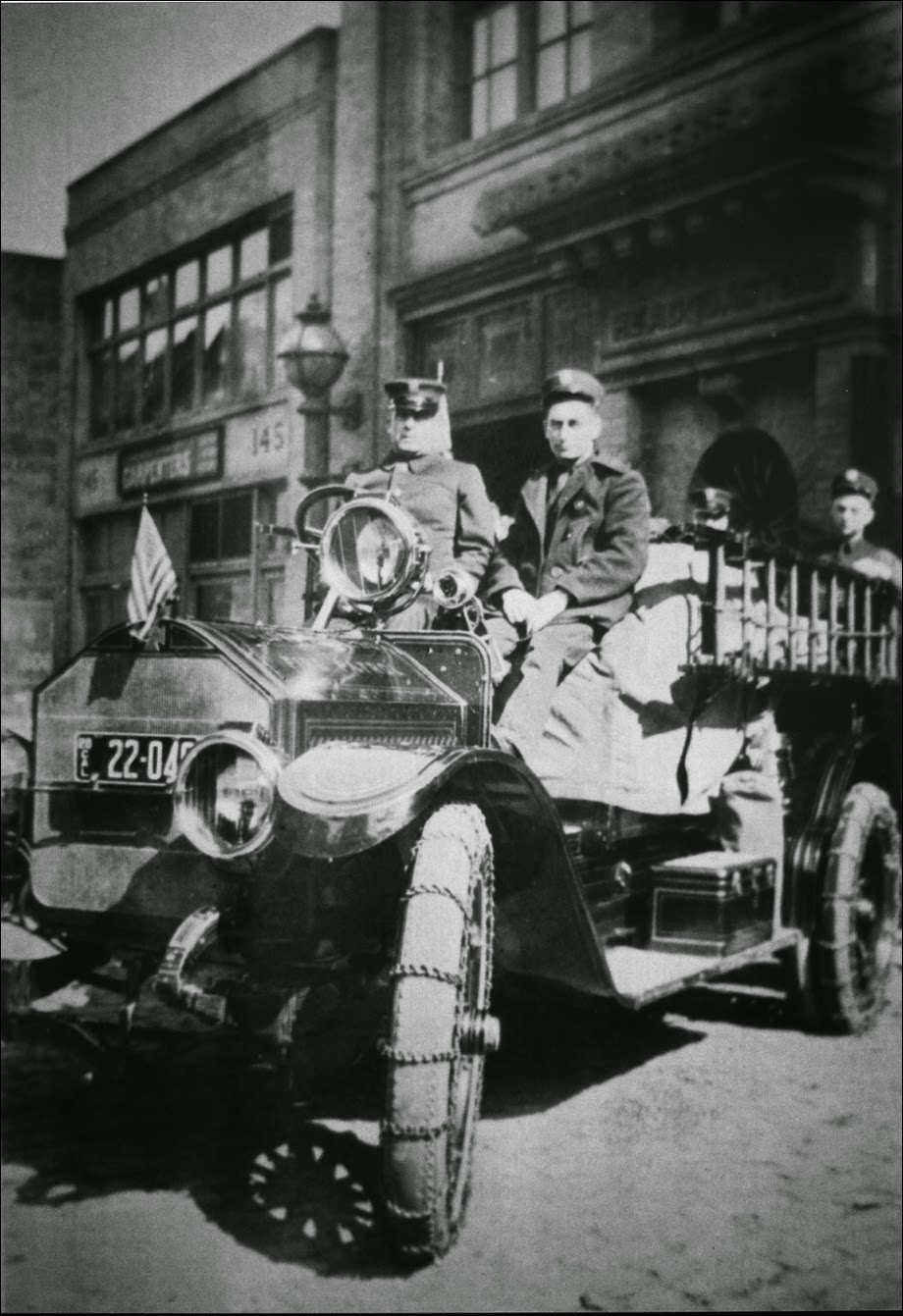 (RIGHT: Santa Rosa Fire Department seen in their Pope-Hartford fire truck, 1915. Photo courtesy Sonoma County Library)
All that was about to change later in 1911, thankfully. The city fathers, who shamefully went on the cheap in building the post-earthquake firehouse, were now willing to put a few bucks towards modern firefighting tools, including a gasoline engine fire truck.
The Knox truck dealership was vying for the sale and brought their latest model up from San Francisco. While demonstrating the machine's bells and whistles, a real fire alarm sounded in the Cherry street neighborhood. Firemen with the horse-drawn steam fire engine were quickly on their way. Not one to miss a great sales opportunity, the company rep invited the city councilmen and SRFD chief Frank Muther to jump aboard and head for the action.
Despite the driver not knowing Santa Rosa streets and taking a much longer route, the truck still reached the fire ahead of the horses. "The conflagration was a small one, but was quickly put out by the Knox chemical," reported the Santa Rosa Republican. "After the fire the members of the city council were taken for a ride about town." Deal closed, eh?
It was certainly a boffo demo, but a few months later the town chose instead to buy a Pope-Hartford model fire engine, which was a better known make. Like the Knox, it was technically a "Combination Chemical and Hose Wagon," which meant that it had tanks that could mix on the fly "carbonic acid gas" (AKA carbon dioxide) to smother flames. The Press Democrat article transcribed below gives a pretty good description of the truck's features, but additional details and a side photo can be found here.
Their Pope-Hartford fire truck was delivered in mid-December, driving up from the Petaluma wharf in less than an hour, thanks to its powerful 50 horsepower motor. Apparently the frenzy over its arrival was so great that a car hit their mascot Buster in front of the firehouse. "He was run over and killed by a careless auto driver who had the entire street, and yet would not get by without killing Buster," lamented the Press Democrat, noting the pooch was "a favorite with all who have occasion to visit the house or pass it regularly." As the Fifth St. PD offices were directly across the street, the writer undoubtedly had first-hand knowledge of the deceased.
The new fire engine finally brought the Santa Rosa Fire Department into the Twentieth Century and just a few months later, there was another page turned when SRFD chief Frank Muther retired.
Frank Muther was universally respected as fire chief and his tireless leadership on the morning of the 1906 earthquake likely saved the town from widespread destruction. Even Press Democrat editor Ernest Finley, who viewed Republicans with suspicion in that era, wrote admiringly of Muther in his collection of character sketches, "Santa Rosans I Have Known:"
| Frank Muther, pioneer cigar manufacturer and dealer, for years was chief of the fire department, and no matter what the hour he was always on hand when the bell rang. He was a picturesque character and in politics an ardent Republican, but with him friendship came first, even when everybody was supposed to take sides and when opposing tickets had to be place in the field as far down the line as dog catcher. Rough and often boisterous of manner, he was a real sport and an all-round good fellow. Muther was a man typical of the times. In later life he quieted down, as most men do, but he never lost his force and mental vigor. |
 (RIGHT: Frank Muther, 1849-1927. Photo from "Illustrated Portfolio of Santa Rosa and Vicinity," 1909)
Yet despite his historical bonafides, Frank Muther is about as forgotten as anyone can be forgotten. There isn't even a headstone on his grave (he's buried in the old Odd Fellows' Cemetery lot 21, just on the other side of the fence from the Fulkerson crypt in the Rural Cemetery). Possibly there was a wooden marker originally; in the 1950s the city made an ill-conceived effort to clean up weedy undergrowth at Rural with a controlled burn which ended up torching trees, roses and many, many wooden markers. As Muther's family plot and several others in that row are likewise bare, it's easy to presume the fire must have crossed the fence.
With the 110th earthquake anniversary coming up next year, some sort of tribute to that man is really overdue.
FIRE SCARE SUNDAY AT COLONEL OATES' HOMEThe residents of Mendocino avenue were alarmed early Sunday morning by an alarm of fire which summoned the department to the residence of Colonel and Mrs. James Wyatt Oates, at the corner of that thoroughfare and Benton street. A blazing chimney was the cause of the alarm, and an extinguisher that was on hand at the Oates home and one from the fire department extinguished the blaze. There was no damage from the fire.
- Santa Rosa Republican, August 28, 1911
AUTOMOBILE FIRE ENGINE WHICH MADE RECORD BREAKING RUN TO CHASE FIRE ON SUNDAYC. S. Richardson, manager of the Reliance Automobile Company of San Francisco and his chauffeur came up to this city Sunday morning, bringing with him a Knox automobile combination chemical fire extinguisher and hose wagon. He brought it here to demonstrate it to the city council in answer to the advertisement made by the city dads for bids for one of these machines to be addd to our fire fighting apparatus.
A fire in the residence owned by Mrs. Frank Graves and occupied by Mr. and Mrs. Guy Chase a few months before 2 o'clock gave the Knox automobile combination machine a chance to demonstrate its efficiency. Although starting from the engine house after the hook and ladder had left. It reached the fire first, going the long way to the fire, as the chauffeur did not know the direct route. The conflagration was a small one, but was quickly put out by the Knox chemical. Mr. and Mrs. Chase were over in Sebastopol at the time the fire started. They were preparing to move from the house, and the fire caught in some goods that were packed. The damage done was nominal. After the fire the members of the city council were taken for a ride about town by Mr. Richardson in the Knox. Mr. Richardson will be here until after the council meeting Tuesday evening.
The run to the fire was made under adverse circumstances, which taken in account, makes the Knox's performance remarkable. At the time that fire alarm 16 was rung in, no one was in the machine. It waited for Fire Chief Muther and several of the councilmen and others before starting and traveled a greater distance, turning three corners to one for the hook and ladder in reaching the conflagration. The working of the twin chemical tanks proved interesting to the people of the fire department. Both tanks have an outlet into one hose that can be run into the burning building. They are so arranged that while the chemicals are being used in one tank, the other can be filled, and then the chemicals drawn from the refilled tank without any loss of time. Chief Muther and the members of the city council who saw the demonstration at the fire and who went on the ride about town on the Knox, were greatly pleased at the high grade quality of the materials and mechanical construction, and its complete equipment.
- Santa Rosa Republican, May 1, 1911
CITY'S NEW AUTO CHEMICAL FIRE ENGINE HAS ARRIVEDSanta Rosa's new auto chemical fire engine, manufactured by the Pope-Hartford Automobile Company of Hartford, Conn., arrived last night, and is now at the Grand Garage on Main street. It is a handsome and substantially built machine, complete in every detail, and will be a valuable addition to the city fire-fighting equipment. It will be placed in commission at once.
The machine was brought up to Petaluma last night by boat, and from there proceeded under its own power, the run from Petaluma being made in less than an hour. S. W. Jewell of the Consolidated Motor Car Company of San Francisco and Charles O. Buckner of the Santa Rosa Fire Department were in charge. Buckner has been in San Francisco for several days, ever since the car arrived from the factory taking instructions as to its use and handling.
The machine is something like thirty feet long and the tires are 40xC. Two thirty-five gallon chemical tanks and two three-gallon hand tanks are carried, a thirty-foot extension and several smaller ladders and hose for the chemical tanks. Besides this a large space is provided for water hose. There is a full compliment of power for lights, including a huge searchlight, all by acetylene with electrical control. The finish is in dark maroon, with brass trimmings and the machine is appropriately lettered. The accompanying illustration gives a good idea of the appearance of the new machine. [Low quality photo on scratched microfilm not shown here - je]
- Press Democrat, December 16, 1911
BUSTER, THE FIREDOG, IS NO MOREBuster is dead. He was run over and killed by a careless auto driver who had the entire street, and yet would not get by without killing Buster.
Buster was the mascot at the fire engine house, a favorite with all who have occasion to visit the house or pass it regularly. The fire laddies amused themselves many an hour playing with the dog as he greatly enjoyed running after a stick, package or stone and returning it to the thrower with a wagging of his tail and a joyous bark.
- Press Democrat, December 17, 1911
HAS TENDERED RESIGNATIONFrank Muther Relinquishes PositionFrank Muther, Sr., who has been chief of the Santa Rosa fire department for several years past, has tendered his resignation of that position. Few men have ever served the City of Roses who have been better qualified in their respective departments than Mr. Muther, as chief of the fire department. He has been engaged in that work for many years, and has the matter of quenching conflagrations down to a science. The people of Santa Rosa have learned to regard Frank Muther as one of the most efficient chiefs on the Pacific coast, and he was always on hand where duty called, and in the thickest of the fray. At the time of the big fire here in April, 1906, he made a record for himself in the handling of the department.
- Santa Rosa Republican, April 4, 1912
Here's a shocking discovery: Ernest Finley sometimes loosened his tie and became quite the fun guy.
The Press Democrat's editor and publisher hardly had a reputation as Good Times Ernie; aside from occasional mention in the papers about card game parties or Elks Lodge shindigs, he didn't appear to have any social life at all. And when did he have the time? He was Santa Rosa's constant champion, tireless Chamber of Commerce booster and unapologetic defender of the status quo, sometimes locked in mudslinging combat with critics and reformers (see "The Many Wars of Ernest Finley").
 (RIGHT: Ernest L. Finley portrait in History of Sonoma County, California: Its People and its Resources, 1937)
All this makes it quite the surprise to read about the silly wager he made in 1911. After several years of depressed prices, the hops market rebounded that year. At the public auction Finley joked he wished he everyone in audience could get in on the boom, and the widow of a late friend offered to give him a bale of hops – but only if he would personally wheelbarrow it the ten miles from the farm to Santa Rosa. Finley accepted the deal.
Thus a couple of hours after sunset on November 6, Ernest Latimer Finley was prepared to start his trek with a customized newspaper handcart. "Mayor James R. Edwards and Hilliard Comstock had placed the bale on the cart and firmly lashed it in place," the Press Democrat later reported, in the first of two stories on the event. "A number of friends motored out to the Woodward ranch Monday evening to witness the outcome. The start was made at 6:30 and an an elaborate picnic was served by the roadside about half-way in. A large party of young people walked the entire distance cheering the man with the cart on his way." The headline from another paper read, "SOCIETY GIRLS WALK UNTIL MIDNIGHT ON FREAK BET".
Finley and his society girls reached the Press Democrat office shortly after midnight. "Don't say anything about this in the paper," Finley ordered his city editor. But an article appeared over his objection because the paper's staff "thought the story too good to be kept out." An item about the "freak bet" was picked up by the wire service and some newspapers nationwide ran it as a kind of believe-it-or-not item, the number of society girls sometimes growing to the size of a mob and the hop bale becoming as heavy as bricks.
The following day a special auction was held for Finley's bale. Milton Wasserman, the top hops buyer in town, bought it at the record price of $125 – but with the requirement that Finley continue his travails and personally cart the hops from downtown to the warehouse.
With his windfall Finley treated his youthful entourage to a weekend in San Francisco, including tickets to the Stanford-Cal football game.* Enjoying two nights of theater and suppers at his expense were a dozen twenty-something young people, nine of them women, along with two of their mothers. Among the party were Hilliard Comstock and Ruth Woolsey, whom Finley would marry about a year later.
Since the doings offer a rare personal glimpse of Mr. Santa Rosa, it's tempting to wonder what it reveals about him. For example, Finley was still a bachelor at age 41 and slightly more than twice Ruth's age; was he simply trying to woo his future wife with the machismo handcart stunt and treating her gang to a swell time? And were there other evenings, occupied with less savory events, when Finley staggered into the Press Democrat office late and ordered staff "Don't say anything about this in the paper"?
But the striking part of the hops story was the crowd of young people who thought it would be fun to follow him as he plodded along the country roads with the cart. Does that sort of thing sound familiar? It should, because it still occurs all over America today; now it usually just happens in school settings. A principal challenges kids to achieve some goal with the promise to do something silly or demeaning as a reward – maybe shaving off hair or singing from the rooftop if the students read a certain number of books or collect enough cans for a food drive. Google for "school principal bets students" and you'll find hundreds of recent examples. Let's revel in an intimidating authority figure playing the clown for us.
Actually, regarding Ernest Finley as Santa Rosa's self-appointed Town Principal works surprisingly well. In his editorials he often came off like a rigid fuddy-duddy demanding miscreants and rebels toe the line. He could be a disagreeable bully, raging when authority was not respected – criticism of the town or its leadership was a serious offense and the Press Democrat had a pattern of defaming anyone who crossed him (or the Democratic party, for that matter). Childish misbehavior was inflated by the PD in par with serious crimes, from stealing eggs to dropping orange and banana peels on the sidewalk. In his official portraits he even looked like a stern school principal; he attempted a smile in a later photograph, but it was more like the surprised expression of someone who had just sat on a tack. You didn't want to be called down to his office and hear the speech about how much he was disappointed in your monkey business and threatening suspension If You Do That Just One More Time.
 Whatever conclusions one draws (or presumes to draw) from the hop cart episode, it's still a cute story in its own right. It is also one that was almost lost; if not for transcriptions in Ann M. Connor's self-published 1970 book, "McDonald Avenue: A Century of Elegance," I would never have noticed the articles – the related microfilm at the Sonoma County Library is illegible. As seen to the right, the emulsion is almost completely wiped off on the image of this page from November 8, and what remains is badly scratched. Normally damaged film can be read by later use of heavy image processing but in this case there was almost nothing to work with. Sadly, much of the 1911 Press Democrat microfilm at the library is in equally terrible condition. I am certain there were many interesting stories from that year I also overlooked.
Alas, the Connor book does not list sources; the auction story was only identified to be the same as in the the damaged Press Democrat microfilm by its bold headline. Two of the other articles she transcribed were not from either Santa Rosa paper, so it's unknown where they first appeared.
* The "Big Game" was actually rugby between 1906-1914, a period when many schools dropped football because of concerns over game violence and player injuries. Cal won that year, 21-3.
 |
| Photo courtesy Sonoma County Library |
SOCIETY GIRLS WALK UNTIL MIDNIGHT ON FREAK BETTrudge Dusty Roads to Cheer on Clubman Wheeling Bale of HopsFor eleven miles along the dusty roads from the county home of the late surveyor of the Port of San Francisco, Edward F. Woodward of Mt. Olivet, and Ernest L. Finley, editor of the Santa Rosa Press and well known clubman, wheeled a cart containing a 192 lb. bale of hops, winning a wager whereby a party of young society people will attend the Stanford-Berkeley football game and enjoy a banquet in San Francisco.
The start was made about 7 p.m. last night and Finley completed his task shortly after midnight. He came into town with his cart of hops, to be sold and the proceeds devoted to paying the expenses of a trip to the football game and a dinner for a party of his friends if he would wheel the gift to Santa Rosa.
The wager was taken up and tonight when the bale was auctioned off in the presence of a large crowd of speculators, it realized over $100. Some of Santa Rosa's popular society girls and several men walked the entire distance with Mr. Finley. Halfway to town the entire company enjoyed a picnic in the moonlight.
- Source unknown, November 7, 1911; from Connor book, pg. 70 (see text)
WINS BALE OF HOPS ON WAGERE. L. Finley Wheels Hand Cart Along Dusty Road for Over Ten Miles Monday NightAs the result of a wager, E. L. Finley on Monday evening wheeled a handcart containing a bale of hops from the Woodward ranch near Mt. Olivet to Santa Rosa, arriving at the Press Democrat office a few minutes after midnight. The distance covered was something over ten miles. The hops weighed 132 pounds.
Under the terms of the agreement Mrs. E. F. Woodward and Miss Bess Woodward were to make Mr. Finley a present of a bale of hops provided he got them to market unassisted, the hops to be sold and the proceeds devoted to taking a party of friends to the Stanford-Berkeley football game on Saturday.
A number of friends motored out to the Woodward ranch Monday evening to witness the outcome. The start was made at 6:30 and an an elaborate picnic was served by the roadside about half-way in. A large party of young people walked the entire distance cheering the man with the cart on his way.
Several taxicabs and automobile loads of people drove out and met the man with the load of hops and the party accompanying him several miles from this city. It was a very merry salutation given, too. Cheers stirred the midnight air when the hops were landed at the Press Democrat office.
The bale of hops will be auctioned off today and they will fetch the top notch figure. Considerable lively bidding is expected, too. Those hops should be worth at least one hundred dollars.
"Don't say anything about this in the paper," said Editor Finley as he started for home at an early hour this morning, still walking by the way. But the city editor and staff thought the story too good to be kept out, and would not heed the request of the man who won the wager.
- Press Democrat, November 7, 1911
SPIRITED BIDDING MARKS SALE OF HOPS AT AUCTIONUnique Transaction is Completed Here Last NightMilton L. Wasserman, the well-known representative for the William Ullman Co. of New York, established a new price for hops last night at the Press Democrat office, when, at a spirited contest, he purchased at auction the bale of hops wheeled in the night before by Ernest Finley from "Pinecrest", Mrs. E. F. Woodward's fine ranch near Mt. Olivet.
The price at which the bale was finally knocked down to Mr. Wasserman was $125, and it was made part of the agreement that Mr. Finley was to personally deliver the hops to the warehouse, starting from the courthouse at noon today.
John P. Overton actioned as auctioneer...
...Just as the hammer was descending for the last time, and as Mr. Overton lingered over the words "going, going...!", Wasserman made his final bid, coupled with the stipulation that Mr. Finley should wheel the bale down Fourth Street today at noon. Mr. Finley nodded his acceptance of the proposition, the auctioneer from his exalted position on the office counter made a few more passes with his hammer, called upon Mr. Finley to bear him out in his assertion that the hops about to be sold were "extra heavy for the weight" and assured prospective purchasers that the goods were being sold "F.O.B. Santa Rosa, which is very different from having to bring them in from Mr. Olivet," ending by finally knocking them down to Mr. W. at the price stated. The result was greeted with hearty cheers from the large crowd present, as was each successive bid, for that matter.
A huge bonfire was then lighted in the street outside, and after another round of cheers and an exchange of felicitations, the crowd dispersed. (Referenced as first in Tuesday's paper of the wager.) Mr. Finley jokingly remarked that if he had 600 or 700 bales of hops unsold at the present prices, he would give the crowd one and tell them to go and see the fun. Mrs. Woodward replied that she would furnish the hops if Mr. Finley would wheel them to Santa Rosa.
The proposition was immediately accepted, and the following evening finally agreed upon as the time for making the attempt. An ordinary newspaper cart to which shaft handles had been temporarily attached by C. R. Sund, a local blacksmith, was used for transporting the bale selected, which weighted 192 lbs., and the distance covered was something more than 10 miles.
The start was made at 7:30 Monday evening, after Mayor James R. Edwards and Hilliard Comstock had placed the bale on the cart and firmly lashed it in place, and the event was made the occasion for a moonlight picnic party, a number of friends accompanying Mr. Finley the entire distance on foot, while others followed or proceeded in automobiles. At the top of the Mr. Olivet hill an elaborate picnic was spread and a stop of more than an hour was made. Refreshments were also served from the automobiles enroute.
The party arrived in town shortly after midnight, after a delightful evening, and Mr. Finley suffered no inconvenience whatever from the trip. Among those making up the party were Mayor & Mrs. Jas. Edwards...and Hilliard Comstock.
- Press Democrat, November 8, 1911
GIRLS GO TO FOOTBALL ON A BIG BALE OF HOPS(At least, going on proceeds of bale that plucky editor wheeled 11 miles.)A party of Santa Rosa society girls arrived at the Hotel Stewart last night on their way to attend the football game at Stanford U. today as the guests of Ernest Finley, editor of the Santa Rosa Press, who is paying, etc...
Later - Friday evening the entire party took dinner at Coppa's restaurant and then attended the Orpheum, where they occupied loges during the performance, a supper at the Portola following. Saturday they proceeded to Stanford U. and were entertained at the Kappa Alpha fraternity for luncheon, after which the game was attended.
Coming back into San Francisco, a dinner at Taite's was followed by the party attending the Cort Theater and enjoying the performance of Sam Barnard, the noted Dutch comedian. Techau's completed the pleasure of Saturday. The party included Mrs. E. F. Woodward, Mrs Frank Woolsey, Miss Bess Woodward, Miss Helen Wright, Miss Jean Geary, the Misses Ruth, Louise and Helen Woolsey, Janet Noble, Dora and Marian Pierson, Hilliard Comstock, Arthur Wright, E. W. Scott and Ernest Finley. They were joined Saturday evening by the Jas. Edwards and the Vernon Goodwins of Los Angeles.
- Source unknown, November 11, 1911; from Connor book, pg. 71-72 (see text)
Try to imagine the West Coast criss-crossed by electric streetcars. You could hop aboard a trolley in Santa Rosa and maybe step off in Sacramento a block from Aunt Mabel's house, or you might start the weekend early by visiting friends in Oakland so the next morning you can all take a streetcar directly to the new amusement boardwalk at Santa Cruz. A world awaits.
 |
| Advertisement from the November 26, 1911 Press Democrat |
Such was the bright future that seemed inevitable between about 1905 and 1910. Probably every cosmopolitan area in the country had an electric trolley system that offered an easy way to move around a city and its outlying towns. What later became known as the Key System served every community along the East Bay shore down to Hayward; the Northern Electric connected Sacramento and Chico and all the small valley towns in between, as just a couple of examples. Locally our interurban system was the Petaluma and Santa Rosa Railway, which carried our great-grandparents between those towns as well as to Graton and Sebastopol and forgotten country crossroads such as Liberty (about 1.5 miles west of the Petaluma Pumpkin Patch and Corn Maze).
And it was only getting better. Everywhere existing "traction systems" (the formal name) were adding new routes and equally important, making deals to link up with other systems; Northern Electric would soon stretch down to the East Bay, sharing tracks and electricity with the Key System. There was talk about forming great interstate networks and maybe even a transcontinental route.
Thus there was excitement but no great surprise when it was reported in 1908 that plans were underway to build an electric railroad from Marin county to Lake Tahoe, with a spur stretching to Petaluma and Santa Rosa. Despite assurances by Bay Area newspapers including the Press Democrat and Santa Rosa Republican, the deal died quickly, not least because it required $12,000,000 from investors in one of the tightest economies in the nation's history; it was only a year past the bank panic of 1907 which saw the U.S. financial system near collapse, and no one was in the mood to gamble on risky projects. Nor did it help that the mastermind behind it was Richard M. Hotaling, a San Francisco playboy who knew nothing about railroads, or for that matter, business.*
But aside from Hotaling's complete lack of business acumen and the wildly ambitious scope of building a Lake Tahoe road, the deal wasn't that unusual. Typically a group of investors formed a new company to build a specific small railroad. Bonds were offered for sale, and from the newspaper announcements it seems the company claimed work would be completed with remarkable (and improbable) speed and/or the hardest phase of construction was already finished. When they inevitably ran out of money or faced some sort of serious obstacle, work stopped and didn't resume for months, years, or maybe ever. It was pay-as-you-go railroad tycooning.
Hotaling had also fizzled in trying to start a railroad company in 1905; that time he planned an electric line from Sausalito to Lakeport via Napa. The road was projected to cost up to $15 million, even more than he would later guesstimate to reach Lake Tahoe. Today it may seem like a crummy investment, but in the first decade of the Twentieth Century, it would have had great appeal for one reason alone: It reached Clear Lake, which was the Holy Grail for railroaders. At the time there was not a single railroad track of any kind in Lake county. Everyone went in and out of the area via bumpy stagecoach until 1907, when a company started offering bumpy auto transport between Calistoga and Middletown. And everyone, it seems, wanted to go to Lake county.
Lake county was then being promoted as the "Switzerland of America" (never mind that Colorado claimed the same after the Civil War, and New Hampshire used the motto a half-century before that) and its mineral spring resorts were world famous. Tens of thousands of visitors spent weeks there every summer. You rubbed elbows with royalty and world leaders; you could watch a boxing champion train at one resort and his upcoming challenger spar at another. The most opulent of the resorts, Bartlett Springs, was virtually a small city, accommodating up to 5,000 guests and an even larger staff. It had a casino, gourmet European chefs, a resident orchestra, five hotels and hundreds of cabins. The Lake county Chamber of Commerce wrote a history of the resorts with a vivid (if somewhat purple) description:
| Turrets and towers reaching nearly to the sky, adorned the multicolored flags waving festively in the mountain breezes, loomed high above the stately evergreen forests in which they were centered. These luxury hotels or baronial castles featured every type of architecture-from the airy Swiss Chalet style, Victorian, with accommodations for 500 or more persons in the main hotel buildings. Often these resorts would have their main hotel and several secondary or smaller hotels that could accommodate from 200 to 300 persons. Also dozens of individual housekeeping cottages, annexes, dormitory type buildings and even extensive campground facilities. Posh casinos, mirrored ballrooms, brocade and satin upholstered salons, music halls redolent with gold leaf and formal dining rooms gleaming with silver and crystal were just some of the luxuries offered the clientele. |
My lord, it sounded like a county full of Disneylands.
Plans to construct some type of a railroad into Lake county went back to 1869. According to county histories, companies were also founded to lay tracks in 1896, 1900, 1903, two in 1905 (not counting Hotaling's plan) and 1907. Hey, want to lose money on a sure thing? I've got some Lake county railroad bonds I'd like to sell you.
 (RIGHT: Proposed Santa Rosa & Clear Lake Railroad route map that appeared several times in the Press Democrat, 1910-1911)
Then come 1908, both Santa Rosa papers herald yet another Lake train scheme. The difference this time is that the 56-mile electric line was to be built by a Santa Rosa company: The Santa Rosa & Clear Lake Railroad, headed by William Reynolds – who was also president of the Santa Rosa Bank. Hearing Reynolds' presentation to the Chamber of Commerce were many of Santa Rosa's real estate and investment heavy hitters.
Little was written of the project until almost exactly a year later, when the Santa Rosa Chamber of Commerce heard another pitch. This time it was from a group of Lake county investors with a company called Highland Pacific that proposed their own Lakeport to Santa Rosa train. Rival Reynolds was there and didn't seem threatened, even proposing the two could share tracks into Santa Rosa from Gwynn's Corners (the intersection of Old Redwood Highway and Mark West). Perhaps the Lake county guys were not aware how much they were revealing their hands to the enemy camp; a few weeks later the Press Democrat reported Santa Rosa's mayor and the Chamber Secretary had been "busy for several days securing rights of way from property owners for the Santa Rosa & Clear Lake Scenic Railway" and they had "practically secured $3,000" to start work.
But the project gained no traction. The PD announced in 1910 that construction would begin at the end of the year and take twenty months. Work appears to have stopped after five miles were graded.
While the Santa Rosa efforts were on hiatus, yet another team showed up to play: The newly-created Clear Lake Railroad Company stated in 1911 they would construct a standard gauge road from Hopland to Lakeport. The shortest route of all at slightly less than 25 miles, it would be a spur from the Northwestern Pacific main line. The NWP would also sell them rails at cost, finance them with discount loans and would be in no hurry to be paid back.
The Press Democrat complained this sweetest of sweetheart deals was really aimed at killing Santa Rosa's dreams: "The Northwestern revives again this old, old proposition at a time when its revival might have a chilling influence upon the new enterprise." The PD announced shortly after that "work on the new Santa Rosa & Clear Lake Railroad, which has been temporarily discontinued, is to be resumed at once." Apparently it was not.
The Hopland project broke ground in November, 1911 and quickly became entangled in a labor dispute. Work sputtered along for over five years, the company selling more bonds and making (what appear to be) questionable insider deals concerning Clear Lake frontage. All they accomplished was a few miles of graded roadbed in Mendocino County. And thus endeth this chapter on Lake county rail.
It can be argued that the failure of the Santa Rosa electric line was the biggest setback to the town's progress since the 1906 earthquake. Not that business interests had such love to serve their Lake county brethren; the attraction was all those wealthy people passing through town. As the Press Democrat explained: "In making Santa Rosa the terminal the city becomes a railroad center of considerable importance. It is estimated that over 50,000 visitors will pass through Santa Rosa in and out annually on their way to and from the various resorts."
 Perhaps just as important, the trolley line would have extended Santa Rosa's sphere of influence north to Healdsburg; note the 1910 full-page ad that appeared in the Republican selling property in the "new subdivision" on the yet-to-be-built route. Lacking a boost in land values from developments and lacking the draw of a major transit hub, it seemed like Santa Rosa had again missed out on boom times.
But maybe that was for the best. Those were the peak years for interurban trains, and it's no mystery why interest began to decline thereafter; in 1907 we began to go car crazy on the West Coast and in 1910 California voted to create a state highway system. People wanted their private cars and paved roads, not efficient public transit on rails. During and after WWI electric systems increasingly shut down or switched to freight-only; in the dozen years centered on the 1929 start of the Great Depression, 8,400 miles of track were abandoned nationwide. The Petaluma & Santa Rosa trolley ended passenger service in 1932 for lack of ridership. During those years the Lake county resort scene was also vanishing; several of the resorts – including the magnificent Bartlett Springs – burned to the ground and were not rebuilt. Had it been completed, the Santa Rosa & Clear Lake Railroad would have been the train to nowhere after about two decades.
Still, those early years would have been marvelous. Imagine: Just a couple of effortless hours away from downtown Santa Rosa, there awaited "turrets and towers reaching nearly to the sky, adorned the multicolored flags waving festively in the mountain breezes." I'd certainly buy a ticket. Maybe just one way.
| * Richard ("Dick") Hotaling (1868-1925) was a San Francisco millionaire and one of the heirs to the A. P. Hotaling whiskey fortune. Besides his short-lived railroad venture he managed the family's 1600-acre Sleepy Hollow dairy ranch in San Anselmo for a few years. But his interest in business matters quickly wained; he was always described in the papers as a clubman and amateur actor, performing at the Bohemian Grove and with a theatrical company in Oakland which usually cast him in the leading roles. He specialized in Shakespearian roles and his interpretations would certainly raise eyebrows today – he performed Shylock with a Yiddish accent and Othello in "African dialect," explaining to the San Francisco Call there was "no logical reason why Shylock and Othello should speak like Venetians" before laughing, "Wouldn't it be funny to hear Othello declaim a la Uncle Tom?" Hotaling was also accused of attempting to defraud family members. He claimed his elderly mother gave him the ranch and handed over the one-quarter share in the business inherited by his brother Fred after she was embarrassed in 1913 by Fred appearing drunk after a society ball. His mother supposedly also gave him her own quarter share of stock with the understanding the deed would be recorded only after she died or in the case of a "German invasion," meaning her fears that the widow of her eldest son was planning to marry a German nobleman seeking to occupy the San Anselmo mansion. The court returned Fred's stock and ruled in favor of mom in 1919. Dick was also investigated by a grand jury a few months before his death regarding a murder-for-hire scheme to poison Fred and his wife, but was not indicted for lack of corroborating evidence. |
NARROW GAUGE RAILROADLine Into Lake County Discussed Thursday NightThere was a good attendance at the regular meeting of the Chamber of Commerce Thursday evening and the time was largely devoted to discussion of a narrow gauge railroad from Santa Rosa into Lake county. This is a project in which W. D. Reynolds and J. W. Barrows have taken an especially deep interest for several years. Maps of the proposed line were drawn in 1906 and 1907 under direction of Mr. Barrows, and when he went east last year he gave the matter considerable investigation. At that time the REPUBLICAN gave the story of his investigations and some points in regard to such roads. The proposed road would have a width of 24 to 27 inches and such lines are declared to have proven very profitable. They go up and down grads much steeper than those of standard gauge lines and are declared to be very safe in their management. The meeting Thursday night was addressed by Judge Crawford, Rev. Peter Colvin, R. C. Moodey, Mayor Gray, A. Trembley , John Rinner, Frank Leppo, Dr. Harry Leppo, Dr. Jackson Temple, and others.
[..]
- Santa Rosa Republican, September 18, 1908
MAY MEAN BIG THINGSProposed Electric Road May Bring Eastern LinesThe proposed electric railroad that was mentioned in the REPUBLICAN of Thursday, beginning from Belvedere, and running north through Santa Rosa and other cities to Lake Tahoe, is really to be the connecting point with a large transcontinental route.
It will mean the entrance to this city and county and state from the northeast to the bay of either the Hill system, the Rockefellers' St. Paul system, the Denver, Northwestern and Pacific project of David M. Moffat of Denver, or the Chicago and Northwestern.
The road projected by Richard M. Hotaling is to be 178 miles in length, and can be used for steam or electric trains. It is to cost $12,000,000 and work is to begin by next March.
At Sacramento the proposed road will connect with the Butters road known as the Northern Electric, which is built as far as Chico and is in operation. It will extend to Redding and form an important link in the transcontinental route. Since the death of Henry A. Butters, interested parties have proposed a combination of the Northern Electric and the Hotaling projects, and it is certain that a merger of these two properties will be made within a year. It is these two companies which will be eventually utilized by some big eastern road to get an outlet to the Bay of San Francisco.
The late Henry A. Butters, along with Louis Sloss, E. R. Lillienthal and other wealthy San Franciscans, built the Northern Electric system between Sacramento and Yuba City, Marysville, Oroville and Chico, and projected it north to Red Bluff and Redding because he has great faith in the development of Northern California.
Hotaling and his associates say they have the same faith in the growth of this part of the State and that the three firms of engineers employed by them reported that this section of the state is a fine field for railway development.
Interested parties in both systems said yesterday the logic of the situation pointed to a close affiliation or combination of both properties. They refuse to say when and how the companies might reach an understanding.
Like the Hotaling system is to be, the Northern Electric can be used by steam or electric trains, or both. It is now being operated by electric power furnished by the transmission mountain plants of the Pacific Gas and Electric Company of this city. Presumably the Hotaling road will use powere from the same company. People who are interested in a merger of the two properties say that as one system they could handle by electric power all traffic purely local. In case of some big eastern road later on became interested in the system, it could readily use steam trains for through freight and passenger traffic.
- Santa Rosa Republican, November 6, 1908
TALKS ABOUT THINGS HE DOES NOT LIKEKinsfolk, Neighbors and Friends:
We need an electric railroad to run from Santa Rosa to Lake county and we need it badly. It is a much easier matter to tell you why we need this road than to try to tell you why the devil is in hogs, or why there should be any devil at all. We can explain this matter to your enquiring minds more satisfactorily than we can tell you why Bryan is in Lincoln, Roosevelt in France or why the thieving Sugar Trust escapes punishment so easily.
We all know that this electric road should be built. We know that it would further the welfare of the county to have it and over a question that is so clear to our minds, we arenot going to divide and quarrel.
We must look after the interests of our county. We must encourage the promoters of this great scheme. Santa Rosa is destined to become a great railroad center. Thousands of people are headed this way. When they arrive, we must prove to them that it will be to their interest to remain...
...But that Santa Rosa and Clear Lake electric line! We must "boost" that. We need it in our business--we need it all the time. With a station every mile or two, the farmers will be able to ship their produce into town in large or small quantities , and at almost any time of day.
[..]
WES MAYFIELD.
- Santa Rosa Republican, May 6, 1910
CONTRACT AWARDED FOR GRADING OF SANTA ROSA AND CLEAR LAKE ROADWork Begins on December 1st and Must Be Completed in Twenty MonthsGREAT INTEREST IN A BIG PROJECTYears of Quiet But Energetic Work Has Achieved Results--Passenger Steamers on Clear Lake
...For nearly five years the gentlemen at the head of the undertaking have been quietly, yet none the less energetically working to bring about the consummation of this railroad into Lake county. Their plans were well defined at the time of the disaster of April, 1906, and but for that set back the road would doubtless have been in operation for some time....
...the electric railroad from Santa Rosa to Clear Lake will be a "scenic railroad." Every one familiar with the route will agree as to this. Through valley and canyon and over hill it will run until its termination on the shores of Clear Lake is reached. It will be the first railroad of any kind to enter Lake county--"the Switzerland of America," famed far and wide for its unparalleled scenery and climate, eagerly sought after each year by thousands of tourists and pleasure seekers.
Route of Proposed Road
The route of the new railroad runs from Santa Rosa to Kellogg, and thence skirting St. Helena mountain, it will go to Middletown, and then on to Clear Lake. In Santa Rosa the terminus will be on Wilson street between Fourth and Fifth streets, and consequently it will connect for passengers from both the Northwestern Pacific and Petaluma & Santa Rosa railroad depots. It will run up Fifth street to North street to the Southern Pacific depot. From the depot it will pass the Odd Fellows' cemetery, and will proceed along the line of the Healdsburg road, and then on by Mark West to Kellogg, passing the Knight's Valley ranch where it is expected the California Trades ^ Training School will be located.
The Lake county terminus will be at deep water on Clear Lake. The plan is to put two large passenger boats on the Lake to connect with every resort frontong on or in touch with the lake.
[..]
- Press Democrat, November 15, 1910
COMMITTEE REPORT FAVORS LAKE CO. RAILWAY PROJECTChamber Commerce Representatives Review the Situation...The local directors have agreed to sell for cash 15 per cent or $528.75 per mile of this stock, thus requiring the sale of about $30,000 worth of stock in Santa Rosa, along the route and in Lake county. Nearly $5,000 worth of stock has been subscribed, we are told, by residents of Middletown. Nearly $5,000 more will be taken at Lower Lake, and nearly $5,000 has already been subscribed in Santa Rosa...
In making Santa Rosa the terminal the city becomes a railroad center of considerable importance. It is estimated that over 50,000 visitors will pass through Santa Rosa in and out annually on their way to and from the various resorts. We believe the road will be a lasting benefit for the community and will be worthy of the attempt to secure same, and should receive the support of all our people...
[..]
- Press Democrat, March 23, 1911
PROGRESS OF THE CLEAR-LAKE ROADNorthwestern Pacific Makes an Effort to Discourage it by Offering to Expedite Another LineSubscriptions are steadily coming in to the capital stock of the Santa Rosa & Clear Lake Railroad Company, the survey has been finished from Santa Rosa to Middletown in Lake county, and five miles of grading work has been completed in the most difficult part of the road. "The road will be finished before winter," is the declaration of the men who are pushing the work.
The customary and expected effort to discourage and forestall the enterprise came to light with the publication in San Francisco Wednesday of the account of a conference held in San Francisco between the officers of the Northwestern Pacific and a delegation of business men who had been invited to the city for the purpose of the interview. According to this story, the Northwestern Pacific offers to expedite the building of a line from Lakeport to connect with and feed the Northwestern Pacific main line at Hopland. The road is to be twenty-two miles long, is to cost $200,000 and is to be financed by popular subscription at $100 a share. It is to be a standard-gauge gasoline motor road with a maximum grade of five percent.
The Northwestern Pacific agreed to furnish rails at cost price, and to bond the road at five per cent, to refrain from control of the line and to give ample time for redemption of the bonds. [? illegible microfilm ?] and published ever time it has appeared that the people of Santa Rosa and the people of Lakeport were doing something to connect the two towns by rail. Nothing has ever come of any of them.
Naturally, a direct and independent line from Santa Rosa to Lakeport would not bring as much business to the Northwestern Pacific as would a feeder line to tap the Northwestern at Hopland. Obviously, the direct line to Santa Rosa will bring more business to Santa Rosa than would the "feeder" line to Hopland. That explains, of course, why the Northwestern would prefer a "feeder," and it also explains, equally of course, why Santa Rosa's interests are with the independent line. Also, it explains why the Northwestern revives again this old, old propsition at a time when its revival might have a chilling influence upon the new enterprise.
But the new enterprise is not affected by the chill.
"We'll have our road in operation before there is a tie laid on the feeder," said one of the men engaged in the building of the Santa Rosa & Clear Lake road, when asked about it by a Press Democrat reporter Wednesday.
- Press Democrat, March 30, 1911
ACTUAL WORK TO BEGIN ON S. R. & CLEAR LAKE R. R.Money Deposited in Local Banks to Start WorkJ. W. Barrows Resigns Position With Western Pacific to Take Charge of Building for New Line--Will Make Headquarters in Santa RosaWork on the new Santa Rosa & Clear Lake Railroad, which has been temporarily discontinued, is to be resumed at once. Milton Nathan of the Nathan, Brownscomb Construction Company was in this city yesterday and deposited $5,000 in cash with two of the local banks to start construction work and announced that there was plenty more on hand which would be forthcoming as soon as it was needed...
[..]
- Press Democrat, July 16, 1911