Good news, Sonoma County! There are now two power companies competing to sell electricity. Sure, rates are about the same for most customers, but there's more to the decision than who offers slightly cheaper volts. One of the companies doesn't just want your business – it wants your love and respect. The company wants you to know it shares your values. The company wants to advise you on how to use energy wisely. The company is being run by your neighbors and if there's anything, anything at all you don't like about the service the company wants to listen to your complaint. The company wants you to be happy.
The company trying so hard to cuddle up to you is PG&E. Welcome to 1912.
Up to that point, there had been a rocky relationship between the county and PG&E and its various predecessors. Electrical service was crazy unreliable; the company superintendent for the county was called before an angry Board of Supervisors in 1908, where he told them he hated the situation as much as anyone else but there was nothing he could do. Sometimes his boss in Napa ordered him to shutdown for no apparent reason at all. Part of the problem was the entire North Bay was powered by a single transmission line from the Sierras; the situation only became marginally better after Snow Mountain, a much smaller hydroelectric plant on the Eel River began selling PG&E some juice for the local grid (see: " Everybody Hates the Electric Company").
But everything changed that June when the Railroad Commission (forerunner to the Public Utilities Commission) granted permission for another company to extend electrical service into Sonoma, Napa and Solano counties. The commission specifically cited Santa Rosa, Petaluma and Sebastopol as being poorly served by PG&E. Exactly two weeks later, the first of a continuing series of large feel-good PG&E ads began appearing in both Santa Rosa newspapers. "'PACIFIC SERVICE' means 'PERFECT SERVICE' always AT YOUR SERVICE" read the ad. (Note to self: Cryptic "slogans" are always IMPROVED BY ODD capitalization and quotes.)
The competition came from an outfit called the Great Western Power Co. – more on their story below. Unlike today's "Sonoma Clean Power," Great Western was an actual competitor to PG&E, setting poles along streets to carry their own electricity across their own power lines directly to homes and businesses.
Great Western's arrival was no great surprise. Months before commission approval, the company penned a tentative deal with the city of Santa Rosa to take over street lighting. For the same price PG&E had been charging for service, Great Western would expand the system to "light up the most remote sections of the city," according to the Press Democrat. From Railroad Square to McDonald avenue there would be no less than 217 electric bulbs burning all night. This represented a very big deal. "Santa Rosa will be the best lighted city of its size on the Pacific Coast when the present system is completed," the PD quoted a Great Western official.
At the same time, PG&E salesmen were swooping over Santa Rosa trying to lock residential and business users into multi-year contracts. "It is said the solicitors have met with a cool reception and find very few business men or property holders who desire to place any obstacle in the way of the new company coming here," noted the Press Democrat.
Once the Railroad Commission gave the go-ahead, Great Western raced into Sonoma county. In just a month they erected 1,600 power poles in Santa Rosa alone, not to mention transmission lines from Vallejo to Napa to Petaluma. Crews were at work constantly, including Sundays. And exactly a month to the day from approval, at 10 o'clock on the evening of July 20, 1912, they threw the switch. Santa Rosa lit up like a diamond, a jeweled city newly borne into the Twentieth Century. "Almost with the word the current of 22,000 volts was heard in the transformers and sparks of light were visible at contact points, while a small circuit of incandescent lights in the substation lighted the place brilliantly." It really must have been something to see.
In response, PG&E made minimal and overdue improvements in its service. The company extended electric service to Bennett Valley and brought gas lines to the subdivisions south of Santa Rosa Creek. They upgraded the coal gas plant on First street to minimize the stink and pollution. "The new smoke consumer at the plant will do away entirely with the great clouds of smoke seen floating over the city whenever gas is being made," reported the PD.
PG&E also matched Great Western's lower rates and offered its electricians for hire as contractors to wire homes, with the work to be paid on an installment plan. One wonders how many people took them up on that offer, at least in Santa Rosa; while electricity was expensive, it had been available since 1888 (two years before that in Petaluma). Surely every home within range of the power lines had some wiring by the late date of 1912 unless the house was very old and the owner very poor. Nothing of this program was further mentioned in the local newspapers.
At least the house wiring advertisement offered a tangible service; most of PG&E's ads at the time simply tried to push the message, "please don't hate our guts."
"Are You Satisfied?" read the headline of one ad. "Perhaps you are not entirely satisfied with 'Pacific Service' -- you may have a grievance against the Company. If so, don't keep it to yourself. Tell us about it. The person who is continually nursing a grouch is harboring a bad enemy."
On Thanksgiving, PG&E offered a little essay which included giving thanks for the "comforts and conveniences" that Americans enjoyed, including "well-lighted homes" and "brilliantly illuminated streets." Of course, those streets were now being illuminated by their competitors because PG&E did a lousy job of it in previous years, but maybe they hoped Santa Rosans had a short memory.
In this period PG&E also ran ads for their gas service that leaned even heavier on the clunky "Pacific Service" slogan. These ads targeted women – specifically promoting gas ranges as being more convenient, easier to use and cleaner than cooking over a coal or wood stove – and sometimes wandered awkwardly into the theme of women's rights. "Freedom for Women," was one headline. "King GAS RANGE issues the proclamation freeing female subjects hereafter and forever from the drudgery of household servitude. COOK WITH GAS and be free." Read that again and try to understand the copy writer was trying to be funny and clever.
The Great Western Power Company presented hardly any advertisements in 1912, seeing as both Santa Rosa papers wrote articles about a big promotion they ran. During "electrical week" the public was invited to see all the latest electric appliances, gizmos and doodads. The Press Democrat offered a list (my fave is the "combined cigar lighter and lamp for automobiles"):
| Among the many electrical appliances for use in homes which may be seen in operation and their workings thoroughly explained may be mentioned the electrical range, electrical vacuum sweeper, washing machine with wringer attached, coffee percolators, bread toasters, egg boilers, curling irons, chafing dishes, tea Samover [sic], irons, combined cigar lighter and lamp for automobiles, and Ozonator which purifies the air, etc. |
 Taken together, all of these power company ads and related news articles provide a great deal of new information about life in 1912 Santa Rosa. Now we know how brightly lit the town was at night, including the detail of Great Western's 12-foot electric sign with lights running "mouse style" outside their office at the corner of Fourth and D streets. We now have a better idea of the air pollution from the gas plant on First street. And it may be a trivial thing, but we now know that the motor vehicle seen at right was called an "auto truck" – as discussed earlier, it wasn't clear how quickly the present meaning of the word "truck" evolved.
(RIGHT: Great Western Power Company truck in Los Angeles, c.1910. Photo courtesy the USC Digital Library)
Most valuable of all were the electrical rates, published for the first time. Today for about 500 total kWh we pay a little over 12 cents per kWh; in 1912 it was a nickel. Thus adjusted for inflation that's $1.24 in 2015 dollars, or nearly ten times more than we are now paying. Still, that was a quite a deal compared to 1905, when electrical service was more than 25 times what it is now.
Great Western's rate sheet also shows how they expected to make a profit. Their residential service was priced the same as PG&E and commercial service was a little higher overall. But once a business guaranteed to hit a minimum goal of usage the cost began to drop sharply. Just as "electrical week" encouraged consumers to buy gadgets to use more electricity, a store might now leave the showroom windows illuminated all night at little extra cost.
By the end of 1912 Santa Rosa looked much different than it had a year earlier, all thanks to Great Western, a company most Santa Rosans probably had never heard of until that year. What was this upstart company that transformed the town?

When the Great Western Power Company muscled its way into Sonoma county in 1912, the corporation was only ten years old. As recently as 1909 its name was mostly unknown outside the utility industry, seemingly destined to be another wholesale electricity seller to PG&E like a larger version of Snow Mountain.
|
 |
Search the books on California history and you'll find little about Edwin T. Earl; his key role in the formation of the Great Western Power Co. is almost completely forgotten – as is his involvement in the greatest controversy in modern state history.
E. T. Earl (1858-1919) is mostly known today for being publisher and editor of the Los Angeles Express and later the L.A. Tribune, newspapers with enormous influence in Southern California between the turn of the century and World War I. Earl's papers were the voice of the reform and progressive movement as it grew in strength, and served as the counterbalance to the anti-union Los Angeles Times and Hearst's yellow-journalism Examiner. Thanks to his papers, Southland voters made progressive Hiram Johnson governor in 1910 and thanks partly to Earl's personal assurance he would carry the state, Teddy Roosevelt made his "Bull Moose" run for president two years later.
Newspapering and playing political kingmaker was Edwin Earl's mid-life career change; he made his fortune in the fruit packing business, having invented and patented in 1890 an improved design for refrigerated rail cars that allowed California oranges to make the 16-day trip to the East Coast. He sold the company to Armour in 1900 for today's equivalent of a half-billion dollars, allowing him to buy the newspapers, swing the Great Western Power Co. deal and stand near the pinnacle of top Southern California investors.
But the most controversial episode in his history is rarely mentioned and remains poorly understood: He was part of the San Fernando Mission Land Company syndicate. Books have been written about the sleazy origins of the Los Angeles Aqueduct (not to mention the great movie, Chinatown) but Earl's role has escaped scrutiny.
Debate still rages to the degree of active conspiracy and/or collusion between city officials and a wide range of promoters, from investors to the Chamber of Commerce to the newspapers. Briefly: At the turn of the century Los Angeles coveted the water in the fertile Owens Valley, over 200 miles east on the other side of the San Fernando Valley. While Owens Valley water rights were being chipped away by a federal regulator tied to pro-development interests in Los Angeles, a group of speculators were buying options on land in the San Fernando Valley. The last federal barrier protecting Owens Valley water was removed in a private 1904 meeting between city officials and their friendly regulator, and less than a week later the speculators incorporated as the Mission Land Company, with rights to buy over 16 thousand acres for $35 each. When Los Angeles announced the bond to build the aqueduct through the San Fernando Valley seven months later, those real estate values increased tenfold overnight and would double or triple again before the aqueduct was finished.
With all newspapers except Hearst's pushing for the aqueduct and fear-mongering that Los Angeles was in a serious drought (1905 was actually an unusually wet year), voters approved of the bond and another one in 1907. After that San Fernando Valley land prices skyrocketed, enriching the Mission Land Company syndicate - yet without irony a 1911 editorial in Earl's evening Tribune decried "certain rich men" were building fortunes by selling Valley land on speculation. How much Earl profited and the degree of his personal involvement is unknown, but the only known time aqueduct mastermind William Mulholland discussed the land syndicates he distanced himself from all investors except Earl. The aqueduct company was even located in the same building as Earl's own offices – which was either intentional or a truly remarkable coincidence, given downtown Los Angeles was then chockablock in high-rise office space.
Why he reached out to Earl in 1901 is the first mystery of the story. While Earl was fabulously rich (see sidebar) he had no experience with massive building projects, plus he had just purchased a Los Angeles newspaper to reinvent himself as a liberal version of William Randolph Hearst. Maybe it was all that money burning a hole in his pocket, but Earl was intrigued. He talked it over with his brother Guy – a practicing Oakland attorney who also lacked any relevant experience but had social connections to San Francisco's wealth – and they decided to cautiously move ahead. Over the next few months an agent of theirs (the moonlighting Oakland city auditor) bought options on about 15,000 acres in Big Meadows and an adjoining valley, misleading locals to believe that he was representing a wealthy rancher planning to build a cattle spread of epic size.
Once those deals were sealed, Howells was sent there to claim the water rights under the archaic rules carried over from the Gold Rush days. On a tree near the location of the future dam, he nailed a sign claiming 100,000 inches of the river for almost all uses including "generation of electrical power."
Afterwards he rode a couple of miles downstream and found a couple of men posting their own sign claiming electrical power rights. Howell had noticed them on the same train he had taken from San Francisco because they were wearing the sort of high-laced boots favored by surveyors and engineers. Because the water rules were "prior in time, prior in right," a race followed to see who could first register their claim at the Plumas county seat. Perhaps because he had the advantage of knowing the terrain, Howells filed his papers forty minutes ahead of the other guys.
Now that they had the land and water rights, they seemed unsure what to do with it. Even Earl's fortune wasn't enough for a project of this magnitude and the brothers approached the forerunner to PG&E, offering to sell the whole package. The company turned them down – it was too big and risky a deal even for them.
It took four years for the Earls to put together a syndicate of New York and Boston investors to form the Great Western Power Company; among the group were banking, tobacco, and oil interests. The deal almost fell apart after the 1906 earthquake because the East Coast group thought San Francisco would never recover; it was up to Guy Earl to convince them the disaster would increase demand for electricity. For their troubles the Earl brothers and their associates received $2.5 million in stock. Guy Earl was named VP and later president of Great Western.
This blog is not the place to describe details of how the project was built – that's covered in some depth in the 1952 corporate hagiography, "P. G. & E. of California" – but there are a few stories too good not to share:
 |
Work began in 1907, with a camp set up large enough for a thousand workers. When the Bank Panic hit that October, many large construction projects shut down because workers refused to accept the "clearing house certificates" that temporarily were issued by banks instead of money. To keep them on the job, Great Western paid them weekly in gold coin delivered under guard from San Francisco. To get the cash, the secretary of the corporation made nightly tours of New York City theaters, restaurants, hotels and other places where he could trade certificates for gold. Only after he deposited a payroll's worth of gold at the New York Subtreasury would the government allow the company to withdraw an equivalent amount of gold in San Francisco.
|
|
While construction was underway, three record-book sized transformers were being built to create the high voltage needed for transmission. Each transformer weighted 60 tons – and a third of that weight was just the 5,000 gallons of oil needed to cool and insulate a machine.
|
|
Conflict arose in 1911 when a company supplying power to nearby Oroville began building a small dam across a creek that fed into the north fork of the Feather River. Claiming this "threatened" the water supply needed by a small, temporary power plant Great Western was using during construction of their massive dam, Great Western's superintendent led a group of workers to the site and "blew it to splinters with dynamite," according to the official PG&E history. Lawsuits from both sides were fought in the courts for the next six years, and settled only when PG&E bought the Oroville company.
|
|
The Earls had acquired most of Big Meadows, but not all of it; on the western side was the little town of Prattville with homeowners unwilling to sell, some apparently hoping to have lakefront property once water filled the valley and became "Lake Almanor." According to a local history, most residents were a Fourth of July celebration about a mile away in 1909 when a fire swept the town, destroying most of it. The company was immediately suspected; at the Lake Almanor museum is an old schoolteacher's handbell with a card reading, "Taken from the Prattville School the day before Great Western Power Company burned the town." Author of that card was Dr. Fred Davis, who ran the company hospital for injured workers. Some in Prattville still refused to sell and over the next two years Great Western asked the courts to condemn the properties. "Before water flooded the area, the partly burned remains of the old mining town of Prattville were cleared away," the PG&E book noted, matter-of-factly. Great Western was also compelled to move bodies from the Prattville graveyard to the cemetery in nearby Chester, but the power company neglected to purchase land there for those new graves. The title to the property was only settled recently by PG&E.
|
| The dam at Lake Almanor was completed in 1914, but Great Western continued operations there from an island called "Nevis." Working in a building that had been the tavern from another submerged village named Meadow View – abandoned after the rising lake contaminated drinking water supplies – the company eventually moved headquarters to the shore. The little island and old tavern might have made a nice tourist attraction; but as noted in the local history, "Following the established company practice it was burned." |
PG&E finally became the monopoly we know and loathe in 1930 when it acquired Great Western and the San Joaquin Light & Power Company.


BRISK BUSINESS IN LIGHT BILLSBoth Concerns are Busy With Men in the Field With Contracts and PetitionsWith the view of preventing the Great Western Power Co. from securing sufficient encouragement in the way of signed agreements with local merchants and householders for light and power to warrant them coming into Santa Rosa with their power line the Pacific Gas & Electric Company has a force of three men here seeking to have the local patrons of the company sign contracts for a period of years at the present rates.
It is said the solicitors have met with a cool reception and find very few business men or property holders who desire to place any obstacle in the way of the new company coming here, while most of them desire to assit it in every way even to signing contracts to patronize it.
In fact the solicitors of the Pacific Gas & Electric Company are making no inducement for patrons to sign contracts whatever. For a time before the soliciting for contracts began a representative of the company visited some of the patrons of the company warning them not to sign contracts with the Great Western Power Company, as any rate the latter might make if it entered the field would be met and gone one better by the old company. Many light and power users were not slow in informing the representatives of the P. G. E. Co. that now was the time to offer a reduction if they expected and favors from the patrons.
- Press Democrat, January 25, 1912
WESTERN POWER OFFICIALS HEREMen Are at Work Here Preparing Poles for Installing System in Santa Rosa[Three executives] of the Great Western Power Company with their wives were visitors to Santa Rosa Sunday. The gentlemen desired to look over the city and took Sunday and brought their wives that all might enjoy the outing. They were greatly pleased with what they saw and returned delighted with the City of Roses.
[..]
Monday afternoon a crew of men were put to work in the Southern Pacific yards preparing the poles for the city distributing system, which the new company is to erect in this city for use in lighting the city on and after July 1. Five carloads of 300 poles are on the ground...
- Press Democrat, April 2, 1912
THE PLAN FOR THE NEW LIGHTINGSuburbs Will Have More Attention in the Way of Lighting Under the New ProvisionThe outlaying district will be well lighted under the new contract with the Great Western Power Co. By the change from arc lights to 100 watt Tungsten lamps with 20 inch porcelain deflected suspended in the middle of the streets there will be sufficient lights to light up the most remote sections of the city.
According to a map just completed for the information of the City Council, there will be 35 lights west of the Northwestern Pacific railroad; 77 south of Santa Rosa Creek; 54 between the creek and Fourth street; 217 on Fourth street from the railroad to McDonald avenue; 34 east of the Southern Pacific railroad and north of Fourth street; 30 on Fifth and the same number on College avenue.
...Every street intersection will have a light, while in the thickly settled and dark sections of the city there will be one in the middle of the block to dispel the gloom. The expense will be no more to the city that the present method. The lights will all be turned on and off from the power station, doing away entirely with the lights burning all day if not turned off by some one with the pole they are on as at present.
- Press Democrat, May 11, 1912
PACIFIC GAS MAY REDUCE RATESRailroad Commission Grants P. G. & E. Permission to Reduce its Rates Outside of City LimitsThe Pacific Gas & Electric Company has been granted permission by the State Railroad Commission to reduce its rates outside of Santa Rosa to the same price they are within the city...the company recently reduced its rates within city limits to meet the prices made by the new competitor, the Great Western Power Company, but under the new Public Utilities law could not reduce outside of the city without first receiving permission from the State Commission...
- Press Democrat, July 13, 1912
COMPLAINT AGAINST HIGH POWER LINESComplaint has been filed with the State Railroad Commission by the Pacific Telephone and Telegraph Company against the Great Western Power Company, in which the telephone company charges that the power company is considering a poer line from Napa to Sonoma so that it parallels the wires of the telephone company for several miles, the wires of the two companies being within fifty feet of each other. The telephone company charges that its service will be ruined by the close proximity of the high power electrical wires. It is also alleged that the danger to employees and property is greatly increased by the nearness of the power company's line. The telephone company has filed similar charge against the Sierra and San Francisco Power Company...
- Santa Rosa Republican, July 10, 1912
GREAT WESTERN "CUTS IN" AT SANTA ROSA LAST NIGHTThe Great Western Power Company "cut in" its transmission power line last night at the stroke of 10 o'clock for the first time, and for two hours the entire district south of Fourth street was lighted by the new system.
It was the intention at first to try out the new power line at 4 o'clock so that any defect might be found and remedied before night, but the line and substation could not be made ready...it was striking ten o'clock when the word was given over the telephone to "cut in."
Almost with the word the current of 22,000 volts was heard in the transformers and sparks of light were visible at contact points, while a small circuit of incandescent lights in the substation lighted the place brilliantly. The proper tests were made and everything having been found working in proper shape, the street light circuit was switched on and practically half of the new street lights were burning. The lights burned without a flaw for two hours showing that the installation work had been well done...
...Parts of the city which have never had a street light now are lighted almost as well as some of the best lighted streets have been heretofore. In fact [General Superintendent E. E. Sproul] is of the opinion that Santa Rosa will be the best lighted city of its size on the Pacific Coast when the present system is completed.
The State Railroad Commission announced its ruling granting the Great Western Power Company the required certificate of convenience and necessity on June 19, just 30 days ago, to enter Napa and Sonoma Counties. Since that date the corporation has erected the transmission lines from the Vallejo straits at Vallejo to Napa, thence to the eastern edge of Petaluma, and thence to Santa Rosa, and erected its complete distributing system in Santa Rosa, as well as installed the transformers and substation on E and First streets.
In making this system complete for the conduct of business, there have been 1,600 poles erected within Santa Rosa and 100 miles of wire strung, in addition to putting in place 576 street lighting fixtures and providing half of them with the 100-watt lamps. Between Vallejo and Santa Rosa there has been erected 1,000 poles and 1380 miles of transmission lines. To do this in the 30 days has taken some work, and the employees have been busy early and late as well as all day Sundays. They pay roll from July 1 to 15, inclusive, between Schellville and Santa Rosa, including men working in this city reached the total of $12,000.
One of the features of the construction work and one which has materially aided in the hastening of it, has been the use of eight auto trucks for handling materials and men, both in and out of the city. One of the auto car trucks has been assigned to the Santa Rosa division for permanent use.
- Press Democrat, July 20, 1912
GAS AND ELECTRIC CO.Great Work is Outline For the FutureHaving secured the necessary permission from the State Railroad Commission, the Pacific Gas & Electric Company has started to expend a very large sum of money, in the neighborhood of $3,500,000, for the purpose of improving and extending its hydroelectric power system which supplies electricity to the inhabitants of not less than thirty counties in the State of California...
[lengthy generic PR article with no direct application to Sonoma county, adjacent to PG&E advertisement]
- Santa Rosa Republican, July 22, 1912
ORDERED BACK TO WORK; ELECTRICIANS REFUSEVote to Continue Struggle With Great Western Power Co.
Despite the fact that orders were received by the electrical workers of Santa Rosa to return to their employment with the Great Western Power Company, the men held a meeting on Tuesday morning and decided they would continue the present controversy with the company, which, they declare is a lock-out...
...The recent trouble between the men and the company is founded on the fact that the pay checks did not come as promptly as the men considered they should. The agreement, it is alleged, calls for a pay day not later than the sixth and twenty-first of each month and recently when the 9th day of August rolled around and the money was not forthcoming the men declared that they would take a vacation until they were paid. The men claim the public was demanding money from them for their board and lodging and that they took the vacation to enforce the demand for a prompt pay day...
...R. W. Garrison, foreman of construction for the Great Western Power Company, and a prominent member of the Electrical Workers' Union, declared to a Republican representative on Tuesday afternoon that the company was willing at the present to reinstate all of its former employees in their old positions which they held at the time they quit their jobs.
Mr. Garrison stated that the morning the men quit work they held a meeting and decided that they would not labor until their pay checks arrived. When this decision was reached the men sent a representative to Mr. Garrison to acquaint him with the decision. He thereupon called up Napa, where the paymaster of the company had been paying the employees and ascertained the paymaster had left Napa with the checks for the Santa Rosa boys half an hour previous to that time. Mr. Garrison gave the men this information with the further statement that the checks should arrive in an hour and a half. Garrison announced that if the men wanted to go back to work they could do so, but that if they did not go back at once they need not go back at all. The men, according to Garrison, have construed themselves as being discharged while Garrison claims that the men quit their positions voluntarily by refusing to work.
The foreman of construction claims that the refusal of the men to wait for their money when it was on the road between Napa and Santa Rosa as unreasonable and that because of the unreasonableness of the matter the district council refused to back up their stand and has ordered them to return to work at once. This order was sent out officially.
- Santa Rosa Republican, August 13, 1912
GREAT WESTERN OFFICIALS HEREWill Have Conference Over Trouble With Linemen--Linemen in Conference Last Night
- Press Democrat, August 14, 1912
GREAT WESTERN HAS A FINE SIGN
The Great Western Power Co., is erecting a 12-foot electric sign on the front of the Masonic Temple in which building the company has its Santa Rosa office. The sign reaches from above the entrance to the company's offices to the top of the fire wall, and will be the largest sign in the city.
The sign stands edge to the building with the letters, "Electric Service" beginning at the top and spelled downward. Between the two words will be the circular trade mark of the corporation, with the letters "G. W. P. Co." The sign will be extremely attractive, as the lights will run mouse style, and with the flasher in the office any number of variations of lighting will be possible, and it will be changed frequently.
The sign will be discernable the entire length of Fourth street, and will light up the corner brilliantly at night.
- Press Democrat, September 13, 1912
ELECTRIC LIGHTS IN THE BENNETT VALLEYThe Pacific Gas & Electric Company are running an electric power and light line into Bennett Valley from this city to provide residents along that road with light and power. Martin Hoff, Mrs. Peter Segrist, Frank Arnold and Charles Reese will have their homes in the Valley illuminated this week and in a short time. It is expected the company will extend the line out the avenue for the convenience of other people who would like light and power.
- Press Democrat, September 18, 1912
ELECTRIC CO. SPECIAL WEEKCampaign of Education is to Begin MondayThe Great Western Power Company has adopted its slogan, "Electric Service." The company will take six days next week to show to the people of Santa Rosa what their idea is concerning electric service. Such a demonstration as they propose to make next week has never been attempted before in the west.
The company not only believes it is their duty to sell electric current, but also the best appliances for which electricity is used. With this idea the best appliances that have been made in this country have been secured and will be demonstrated to the company's patron's next week. The company will sell nothing that it cannot fearlessly stand behind with a guarantee.
The various appliances, irons, toasters, ranges, fans, oxinators [sic], motors, etc., which will be for sale will be demonstrated morning, noon and night daily during the electrical week, men who know their business being on hand for that purpose.
Two features are attached to the "electrical service week." One is that the company will distribute 500 of the best electric irons made to the company's patrons for 30 days' trial. If they prove satisfactory the patrons may purchase them, but if they do not want them, they can return them to the company and no charge will be made.
The other feature will be a boost for a "Brighter Santa Rosa." This is an important part of the campaign during electrical week. The company will show the merchants of this city the best methods of lighting their stores and windows and the kind of signs they should use.
The Great Western Power Company hopes to make "electrical week" a yearly institution. They have brought to this city from their general offices in San Francisco several of their best electric sign specialists and illuminating engineers. The excellent service the company is going to demonstrate next week is going to be give the company's patrons all through the year and all time in the future.
- Santa Rosa Republican, September 21, 1912
MUCH EXTENSION OF THE GAS MAINSPacific Gas & Electric Is Increasing Its Supply Service in Several Parts of TownSherwood Grover, assistant engineer for the Pacific Gas & Electric Co. was a visitor to Santa Rosa yesterday looking over the city and local gas plant of the company with the view of ascertaining what improvements are required to increase the facilities in this city. The company is seeking at all times to enlarge its capacity and better its service. A large amount of new pipe has been laid and many new service connections made in the past few months.
Special attention is now being given to the South side which has increased materially in population and new homes during the past year. A new four inch main is to be laid the entire lenght of Santa Rosa avenue as soon as the material can be secured, while a four inch cast iron pipe will be laid down Sebastopol avenue with laterals in all directions.
- Press Democrat, October 23, 1912
PACIFIC GAS MAKING SOME EXTENSIONS IN THIS CITYThe Pacific Gas & Electric Co. has a large amount of work outlined for Santa Rosa and immediate vicinity. The company is putting about $40,000 in new pipe work also in the way of extending, replacing and enlarging its present pipe lines. In addition a new 100-horsepower boiler is being installed at the plant on First street, which will do away entirely with the smoke from the gas making retorts...
...The new smoke consumer at the plant will do away entirely with the great clouds of smoke seen floating over the city whenever gas is being made. It consists of a series of immense cast iron pipe which will carry the smoke off, cool it and finally by means of a magnetized surren of air take up all the carbon, leaving nothing but a gas to escape, which has no dirt or injurious substance in it. The system is an adoption of that being installed in smelters to carry off the deadly fumes which kills all vegetation in the vicinity for miles around. The iron in this piece of work alone will weigh approximately 13,300 pounds or over nine tons. A large concrete tank forms a part of the plant also.
- Press Democrat, November 30, 1912
Fool our readers once, shame on us, but try it again and it's perfectly okay if you're a paid advertiser.
In 1912, both Santa Rosa newspapers ran ads for a medicine show quack who called himself "Brother Benjamin." Nothing unusual about that; every issue of every paper offered ads for nostrums promising to soothe what-ails-you. Unlike other ads, however, the ones from Brother Benjamin were almost indistinguishable from news articles – they were typeset in the same fonts as regular stories and were featured high up on the page, not buried beneath the fold with all the other patent medicines. But while Brother Benjamin did sell a cure-all potion, in Santa Rosa he was advertising the services of his "Marvelous Medical Specialists" who could cure anything – including cancer – thanks to their skills in "bloodless surgery."
If this scam sounds painfully familiar to longtime readers, it was almost an exact replay of the 1909 visit by the "Great Fer-Don". As explained earlier, James M. Ferdon toured the Western states with his step-right-up medicine show - and was supposedly accompanied by some of the world's leading doctors. (Amazingly, many people apparently did not think it was a bit incongruous that such experts would be working with a huckster whose show included stunts like catching a live pig.) Ferdon's downfall came after he encountered newspapers elsewhere that refused his lucrative ads and instead sent investigative reporters to expose his operation as a fraud and even a public danger, as victims were lulled into believing they were receiving life-saving (and extremely expensive) treatments. Indictments followed in several states and Ferdon became a fugitive, with two of his accomplices sent to prison; yet despite these developments being widely reported in Bay Area papers and elsewhere, there was not a peep in the Santa Rosa press about the woes of their former advertiser. It was a shameful episode in the history of our local newspapers – and here they were, three years later, helping another con man do exactly the same thing.
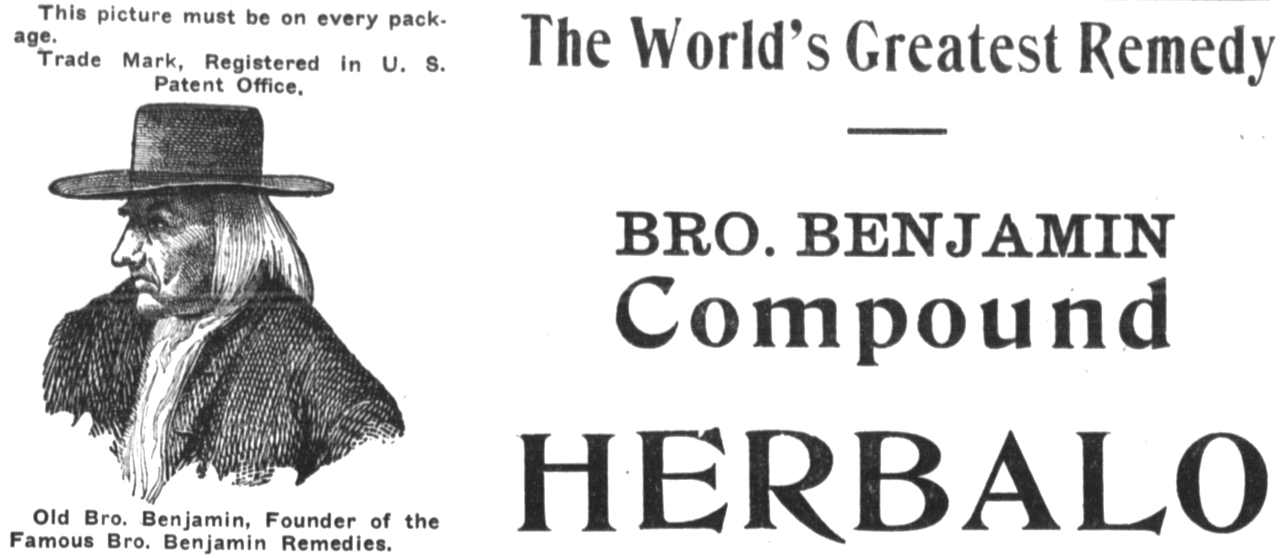 One of the few differences between the Great Fer-Don and Brother Benjamin was the latter claimed to be a Quaker offering Quaker medicines created by "Old Brother Benjamin" (who coincidentally had the same name, apparently). The Quaker image was even part of his trademark, as seen in the ad shown to right. But before Ferdon reinvented himself as the Great Fer-Don he had also pretended to be a trustworthy Quaker and called himself "Brother Paul," so even that part of Benjamin's shtick was stolen.
Both of them emphasized in their fake news-ads they had removed really disgusting things from the bodies of clients, and everyone in town could come over and take a good close look at bottled collections of them. In the case of the Great Fer-Don it was jars of tapeworms of epic lengths; Benjamin showed hundreds of gallstones supposedly removed from a single patient. Give them credit for being the Don Drapers of their day – they knew precisely how to use turn-of-the-century morbid curiosity to draw in the rubes.
Every night in 1909 the Great Fer-Don peddled his patent medicines at an old-fashioned medicine show and in 1912 Brother Benjamin likewise drew crowds in the early autumn to his temporary stage at the big vacant lot at Third and B streets (think the current location of Luther Burbank Savings). A man from Red Bluff recalled these shows in a "good ol' days" section of the Oakland Tribune in 1941:
| There were always two or more black face performers who put on skits and sang songs, as well as musical numbers. Between intermissions, attendants would pass through the crowd selling different kinds of medicine products that were guaranteed to cure everything from a corn to appendicitis and warts on the back of the neck. One products that stands out in my memory was Brother Benjamin's Herbalo, which sold for $1.00 per bottle, and every time the hawker made a sale he would yell out, Sold out again, Doctor. Some times a so-called doctor with the show would establish a local office temporarily to treat the sick, much to the annoyance of local reputable practicing physicians... |
Technically, they were selling Bro. Benjamin's "Herbalo Blood Purifier Stomach-Liver & Kidney Renovator" plus other custom liniments and whatnot, but the real money came from steering seriously ill members of the audience to his phony doctors set up in a Fourth street office across from the courthouse.
Like the Great Fer-Don previously claimed his "European Medical Experts" could handle the most serious medical problems, Bro. Benjamin boasted his team would "positively cure" a long list of ailments from asthma to diabetes to tumors. "Wednesday a large monster parasite over 100 feet long was removed from a leading lady of this vicinity," one of his Press Democrat ads announced, and "Thursday a cancer was removed and is on exhibition at the concert ground every night." Undoubtedly the "doctors" were using sleight-of-hand (better known today as "psychic surgery") where the practitioner's fingers magically appear to enter the body and pull out bloody diseased bits, all without breaking the skin. "No knife, and no pain," promised Benjamin's advert.
 We don't know what Benjamin charged for these "cures," but Ferdon was caught sometimes bilking the sick for the equivalent of an average worker's entire annual wage. One ad of Benjamin's listed the names of several local people who supposedly had been treated by his "Medical Specialists;" of those who can be identified, all had lower-income jobs, such as laborer, waitress, and candy salesman.
Brother Benjamin apparently did not get into serious legal trouble – or at least, nothing can be found in the newspapers. Perhaps that was because he kept a lower profile; Ferdon's downfall came after he tried his con in larger towns such as Sacramento and Seattle. It looks like Benjamin kept to the backwaters of California.
Benjamin J. Bruns – his real name – seems to have stopped touring in 1914, although he kept manufacturing Herbalo at least through the end of the decade from his hometown of Cincinnati. After he left Santa Rosa the Hahman drugstore advertised Benjamin's tonics were for sale there, and similar newspaper ads can be found from pharmacies elsewhere. It was probably harmless stuff - at least, harmless compared to that "Marvelous Specialist" scam our newspapers helped promote. Again.
IT IS TO LAUGH, SAYS BENJAMINBro. Benjamin, who has been herewith with the Marvelous Medical Specialists for the fast four weeks, meets with many laughable and peculiar experiences in his travels--notably arguments his detractors and envious competitors put up to try and stay his onward victorious career.
Benjamin and the Marvelous Specialists represent all that is new and late in the discoveries of medicine and surgery, hence those who are back numbers and cannot make the wonderful cures these Scientists are famous for, stoop to some ridiculous depths to try and decry the good work done by the Medical Specialists.
Some physicians claim that it is impossible for more than two or three gall stones to be in the gall gladder. Now such a statement is absurd and any physician who claims to be such knows better, and when he makes such a statement, he simply holds himself up to ridicule to all intelligent people.
Benjamin laughed when the statement was repeated to him and said he was for a physician that said that, as he himself had seen over 400 gall stones cut out of the gall bladder of a subject at a post mortem at the Cincinnati hospital, one of the largest and best hospitals in the United States and owned by the city of Cincinnati. It only goes to show that even envious physicians do not hesitate to make the most absurd statements to try and harm the good work done here by these wonderful specialists.
They have scores of friends here, made by their marvelous cures. They have done their work in the most stubborn case.
What is remarkable about the Medical Specialists is the marvelous results they bring about in such a short time.
From Mr. J. M. Lucas, 734 Third street, Santa Rosa, traveling salesman, these specialists removed over 200 gall stones with their secret medicines--and no operation. He has been ailing over three years and is loud in his praise of the good work done in his case in such a short time.
Mr. M. H. Inman, Route 6, box 607, well known in Santa Rosa, is emphatic in his testimony of the good results obtained in his case, removing 182 gall stones without an operation.
From Mr. P. A. Lawson, Route 4, box 10, ailing over four years, these specialists removed over 200 gall stones with their secret remedies.
When we can give testimonials in your own city from such well known and prominent people as ...[ten names, with J. M. Lucas repeated]...all prominent and well known in Santa Rosa; Mrs. Josephine McCrone of Lodi, who was cured of a complication of diseases, and scores of others from people here and in other places, even the most skeptical must concede that we are as we claim and can perform the cures we advertise.
It is the same story wherever these Marvelous Experts go. Seemingly impossible cures and wonderful work. Space forbids giving the many hundreds and thousands of testimonials they have, and they are still pouring in every day.
Many other names might be mentioned to show what work the Specialists are doing in our city, names of people who have tried other doctors and other medicines without avail but who are now being cured. Hundreds are taking advantage of the presence of these Medical Marvels at their office.
Our office hours at 609A Fourth St. upstairs, are from 10 to 12 mornings, 2 to 4 afternoons, only a few days more. The big free show continues every night at 7:45, at Third and B street, opposite the Columbia theater, another week.
The Bro. Benjamin Medical Specialists have their own private waiting rooms and offices and everything is absolutely confidential. They positively cure asthma, dropsy, epilepsy, St. Vitus dance and nervous disorders, lung trouble, incipient consumption, diseases of women and children successfully treated and cured without operation, old chronic diseases of the stomach, blood, liver and kidneys, diabetes, gravel, piles, hemorrhoids, incipient Bright's disease, rheumatism (acute, chronic, muscular and sciatic), hip joint disease, rupture, hernia, goitre, diseases of the eye, ear, nose and throat--in fact, what has puzzled you and your doctors gives way to the wonderful medicines of these specialists. Cancer, tape worms, tumors and gall stones removed; no knife, and no pain. These specialists speak all languages.
- Santa Rosa Republican, October 1, 1912
MARVELOUS CURES BY THE BRO. BENJAMIN SPECIALISTSTHEY REMAIN IN SANTA ROSA ONE MORE WEEKOVER 150 GALL STONES REMOVED FROM MR. W. E. COOK, PROMINENT IN SANTA ROSABro. Benjamin and the Marvelous Specialists remain in Santa Rosa another week owing to the insistent demand of people from far and wide.
They are greeted every night by large and enthusiastic crowds of our best citizens at the show grounds... the free show at Third and B sts., attracts the largest crowds every night and under the blaze of electricity, a really novel and clever program is presented which abounds in mirth, melody and music and causes enjoyment to young and old, and will be talked of for months after Bro. Benjamin leaves...
- Press Democrat, October 6, 1912

Busted! The city phoned last week to inform us we were violating Santa Rosa's mandatory water-use restrictions - we were spotted using sprinklers during the day. After hanging up, I searched out the city's drought web page. Sure enough, the new rules are "outdoor irrigation must occur between 8pm and 6am." We did not know that and have adjusted watering accordingly.
The unsettling part of this incident was concern a neighbor might have snitched instead of speaking with us directly, but the water dept. staffer who called - and who undoubtedly has the only civic job more thankless than parking enforcement - said the report came from someone "with the city." Looking at the drought web page again, I found "water watch patrols, performed by city staff, are actively looking for water wasting behaviors." Good Lord, it's the return of the Water Police of yesteryear – one of the most peculiar episodes in Santa Rosa's history a century ago. Before getting into that topic, however, let's look at some of the things said about our current situation.
| AVERAGE RAINFALL Santa Rosa gets an average of about 30 inches of rain per season – give or take an inch or so, depending on where you are. Bennett Valley is different from downtown is different from Fountaingrove. While this makes "average rainfall" a bit of a fuzzy target, you can add up all the numbers claiming to represent "Santa Rosa" going back a century and come up with 30.36 inches. (Inexplicably, a search of Press Democrat articles over the last few years finds the paper variously claiming the average is between 31 and 40 inches, consistently skewed to the high side.) Historical data shows a standard deviation of 9.15, so a year with 21 inches of rain would be considered low-normal. |
| ANNUAL VS. SEASON Not so vague is the definition of our rainy season; like most of the state, our "water year" is July through June. It makes no sense at all to discuss rainfall in terms of a calendar year, yet many resources – including Santa Rosa's current Wikipedia page – can be found using calendar year totals. On the city web page linked above, it's claimed "In 2013, Santa Rosa received less than 6 inches of rainfall." That's an alarmist statement and badly misleading; in the 2013-2014 water year, the total was nearly three times that. |
| MISSING HISTORY Any discussion of "average" rainfall should come with the caveat that there are serious gaps in the historical record. In the Santa Rosa rain data between 1903-2010 (LINK) there are months incomplete or missing, and much of the data between 1916 and 1925 appear untrustworthy; move back to the 19th century and there are entire years either blank or have just overall county summaries. There's a (surprisingly interesting) paper on the history of Sonoma County weather stations that discusses the various old records. The Press Democrat occasionally printed the readings going back to 1889, as seen in the illustration below. Recent measurements can be found from UC Extension and many places elsewhere. |
| DROUGHT Is Santa Rosa currently in a drought? Yes, absolutely – a drought is two or more consecutive dry water years, and this is the fourth we have floated near the bottom of the low-normal range, with 2013-2014 way down at an abnormal 17.91 inches. The situation's not good, but not nearly as dire as many other parts of the state. Through the end of May our 2014-2015 year stands at borderline-abnormal 20.65 inches. This is probably Santa Rosa's third worst drought since statehood (see above, re: missing history). Over the two water years of 1862-1864 there was only 29 inches combined, and about the same during the 1975-1977 pair. |
Santa Rosa's water situation was far worse at the turn of the last century, but not because of drought. I've written up various parts of that story in posts that can be found in the archives, and am shamelessly plagiarizing myself herewith. Links back to the original pieces appear at the end.
(RIGHT: Santa Rosa rainfall 1889-1912)

Although Santa Rosa was surrounded on all sides by fresh water (river, laguna, aquifer, even large creeks running through the center of town), the stuff that came out of the faucet more than a century ago was always somewhat foul and sometimes scarce. Part of the problem stemmed from the town having both privately owned and public water utilities with separate pipes running down all the main streets.
The water pipes for the private system belonged to the old Santa Rosa Water Works, better known as the McDonald Water Company, which had been operating since the mid-1870s. Water from the McDonald system was "soft" and considered good tasting, even though an 1891 report confirmed suspicions that its reservoir, Lake Ralphine, was contaminated with hog and human waste (maybe it was E.coli that gave the water its je ne sais quoi).
The municipal system came along in 1896 and was also plagued with problems from the start. City water was unmetered and free, but "hard" and tasted of sulphur. Still, they couldn't keep up with demand because there weren't enough wells and the steam engine pumps were underpowered. Even with the addition of a 1903 well that nearly doubled capacity, the city's pipes were always at risk of running dry and a report the next year explained why: Almost a quarter of the water leaving the reservoir was lost somewhere in broken plumbing - 270,000 gallons just dribbled away every day.
(RIGHT: The 1909 rates for the hated Santa Rosa municipal water system. CLICK or TAP to enlarge)

Caught in the middle between these two "just good enough" companies was the public, stuck with choosing between bad and worse. The McDonald system had no incentive to upgrade its service while the city water works had trouble raising bond money for improvements as long as there was a competitor in the private sector. And it surely did not help that at a 1906 City Council meeting Thomas J. Geary was wobbling between jobs as city attorney and lawyer for the McDonald water system, where he argued that the city water works should be shut down. Along the way, Geary also told the Council the rich were entitled to more water than Average Joe because they paid more taxes.
Santa Rosa's water system was such a mess the town enacted severe conservation measures. Policemen, firemen and city inspectors became the Water Police, empowered to wake you in the middle of the night if someone heard water running. A city inspector was hired to examine toilets, faucets, and other fixtures for leaks, and had powers to issue a $2.50 fine - equal to a few days' pay for the average worker - for each violation. There was also a monthly fee for every water fixture in your home; it'll be 25¢ per month for the pleasure of that bathtub in your house and having an indoor toilet cost another quarter (and worth every penny). Water Police assessed extra charges for nearly everything; watering your lawn cost 1/2 cent per square yard per year, irrigating strawberries and vegetables, 3¢ per square yard.
And then there was the nutty Pavlovian alert system. Lawns and gardens could be watered only at certain times and/or certain days depending whether you lived east or west of Mendocino Avenue; in the scheme used following the earthquake, the east side could use a garden hose between 4 and 8 o'clock, while westerners had the hours between 5 and 9. Starting and stopping times were announced by the Grace Brothers Brewery steam whistle which also sounded to announce lunch time and quitting time. If you're keeping track, all that meant the brewery whistle was sounding at 12, 4, 5, 8, and 9. When that whistle blew I imagine people often just stood still for a moment with their heads cocked, like puzzled dogs, trying to figure out if they were supposed to eat, start, turn off or go home.
Santa Rosa introduced water meters in 1905 with the promise that a family of five or less still could have 350 gallons of free water a day. But old habits die hard and the town kept the Water Police around at least through 1907, when the reservoir was finally patched and covered, a new well drilled, and high powered electric pumps replaced the antique steam engines. Street repairs after the earthquake also fixed many of those leaky pipes.
But water woes continued, now because the town screwed up installation of the new meters. In one outrageous SNAFU, it was revealed that five businesses - including a bakery and one of Santa Rosa's largest saloons - were connected through a water meter for a private residence. The homeowner understandably refused to pay the excess-use water bill so the city shut off the meter, and thus the water supply to the home and businesses alike. Two of the businesses agreed to pay the flat business rate, but the others balked, leaving the water turned off. "Without the necessary water, sinks and toilets go without flushing and the neighbors are wondering 'how about the sanitary condition' of the block," commented a letter to the editor.
By 1909, downtown businessmen were flatly refusing to pay their water bills, viewing the rates as capricious - a liquor store owed $2 a month but a dentist paid only a dollar above the base rate and physicians paid nothing. When others heard their neighboring businesses were getting away without paying, they began ignoring their bills as well. Thus on a fine spring morning in 1909, Street Commissioner W. A. Nichols marched up and down the downtown streets and shut off the scofflaw's water. A standoff began, and soon the Press Democrat reported, "For the last few days block after block on Fourth street has been without water."
After a week without toilets or tap water, about a dozen delinquent businesses paid their bills. At least one major property owner thumbed his nose at the city system and signed with McDonald. But Santa Rosa's intractable policies placed still other companies in a Catch-22. Most buildings had only a single water hookup, yet there could be more than one business at that address. Under city rules, all water was shut off to the building if any of the businesses there were past due. One company caught in the middle was the main downtown grocery store: Erwin Brothers, at 703-705 Fourth street. They went to city hall to pay every cent in arrears and make a deposit toward future payments but the city refused to accept their money - there was another tenant in the building who still didn't want to pay. After nine dry days, the Erwins illegally turned the water on themselves and filed an injunction against the city to keep it on.
What happened next probably had the town buzzing. According to comments from the Erwins published in the Republican, the mayor personally asked them to drop the lawsuit, suggesting, "Why don't you connect with the McDonald system and save all this trouble," foolishly placing Santa Rosa in legal peril, given they were litigants against the city over this very issue. The mayor claimed none of that was true and he hadn't even spoken with them; the Erwins countered with details of the visit, including the mayor had left his kid waiting in the buggy.
The suit was dismissed a couple of weeks later and the business hookup rules fixed, bringing to an end over a decade of various skirmishes in the Santa Rosa Water Wars. For years the city still had two water systems – the McDonald Water Company continued to operate through the Roaring Twenties. The city eventually simplified rates so residents were no longer paying different prices to water their watermelons and flowers. But city water still was hard and sulphurous, so on warm summer afternoons the sprinklers danced wild over Santa Rosa lawns with a golden spray and a faint stench of eggs gone rotten.
SOURCES:
SANTA ROSA'S WATER SYSTEM WARS
WATCH OUT FOR THE WATER POLICE
PLENTIFUL WATER, BUT IT STILL TASTES AWFUL
HEAR THAT PAVLOVIAN WHISTLE BLOW
NOW IT'S THE WATER METER WARS
WHEN "BUSINESS FRIENDLY" SANTA ROSA NEARLY CLOSED DOWNTOWN
For further reading: Ample and Pure Water for Santa Rosa, 1867-1926 by John Cummings
Dear sir or madam; the city destroyed your pioneer ancestor's grave marker. You may want to hire someone to make a new one. Sincerely, Santa Rosa.
No mistake about it: Santa Rosa's Rural Cemetery was a real mess in 1951.
"It is a disgrace to Santa Rosa," Fred Cooke, chairman for that year's Memorial Day committee wrote the Press Democrat that May. "I visited this cemetery to arrange for the ceremonies and found it difficult to even drive around the roads. In all my experience, and I have visited many a cemetery, I can say this is the worst of them all."
Another writer, Guy E. Grosse, agreed in letter to the editor a week later. "In some instances [it is] almost a forest, with weeds, underbrush and young trees making it almost impossible to walk through the roads, and in some cases, impossible to locate tombstones."
City Manager Sam Hood was most specific of all, saying the cemetery was a jungle of tangled brush four feet high, including matted undergrowth of sweet pea "about two feet thick."
 (RIGHT: View of Santa Rosa Rural Cemetery in 1970. Detail of photograph by Don Meacham courtesy Sonoma County Library)
Alas, the old cemetery had been long neglected, but 1951 was apparently a pathetic low. Overgrown with sweet pea, blue periwinkle, acacia, bramble, poison oak and sapling trees, it must have taken decades to build up enough thicket to conceal a tombstone as tall as an eight year-old child. There were community cleanup efforts in 1907 and 1908, but after that plots were weeded only by the occasional family member – and presumably by undertakers preparing a grave for one of the diminishing number of new burials. The year 1951 as well would have likely passed without anything done had it not been for the vandalism incident.
In the bold headline type usually reserved for earthshaking news, the June 5 front page of the Press Democrat screamed: "Vandals Desecrate Graves in Odd Fellows, Rural Cemetery". Beneath two large photographs, the article stated most of the damage was in the section of the Odd Fellows cemetery near Franklin Avenue, with 22 tombstones knocked over or damaged. "The littered ground looks as if a bulldozer had ploughed over the graves," the PD reported. Across the fence at the Rural Cemetery, "several stone and wooden crosses were snapped."
By the following day, it was apparent the overgrown condition of the older cemetery had concealed the vandal's scope: the paper now said, "most of the scattered destruction took place in secluded areas of the rambling rural cemetery, where at least 35 ravaged graves have been counted." A subscriber later wrote he or she counted 87 headstones turned over. The damage estimate there came in at $15,000, with a North Bay Monument quote of over $1,000 to simply right all the toppled markers. In contrast, it was expected to cost only $150 for repairs at the Odd Fellows cemetery. ($15,000 is equivalent to about $140,000 in today's dollars.)
The vandals were quickly caught – schoolboys age 9 and 12, who said they were "just having fun after school." Their parents agreed to pay full restitution. The last we hear of the young hooligans was that "State psychiatrists" would soon be examining them. "Investigating officers who questioned the boys expressed the belief that neither vandal was aware of the sacrilegious nature of the crime."
(For what it's worth: Every 1951 Press Democrat article described the vandalism as being "sacrilegious" or "desecration" – the offense against morality trumped the criminal act – and there was an editorial on the vandalism titled, "Moral Revival Should Start in the Homes." This was in step with the pious tone of the newspaper in that era; every day there was a section on the front or editorial page titled "The Shepherd," with a Bible verse and little homily. In the letters section readers debated bits of scripture continually.)
For reasons unclear, it was decided the monument company needed written consent from relatives of the deceased before they could repair damaged tombstones at the Rural Cemetery. But very few wrote to grant permission; the PD noted "survivors of many whose graves were mutilated have themselves died or moved from the area." Doubtless there were others who lived around here but didn't even know there were family members up on the hill, hidden somewhere under the weeds.
And that was the nub of the problems with the Rural Cemetery; nobody took responsibility for the place. It was outside Santa Rosa city limits. Most of it was supposedly owned by the Santa Rosa Rural Cemetery Association, but that organization was long defunct and there were no records to be found. According to the Recorder's Office, the last time a burial plot had been sold was in 1930.
Shift forward now two months. Northern California had sweltered through a long hot summer and nearly every day the papers reported there were fires burning out of control in the forests. About then, City Manager Hood and other officials apparently remembered there was a vandal-friendly, six acre tinderbox right on the edge of town.
"It's getting so we can't sleep night worrying about the situation," Hood told the Board of Supervisors. "We could have a major catastrophe on our hands" if a blaze at the cemetery jumped to surrounding neighborhoods.
Hood's proposal was that a workcrew of twenty prisoners from the county jail should be provided to clear the weed-choked narrow roads winding around the cemetery. Following that there would be a controlled burn, supervised by the city fire chief and firefighters from the state Forest Service.
The only objections to the plan came from Supervisor William Kennedy of Sebastopol, who was worried about setting precedent by using country jail labor. "There are plenty of other cemeteries in the county which aren't in good condition," he said, adding a cleanup at the Pleasant Hill Cemetery was paid for privately. The decision was that prisoners could be used because fire prevention was in the county's interest, but no money would be spent to "beautify" the cemetery, which presumably meant resetting pushed-over monuments. "The resulting improvement of the neglected cemetery's appearance will be only incidental," summarized the PD.
Thus on August 25, 1951, the Santa Rosa Rural Cemetery was burned in a controlled fire.
Or maybe not so controlled; a small item in the PD a couple of days later claimed success, with a small qualification:
Some wooden grave markers were inadvertently destroyed, when the burning revealed a number of plots that had lain concealed for years. An attempt will be made to trace families of those whose graves were hidden, City Manager Sam B. Hood said. He indicated that "private arrangements" will have to be made, since most of the cemetery is outside city limits.
It was a true Pyrrhic victory – Santa Rosa had "saved" its historic cemetery, and in the process, destroyed many of the oldest markers that made it historic. It is a loss that plagues historians today.
We can argue the city and county should be held blameless; the thick overgrowth completely concealed the old wood markers from the fire crews and conditions at the cemetery truly represented a serious fire risk. Or we can also argue it was irresponsible to do it in such a great rush and on the cheap. But whether by accident or carelessness, it's difficult to defend Santa Rosa's stance that descendants were responsible to make their own "private arrangements" to replace what was destroyed by the city.
And perhaps the burn may not have been so controlled after all. A few days later a letter appeared in the paper: "For years it has been a disgrace to the community with its majority of unkept lots and weed-covered roads. Now we have acres of blackened fire-swept stubble, smoke-covered monuments, burnt wooden markers and scorched trees."
As the obl. Believe-it-or-Not footnote, there's an unseen player to be spotted in all corners of this story: Hyperactive developer Hugh Codding.
Codding had opened his Montgomery Village shopping center a year earlier – hijacking a chunk of downtown Santa Rosa's mercantile base in the process – and in 1951 was building hundreds of tract houses nearby which were intended to be the foundation of a sister city to Santa Rosa. Just before the cemetery vandalism a wag wrote the Press Democrat to suggest we should surrender and just rename the whole area "Coddingville." Another PD correspondent at the time thought we should beg Codding to "clean up the terrible unsightly condition that exists" at the Rural Cemetery as a civic duty. (Codding didn't reply, but in the same edition a letter from him denied "The Montgomery Village News" was about to become a daily newspaper in competition with the Press Democrat.)
But there are cosmic ironies in Sam Hood's appeal to the Supervisors for an emergency prisoner work crew, which he said was based on the threat a cemetery fire posed to "the Codding Village area." Hood was then new to the post of City Manager, and three years later would be locking horns with Codding over whether Montgomery Village should be incorporated into the city. By eliminating the greatest fire risk in the area, Hood also lost a major bargaining chip – no longer was there urgency for Codding to compromise in order to ensure his sprawling subdivisions were under the protection offered by Santa Rosa fire stations.
EDITOR: There are many men and women buried in the Rural Cemetery who were well known and well liked citizens of Santa Rosa.
When alive and active in making this city "Designed For Better Living" they gave their time, money, labor and they paid taxes and had hopes for the progress of Santa Rosa.
Now they seem to be forgotten, with but few exceptions, and to show how shameful all this is, just take a walk or drive through this cemetery. It is a disgrace to Santa Rosa.
Why do we neglect the respect for our dead? When you read the names on the headstones of many who were well known, and see the condition of them, you wonder why something is not done to care for this cemetery.
Being the chairman of the committee for Memorial Day Exercises, I visited this cemetery to arrange for the ceremonies and found it difficult to even drive around the roads. In all my experience, and I have visited many a cemetery, I can say this is the worst of them all...
..You may say the relatives of the dead should clean it up. Some whole families are buried here and no one left. Others have moved away. Decency demands that some provision should be made to clean this cemetery, at least, before Memorial Day.
I have been told the Board of Supervisors are responsible for this condition and I hope that everyone interested in cleaning up this terrible condition will demand some effort be made to clean up this condition which is a disgrace.
Let us not forget and forsake our dead.
FRED A. COOKE, Commander, United Spanish War Veterans.
- Press Democrat, May 18, 1951
EDITOR: I read with great interest the magnificent article written by Commander Fred A. Cooke...
...Why not call up your favorite supervisor or several of them, and they will possibly arrange to have the county jail prisoners do the clean-up work under the supervision of the city or county park gardeners, or let them use common sense.
Certainly it will not take any amount of brains to do the job. Of course the supervisors may have a better solution for cleaning up not only these graves, but the roads and paths into the plots of our pioneer dead...
...Their resting places are, in some instances, almost a forest, with weeds, underbrush and young trees making it almost impossible to walk through the roads, and in some cases, impossible to locate tombstones, let alone the markers of the revered dead. Shame on you, Santa Rosa and community citizenry. Do you want your lot to be the same?
Why not make it a semi-annual affair to clean up the Rural Cemetery. Then we will be able at least to pass the cemetery without a shudder and be ashamed to drive past it with visitors who have been attracted here by what our Chamber of Commerce and we like to say is a city "designed for living"...
GUY E. GROSSE, Santa Rosa
- Press Democrat, May 24, 1951
EDITOR: I hope that the public will read the following lines and be as serious about the entire matter as I am. I am sincere and have no thought of sarcasm and I have a great deal of respect for Mr. Hugh Codding, and feel that this town and Sonoma County are indeed fortunate in having as progressive a man as he in regard to his terrific subdivisions.
There has been much comment regarding the terrible condition surrounding the cemetery at the end of McDonald Ave., and I, too, feel that this is one of the most disgraceful situations we have in this beautiful city of Santa Rosa.
Everyone feels that something should be done to correct this unsightly condition, but there seemse to be no heads or tails as to what should be done.
Now if Mr. Codding is able to move the bank which was to be built on 4th street to the Codding subdivision in Montgomery Village, and if Mr. Codding was able to get a permit to build a theater in Montgomery Village, and I think if he tries hard enough he will move the court house to Montgomery Village--if all this is possible, why isn't it reasonable to believe that with a little encouragement Mr. Codding could move the present cemetery and clean up the terrible unsightly condition that exists?
[..]
HARRY B. FETCH, Santa Rosa
- Press Democrat, June 3, 1951
EDITOR: I am wondering how many have been through the Rural Cemetery since the recent cleanup and just what they think of it.
For years it has been a disgrace to the community with its majority of unkept lots and weed-covered roads.
Now we have acres of blackened fire-swept stubble, smoke-covered monuments, burnt wooden markers and scorched trees.
Surely it is a showplace for a "City Designed for Living" to be extremely proud of.
MARY A. McDANNEL, Santa Rosa
- Press Democrat, August 30, 1951
It's nearly Christmas, 1912. Want a nice gift for your spouse? There's an art auction in Santa Rosa, and the paper says original oil paintings would be sold "at a remarkably low figure." You might even know the guy who painted those landscapes – he's S. Tilden Daken, "the Sonoma County artist."
Other painters blew through Sonoma county with brushes and easels in the first few years of the Twentieth Century, most notably Carl Dahlgren, who was hired in 1908 to paint Burbank creations by one of the publishing groups trying to write a series of books on Burbank's plant breeding. Dahlgren also found time for at least one landscape painting and some sketching on the river ("oh, in your coundy it iss beautiful, b-e-a-u-t-i-f-u-l!" he raved to a reporter for the Press Democrat in his Danish accent) but he was still a visitor, working out of San Francisco. Daken lived here with his family on Chestnut street (off Sebastopol Ave.) and rubbed shoulders with Santa Rosa's hoi polloi; when the Press Democrat ran a silly 1909 scavenger hunt contest to promote downtown businesses, there he was as question #91, between the Gamble Brothers grocery store and the Harper Hair Dressing Parlor. "What is the name of the eminent artist who came to Sonoma county three years ago and established a studio and school of art?"
 (RIGHT: Samuel Tilden Daken portraits in the Santa Rosa Republican, 1911 and 1912)
The art studio could be found on Fourth street, but there never was a "school of art." He had moved to Santa Rosa in late 1908 hoping to establish an art institute affiliated with a national association of art schools. Plans never advanced past the drafting board, but he was so convincing the Chamber of Commerce included his architectural drawing of the proposed building in its hyped 1909 "Illustrated Portfolio of Santa Rosa and Vicinity" promotional book. Lack of funding probably killed that project but he stuck around, painting redwoods and valleys and geysers and more. Sonoma county is "b-e-a-u-t-i-f-u-l," after all. In summertimes the family, with two baby daughters born here, enjoyed painting excursions to Yosemite and Lake Tahoe.
Daken also was the focus of a 1911 promotional campaign to distribute prints of three of his Sonoma county views to selected parties in the Midwest and Eastern states with the goal to hopefully "induce them to come to this favored section to make their homes." The printing was done by the Santa Rosa Republican, which patted itself on the back in announcing "This is the most extensive 3-color cut work ever done in Sonoma county...It is superb in every way." In truth, the printing is terrible; with poor registration and the colors oddly washed out, the prints look like the sort of crappy halftone found on baseball cards from twenty years earlier.
Amazingly, researcher Bonnie Portnoy – Daken's granddaughter – has a mint-condition copy of the 1911 "Sonoma County Beautiful" portfolio. With permission the prints are reproduced below and a higher resolution copy of the entire brochure is available at the Comstock House digital library (DOWNLOAD). Bonnie writes and curates the tildendaken.com website and has penned articles about Daken for the Sonoma Historian. She has unearthed a trove of information on him and is preparing a full biography.
There was apparently no East Coast tour by the artist following distribution of the art portfolio, but Daken was busy anyway; "For some time past Mr. Daken has been making displays of the Sonoma county scenes throughout the state, at county fairs and industrial exhibitions, particularly the one at San Jose, where he spent some weeks," the Republican reported. A particularly fine painting, "View of Russian River from Guernewood Heights," was often exhibited and won awards.
 But these must have been lean times; until the 1912 auction, there are few mentions in the papers of paintings sold. One of the few known commissions during these years was a pastoral scene painted on the "drop curtain" for the theater at the Union Hotel in Sonoma (now on display at the Depot Park Museum). Before moving to Santa Rosa he lived in Glen Ellen for a couple of years, and in the Sonoma State archives Bonnie Portnoy found he was sued by a storekeeper there for an amount due of $27.35 – about two weeks' average household income at the time – and to settle the paltry debt, he had to turn over two paintings. Adding to his misery, he was summoned back to court because he still owed $2.70 in fees.
The 1912 auction marked the end of his reign as "the Sonoma County artist" and the Daken family returned to San Francisco. This was also apparently the year the Comstocks closed "The Gift Shop" in downtown Santa Rosa, where they sold work by members of the local Arts and Crafts Guild as well as artwork from many pioneers of the emerging Arts and Crafts style. It is left to you, Gentle Reader, to ponder why the town's only two purveyors of fine art both closed studios while Santa Rosa was enjoying its first truly prosperous year since the Great Earthquake.
It turned out his six years in Sonoma county were an idyl in an otherwise bold, tempestuous life. In 1913 he left his family behind and moved to Mazatlan, where he was caught up in the Mexican Revolution, wounded a couple of times and imprisoned as a POW. His marriage ended after he had an affair with Sophie Tucker ("The Last of the Red Hot Mamas"). There were years in Hawaii where he designed a custom diving bell so he could paint underwater landscapes seascapes. He painted headhunters in New Guinea and silent film stars in Hollywood. He wrote short stories based on his restless adventures.
Examples of his art can be viewed at the tildendaken.com website, but he created an estimated four thousand paintings – if it were possible to view them all and spend just one minute looking at each, it would take nearly three days straight. Until he died at age 59 in 1935, his brushes must have been never dry for a single moment.
   |
ELEGANT THREE-COLOR WORK BY REPUBLICANDaken's Art Portfolios Ready for Public DistributionThe REPUBLICAN office has turned out some of the most artistic printing ever done north of San Francisco in an Art Portfolio issued for Samuel T. Daken, the Sonoma county artist. The work is done in three colors, and represents some of the splendid paintings from the brush of the artist. This is the most extensive 3-color cut work ever done in Sonoma county and it shows the ability of the REPUBLICAN mechanical force to do the best work that can be done.
The three pictures which are reproduced in the colors are "Glimpses of the Sonoma Valley," "Overlooking the Lowlands of Sonoma County," and "Redwoods at Sunset." They are among the best works of Artist Daken, and are to be given free to some persons in an effort to raise funds for an exhibit of Sonoma county scenes in eastern cities.
The portfolios are to be sold at one dollar each. The matter has the hearty approval of the Board of Supervisors.
With the funds thus raised for the disposal of these pictures, an exhibition of the famous Sonoma county scenes depicted on canvas by Artist Daken will be made in all of the principal cities of the east and middle west. Mr. Daken will make this exhibit with the handsome scenes which he has transferred to canvas and it will be a matter of the best kind of publicity for Sonoma county to have these beautiful scenes shown in the eastern states.
All persons should secure some of the portfolios, not only for their intrinsic value and the opportunity presented to secure one of the three paintings mentioned, but because it will enable the beauties of this splendid section to be shown in the east. When the edition has been disposed of Artist Daken will arrange the exhibit at once and start on his eastern journey to give the people there an opportunity to view Sonoma county, and induce them to come to this favored section to make their homes.
The color work done by the mechanical department of the REPUBLICAN office reflects great credit on the force. It is superb in every way, and shows how well all classes of printing can be handled on the up-to-date machinery with which the office is equipped.
For some time past Mr. Daken has been making displays of the Sonoma county scenes throughout the state, at county fairs and industrial exhibitions, particularly the one at San Jose, where he spent some weeks. At this display between ten and twelve thousand people attended daily and viewed the beautiful pictures of Sonoma county scenes and landscapes of different sections of the county.
These three pictures, which are to be presented to the persons purchasing the folios, will be placed on display in the Hotel Overton lobby, where they may be viewed by the people.
- Santa Rosa Republican, November 13, 1911
INTEREST IN DAKEN DISPLAYPictures May Be Seen at Odd Fellows' Hall SundayThe elegant display of paintings from the brush of S. Tilden Daken, the well known Sonoma county artist, is attracting much attention. The display is made at the reception rooms of the Odd Fellows' building on Mendocino avenue, and many visitors are going in daily to inspect the canvasses. The exhibit will be open on Sunday from 10 in the morning until 9 o'clock at night and Mr. Daken will be present during these hours. An invitation is extended to the public to come in and view these elegant works of art.
Daken is the first artist to paint the beauties of Sonoma county scenes, and he has a number of splendid views of this county, including pretty landscapes from various sections. Some of these are from the Pluton [sic] regions, others from the redwood section and still others from the fertile valleys. Persons can find just what they desire in the Daken collection, and these beautiful paintings will make elegant Christmas presents.
Among the canvases displayed are some of the beautiful Yosemite valley, to which place Artist Daken made a number of pilgrimakes [sic], and whose beauties have been transferred to canvass [sic]. The display is well worth seeing, and none should fail to make a visit to it.
- Santa Rosa Republican, December 14, 1912
PAINTINGS TO BE AUCTIONEDDaken Collection to Go Under Hammer Friday EveThe splendid collection of paintings which have been on exhibition at Odd Fellows' hall on Mendocino avenue, will be offered at auction on Friday evening, December 20th. There are about forty beautiful views in this collection, and it is by far the best that Artist Daken has ever grouped together. It represents a number of beautiful landscapes from Sonoma county scenes and some from Yosemite Valley, which is the ideal spot for artists. In variety the collection is one of the finest that could be found anywhere, and the pictures will be auctioned without reservation. The auction will begin at 8 o'clock sharp and it is more than probable that a large crowd of Santa Rosa and Sonoma county people will be in attendance.
Every one is cordially invited to come in and look over the collection of pictures, whether they purchase or not. The pictures will be sold under the second bid, and this will afford a fine opportunity to get a fine example of Artist Daken's work at a low figure. Daken is the Sonoma county artist, and has done more with the brush to make Sonoma county popular and prominent than all the other artists combined.
Edward Curtis, the noted art auctioneer of San Francisco, who conducts a studio at 1700 Van Ness avenue, and who is the greatest art auctioneer of the Pacific coast, will conduct the auction of this splendid collection of paintings. Mr. Curtis has conducted large sales of paintings on the Pacific Coast and in the east, and is a noted critic of all the schools of art. One of the large sales which he conducted was that of the collection of the late Colonel Issac Trumbo. This collection of paintings was appraised at $35,000 and was conducted at the St. Francis hotel in the metropolis.
- Santa Rosa Republican, December 19, 1912
AUCTION SALE OF PAINTINGS ODD FELLOWS HALL TONIGHTS. Tilden Daken, whose likeness is presented in the cut printed herewith, is known all over the state as the Sonoma county artist. It was he who first produced on canvass in great numbers the many beautiful scenes to be found within the confines of Imperial Sonoma. This evening at 8 o'clock at the Odd Fellows' Hall, on Mendocino avenue, an auction of his pictures will take place. This will afford an excellent opportunity to get a splendid Daken picture at a remarkably low figure.
[..]
- Santa Rosa Republican, December 20, 1912
After California women won the right to vote in 1911, everyone watched the first elections of 1912 to see whether the winds had changed, particularly concerning one issue: prohibition.
Passage of the amendment to the state constitution had not been easy – it won by a narrow two percent statewide and by four points in Sonoma county. Petaluma, Sonoma, Windsor and Healdsburg all voted against allowing women to vote; local support was only enthusiastic in Santa Rosa, where male voters approved by a 14 point margin. Suffragists were fought every step of the way by a coalition of social conservatives and the national liquor industry, together dubbed the "anti's" in the press.
(This is the third and final article on the campaign for women's suffrage in California. For background see part I, "WILL MEN LET THE LADIES VOTE?" and "THE SUMMER WHEN WOMEN WON THE VOTE.")
Predictably, the anti's carped about the measure passing and there were noises about a Sonoma County recount, but nothing came of it. One of the most vocal member of that faction was state Senator J. B. Sanford (D-Ukiah), also editor and publisher of the Ukiah Dispatch-Democrat, who put his unique spin on the results to make it sound as if men had foolishly decided to force women to vote against their will: "The ballot on Equal Suffrage was not a fight between the men and women, but was rather a fight between the women, and the men were called in to decide the matter...it seemed that a majority of women did not wish to assume the extra duty, but the men have said, 'Ladies, you must vote.'" Still, he encouraged the women of Ukiah to register "...and thus offset the evil that might arise from giving the ballot to some women in the large cities."
Sanford also couldn't resist throwing one final misogynist bomb: "[Women] will have to go to the county clerk's office and submit to many formalities, among which will be to give their visible marks and scars, age and previous condition of servitude, all of which will be open to inspection."
 (RIGHT: This April, 1912 advertisement ran in the Santa Rosa Republican a few days before the first local elections where women could vote, one of several display ads that month with a similar voting theme)
Some confusion arose in the weeks following passage. Technically the amendment didn't become law until 90 days after the election, but women were already lining up to register in some places; county clerks added women registrars to help. The first woman to register in Sonoma County on Jan. 2, 1912 was Mrs. Jennie Colvin – a milestone little noticed by either Santa Rosa paper – and she wasn't asked about any scars, or even her exact age; the legislature had changed the voter requirements after the amendment passed, and now the voter only had to swear that he or she was over the age of 21. They still required height be recorded for ID purposes, which caused a minor problem because women at the time wore elaborate hats that could be difficult to position without a mirror. So the County Clerk installed a mirror in the office.
There was also uncertainty whether or not women would have to pay the poll tax to vote, as that part of the election law named only males. It was was quickly decided that women were exempt unless voters passed another amendment to change the language, which was in a different section of the state constitution. Aside from that issue and the need for mirrors, registering new women voters went smoothly and the county soon had an all-time high of over 17 thousand voters. Republicans outnumbered Democrats more than two-to-one, a proportion that must have unnerved Ernest Finley, editor of the fiercely-partisan Press Democrat.
In an ill-conceived Sunday editorial, the PD suggested women needed a "class in politics" to educate them about the differences between Dems and Repubs so they could be sure to pick the right team. A blistering letter to the editor followed in the Santa Rosa Republican, almost certainly written by the indomitable Frances McG. Martin, titled, "MOST WOMEN ARE NOT IDIOTS".
| It starts out with a request for nonpartisan instruction, and closes with a prayer to "politicians" to tell her why she is a Democrat or Republican...The men and women who worked for the enfranchisement of California women, worked with the hope that women would not prove to be blindly and passionately partisan, and that they would not adopt the methods of the professional politicians and wire puller; but, since the just men gave us the ballot, the women who worked against the cause or were indifferent, have displayed a very lively interest in politics of the old brand. Women are not all idiots, then why should there be such a hue and cry, raised about instructing them as to what they believe and how to prepare and write a ballot? |
Then came the local elections that April. Women were eager to vote; the Republican paper told the story of Santa Rosa Police chief Boyes leaving home before dawn to setup polling places, promising his wife he would later "send an automobile for her and some other ladies in the neighborhood" so they could vote. By the time he returned home for breakfast, Cora Boyes had already gone out and cast her ballot as the first voter in their city ward.
Then there was the matter of the prohibition vote. About twenty California towns had ballot items to decide if their community would go "dry." Locally, Cloverdale held a series of spirited public meetings; at the weekend rally before the vote, Andrea Sbarboro (male), the founder of the Italian Swiss Colony in Asti, made a rare public appearance to speak against the proposal. In the end the township of Cloverdale voted for leaders who promised to clean up the saloons - particularly gambling and serving liquor to minors - but rejected outright prohibition by an almost 2:1 majority. Overall, about half of the towns voting on alcohol went dry; in the Bay Area, only Los Gatos and Mountain View closed their saloons. "FEMALE OF SPECIES AS THIRSTY AS THE MALE," quipped the Santa Rosa Republican headline. In November, however, county voters did pass an anti-roadhouse ordinance, about which more will be written separately.
But suffrage did not equality make; it would still be a decade in Sonoma County before women were seated on a Superior Court jury, for example. And although Senator Sanford tried to frighten men in 1911 with the image of a helpless mother sequestered late at night with eleven leering men, there were five women jurors on that trial in 1922. Turns out they didn't need Sanford's protection at all. Never did.
WOMEN WILL NOT PAY POLL TAXAnother Amendment of the Constitution Would Be Necessary Before Tax Can Be CollectedMany opponents of woman suffrage before and after the recent election declared that the adaption of the amendment allowing women to vote would carry with it the added responsibility of paying poll tax. This, however, is not true.
The right of suffrage was given by the adoption of an amendment to Section 1 of Article 2 of the Constitution of California, and which amendment consisted of stipulating the word "male." Women could not be allowed the right of suffrage without the addition of the amendment.
The liability for poll tax is fixed also by the constitution of the state: Section 12 of article 13 of the Constitution of the State of California reads as follows...
...So it will be readily seen that the women will not and cannot be required to pay a State poll tax without an amendment to Section 12 of article 13 of the Constitution. In the adoption of such an amendment as will require the women to pay a State poll tax the women will now have the right themselves to vote on such an amendment, and if such an amendment is adopted it necessarily must be done with their consent.
- Press Democrat, October 20, 1911
REGISTRATION PROVISIONSSome Changes in Registration Laws Are NotedThe recent legislature made a number of changes in the form of the registration blanks used in the registering of voters for the coming elections. The changes were made mostly for the accommodation of women, as a voter under the new law will not have to give his or her age, nor visible marks or scars. The only requirement about the age is that the voter must swear that he or she is over the age of 21 years.
There might be a little dispute over the question of whether the husband or the wife is the head of the house, but the decision is that this question must be settled in the home.
The question of naturalization is also different from the old blanks. A woman of foreign birth must state how she became a citizen--if she became one by the naturalization of her father when she was a minor, by the decree of the court, or by marriage. If by marriage, she must state when she was married, and if she registered under one name and afterwards married, she must re-register. The same rule applies to change of name by divorce.
- Santa Rosa Republican, January 1, 1912
REGISTRATION OF VOTERS HAS BEGUNRegistration of voters began at the county clerk's office on the new year...Rev. Peter Colvin and wife, Mrs. Jennie Colvin, registered. Mrs. Colvin was the first lady to register...
- Santa Rosa Republican, January 2, 1912
M'LADY YOUR HAT CAN COME OFFBig Mirror to be Installed in the Office of the Registrar of Voters in Court HouseCounty Clerk Feit is to install a big mirror in the County Clerk's office which will add materially to the comfort of the women voters who visit the office for the purpose of registering.
A number of women who have called to register have not been able to give their height and have had to take off their hats prior to standing under the measure. When it came to readjusting their hats without the aid of a mirror, the effort has not proved very successful in some instances.
Hence the providing of the big looking glass by the county clerk.
- Press Democrat, January 28, 1912
MOST WOMEN ARE NOT IDIOTSEditor REPUBLICAN:
Will you please explain the following clipping, taken from the Sunday morning paper?
There has been this past fortnight several expressions regarding the establishment of a non-partisan class in politics for women. If some of the deep-thinking politicians would volunteer to discuss simple political problems from purely unselfish standpoints, they would undoubtedly be listened to with interest and pleasure. Last week one new voter asked: "Will you ask some Democrat and Republican to briefly state through the press, why I am a Democrat and why I am a Republican?" Attention! politicians, tell us why.
It starts out with a request for nonpartisan instruction, and closes with a prayer to "politicians" to tell her why she is a Democrat or Republican. A non-partisan, in politics, is one who is not blindly or passionately attached to any political party, so defined by the standard dictionaries. The men and women who worked for the enfranchisement of California women, worked with the hope that women would not prove to be blindly and passionately partisan, and that they would not adopt the methods of the professional politicians and wire puller; but, since the just men gave us the ballot, the women who worked against the cause or were indifferent, have displayed a very lively interest in politics of the old brand.
Women are not all idiots, then why should there be such a hue and cry, raised about instructing them as to what they believe and how to prepare and write a ballot? The Los Angeles women certainly demonstrated the fact that they could vote more rapidly and mark their ballots more accurately than a great many men voters. Any man or woman who is fit to cast a ballot can master the mechanical part of it in ten minutes. Each voter is furnished with a sample ballot not more than ten nor less than five days before an election. Full directions are printed upon those sample ballots, and the woman voter, as well as the man, can take her time and mark her sample ballot as she intends to vote, take it with her to the voting booth and use it as a model by which to stamp her real ballot.
No woman can vote who cannot read the constitution in the English language and write her name, then why can she not read the able editorials which appear in the leading papers and magazines, and deal with the vital questions of the day. If she have children in the public schools, let her take up with them the study of civics as set forth in a state text book of that name and sold for sixty (60) cents. Any woman can afford to buy one for herself. In the History of the United States, published by the state for use in the public schools--price eighty (80) cents--she will find both the state and national constitutions, and a history of bot the Democratic and Republican parties. If she desires to study Socialism, she can secure the literature of that party at a nominal price, or she can attend the lectures delivered in all parts of the country by the best Socialist speakers.
For a number of years, women, in constantly increasing numbers, have attended public political meetings; in fact, the writer has often heard men complain that the non-voters crowded out the voters; that the tired men had to stand if they wished to hear the speeches, while the women occupied their seats. Now, why do they not know whether they are Democrats, Republicans, Socialists, nonpartisan, etc.? Women have now, as they have always had, men relatives and friends, who are willing to talk over all kinds of questions with them, but why pose as idiots without minds of their own? I sometimes wonder that men gave the ballot to women at all, as so many women disclaim all title to reason and judgement; but I conclude that the men relatives of good, level-headed, conscientious and devoted mothers, sister, wives, daughters and sweethearts, who are strangers to afternoon bridge, divorce courts, etc., felt that such women are in the majority and that they would do their duty toward their homes, state and nation.
Women of Sonoma county, it is our duty to inform ourselves by reading, conversation and observation as to the measures most important to be voted upon, the candidates most likely to carry out the best of those measures, if elected, and vote accordingly; to vote for the best measures and best candidates, irrespective of party lines, and not need to be "told" by somebody just how we must vote; after hearing all sides, let us conscientiously decide that for ourselves.
Let us vote for members of the legislature and congress who are not so anxious to make new laws, as to simplify and embody in plain English the laws now in existence, so that any citizen of common intelligence may read and understand them, and it may not require years for the courts to interpret them.
And let us no longer play at being feeble-minded--the day has passed when that pose appeals to any man whose regard is worth having.
ONE OF THE NEW VOTERS.
- Santa Rosa Republican, March 12, 1912
MANY LADIES VOTING AT MUNICIPAL ELECTIONSome Interesting Happening With the Fair SuffragistsSanta Rosa's first election at which the ladies voted has almost passed into history and that it was all the better for the influence which the ladies exerted cannot be doubted even by those who have heretofore been opposed to the injection of the ladies into politics. Many had caused their names to be placed on the great register, giving their ages, to be permitted to cast their ballots at this election. They are the pioneers in the suffrage cause. The others, who waited until the law made it unnecessary to give their ages, failed to get the privilege of the ballot at the municipal election.
During the hours of the forenoon and afternoon the ladies went to the polls, many preferring to walk and cast their vote than to avail themselves of the time-honored custom of the men to ride in automobiles or buggies. To show that they were awake to the privileges and enthusiastic, some of them were at the polls quite early in the morning.
In at least two instances ladies were absolutely the first to vote...
...At 12 o'clock figures were obtained from each of the polls in the city, and the table given below shows the the total number of votes cast, and the number of women who had voted: [Votes cast to that time: 808 "Ladies": 284]
Many amusing incidents were narrated on the fair sex, one being to the effect that one lady left her ballot lying on the desk after having marked it, and failed to hand it to the judge of election to be placed in the ballot box, and that another lady marked her ballot and then calmly folded it up and placed it in her pocket.
Chief of police Boyes arose at 4:30 o'clock Tuesday morning to go with City Clerk Charles D. Clawson to distribute the election ballots and paraphernalia. Mrs. Boyes asked her husband regarding her going to the polls and he informed her that during the afternoon he would send an automobile for her and some other ladies in the neighborhood. After the chief had gone, Mrs. Boyes arose and dressed herself, wended her way to the polls and when Chief Boyes had returned to his breakfast, the good wife calmly informed him that she had cast her ballot.
[..]
- Santa Rosa Republican, April 2, 1912