"That brown shingle house across from the high school? It's probably a Julia Morgan," an architect told me shortly after we moved into the neighborhood in 2006, naming the famous designer of Hearst Castle. In a recently updated survey of work by Brainerd Jones - the architect of Comstock House - it is listed as one of his buildings. Somewhere in the years between, I was told that while it was unlikely to be an actual Frank Lloyd Wright design, it must have come from the drafting table of someone who trained in the master's office.
 |
| 930 Mendocino Ave. PHOTO: Wikimedia Commons |
Umm...who?
She was related to the property owners (more about that in a minute) but this was not nepotism at work. Mary was a capable architect as this building shows, even though it was only the second of her designs to be built. She was also a pioneer several times over, for whom recognition is overdue.
Mary Rockwell Hook (1877-1978) decided to become an architect in 1902, during an era when few professions were open to women and any who wanted a career were suspected of being something between an ardent feminist or political radical. She had qualified support from family; her father approved of the artistic aspects of architectural study and paid her tuitions, yet expected she accept no salary when she found a job. And of all the professions to pursue, architecture was among the least welcoming to women at the time, having evolved from the manly building trade. At the first firm she approached for a job she was told, "We're sorry but we could not take a woman. You can't swear at women and they can't climb all over full sized details." But the next office was glad to accept her. "They never needed to swear and I could manage full size details," she wrote in her memoir. So rare was her kind that even by the time she reached middle age, you could have assembled every single American female architect in a small school auditorium that seated 200.
Although she was denied entry to the fraternal system that advanced the careers of her male colleagues, she had a major advantage: Mary was a Rockwell. The wealthy and esteemed family (introduced here) spent much of their time traveling abroad or visiting each other; she and her four sisters were immersed in high culture. After she graduated Wellesley College in 1900, for example, the family spent eight months in Italy and Switzerland. They were barely back home in Kansas when her uncle, General Adna Chaffee, was appointed military governor of the Philippines. So off they went again, this time visiting Japan and China and the Middle East as well. The next year were trips to Venezuela and Sicily. And so life went for the Rockwells.
Her architectural studies began in 1903, when she was the only female student in that department at the Art Institute of Chicago. Reference works state she studied and/or graduated from the Ecole des Beaux-Arts in Paris, but that's not quite true. According to her autobiography, she was enrolled in an atelier operated by Jacques-Marcel Auburtin, a rising star in French architecture (and who had recently proposed marriage to one of Mary's sisters). Mary did take an entrance exam - being the first woman since Julia Morgan to get that far - but received a failing grade. In truth, she could not have attended the school for very long, even if she had passed all the exams; although it was no longer off-limits to women, there still was a policy that students couldn't be older than thirty, and Mary was already 29.
But at the same time, being accepted by an atelier was a not insubstantial achievement. They acted as an adjunct to the Ecole proper; some were even located inside the main building. It was a bit like having workshops training medieval journeymen grafted onto a modern college. You studied - often for years - at an atelier préparatoire to prep for passing all three entrance exams, then once you were admitted your student work was prepared under the guidance of an atelier, possibly the same one. A very good overview of the tradition-bound Beaux-Arts system as it worked around the turn of the century can be found in this book.
Here is exactly what Mary wrote of her Beaux-Arts experience, which biographers consistently misstate:
| Through Kitty's acquaintance with Marcel Auburtin, I arranged to study architecture at his atelier in Paris. He had seven Americans enrolled - all graduated of Yale and Princeton. When these boys heard a girl was coming they didn't like the idea. They decided to name me "Liz." It turned out that we all became lifelong friends. These boys worked three years before they passed all the examinations to enter the Beaux Arts. We all took the first examination. I learned that I was the second woman who had ever taken an examination at Beaux Arts. The other woman was Miss Morgan of San Francisco who later devoted most of her life to the building of the Hearst Palace of great renown in California. One must pass the first exam to qualify for the second, then must pass the second for the third, and so on for several weeks. None of us passed the first one, but what a memorable day! They put me in a big library with guards and locked the door. Hundreds of French boys begin to take these exams every six months, beginning at 14 or 50 years of age. All day I could hear them yelling and singing. When the day was over one of the American boys came to rescue me. He said he would take me by the back way because all day the French boys had been planning to throw buckets of water on me as I entered the big courtyard. He had a taxi waiting and we ran, falling into it with our drafting boards, "T" squares and triangles. |
Incidents of gender harassment aside, it left fun memories. She and a couple of her sisters lived in the raucous student quarter of the Left Bank and she wrote happily about bicycle sojourns into the countryside. She was still in Paris when the April, 1906 earthquake hit Santa Rosa. Her mother later told her, "On the morning of the earthquake she [mother] appeared fully dressed with hat, veil, and gloves and wondering if she shouldn't call her sister, Mrs. Finlaw, to cancel their dinner engagement. A call she couldn't have made. All the phone lines were down."
View Larger Map |
She later wrote that house "followed the latest trends of California cottages" and the design, with its asymmetrical saltbox roof with extended eaves and dormer windows, was in keeping with the contemporary Arts & Crafts style. In particular, it resembles Gustav Stickley house design No. 28 (example here) which she could have seen in a 1905 issue of his magazine, "The Craftsman." After it was completed, she lived it in for a month "to try it out."
From her autobiography: "Next came a house for my sister Florence Edwards in Santa Rosa, California." The Edwards' moved in autumn of 1908, so the home at 930 Mendocino was designed 1907-1908.
She designed a house for a college friend and her father purchased another Kansas City lot, this intended for her to build an 11-bedroom family manse. That home and eight others she designed in the area between 1908 and 1927 are on the National Register of Historic Places (PDF). Together, they describe what might be called a "Mary Rockwell Hook style" that was in step with the progressive craftsman designs coming from leading architects at the same time.
RIGHT: Mary Rockwell c. 1911 PHOTO: Rockwell Family Archives

Her homes were usually asymmetrical, according to the authors of the Register nomination for the Kansas City houses, with a "T" or "L" shaped ground plan instead of a square or rectangular box. Windows were plentiful and also not symmetric, and the floor plan was often multi-level with irregularly shaped rooms. In some, she included an area that could be used as a stage. The home she designed for herself was described as "a rambling aggregation of intersecting wings and extruding gables, dormers, decks and porches." She incorporated outdoor space into the designs with sleeping porches, upper decks, balconies, patios that were called "outdoor living rooms" and even integrated swimming pools. She gave rooms an Old World touch by often making fireplaces and chimneys out of rough stone and antique tile. "Long before recycling of materials became an economical advantage, Mrs. Hook was rummaging in demolished buildings and salvage yards for useable or picturesque artifacts, which were employed both structurally and decoratively."
The Santa Rosa house matches her typical style, although in appearance it's quite different from the Kansas City houses. It fits into the shingle-style "First Bay Region Tradition" that characterizes residential designs from that period by Julia Morgan and others and she may have also been encouraged by character of the neighborhood, where there were new and prominent Brainerd Jones buildings in this style - Comstock House, the Saturday Afternoon Club, and the lost Paxton House - just down the street. Mary would have been very familiar with those shingled places; she was designing the house for sister Florence, who was a past president of the Club, and the Oates family (first owners of Comstock House) threw a party for another of the Rockwell sisters in late 1907, just about when Mary would have been drawing architectural plans.
 |  |
Mary loved sleeping porches, and wrote in her memoir, "This and That," of once waking up with snow on her blankets. Her original design for the Rockwell family home had a sleeping porch off of every bedroom, and the Edwards House in Santa Rosa had a screened porch as large as a regular bedroom. Now enclosed with windows, the exterior of the porch can be seen above left, and the door to the porch - shown here opened - has a diamond paned lattice window that lights the second floor hallway.
(As the building has been converted to private offices, only common areas are pictured here. CLICK or TAP on any image to enlarge.)
 |  |
Similarities to her first home design can be seen above in the dormer windows, strong roof corbels, and square bump out window seat in the living room. The earlier house also had a juliet balcony, although the railing is currently steel and not likely to be original. The balcony on the Edwards House faces south and is now heavily shaded by mature trees, but would have brought considerable natural light into the second floor hallway. Note the decorative balusters that continue the craftsman design of the glass doors, discussed below.
 | 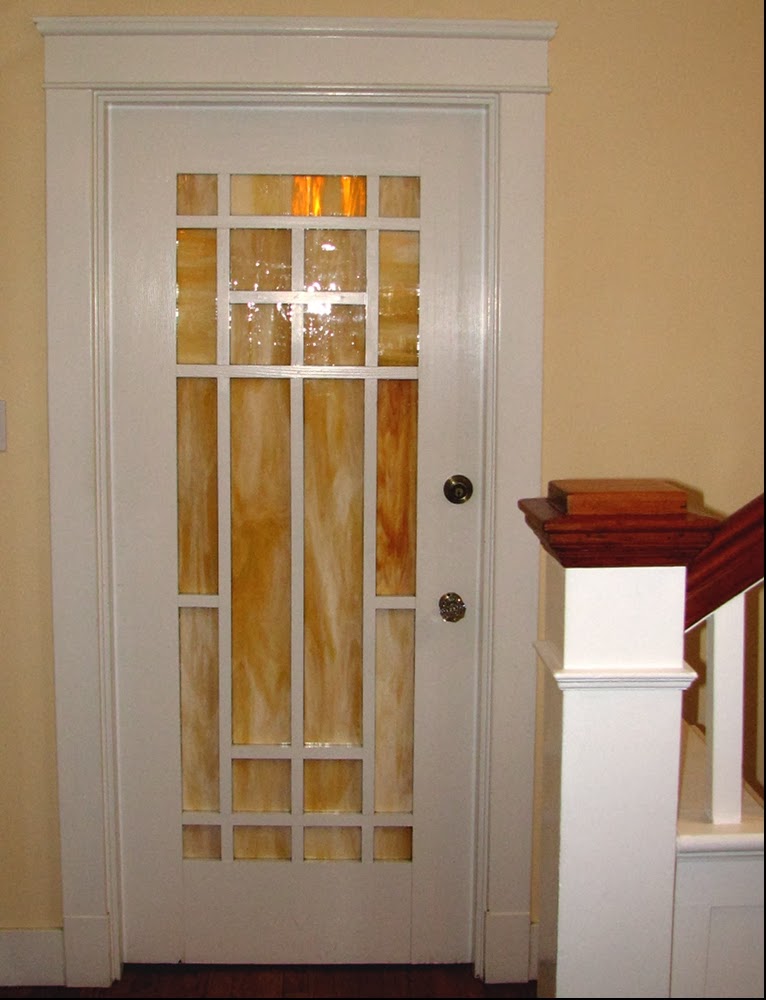 |
The ground floor plan of the Edwards House is quite novel. From the front door is a large entrance hall with a free standing stairway in the center. Walking directly forward passes under the stairway's landing and directly into the living room. At the foot of the stairway on the other end of the entrance hall are four matching glass doors partitioned into a Arts & Crafts pattern very similar to Stickley designs of that same period. Above left: The double doors that led to the dining room, and to their immediate right, another door into the living room.

Above: The glass door leading into the panty with the alabaster stained glass illuminated from behind.

The pantry is quite large in proportion to the 3-bedroom house and suggests Mary's sister, Florence, had quite a dish collection. In a short essay about the 1906 earthquake (transcribed here) she lamented that "...[We] listened to the crash of our beautiful wedding china and glass as it smashed on the floor. My parents screaming as they both fell down on the floor amid glass and china and cut their knees and hands."
 |  |
Although the kitchen is bungalow-sized, the lighting is very good with a pair of east windows and one facing north providing supplemental light. A sunny kitchen was not to be taken for granted; in many home designs of that period the kitchen was an afterthought. In Brainerd Jones' original 1904 design of Comstock House, for example, the stove was in the least ventilated part of the room with the single source of natural light being a window connected to a porch, several feet behind the cook - it must have been onerous to prepare the simplest meals. Inclusion of a well-designed kitchen shows the architect understood how domestic work functioned, and may demonstrate a significant advantage for architects who grew up in Victorian America as girls instead of boys. Mary wrote in her autobiography that at her first job, the head draftsman asked her, "tell me, what does a butler do in a butler's pantry?"
 |  |
Most of the windows in the Edwards House are casements, which were very modern at the time and part of the Mary Rockwell Hook "style." But the latches on these dual windows above the stairway landing would require a ladder to open, making it impractical to cool the second floor at the end of a hot summer's day by inviting in the foggy marine layer.
Current owner Trae Seely deserves highest praise for his good taste and judgement in restoration of the house, but the interiors may have been modified by some of the (at least) five previous owners. The complete lack of ornamentation is surprising; except for the alabaster glass doors and picture rail, the house is spartan. There is no wall crown molding, nor basic details such as returns on door or window trim. Missing are typical craftsman style features such as box beams and natural wood paneling, except for the fireplace mantles. As the closeup above right shows, the crown molding above doors, windows and cabinets is not just simple, but minimalist. But while there are examples such as the newel post that do show signs of replacement, why would someone would tear out substantial original woodwork? It would be very interesting to compare these interiors to those in other houses she designed in that period. If original, it would be notable as a pre-modernist take on the general craftsman style.
Mary Rockwell Hook's career divides neatly into two chapters. The latter part began in 1935 when she purchased 55 acres near Sarasota, Florida for only $10,000 and designed many of the homes there, including an artist's colony (more about that period here, including another portrait).
But the first part began with the house for her friend and sister Florence, and concluded in 1929 with the final construction of another California house for her sister Katherine in Woodside. That chateau-like manor house, called "Le Soleil," is as opulent as the Santa Rosa house is humble, with gold leaf ceilings and a 12-car garage. Sister "Kitty" - the same one who was once engaged to the Beaux-Arts atelier master - married Francis Crosby, who was president of the famous Key System streetcar service that linked San Francisco and the East Bay cities (until General Motors, Firestone Tire, and Phillips Petroleum conspired to put them out of business, that is). Like the Edwards House, Le Soleil is mostly unknown as a Mary Rockwell Hook design, and her name wasn't mentioned in promotional materials when the estate sold in April, 2013 for $8,400,000 (photos here, here and here).
Also in the first part of career she designed most of the campus for the Pine Mountain Settlement School, a boarding school and local cultural center in a remote area of the southern Appalachian Mountains. From her memoirs it is clear this work meant much to her and although the site is now a National Historic Landmark, it never brought her great acclaim. But that certainly was okay with her; while she clearly loved architecture, she did not have the ego driving her to want to be The Great Architect. By the age Mary decided that she wanted to pursue a career in the field, Julia Morgan already had a BS from UC/Berkeley in Civil Engineering and had completed an internship with Bernard Maybeck. There were years that Mary did not practice architecture at all; near the end of WWI she worked for the Post Office translating "Spanish trade mail" and later spent a year working for a charity assisting French peasant-farmers trying to reestablish their lives postwar. She often spent hours a day riding horses and sometimes toured in amateur theatrical productions. It seems that she had a well-balanced and happy life right up to her death at age 101.
As for the Edwards House, Florence and her husband did not live there long. It appears that they moved in during the autumn of 1908, judging by the newspaper clipping mentioned below and because the Rockwell family scrapbooks contain an October 12, 1908 receipt from the Fountaingrove Vineyard Co. for five gallons of "Saut (sweetened)" - presumably sauterne, which was quite popular in the day - that cost 75 cents a gallon, plus another buck for the keg. Presumably there were more gallons of the cloying sweet wine on hand when James was elected mayor of Santa Rosa in 1910 and invited the congratulatory crowd that gathered outside their home to come in and have "something to eat and drink." Hopefully Florence didn't lose too many pieces of her replenished dishware collection that evening.
The Edwards apparently sold the house in 1913 to Milton Wasserman, one of the larger hops dealers in the area. Florence and James Edwards moved back to McDonald Avenue, where he had lived most of his life, this time taking up residence at number 925, directly next to the Mabelton mansion.
The James R. Edwards are now comfortably installed in their handsome new residence on Mendocino avenue. They have certainly good reason to be proud of their new home and the friends who have been privileged with an inspection of the interior furnishing and arrangement cannot say too much in compliment of the taste displayed.
- "Society Gossip", Press Democrat, November 22, 1908
Happy Halloween, 1910! It's that night when young pranksters are afoot and angry men blast away at them with shotguns.
The last time we looked at Halloween trends was for the year 1907, when there were at least seven fatalities nationwide. Only two died in 1910 but that may have been just dumb luck - there were three accounts of men firing shotguns into groups of boys involved in mischief. One young man was hit in the neck (it wasn't reported whether or not he later survived) and another had forty buckshot pellets removed from his body. It's likely there were other incidents like those; non-fatal shootings were local news only, and those three cases were found in the small sample of newspapers currently available through the Internet.
The papers show the country was in a far better mood than that earlier Halloween, which is no surprise considering the 1907 Bank Panic happened just a couple of weeks before the holiday, and many were fearing it was the start of a great depression (Press Democrat headline one week before 1907 Halloween: "FINANCIAL SITUATION IS PANICKY ALL OVER COUNTRY"). But in 1910 jolly Halloween parties were reported everywhere, and many schools and churches threw parties for kids, a transparent ploy to corral the little hooligans.
Pranks were mostly the same as from earlier years. (The whole notion of "trick or treat" as barter against vandalism apparently did not evolve until around 1927.) It was still popular to steal front gates from homes and hoist them high into trees; wagons and buggies were taken apart and reassembled atop a roof. There were regional variations, too. In the Midwest it was apparently common to dump a load of feed corn on someone's porch, creating a cleanup mess (think of it as the old-time version of TP'ing trees). The police in Indianapolis were on the alert for vandals throwing putty at passing automobiles. And in Provo, Utah, which became "dry" at the beginning of 1910, prohibitionist pranksters painted the word "blind" and a cartoon of a pig outside the speakeasies (here's the meaning of "blind pig" for those unfamiliar).
 Some pranks also involved a "tick-tack," about which some deeper research was required. Completely forgotten today, this little noisemaker was incredibly popular at the turn of the century and easy for even a small child to make. Take an empty thread spool and notch teeth on the top and bottom to make the ends into something like a gear. Stick the spool on a pencil and wind string around the core. Pull the string and quickly press it against the outside of a window. Anyone inside the house would be startled by the very loud rat-a-tat-a-tat-a-tat sound that results. There were more complex versions including a couple of patented gizmos - the image shown at right is from a patent that included suction cups to attach to the window and a metal spring. You can find directions for a rubber band cranked tick-tack in the 1914 book, "The American Boy's Workshop," which also includes directions in how to trap a skunk, build a raft ("surely you can find four good stout logs and cleat them with pieces of scantling firmly spiked on") and several ways to put your eye out. But a tick-tack was not intended to be your everyday ratchet noisemaker; it was meant to terrorize people in the comfort of their home. And so one of the 1910 deaths came to be a sickly two year-old boy in Denver, who had a seizure and died after he was startled by the racket of a tick-tack on his bedroom window.
Here are some other pranks reported in the 1910 newspapers:
 | Pranksters remove a guardrail surrounding a excavation pit in Chicago and an unidentified man falls to his death. Also in the grim category is the burning of a freight car in the Rock Island railroad yard, the vandal probably unaware that nearby cars were loaded with timber, coal, and other fuels that might have caused a conflagration |
| A Salt Lake City motorcycle cop spots a group of boys dragging away a gate with a rope. As he drives up to them, the boys use the rope to lasso the policeman. The boys spend the night in jail |
| A young man in Indiana decides it would be funny for his friends to tell his father he had been kidnapped and would be killed if a ransom wasn't paid. The group of boys - presumably masked - wake up the surprised dad, who promptly jumps from his second-story bedroom window in his nightgown |
The most interesting pranks, however, are the ones that remind us how different things were a century ago.
In the town of Jackson (Amador County) school was cancelled because someone stole the clapper in the school bell, and as everybody knows, school can't be held unless the school bell rings.
Another school cancelled classes because wiseguys broke into the school, led a cow to the second floor and left it there. This was a two-fer; not only was school called off because of the janitorial mess, but it's also impossible to lead a cow down a set of stairs - how they got it out of the building is anyone's guess.
And then there was the teacher in Duncan's Mill who found her buggy on the top of the barn the morning after Halloween. She demanded her students have it ready for use by the next day and come the following dawn, she awoke to find her buggy still on the barn but now with a goat hitched into position. Anythin' else we kin do for yer, Ma'am?
PRACTICAL JOKES AT DUNCAN MILLSTeachers' Buggy Placed on Top of Barn Hallowe'en and Tuesday Night a Goat Was Hitched in Shafts
Some of the practical jokers at Duncan's Mills had some amusement Hallowe'en and since at the expense of Miss Ethel Piezzie of this city, who is teaching in Ocean district, and living at Duncan's Mills.
During Hallowe'en night the buggy in which Miss Piezzie drives to and from he school daily was taken up on top of the barn, and her horse taken out of its stall and an old plug put in its place. When it came time to go to schools, Miss Piezzie was compelled to hire a buggy.
Dire threats were made by the teacher as to the results to the jokers unless her buggy was ready for use on Wednesday morning. When Wednesday morning came there was the buggy still on the barn, but hitched in the shafts was a goat which had been secured during the night and taken aloft for the purpose. The affair has created much amusement to all but the unfortunate teacher.
- Press Democrat, November 3, 1910
Flip a coin and vote for either the Democratic or Republican candidates; it doesn't matter because they're the same guys.
For the second election in a row, the 1910 Santa Rosa election was fixed - the Democrats and Republicans united to offer a "fusion" ticket with the same slate for mayor and city council. The main difference between that year's setup and 1908 was that the earlier candidates were "chosen" by a sham vote at local party conventions; in 1910, the nominees were selected by a committee of political party leaders.
Having the winners of the upcoming election already settled in a smoky backroom deal was a bit much, even for Santa Rosa's go-along lumpenproletariat. There were apparently grumbles, addressed by Press Democrat editor Ernest L. Finley in a pair of editorials. There was nothing un-democratic at all about the process because the committee's decisions were "authorized by the central or executive committees of those organizations." And besides, the nominations were only recommendations:
There is no good reason why there should be any opposition whatever to the non-partisan ticket suggested by the representatives of the three local political organizations as the result of their recent conference...Some people seem inclined to object to the manner in which "the ticket was nominated." They say a mass meeting should have had a voice in the proceedings and contend that the action of the conference committees savors of "star-chamber" proceedings. But as a matter of fact, no ticket has yet been nominated. All that the conference committees did, after getting together and ascertaining that there was no real difference between the three organizations as to questions of local policy, was to recommend that James R. Edwards be nominated for Mayor, and Messrs. Johnston, Forgett and Pressley be nominated as candidates for councilmen. |
WAS THE 1910 SANTA ROSA ELECTION ILLEGAL? |
But politics can make for strange bedfellows and besides the Democrats and Republicans making the committee's decisions that Finley deemed proper and praiseworthy, the third party at the table was the Municipal League - the very political group that Finley had hammered two years earlier as lying troublemakers with a secret agenda. The Municipal League of 1910, however, was not the Municipal League of 1908; the progressive faction that wanted reform - the people who always seemed to make Finley feel most threatened - had mostly split off to form a county chapter of the Lincoln-Roosevelt League that was attempting to elbow its way into the local Republican party. (Much more about that drama later.) Apparently the Municipal League was now mainly the church element that wanted prohibition, which accounts for the "fusion" plank that promised there would be no new saloons and existing liquor laws would be enforced. New hotels and restaurants were exempt, of course, and fat chance on the latter.
Although he lacked a proper foe to demonize in this election, Finley did not retire his cudgel. His target now was the man who had the temerity run against the fusion ticket candidate for mayor: Evariste de Bernardi, an Italian immigrant who had operated a hotel and grocery in Petaluma and now owned the Magnolia Hotel in Santa Rosa. Apparently unwilling to openly attack a Santa Rosa businessman, Finley smeared de Bernardi using an editorial page "humor" column from his alter-ego, "Sleepy Bill." Written in thick dialect supposed to imitate an old-timer, Sleepy Bill longed for a return of the good ol' days when Santa Rosa was "wide open" and hoped that he and his sort could elect de Bernardi on the sly. "Bernardi's a cute one, all right, and if youse blokes don't tie no handicap to him, he'll fool de talent and make de trip dead easy."
The libel against de Bernardi continued with asides that "He's promised seven or eight fellers to make 'em Street Commissioner," that he was plotting to bring back prostitution, that he was arrested for backroom gambling and that he gouged customers by jacking up prices after the 1906 earthquake:
De good peeps ain't fergot as how Bernardi was arrested and fined two or three times fer runnin' a gambling game in his joint after de shake, or how he soaked de price of beer up to a quarter and coffee to a half, and de boys in blue had to call him down. And if I gets it straight, a lot of folks here already knows how he used to run dat hotel in Petalumy. No sir, we don't want to do nothin' that will git any of dem stories started around dis burg just yet. |
 While the dissolute Sleepy Bill hoped de Bernardi was voted into office "afore anybody drops on to what's doin," he still wouldn't knock the fusion candidate for mayor: "Jimmy Edwards ain't fer no dry town...Jimmy Edwards is all right, but he don't trot in my class" ('live the high life like me,' probably). And, in fact, candidate James R. Edwards invited no rebuke. Like the previous mayor, James H. Gray, he was by all counts an honest man untouched by scandal, and unlikely to exploit his position as Santa Rosa's mayor.
 James Edwards was the assistant cashier at Exchange Bank and after the 1906 earthquake was treasurer of the Earthquake Relief Fund. It was James who drove his father-in-law, Bertrand Rockwell, to a Petaluma bank immediately after the earthquake, where Rockwell cashed a check needed to pay emergency workers. Edwards later became president of the Luther Burbank Company and honorably resigned when the company became mired in disgrace (not of his doing). And as the obl. Believe It Or Not! item for this article, be astonished that he has two graves! One is in the Santa Rosa Memorial Park Cemetery and the other in the Rural Cemetery. James died in 1932 (age 59) and was buried next to his mother at Rural, but his widow, Florence, lived another thirty years - presumably she requested he be disinterred and reburied at her side in the Memorial Park. But the earlier headstone remained behind at Rural.
Edwards also shared with his predecessor, Gray - also elected as a "fusion" candidate - a lack of any experience or apparent ambition in politics. Finley and the Chamber of Commerce bunch probably wanted them in office not because they were supposed to act upon the behalf of special interests, but because they could be counted upon to head a laissez-faire administration. Neither mayor stepped up to the plate as a leader, although Gray tried to mediate a dispute early in his tenure and ended up putting the city at risk of a lawsuit as a result. Edwards offered little or no leadership in his two years, even staying on the sidelines during the battle over moving the tannery, which pitted most of the citizenry against the town's largest employer.
On election day, Edwards beat de Bernardi 69 to 31 percent, which seems like a huge win until you consider that de Bernardi won a third of the vote with absolutely no support from any political party. The fusion ticket councilmen also all won, although one of them faced a pair of opponents who together received more votes. The anti-fusion votes may have been only a minority dissenting against the town's status-quo polity but it was dissent just the same, and a sign that a sizable number of voters were no longer marching to the beat of the same old political drums.
THE POLITICAL POT BOILINGLion and Lamb to Lie Down Together This SpringThe political pot has begun to boil in Santa Rosa already, and there seems to be a general disposition among the parties to eliminate any contest in the coming municipal election.
With that end in view conferences have recently been held between committees representing the fusionists at the last election and the Municipal Leaguers. Certain matters have been tacitly agreed upon, but other matters are yet in the embryonic state.
A mayorality [sic] candidate has not yet been found and a nominee to succeed Councilman L. W. Burris has not been chosen. Councilman Burris long since announced tht eh would not under any condition accept the nomination again.
In the conferences held, as stated, it has been agreed that the Fusionists shall name the nominee for councilmanic honors from the fourth ward, and it is understood that means the selection of Councilman C. Fred Forgett to succeed himself.
The selection of the nominee for the sixth ward has been left entirely to the Municipal Lague, and it is understood that Councilman Robert L. Johnston, the incumbent, is to be his own successor.
In the fifth ward, from which Councilman Burris retires, there are two candidates in the open, with a dark horse who may yet take the lead. The men who have been mentioned for councilmen in this ward are Henry A. Hoyt, the contractor, and Leslie A. Jordan, the insurance man. If a choice cannot be made between these men by the committee having the matter in charge, a dark horse is known to be in existence.
Representing the parties in the conferences have been seven men, two Republicans, two Democrats and three Municipal League men.
- Santa Rosa Republican, February 17, 1910
FUSION TICKET NOMINATED AT COMMITTEE CONFERENCEEdwards for Mayor, Johnston, Forgett and Pressley for Council
THE TICKETFor Mayor--James R. Edwards
For Councilman, Third Ward--Robert Lyle Johnston
For Councilman, Fourth Ward--Charles Frederick Forgett
For Councilman, Fifth Ward--Lawrence Adams Pressley
MATTERS AGREED ON FOR THE PLATFORMWe, the representatives of the municipal organizations of the Democratic, Republican and Municipal League parties of the City of Santa Rosa, pledge our candidates for the offices of Mayor and Councilmen to the following platform:
I.Impartiality and non-partisanship, in the appointment of all city officers, in the employment of labor, the purchase of materials, and the letting of contracts.
II.That no bawdy-house district, or public prostitution, shall be permitted to exist within the corporate limits of the city.
III.The regulation of the saloons, and the orderly conduct of of the same; a strict and impartial enforcement of all municipal and state laws with respect to the sale of spiritous, malt, and vinous liquors; the issuance of no new liquor licenses except to bona fide hotels and restaurants, and the reduction of the number of saloons now existing as opportunity will permit, without undue injury to individuals; and in the event of the forfeiture of a license for any cause, no new or other license to be issued in lieu thereof.
- Press Democrat, February 29, 1910
AN ACCEPTABLE TICKET
Much satisfaction is being expressed over the ticket proposed by the conference committee, and there is little question but that it will be heartily endorsed at the polls. Many a time we have fought and struggled through a two-months' campaign, engendering feelings that lasted for years, only to emerge with a set of officers not nearly so well qualified and not half so acceptable generally. James R. Edwards is a man of high character, fine business ability and sterling worth. He can be depended upon to discharge the duties of Mayor faithfully and well. Messrs. Johnston and Forgett have rendered good service on the City Council, and no mistake will be made in electing them for another term. Lawrence Pressley has occupied numerous positions of responsibility and trust, always acquitting himself with credit. As a member of the City Council he will fully substantiate the confidence that has been placed in him.
- Press Democrat editorial, March 1, 1910
JAMES R. EDWARDS IN AN INTERVIEWNon-Partisan Nominee for Mayor Outlines Position in Talk With Press Democrat Representative
[..]
"The several matters covered in the platform speak for themselves, and seem fair enough to suit anybody. This nomination came to me entirely unsolicited, and I am bound to no party, individual or set of individuals. If elected, I shall try to serve the interests of all the people. As far as I am able to learn, affairs in the various departments appear to be running along in a satisfactory condition, and as the object of this election seems to be to avoid any undue disturbance. I see no reason at this time why any changes should be necessary among the city's employees. If I should be elected and later discover that any of the employees of the municipality are not doing their duty or giving the city the proper kind of service, they will have to go, and that is all there is about it. A city, it seems to me, is pretty much like a business concern, and there is no reason why it should not be run along business lines."
- Press Democrat, March 3, 1910
OPPOSITION ILL-ADVISED
There is no good reason why there should be any opposition whatever to the non-partisan ticket suggested by the representatives of the three local political organizations as the result of their recent conference. The four men recommended for office are all good representative citizens, who can be depended upon to treat all interests with fairness and impartiality; all are well qualified for the positions they have been asked to fill; there is absoulutely no issue to be fought out; and the best interests of the city demand that the strife and turmoil attending recent municipal elections here be avoided this year if such a thing be possible.
Some people seem inclined to object to the manner in which "the ticket was nominated." They say a mass meeting should have had a voice in the proceedings and contend that the action of the conference committees savors of "star-chamber" proceedings.
But as a matter of fact, no ticket has yet been nominated. All that the conference committees did, after getting together and ascertaining that there was no real difference between the three organizations as to questions of local policy, was to recommend that James R. Edwards be nominated for Mayor, and Messrs. Johnston, Forgett and Pressley be nominated as candidates for councilmen. The nominations have not yet been made. They are being made now, by petition.
Under the new primary law, conventions and mass meetings are things of the past. And the members of the three committees named to confer regarding the best way to go about handing the election under the new and untried law were all duly accredited representatives of the political organizations for which they acted, and their acts were not only authorized by the central or executive committees of those organizations, but also duly ratified before being made public.
In addition to the facts above set forth, the action of the conference committees has resulted in saving the city the expense of holding a primary election. Less than a couple of hundred electors were registered in time to qualify themselves to vote at the primaries, and the expenses of holding the primary would have been between $1,200 and $1,500.
Taking everything into consideration, it is difficult to understand how any citizen having the welfare of the community at heart can conscientiously oppose the plan that has been suggested for getting rid of the usual election squabble here this year.
- Press Democrat editorial, March 3, 1910
ANNOUNCES CANDIDACY FOR MAYORALTY
E. DeBernardi has announced his candidacy for the office of Mayor. Yesterday he called at this office and handed in the following signed communication with the request that it be published:
Having been requested by a number of prominent business men and citizens of Santa Rosa to become a candidate for Mayor in the next election to be held in our city on the 5th day of April, I come before you after due consideration and ask your support.
I must say that I come before you with free hands, pledged to no machine nor party, making you no promises, nor trying to mislead you. I do not want you to criticize what I am going to do, but what I have done.
My platform will have no planks (especially if rough lumber one may get slivers), no flourishing words, but only three phrases; honesty of purpose, justice to all, and favor to none.
I want your support and the support of those that love liberty; liberty of thoughts and action, and if by the past you may judge the future, then I have nothing to fear, fully believing that you will entrust to me the care of your city. I have lived among you for nearly a decade, and having been in business all this time, you have had a chance to see more or less of me and judge if I am not worthy of your confidence, and if next April, the 5th you will choose to cast your ballot for me. I will give an administration that you shall have just reason to be proud of.
[signed] E. DeBernardi.
Mr. DeBernardi does not come before the public as the nominee of any organization, political or otherwise, but merely as a citizen willing to occupy this high place and take over the direction of public affairs here if the people so desire. In launching his candidacy he proceeds under the general law, which provides that any citizen may become a candidate for office upon presenting a petition duly signed by at least three percent of the voters. Mr. DeBernardi was out yesterday securing signatures to his petition, and met with good success. He hopes to file his petition today. Mr. DeBernardi has been a resident of this city for several years, and lived in Petaluma for some time before coming here. He is a native of Italy, where he was born 46 years ago. He was naturalized in 1885, in Marin county.
- Press Democrat, March 5, 1910
OLD SLEEPY BILL COMES BACKWell-Known Local Character Discusses Political Situation Straight from the Inside
"Say, what are youse guys a-tryin' to do, start something?" said Sleepy Bill yesterday, as he strolled into a down-town resort and began to shake hands all 'round after his long absence. "Can't youse mutts see dat a scrap now is a-goin' to spoil de game and beat de big bloke for Mayor?" he continued. "Our play is fer to lay low, and shoot Bernardi in afore anybody drops on to what's doin.'"
"Why, if de choich gang ever gets wise to our man we won't have no more show dan Jim Ramage has of winnin' out in de big race meet wid his one-lunger. Say, dey'd make us look like Joe Tarzyn after a game of pool at de Elk's Club. De good peeps ain't fergot as how Bernardi was arrested and fined two or three times fer runnin' a gambling game in his joint after de shake, or how he soaked de price of beer up to a quarter and coffee to a half, and de boys in blue had to call him down. And if I gets it straight, a lot of folks here already knows how he used to run dat hotel in Petalumy. No sir, we don't want to do nothin' that will git any of dem stories started around dis burg just yet.
Bernardi's a cute one, all right, and if youse blokes don't tie no handicap to him, he'll fool de talent and make de trip dead easy. He's promised seven or eight fellers to make 'em Street Commissioner, and de way dey is out a-leggin for him is something pitiful. Why, when it comes to promisin' t'ings, he's got Henry Silvershield beat to a pulp. Tarkey Rains, Little Bill Nichols, Charlie White, Political Dick, Jess Musselman, Charley Holmes and three or four others t'ink dey has got de street job nailed to de cross fer fair. Dey say he promised 'em de place right out. He's kinder overdid de promisin' act as fer as de Street Commissioner busines goes, dough. A day or two back, one of de boys heard conflictin' yarns about who was to git de place, and went and asked him what id meant. 'Well,' says Bernardi, 'I did tell Jess he could have it, but you're de real Injun, see? I was only a stringin' Jess, so as to make him feel good.'
"Naw; de Police Chief aint settled on yet. De big one wants to give it to Curley Murphy, but we has promised it to t'ree or four, and I don't know just how it is a-goin' to come out. Yes, when it comes to promisin' dats our strong suit, but if you know who you're a talkin' to you don't take any chances. We promised the good gang dat we wouldn't stand fer no red lights and den we turned 'round and throwed de gaff into de udder gang and told 'em if dey wanted t'ings put back de way dey was before, dey would have to come across wid de goods. And dey come, you bet. Oh, when it comes to doin' slick politics, DeB is right dere wid bells, and don't youse fergit it. Pop Collins learned him de game down in Petalumy.
"Jimmy Edwards ain't fer no dry town; he says everything is a-runnin' along all right now. But what we wants is to t'row 'er wide open, wake up dese chicken-farmers and make 'em circulate dere egg money.
"Me and Dock Reed and Charlie Holmes was a-talkin' yesterday in de J & M and Dock he says dey has got to be a change. 'De choich crowd and Rolfe Thompson and his gang has run dis town long enough, and its a dead one alongside of Reno and Truckee and some of them up-to-date burgs,' says Dock. 'Jimmy Edwards is all right, but he don't trot in my class. It's me fer de swinging doors and de 'lectric lights--lots of 'em. If de gang had a-put me up, I'd a-made de old town go some, you bet.'
"'You're de man what ought to a-had it too, Dock,' says Charlie. 'You had no business a-gettin' cold feet like dat, and lettin' Bernardi beat you to it.'
"'You bet, I'd sure a-showed 'em some real speed,' says Dock.
[..]
- Press Democrat editorial page, March 27, 1910
EDWARDS' MAJORITY LARGEST EVER POLLED FOR MAYOREntire 'Non-Partisan Party' Ticket Elected, by Majorities that Vary from 529 to 21
[..]
The election passed off quietly, as such things go, although during the day much interest was manifested regarding the probable outcome.
Edwards' supporters were out early with teams and carriages, and Bernardi had an automobile at work, supplementing this later in the day with a carriage or two. Several of the other candidates also had carriages out.
The voting began early, and the total vote cast was 1427. With one or two exceptions, the election officers were those already announced in these columns.
As usual, the Press Democrat office was the principal scene of activity in the evening when the returns began to come in. The crowd began to gather before seven o'clock. As the messengers came in from the polling places with the return of votes, the results were quickly totalled up and announced, thus keeping the crowd posted as to the progress of the count.
All the returns were in shortly after eight o'clock, with the exception of those from the Fifth precinct, where the count was slow. The fact that there were three men running for Councilmen in this ward may have accounted for the delay there to some extent.
Shortly after nine o'clock all the votes were in and as soon as the result was formally announced a procession was formed and headed for the Edwards' residence on Mendocino Avenue to congratulate Mr. Edwards on his election. Arriving there, Mr. Edwards was called out, and from the porch introduced by Ernest L. Finley as "the next Mayor of the City of Santa Rosa."
Mr. Edwards' appearance was greeted with much enthusiasm, and after the cheering had subsided the crowd called upon him for a speech. Mr. Edwards responded with a few well-chosen remarks in which he thanked the citizens for the honor conferred upon him, and pledged himself to do all in his power to promote the welfare and advancement of Santa Rosa. He concluded by inviting all present to come in and have "something to eat and drink."
The invitation was accepted with three rousing cheers and the entire gathering trooped inside where Mrs. Edwards and a number of her lady friends served coffee, sandwiches, etc., everybody shaking hands with the new Mayor as they entered the door. After felicitating the new Mayor personally upon his his election and partaking of his hospitality, the crowd departed and later on in the evening, when the meeting of the City Council had adjourned, Mayor James H. Gray and the city officials also called at the Edwards residence and congratulated Mr. Edwards upon his election. The latter party remained about an hour.
About half-past nine o'clock, Mrs. DeBernardi, wife of Mr. Edwards opponent, telephoned to the new Mayor congratulating him upon his election and wishing him a successful administration.
[..]
- Press Democrat, April 6, 1910


It's election day, 1910: Will you vote for California to create a state highway system? It's not an easy decision.
 Another use for the modern automobile: Dressing it up as a parade float. Florence Edwards, wife of Santa Rosa mayor James Edwards, and her sister Katherine Rockwell driving their entry in the 1910 Santa Rosa Rose Carnival. Underneath all those blossoms was a 1909 or 1910 model Buick Model 10 Runabout, which was a 22.5 horsepower three-seater (there was a "mother-in-law" seat in the rear not visible in this image). The local Buick dealer was Santa Rosa Garage at 216 B Street. Photo courtesy Rockwell family archives
There were now three auto dealerships in downtown Santa Rosa and judging by the large, expensive ads crowding the pages of both local papers in 1910, the town was more car crazy than ever. Buying a car was usually no longer a newsworthy item, but the gossip columns kept track of whom was driving where for whatever. The first auto fatality was also recorded that year; a nine-year old boy was killed by an auto at the corner of Third and B. The coroner's jury found the driver blameless - the child simply dashed in front of the car without looking.
But the most significant event of the year was the upcoming vote on the State Highways Act. California voters were being asked to approve a state bond for a jaw-dropping $18 million that would last until the futuristic year of 1961. The bond would pay for the construction of two highways running north-south. One would follow the the Central Valley through Sacramento, becoming more-or-less the route of today's I-5; the other highway route would be "along the Pacific coast," although it was left undetermined if that would be a true coastal road such as modern highway 1 or follow the trail of El Camino Real, becoming highway 101. "Several county seats lying east and west" of each highway were promised connections via new branch roads.
At this point, Gentle Reader's mouse finger is probably getting twitchy; reading about old state bond measures sounds just about as boring as, well, reading about old state bond measures. But there is a point to be made and hopefully you'll stick around for a few more paragraphs.
James Wyatt Oates, president of the Sonoma County Automobile Association, wrote a lengthy defense of the Act in the Santa Rosa Republican. He argued the new system would probably be more cost-effective (while admitting he didn't know how much was currently being spent on county roads) and that the system would end the haphazard local maintenance (while overlooking it would be up to the same locals to maintain any new state road construction, and doing so without state financial help).
There were loopholes and other unsavory details in the Act that Oates neglected to mention but were being hotly debated in newspapers around the state. Warnings were sounded over the politically-appointed advisory board that determined the exact locations of the new roads; they would be wielding enormous political power - a sensitive issue in California, which was still trying to wriggle out from under the cloven hoof of the Southern Pacific Railroad.
There was particular concern over the repayment demands. Whenever any bond money was spent in a county, it was required to pay four percent back to the state (the amount of interest paid on the bonds). That sounds fair on paper, but consider that neither highway would cross through bridge-less San Francisco County - the wealthiest part of California - so the region most likely to profit from the new intrastate road system would pay little or nothing. Counties in the path of the highways might gain an income windfall for turning county roads over to state ownership, but that would create holy hell in Los Angeles County, which had recently sold $3.5 million in road bonds; paying the state its four percent for roadwork plus the interest due from those earlier bonds meant that Los Angelenos would be double-taxed. There were many poor, eastern counties such as Amador complaining they would see no benefit at all because they were too far away from the action. For these reasons and more, opposition was stiff. The popular California Good Roads Association and the Automobile club of Southern California campaigned against approval.
With all that it mind, let's pretend it's the morning of November 8, 1910, and you are an average Santa Rosa voter (meaning, you are male and have a receipt showing you've paid the poll tax). How will you vote?
Before marking the ballot yes or no, further consider this: You and yours can't expect to personally ever enjoy the new road system. The average household income in 1910 Santa Rosa was around $600, which meant that a car big enough to seat your family would cost around two full years' pay. Even the tiny Buick runabout shown in the picture above was out of reach (it sold for $900). Yes, the situation would change in the near future, thanks to Henry Ford; five years later, a new Ford would cost as low as $360, making autos affordable to nearly everyone - but 1910 voters couldn't see into the future. So while the new highways might offer local advantages in trucking crops to market and such, cruising around the Golden State on those endless miles of beautiful fresh pavement was a pleasure reserved for the wealthy. People like James Wyatt Oates, relentless crusader for more roads.
Come election day, Los Angeles voted against it 3 to 1. It won 55 percent approval in Sonoma County and passed statewide.
Passage of the State Highways Act bond was a turning point in California's history; it's impossible to imagine the state would have experienced its later decades of explosive growth and agricultural development without those major north-south arteries. Sure, had it failed to pass, the WPA might well have built similar highways 25 years later - or just maybe we would have been stuck with a fractious system of county toll roads that evolved in its absence.
Yet it's also hard to see California voters approving something like the State Highways Act today. That $18 million might not sound like much to our ears, but it was an enormous sum at the time; with inflation it works out to $8.6 billion in modern dollars, equal to about three-fourths of all California state bonds sold last year. Every special interest in the state would now fiercely lobby against such a proposition simply because it would suck all the air out of the investor's bank vaults.
Still believe the Act would be approved by modern-day voters? Compare criticism against it in 1910 to recent arguments against funding the SMART trains. Just as then, SMART opponents charged the project is a boondoggle, that it will benefit only a privileged few, that the choices for the route (train stops) will be decided on political favoritism, that it can't be completed as promised without additional rounds of future funding. It took two attempts to gain voter approval for SMART and it nearly faced a recall. Think back over all those years of heated struggle on SMART funding, then realize that cockfight was squabbling about two percent the relative size of the State Highways Act bond.
The 1910 Act passed because it won approval in counties that expected to gain state highway status - Los Angeles excepted - with a big boost from San Francisco, which at the time had a quarter of the state population. It should be noted, too, that 1910 was near the peak of the Progressive Era, when many people eyed civic betterment as more important than "what was in it for them."
Skeptics were right, however, in predicting the State Highways Act bond would fall short on money. Additional bonds were passed in 1915 and 1919 to complete the work. Over the course of that decade Sonoma County built roads in a frenzy; by 1913, Santa Rosa was spending over $28,000 a year for highways - among the highest of California cities of its size - and the county was spending almost as much on new roads as larger Alameda County and far more than Marin. For better or ill, Sonoma County was among the vanguard in subsidizing the car culture using public funds.
GOOD NEWS FOR AUTOMOBILE MENRoads in Marin County From San Rafael to Sausalito Are to be Improved Soon
Santa Rosa autoists as well as those on all sides of the bay will be glad to know that through the efforts of the automobile owners of San Francisco and Marin county, aided by the proper authorities, steps are to be taken very soon to improve the roads in Marin county, particularly from San Rafael to Sausalito, a road much used but in a very bad condition.
The Sonoma County Automobile Association, of which Colonel James W. Oates is president, will shortly take up some active work for the improvement of certain roads in the county. The Ukiah Good Roads Association, as has been stated heretofore, is doing fine work on the roads from the Sonoma county line northward to Ukiah. Already they have held two "good roads" days, and the members of the club have turned out in full force to help in the repair work on the roads.
- Press Democrat, April 29, 1910
AUTO BREAKFAST A GREAT EVENT TODAYSplendid Time in Prospect--Anyone Favoring Good Roads Can Join the Association
Today the much anticipated outing, annual meeting and bull's head breakfast under the auspices of the Sonoma County Automobile Association of which Colonel Jas. W. Oates is president, occurs in Bosworth's Grove at Geyserville.
All members of the Association and their families are expected to be present as well as all others who become members of the Association prior to twelve o'clock noon--you can join on the field--when the big feast will commence. Anyone interested in good roads, whether he or she be owner of an automobile or not, may become a member of the Association, a prime move of which is to encourage the building of good roads throughout the state.
There will be all kinds of good things on hand for the breakfast menu. The Bismark Cafe proprietors, Bertolani Brothers, have charge of the feast, and they have secured the services of a special Spanish cook of note who will superintend affairs. Saturday night a staff of seven men left here for Bosworth's Grove so as to get everything in readiness, for the grand breakfast will be enjoyed under the shade trees. The thoughts of that perfectly good feed should be an inspiration to membership in the Association, let alone the splendid object that is to be the strong feature of the meeting following the breakfast, that of boosting good roads.
- Press Democrat, June 5, 1910
COLONEL OATES EXPLAINS ACTSynopsis of "State Highway Act" Now Pending
Santa Rosa, Oct. 19, 1910I have been requested to give a synopsis of the "State Highway Act," now pending and to be voted on by the people at the November election.
This act, speaking generally, provides:
1--For the issuing by the state of eighteen million dollars of bonds in serials, to fall due in equal amounts each year until 1961.
2--The funds raised from the sale of these bonds are to be for the construction of two main highways, one to run through the Sacramento and San Joaquin Valleys, and from the Mexican line to the Oregon line; the other to run through the coast counties, both running north and south, and to connect every shire, or country town in the state.
3--These highways are to be constructed under the management and control of a state engineer.
4--The state pays the principal of these bonds by general taxation.
5--These bonds are to bear interest at a rate not over four per cent per annum, and each county in which any part of such highway is constructed is to pay the interest on the bonds represented by the amount of such highway fund expended in constructing such highway in such county.
6--After the construction of any highway inside a county, the management and control of the same is to be turned over by the state to the county in which it lies.
There are other provisions in the act, but they, in the main, deal with mere methods of procedure in putting the act into operation and for paying the bonds.
The way this act would operate in this country would be about this:
The only roads we have that would come under the operation of this act are the present ones from the Marin county line through Petaluma and Santa Rosa to the Mendocino county line, that from Santa Rosa through Sonoma to the Napa county line, and possibly from Cloverdale to the Lake county line.
These roads are now and have been for many years, county highways in more or less good condition, but never, within my knowledge, have they ever been in good condition throughout at the same time.
The construction of the state highway along these routes would be in all probability, by no means the same or as costly as the construction of new roads. In many places they would require much less work than in a new construction so that much of the expense of constructing new roads could be saved. All this, however, would depend upon whether the roads would be entirely reconstructed, and this is a matter of detail to be determined later by the proper authority.
To illustrate, we will say such construction within our county should cost $100,000 of this highway fund. When completed the roads would be turned over to the county government, and the latter would thenceforward have to pay the interest on $100,000 of the bonds, which would not be over $4000 per year at first, and would gradually grow less as the state paid off the principal of the bonds, till in the end the amount would be very small. The county, however, would have to keep up the roads.
From the Marin line to the Mendocino line, and from Santa Rosa by Sonoma to the Napa line is approximately 86 miles of road.
I have tried to find out how much money is spent each year on these roads, but from the present system it is almost impossible to do so. It would not, however, be far from the mark to say that such expenditure is annually not far from $4000 each year, which is the amount we would have to pay at first as interest on the bonds. Under the present system the results are by no means satisfactory. It is not much more than mere patchwork, at best. The system in inefficient and wasteful. Once a good road is constructed, the keeping of it in repair in a good system would not be very costly. Most of the nations of Europe have solved the trouble by letting a good road out to the lowest bidder for a term of years to keep it in good condition, and putting the contractor under bonds. One having a contract say on twelve miles of road, could watch it and by proper care keep it in complete repair at a nominal cost to him and make the upkeep to the county also much less than is expended now in patchwork, with the result of good roads all the time, instead of bad ones most of the time.
The economic advantages of better roads than we have had in America is just now attracting the attention of the people all over the Union; in fact the good roads movement is now on and will continue until a better system of construction and preservation is attained.
Some object to this "State Highway Act" because it is thought it might be better to have such portions of those highways constructed under county control. There are some advantages that might result from county construction, but the disadvantages greatly outweigh them. Inder that idea each county would have its own system of construction, and we would have nearly as many kinds of roads as we have counties. It would result in a huge piece of patchwork, and much of it, no doubt, would be a failure. Constructed under state control we would have at least uniformity of plan, construction and result; and it strikes me we can get that result in no other way. That this is a controlling consideration is obvious.
This plan is intended and will operate as an entering wedge for an improved road system in this state. With such highways through a county lie benefits and economic worth will soon be so manifest as to lead to similar treatment of all other roads in the county, from time to time, as the county can get at them. No one can rationally expect any system of good roads to be adopted and applied to all roads at once. A beginning must be made somewhere on some road, while other roads must wait their turn. In this way those fortunate enough to live on or near the first ones improved would reap an advantage, but under any system such would be the case. Unless some main roads are used for a beginning, all the roads will continue to be as they are.
The people vote in November on this "State Highway Act"; they can vote it up or vote it down; if they vote it up we have taken a long step towards bettering road conditions in the entire state. If they vote it down, we will have to continue to do the best we can with the road system as we have it.
JAMES W. OATES.
- Santa Rosa Republican, October 21, 1910
It was the worst fire since the 1906 earthquake, but that's not what made the Levin Tannery's destruction a disaster.
 |
| Photo courtesy Sonoma County Library |
The fire, at the modern location of 101 Brookwood Avenue, immediately spread from the tannery to the adjacent shoe factory and a couple of houses. And then it was remembered that gasoline was being stored at the building next door. "It was said there was enough gasoline in the place had it exploded, to have wrecked every building within a considerable distance, to say nothing of the probable loss of life," the PD reported.
Afterwards, there wasn't much left at all, which in a way was great news; the tannery had a history of being a terrible citizen, stinking up the town and repeatedly poisoning Santa Rosa Creek with illegal discharges. The Levin brothers promised in 1906 and 1909 to clean up their business but never did, as discussed at length in the earlier article, Tannery Town. Good thing: Tannery gone. Bad thing: There were about 140 men working there at the time of the fire, which meant about three percent of the local workforce was now unemployed.*
Soon afterwards the Santa Rosa Chamber of Commerce held the first of three public meetings on the future of the tannery and shoe factory, the events chaired by Press Democrat publisher Ernest Finley wearing his hat as the Chamber's president. Curiously, no members of the Levin family or representatives from the owners attended. Some prominent businessmen said they had discussed matters with the Levin brothers, and while hastening to add they were not speaking on the Levin's behalf, were in fact clearly doing so.
At the first meeting, one of the non-spokesman spokesmen for the Levins stated "plans are already well under way for the immediate re-establishment of the Tannery, but had intimated that if any suitable arrangement should be proposed they might be willing to move to some other part of town, as they were tired of having to fight with their neighbors and carry on business at the same time." Dr. Bogle suggested the tannery could be rebuilt near the train depot, which sounds similar to the 1908 proposal that Santa Rosa move all the bordellos to the West End Italian neighborhood.
 |
| Photo courtesy Sonoma County Library |
It was quite the sweetheart deal for the Levins, who apparently had enough insurance coverage to rebuild both businesses anyway. They would net the equivalent of about $5 million today while hanging on to half ownership in the factory. And presumably, the new location for the tannery would come with a city guarantee there would be no further complaints made against them.
The third meeting recapped the proposals and State Senator Walter F. Price reported that investors were really getting excited; they had raised about 20 percent of the funds in just the past 72 hours. Oh, and it had been privately decided it was important for the city to buy the former tannery land for a public park. And thus two weeks later, everything was riding on the City Council approving $5,000 (the investor's half of the property deal with the Levins paying themselves the other half).
And the Council said no. "The City has no money for such purposes," a councilman told the Press Democrat.
Newspaper editor Ernest Finley was apparently irate the Council had put the kibosh on the deal negotiated by Chamber of Commerce president Ernest Finley:
At a special meeting of the City Council called for last evening to consider the park proposition upon which also hinged the re-establishment of the shoe factory, the removal of the Levin Tanning Company's plant from the residence district, its early re-establishment here in another part of town, and the ending of the long and bitter wrangle that has resulted from the maintainence of the tannery at its present location, the entire project was turned down, and with scant ceremony. |
In addition to that remarkable sentence which dribbles on for nearly seven dozen words, the PD article closed by naming all members of the Council who were at that meeting. At least he didn't publish their home addresses and announce the hardware store was having a sale on rope.
That was the end of the tannery removal saga. The Levins began to rebuild the shoe factory and tannery in the exact same locations. Five weeks after the Council refused to appropriate funds, two people sued the Levins, claiming the tannery conditions were damaging their health.
There are two takeaways to the story.
First, it's highly unlikely the tannery actually could have been relocated elsewhere in Santa Rosa. Tanneries use lots of water and thus need to be near a plentiful supply, such as Santa Rosa Creek, and it's doubtful there was another creekside location available in city limits - Santa Rosa was so small at the time you could probably bicycle from any end of town to the other within ten minutes. If they left their old location it would make more sense for the Levins to leave Santa Rosa altogether and rebuild somewhere like Petaluma, which already had a large tannery on the river.
 |
| Rebuilt tannery in 1944. Photo courtesy Sonoma County Library |
It has to be understood, too, that the tannery drama was playing out at the exact same time as the courtroom case over the downtown lake. As described in the previous item, a group of citizens banded together and created a little lake by damming Santa Rosa Creek. Admired by all for creating a much sought-after park, it was doomed first by the toxic discharges into the creek during the tannery fire, then threatened by a lawsuit from a man who claimed his property line extended into the middle of the creek.
But like the tannery situation, there were no better angels in Santa Rosa to step up and do what was best. Even though the District Attorney was part of the grassroots effort, the city averted its gaze and allowed the dam to be demolished. For reasons unrelated to the ersatz lake, Santa Rosa had reasons to challenge such a claim - it was important to settle legally whether half of the creek was private property or not.
The lake story and the tannery relocation tale ended up being twin failures for the town, the two episodes joined together like the front and back sides of the same plugged nickel. Which was about all Santa Rosa's leadership was worth.
*The population of the greater Santa Rosa area in 1910 was around 11,000 (see discussion) which would make 4,000 a reasonable guess as to the number of total able-bodied men in the workforce. |
FIERCE FIRE DESTROYS LEVIN TANNERY AND THE SANTA ROSA SHOE FACTORYGreat Excitement Prevailed Tuesday Afternoon while the Flames Held Angry Revel and Threatened Further DestructionMUCH DAMAGE DONETannery and Factory Practically Covered by Insurance--Two Cottages Burned--Loss Keenly Felt by the Large Number of Employees--Cause of Fire Unknown
Fire dealt Santa Rosa another hard blow yesterday afternoon, leaving in its wake a mass of smouldering ruins to mark the spot on upper Second street where the big plant of the Levin Tanning Company and the Santa Rosa Shoe Manufacturing plant had stood. Within an hour from the time the alarm was turned in, so fiercely did the fire rage, that damage amounting to more than $150,000 had been wrought, and two of the city's largest and most important institutions wiped out.
About ten minutes past five o'clock the alarm sounded, and it took but a glance in the direction indicated by the box number to show that a fire of startling proportions had broken out. Before the fire department could reach the scene, the highly inflammable nature of the main tannery building and its contents, accelerated by a stiff breeze blowing from the southwest, had given the flames such a mastery of the situation that it was apparent the big building as well as the one beside it, was doomed.
A Spectacular Conflagration
It was one of the most spectacular fires ever seen here. Great masses of heavy, black smoke rolled high into the heavens, solid walls of red and angry flame leaped in every direction, explosion followed explosion as oil tanks and acid receptacles were reached, and the hissing of escaping steam from the great boilers added to the unearthly din.
The fire started in the main tannery building, which was located right on the creek bank, and at the worst possible point, as far as controlling the flames was concerned. The wind drove the flames directly on and into the big structure, leaping higher and higher in their angry revel, crackling and roaring their defiance. Leaping across the narrow passageway between the main tannery building and the four-story finishing house, they rushed on toward the street and the office building and dwellings standing opposite.
The Shoe Factory Goes
From the first it was seen that the big shoe factory to the east was doomed, and when the long arms of flame reached out and took it in, a fresh touch of the spectacular was lent to the scene already boarding on the tragic. In and out of the many windows the angry flames played and when the wind drove them clear across the street. Just when it seemed that the warehouse and office building must likewise become their prey, the wind again veered and drove the flames back over the already half-demolished factory building.
With the tannery building, finishing house and shoe factory, much valuable machinery and large number of tools, as well as immense quantities of leather and shoe stock, were consumed.
Two Cottages Burned
The cottage occupied by Mr. and Mrs. Frank Day and owned by Mrs. Anne E. Straub, was completely gutted. The Days succeeded in removing considerable of the furniture, but as they held no insurance the loss is quite heavy. This cottage adjoined the tannery on the west. On the east side of the shoe factory the residence owned by John Brennard and occupied by the Misses Anna and Maria Brennard, was also burned. The occupants saved some of their belongings.
Excitement in Neighborhood
The magnitude of the fire occasioned much excitement in the neighborhood and people on both sides of the street in proximity to the burning buildings carried out most of their furniture. Many roofs were wetted down and a number of smaller blazes started by the flying embers were extinguished without much damage resulting.
The residence of Milton Wasserman on upper Third street caught on fire several times, but the flames were fortunately extinguished without any serious damage being done. A grass fire was also started near the residence of John Rinner, but was speedily stamped out when discovered.
Gasoline Warehouse Menaced
The greatest excitement prevailed when it was known that almost in the path of the flames was an old planing mill, in which was stored a large quantity of gasoline belonging to the company represented here by A. D. Sund as local agent. It was said there was enough gasoline in the place had it exploded, to have wrecked every building within a considerable distance, to say nothing of the probable loss of life. Very fortunately the fire did not take the building.
Ben Noonan's Loyal service
Ben Noonan, in his big Stoddard-Dayton touring car, did valiant and effective service during the fire. When the blaze was assuming dangerous proportions, he raced to the fire station on Fifth street, hitched the auxiliary steamer on to his machine and in on time had it at the scene of action. Again he raced back for a load of fire hose, and again he went back for a fresh supply of coal for both steamers. At one o'clock this morning he drove past the Press Democrat office, pulling the auxiliary engine back to the engine house, for it was not until that hour that the engines were removed. Hosemen were on duty all night, guarding against any possibility of further outbreak of fire.
Fire Origin Not Known
The origin on the fire is not known. It broke out soon after the men had quit work for the night, and before they had all left the premises. Two men still working in the finishing house were compelled to flee in their working clothes.
Carried Good Insurance
Fortunately the plants were well insured, and it is likely the insurance will practically cover the loss. Both institutions were doing a great business at the time, and the fire necessarily hinders that, and at the same time throws many people out of employment. About 140 men were employed at the time of the fire.
[..]
- Press Democrat, June 1, 1910
LOCAL BUSINESS MEN SAY FACTORY SHOULD REBUILDNew Site for Tannery and Other Matters DiscussedChamber of Commerce Committee Named to Investigate Situation Fully and Report Back Monday Evening--Tannery to Resume Operations at an Early Date
Last night's meeting of the Chamber of Commerce was largely attended, the big rest room adjoining the regular headquarters being used as a meeting place and being crowded to its utmost capacity. President Ernest L. Finley occupied the chair, while Secretary Edward H. Brown was at the desk...
At last night's meeting of the Chamber of Commerce, which took the form of a mass meeting at which tannery matters had been made the special order of business, the matter of rebuilding the Levin Tannery and Shoe Factor was discussed at length, as was that of assisting the institutions in finding a new location in another part of town. The proprietors were not present, but it was stated that plans for the immediate reestablishment of the the Tannery here are already well under way, while the Shoe Factory may also be rebuilt providing some assistance is forthcoming from the community. The Chair was finally authorized to appoint a committee of five to investigate the situation fully and ascertain just what can be done...
...Under the head of new business, Chairman Finley stated that the special order of business for the evening was the consideration of tannery matters, briefly outlining the situation resulting from the recent destruction of the Levin company's big plants, and stating that a free and full discussion of the matter was desired.
J. H. Einhorn started the ball rolling by stating that everybody wanted to see the Tannery and Shoe Factory reestablished, because they had been a good thing for the town. The business community could not fail to notice the loss of the company's big payroll, he said.
M. Rosenberg stated that he had had a talk with Nate and Pincus Levin, in which they both had told him that plans are already well under way for the immediate re-establishment of the Tannery, but had intimated that if any suitable arrangement should be proposed they might be willing to move to some other part of town, as they were tired of having to fight with their neighbors and carry on business at the same time. He said the Levins had further told him that while the Shoe Factory was on a paying basis at the time of the fire, they had not yet made up their minds whether to rebuild it or not. If the community would assist them, however, they would rebuild, and furnish half the capital required. The amount necessary to properly build and equip the Shoe Factory was estimated at between $60,000 and $75,000.
Charles E. Lee said he thought the community could well afford to assist in the establishment of such institutions, and favored as many citizens taking stock as possible.
J. H. Brush said the business community fully appreciated the work that had been done by the two institutions, and wanted to know whether in the event of being asked to take stock it would be in a joint tannery and shoe factory, or merely in a shoe factory operated as a separate concern. Mr. Rosenberg said that as he understood it, the Shoe Factory and Tannery were separate and distinct institutions.
C. D. Barnett said that he had had a talk with the Levins, and while he had no authority to make any statement in their behalf, he understood that they felt that would have their hands full for a while with the Tannery alone, and that if they started the Shoe Factory they would want to put all the details of supervision and management in the hands of a competent manager. On some such basis they would be willing to furnish half the capital required.
Superintendent Gilman of the Shoe Factory was called on, and said that at the time of the fire fifty hands were employed in his department, with a payroll of about $625 per week. The Tannery payroll was much larger, he said, he did not now know just how much so. Orders for about 13,000 pairs of shoes have come in since the fire...
...Dr. S. S. Bogle told of the plan undertaken last year to secure a tract of land near the depot for factory sites, and hoped something could still be done along that line. "Now is the time to settle this matter of location," he said. He said he would be willing to give $100 toward procuring a new site, and thought the people living in the neighborhood of the old plant would all assist to the best of their ability.
John Rinner said that if the people would help who are continually putting their money into wildcat schemes and senting it away to pay for lots in some new "metropolis" that is going to be built about the bay, they would not only be doing themselves but their town some good...
- Press Democrat, June 18, 1910
MASS MEETING DISCUSSES PLANS FOR SHOE FACTORYNew Site for Tannery Favored by the CommitteeCitizens Gather and Hear Plan Outlined by Chamber of Commerce Representatives for Re-establishment of Institution Recently Destroyed by Fire
Monday night's mass meeting under the auspices of the Chamber of Commerce was called to order by President Ernest L. Finley, who acted as chairman. Secretary Edward Brown kept the minutes. The meeting was held in the Columbia theatre, the use of which had been tendered by Manager Ray Crone of the Columbia Amusement Company.
At the mass meeting held under the auspices of the Chamber of Commerce Monday evening at the Columbia theatre, the committee named at Friday night's meeting to formulate a plan of action in the Shoe Factory and Tannery matter submitted its report. The report was adopted, and the committee authorized to proceed and try and work the plan out to a successful conclusion, additional members being added to assist in handing the details.
Briefly stated, the plan proposed is to have a corporation capitalized at $75,000, of which amount the citizens will be asked to subscribe half and the Levin Tanning Company the remainder, said corporation to take over the business of the Santa Rosa Shoe Manufacturing Company and begin operations at as early a date as possible. The Levin Tanning Company agrees to sell to the Shoe Company all [illegible microfilm] at the head of Second street and move its tanning plant to another part of the city for $10,000.
Under this agreement, the Levin people would be paying half of the $10,000 above mentioned, for they would first have subscribed for half of the capital stock of the Shoe Company...
In stating the objects of the meeting, Chairman Finley took occasion to refer to criticisms that had been heard when the Chamber of Commerce took up the tannery matter, stating he believed it was the result of a misunderstanding as to the aims and purpose of the organization. From the first, he said, the only object had been to prevent anything being done that might run the tannery out of town and lose its payroll to the city.
[...]
- Press Democrat, June 21, 1910
SHOE FACTORY PLANS WILL BE RUSHED FROM NOW ONThe City Authorities to be Asked to Buy Old SiteChamber of Commerce Committees Submit Reports at Public Mass Meeting Held at Columbia Theatre Last Night
At the public meeting held last night...President Finley outlined the plan that had been agreed on by the general committee, and told something of the work that had been done to date. Briefly stated, it had been decided to try and form a new corporation to reestablish the shoe factory, said corporation to be capitalized for $75,000, the Levin Tanning Company to subscribe half and local investors the other half. The Levin people had agreed to sell their real estate holdings at the head of Second street to the new shoe company, and move their tannery to another part of town for $10,000...
...W. F. Price reported for the committee named to look out for stock subscriptions, stating that the outlook was encouraging, and that a number of subscriptions had already been received. At the conclusion of his remarks he gave any of those present and desiring to subscribe for stock an opportunity to do so, and about $2,500 was pledged. Up to the present time something like $7,500 has been promised...
...John Rinner called attention to the fact that if the tannery is re-established on its old site, the city will be compelled to expend five or six thousand dollars on a new sewer to accommodate the street sewage, while if the tannery is moved the present sewer will do. This he mentioned as an additional argument in favor of having the city co-operate in the plan now under way to bring about the tannery's removal.
[...]
- Press Democrat, June 25, 1910
CITY COUNCIL TURNS DOWN THE PARK-TANNERY PROJECTHad Endorsement of Chamber of Commerce, Women's Improvement Club, Park Commissioners, Mass Meeting and Citizen's Committee
At a special meeting of the City Council called for last evening to consider the park proposition upon which also hinged the re-establishment of the shoe factory, the removal of the Levin Tanning Company's plant from the residence district, its early re-establishment here in another part of town, and the ending of the long and bitter wrangle that has resulted from the maintenance of the tannery at its present location, the entire project was turned down, and with scant ceremony.
"We declined to endorse the plan -- the City has no money for such purposes," said a member of the Council to a Press Democrat representative after the meeting was over.
The plan as outlined was presented by the Chamber of Commerce, which organization had previously given the project much careful consideration and its unqualified support...The Women's Improvement Club had promised to donate the sum of $2,500 toward the plan and also to assist the project in other ways. The residents living in the immediate vicinity of the Levin plant had promised $5,000 to help carry the plan to a successful conclusion.
The City was asked to assist to the extend of $5,000, said sum to be paid at any time it might prove convenient, half out of one year's levy and half out of the next year's if desired. In return, it had been arranged to have the Levin Tanning Company deed all its holdings at the head of Second street to the City for park purposes.
Present at last night's meeting were Mayor James R. Edwards, Councilmen C. Fred Forgett, H. L Johstone, Fred C. Steiner, Eugene Bronson and Frank L. Blanchard.
- Press Democrat, July 8, 1910
AN INJUNCTION SUIT AGAINST TANNERYMrs. Catherine Bower Plaintiff in an Action Commenced in the Superior Court Here Wednesday
Alleging that she has been damaged in the sum of $2,500 by reason of conditions existing at the tannery that have depreciated the value of her property, and been a menace to her health, Mrs. Catherine Bower has instituted a suit for the recovery of damages and for an injunction against the Levin Tanning Company.
In her prayer the plaintiff asks for a judgment of this court that defendant be forever restrained and enjoined from maintaining, conducting, operating or carrying on a tannery upon the site mentioned, the manufacturing of leather from hides, the handling of hides, the allowing of deleterious matter to enter Santa Rosa Creek and many other things constituting as alleged by Mrs. Bower in her complaint a nuisance.
The injunction asked for is a permanent one. For some time the injunction proceedings have been threatened.
[..]
- Press Democrat, August 18, 1910