If you polled average Americans on what they knew about Santa Rosa a century ago, some might mention Luther Burbank or recall this as the other place hit hard by the big earthquake. But it's a safe bet that far more knew about the "hoodoo" car.
Jake Luppold, a gregarious saloon owner who dubbed himself the "mayor of Main street," loved elections and particularly election nights, when his joint was always packed with with political die-hards, celebrating victories or drowning the sorrows of defeat. "The Senate," at the corner of 2nd and Main streets (currently the south end of the Bank of America building), had a reputation as being the political bar in town, as well as offering the best free lunch to down with your nickel beer.
In 1908 California only men could drink in a saloon, and likewise voting was only a man's prerogative, so local political events dripped with testosterone. Before any sort of vote, there were downtown street rallies marked by noise-making and fire-burning. The noise came from brass bands, shooting guns into the air, or a phalanx of manly men pounding anvils. (The anvil chorus was a more civilized alternative to the dangerous 19th century practice of "firing the anvils," which involved packing the cup-like indentation on the anvil surface with gunpowder and placing another anvil upside down on top. When the gunpowder was ignited, the top anvil was flew into the air - hopefully straight up, and not angled into the crowd - making a loud boom remarkably similar to a cannon's roar.) The fiery activities included torchlight marches to party headquarters or the home of a victor, plus a bonfire or two in the middle of a street.
As much as The Senate saloon was the boozy center of Santa Rosa's political world, chatter in any bar anywhere easily turns to gossip, and a perennial favorite subject was the mystery of Lute Veirs.
L. L. Veirs had a Third street butcher shop and was a city councilman as well as acting mayor when he mysteriously disappeared on November 13, 1903, abandoning his wife Annie. It turned out that Veirs (not "Viers," as misspelled in some histories) had embezzled money from the town and forged the signatures of relatives as co-signers on loans from Exchange Bank. He had also borrowed money from individuals around town, again forging signatures on promissory notes. When he vanished, one of the people left holding Lute's worthless paper was Jake Luppold. It must have rankled deeply; behind the bar he kept a photo of Veirs along with one of the notes, which undoubtedly served to spark more gossipy speculation about where he might be hiding. The case rattled through the courts until 1907, and for compensation Luppold settled on ownership of an automobile.
The car wasn't worth as much as the loan, but its age and make were never mentioned in the papers. Some modern sources say it was a red Dodge touring car, but the first Dodge wasn't made until 1914. There were likely only a handful of (expensive!) autos in Santa Rosa when Veirs vanished in 1903, so it probably wasn't a rusty bag o' bolts that he personally owned. Whatever its provenance, all that's really important to our story is that Luppold now had the thing, and it was a bitter reminder how he had been screwed over by someone he trusted.
Sometime in mid-October, 1908, about two weeks before the Taft vs. Bryan presidential election, Jake or one of his barflies thought of an inspired mash-up: They could have their election night fun and get rid of the damn car at the same time if they burned it in a street bonfire. Luppold received permission from the City Council and the Press Democrat wrote an article that was picked up by the Associated Press. No one could have predicted what followed.
In the next few days, scores of letters poured in; the wire service story had been reprinted nearly everywhere. Because the very idea of owning an automobile was still novel and its cost expensive, people couldn't grasp the idea that someone would willing destroy such a valuable and useful vehicle. Common themes that ran through the letters were that Luppold had to be ignorant of the car's value, a wealthy fool, or a superstitious idiot. Some begged Luppold to give it to them or donate it to a good cause; some offered to trade him for a buggy or less valuable car; some offered to buy it on the cheap. Jake's friend Wallace Ware later wrote that Luppold also received letters from widows, "who were primarily pitching for Luppold's heart and hand." Even local attorney Rollo Leppo, who had nothing at all to do with the deal except having a last name that might sound similar if it were slurred by someone very drunk, received letters asking him to spare the car.
Key to the appeal of the story was Luppold's insistence that this car had a "hoodoo," meaning that it brought bad luck (one letter writer suggested that Luppold was actually the victim of a curse, which Gentle Correspondent could remove for a fee). A hops broker joined the act, noting that prices for this important local crop had been depressed for a couple of years. Thus it was decided that a bale of "hoodoo" hops would burn inside the "hoodoo" car to make everything right.
As hoodoo hysteria swept the nation, Santa Rosans were tickled to read there was a little auto fire at Bacon's Garage, not far from Luppold's bar on Main street. The blaze was quickly extinguished with bottles of seltzer water, but Jake used it as an excuse to humorously charge it was an attempt by Bacon's "...to get ahead of him in this line of entertainment and burn their automobile first." Bacon's Garage, BTW, was where Santa Rosa's Squeedunks had organized their Fourth of July parade of mockery earlier that year.
Come election night, Santa Rosa was ready for some fun. The PD reported that Main street was jammed with people for two blocks on either side of The Senate saloon, which itself was packed. "Standing room in The Senate was at a premium," Wallace Ware recalled in his memoir, The Unforgettables, and "a drink procured became a prized possession."
The hoodoo car had been hoisted to the top of an immense pyre directly in front of The Senate, and the headlights of the auto glowed defiantly. Ware described what happened next:
Jake was, or course, the star of the show...at the peak of all this excitement a shrill voice screamed through a megaphone, four feet long, "Taft's victory has been conceded!" This was the climax. Jake was awaiting, for he instantly shouted the command, "Let her burn!" |
The Press Democrat finished the story: "The crowds cheered themselves hoarse as the flames danced here and there amid the wood which had been saturated with oil to ensure its burning good." (Hopefully that bale of hops helped cut the acrid stink of the enormous kerosene-fueled fire.)
After the ashes cooled the next day, the blackened and twisted metal remains of the auto were removed from Main street and carried inside the saloon, and there hung from the ceiling. Jake Luppold could glance towards the back of his place and recall with satisfaction the night he settled his score with Lute Veirs while selling a record-setting quantity of booze. And until the day he died in 1922, he could show newcomers the hoodoo car, sell them a drink, and tell them all about how he became the most famous man in America for a time (UPDATE HERE).

Jake Luppold outside The Senate, c. 1918. L to R: Henry Carlton, Mr. Harris, Jake Luppold, unknown, and Tom Campion. In 1908, Luppold drew national attention when he had a "hoodoo" automobile burned in front of his saloon. This photo was also taken about the time that Luppold entered Comstock family lore when he told Helen Finley's father that her marriage to Hilliard wouldn't work out because "his family's too damn aristocratic." (Photo courtesy Sonoma County Museum)
"AUTO A HOODOO" SAYS "MAYOR" LUPPOLD
J. J. Luppold, the well-known "mayor of Main street," came into possession of an automobile some months ago. He had to take it to get some payment of a promissory note. He says the auto is a "hoodoo," and he has determined to consign it to the flames. He will not sell it to anyone and on election night, in front of the "Senate" on Main street, the torch will be applied and the machine will go up in smoke and flame. He invites all his friends to come and witness the blaze, and says it "will come off, sure." The "mayor" always sticks to his word and so a fire it will be.
- Press Democrat, October 18, 1908
COUNCIL SAYS LUPPOLD MAY BURN HIS AUTO
The City Council last night granted J. J. Luppold permission to build a bonfire on Main street on election night for the purpose of burning his "hoodoo" automobile. Mention of Mr. Luppold's intention was made in the Press Democrat a few days ago.
- Press Democrat, October 21, 1908
AUTOMOBILE TAKES FIRE
Put Out by Siphons of Seltzer Water
There was an exciting time at the Sonoma garage of Bacon Brothers On Main street Friday afternoon, when in auto belonging to the garage caught fire. A spark caught some surplus oil in the machinery on fire, and the blaze leaped high in the air. Those near the horseless vehicle were fearful lest the machine should blow up and they hurried hurriedly wheeled the vehicle into the street.
While the fire department was responding to a still alarm, Jack Roberts took a couple of siphons of seltzer water from his establishment and distinguished the blades. The department was not required after Roberts got into action. The damage the auto was nominal, only the varnish on the front seat of the vehicle and some of the leather upholstering being burned.
Jay Luppold, the mayor of Main street, is just a little perturbed over the incident. He has automobiles to burn, and believed he was the only individual with such inclinations until the fire of Friday afternoon. Luppold announced the public cremation of his benzine cart to celebrate Taft's election and to remove a hoodoo which has been pursuing him, and he professes to believe that the Bacon's desire to get ahead of him in this line of entertainment and burn their automobile first, The Bacons deny this imputation.
- Santa Rosa Republican, October 24, 1908
"SAVE THE HOODOO AUTO" THEIR CRY
Luppold Gets Letters Galore Wanting Machine as Gift or Would Pay Coin for it
The publicity given the fact that J. J. Luppold, "the mayor of Main street," is to burn his "hoodoo" automobile on election night, has resulted in his receiving a batch of letters from all over the state from persons, some remonstrating with him for his wastefulness in burning the machine, and others offering to purchase the machine, "hoodoo" and all. "Jake" says others offering to purchase the machine as he has taken a solemn oath that it must perish in the flames.
The Rev. G. R. Bryant, pastor of the Wesley Methodist Episcopal Church, Los Angeles, a colored brother, asks Luppold to give him the machine to enable him to "further the Lord's work." Bryant is also president of the colored Y. M. C. A. of Los Angeles. "Don't destroy the auto," writes the pastor. "It is just what I want to use in visiting the five hundred members of my flock. Mr. Luppold, the very machine you would destroy is just the thing we for our automobile class demonstrations. Now, Mr. Luppold, remember, I do not ask for the automobile for sporting purposes, but because I thing that you will be glad to know in after years that you have helped your fellow man. Amen."
Harvey S. Harriman, of Los Angeles, sends a long epistle remonstrating against the burning of the "hoodoo" automobile. He wants the automobile, and "hoodoo" thrown in." He is a cripple and has to ride in a wheel chair, but he believes that he "can coax the auto into being good for him."
"Jim the Penman" write Luppold from Los Angeles (his penmanship belies his title to being a good penman). He states his willingness to give advice on the assurance that it is kept "secret," as to the best way to remove the "hoodoo" from the machine, and suggests by way of introduction that a curse may have been put on the "mayor of Main street" which can be removed with little expense.
C. Parker of Oakland writes that he is willing to pay $200 for the auto, if it is a standard make, and closes his bid by saying that the coin is better than "a total loss by fire."
H. Bryant of Berkeley writes: "Dear Mr. Luppold--Isn't it a shame to burn up an auto when there are plenty of poor men who would be willing to trade a cord of wood for your bonfire and save the machine."
And there are others, demonstrating again that it pays to advertise.
- Press Democrat, October 25, 1908
AMUSING MISTAKE AS TO AUTO OWNER
The story concerning J. Luppold's burning of his "hoodoo" auto on election night has gone far and wide. But imagine Rollo Leppo's surprise when he received letters on Monday evening remonstrating with him for his determination to burn his fine touring car. At long distance friends had evidently mistaken the name. There's "nothing doing" when it comes to burning the popular lawyer's auto.
- Press Democrat, October 27, 1908
HOODOO AUTO IS INTERESTING
Jake Luppold has been receiving some more letters from the four quarters of the globe regarding his hoodoo auto, which it is proposed to burn on election night in this city. Some of the letters have been the source of much amusement. For instance, on Thursday Luppold received a letter from a woman in San Francisco in which she says: "My advice to you is to go and have your head examined, as I think there is something the matter with it."
One San Francisco woman says, "To show you I am a good fellow, I would pay the freight on the machine to San Francisco, or else trade you a nice horse and buggy which has no hoodoo. Is it a trade?"
Teddy Lohse, who used to be here before the earthquake, and is well known by many, sends a post card which says, "Send me the auto, for I've been hoodooed since the fire. Someone told me you were dead."
One young man in Portland urges Luppold to let him sell the machine for a fancy sum and invest the money in some enterprise in the northern city, agreeing to give Luppold half the stock in the company."
A man named L. V. Walters of San Francisco writes, "If you are determined to burn your auto, why not first make a trade with me. I have an old Pope-Toledo which will run just about as far as from your place of business to the bonfire you contemplate. Put enough gasoline in it and it will make as large a fire as your car, and if it starts to burn quick enough--and I think that could be arranged--then very few people would be able to tell whether it was your car or someone elses. He is a good fellow and let's swap."
- Santa Rosa Republican, October 30, 1908
ANOTHER HOODOO TO GO WITH AUTO
"Hoodoo" to Be Driven From Hope--Mr. Luppold Invites Hop Growers to Attend the Cremation
With Jake Luppold's "hoodoo" automobile on election night will be destroyed another "hoodoo," at least it is hoped so. Milton Wasserman, the well known manager of the William Uhlmann Company, hop merchants, has accepted an invitation to apply the torch to the bonfire at ten o'clock on election night which will consume the auto. Two cords of wood will compose the bonfire, and it will be well saturated with oil.
Now as to the other "hoodoo." Listen! all ye hop men who are watching and praying that the price of hops will advance. It was in 1907 that a "hoodoo" descended on the price. Consequently in the hopes that the "hoodoo" will be driven away by a baptism of fire, Wasserman has donated a big bale of "hoodoo" hops--the "1907s." The bale of hops will be placed in the seat of the automobile and will be burned. If that hop "hoodoo" does git, won't there be rejoicing among the growers, though? Don't all speak at once.
- Press Democrat, October 31, 1908
THE HOODOO FOLLOWS STILL
Jake Luppold has Experience at Polls Tuesday
J. Luppold, the Main street saloon-keeper, which has been trying to escape from a hoodoo for some time and who has announced that he will burn an automobile tonight in front of his place of business to vanquish, if possible, the ill luck that has been following him, met with the worst omen of all Tuesday morning when he went to the polls to cast his ballot. The following data secured at the voting place in precinct No, 7, will be enough to convince the most skeptical that he has a real "hoodoo:"
His number of the index of registration was 113, and he was the 13th voter to cast his ballot at the polling place, his number was "13" on the poll list, his ballot was number 18013, he was the thirteenth man to enter the booth and he voted sharply at 8:13 a. m. according to the watches of the officers of election.
- Santa Rosa Republican, November 3, 1908
THE HOODOO AUTO GOES UP IN SMOKE
Vast Crowd Witnesses the Cremation of Machine and "Hoodoo" Bale of Hops Last Night
In the presence of a tremendous crowd of spectators Luppold's "hoodoo" automobile was consumed by baptism of fire at ten o'clock last night. The auto and a big bale of "hoodoo" hops was placed on a pile of specially selected oak and pine cord wood.
At a given signal a skyrocket was sent up and then Milton Wasserman applied the torch. The crowds cheered themselves hoarse as the flames danced here and there amid the wood which had been saturated with oil to insure its burning good.
Luppold was the hero of the occasion. He had said the auto should burn and it did. He kept his part of the agreement and the people were satisfied. The old auto was soon reduced to a small pile of ashes and fragments of iron and as the embers died out above the din there arose an exultant voice. It was Luppold saying "I guess the 'hoodoo' is gone sure now."
Among those gathered in the vast crowd that blocked every foot of Main street for a couple of blocks on either side of "The Senate," Luppold's place of business in front of which the bonfire was kindled, were a number of hopgrowers. They came from many parts of the county to see the "hoodoo" bale of hops consumed. The hops were "1907's," the hoodoo price year. The hopgrowers hope that their "hoodoo" disappeared when Luppold's did. The auto burning was certainly a novelty unheard of in the history of automobiles in the manner in which one was burned here last night and for the reason. Luppold and his "hoodoo" auto have become known from ocean to ocean, and newspapers everywhere have published accounts of the affair and in addition Luppold received scores of letters, a number of which have been published in these columns.
In the burning of the automobile last night Luppold also celebrated the election of Taft. He said he would do so when he first announced that the "hoodoo" machine would go up in smoke.
- Press Democrat, November 4, 1908
Even before Konocti Harbor became synonymous with oldie rock bands, the North Bay was a popular stop for fading has-beens. In the first decade of the 20th century, not a single top name musical act played near Santa Rosa, with the arguable exception of John Philip Sousa's Band in 1904 (and even his group could be viewed as an oldies touring band, as the March King's glory days had passed). Instead, the little theaters north of the Golden Gate churned through a procession of unpolished - and often cringe worthy - vaudeville acts, novelty athletic exhibitions such as the man who roller skated on stilts, and those geriatric tours of names once famous on Victorian stages, back 20, 30, even 40 years before.
 One group that played Santa Rosa in 1908 had been quite famous less than a decade earlier: The Richards & Pringles Original Georgia Minstrels. The Press Democrat interviewed their manager, asking if he had read a recent newspaper article about declining audiences for minstrel shows. Manager Jack Holland predictably dismissed the idea as "the veriest rot," conceding that a few minstrel touring companies had folded, but the recent theatrical season had been rough for everyone. "The good old style of entertainment still holds a warm place in the hearts of the American people," he assured the reporter.
Some of this was braggadocio and whistling past the graveyard; minstrel shows were being slowly squeezed out by the modern and always-changing vaudeville bills, as discussed here in an earlier essay. The Richards & Pringles show wouldn't fold until around 1916, and a few companies would hang on for another two decades beyond that, booking halls in smaller and smaller rural communities in the Deep South and performing for audiences that were mostly African-American.
Sadly, the PD interview with manager Holland begins with that single insipid question and ends with his predictable and banal answer. Even a Journalism 101 student today would have probed a bit, and realized that this man had stories enough to fill the newspaper for days. (Nor was this the only time that year a clueless local reporter had flubbed the shot at a big, newsmaking interview.) Jack had worked for several circuses before becoming an agent for Richards & Pringles, and by the turn of the century, he and his financial partner simultaneously owned that famous minstrel troupe and three others, all using only African-American performers. For showmen they were remarkably successful, and that should have led an astute reporter to drill down to the fundamental questions: Why is your famous company playing a dinky theater in a remote California farm town? Where's Billy Kersands? And where were you on that night in Missouri, six years ago?
John Holland started working for Richards & Pringles in 1891, about three years after the company was founded. Billy Kersands was already the star of the show. Holland greatly owed the success of his shows to this black showman, who was possibly the most charismatic stage performer of the late 19th century and could be considered the first crossover act, as wildly popular with black audiences as white. Kersands was renowned as a comic genius and also created - or at least, popularized - a dancing style known as "Virginia Essence," which was the direct ancestor of tap dance. He was universally admired and respected; when the group toured England and Europe, Queen Victoria awarded him a diamond pin. A good biography - and a Ken Burns-quality documentary, even a motion picture (he looked remarkably like Eddie Murphy) - is long overdue.
The money-making Kersands/Holland machine might have chugged along for another decade if not for what happened February 16, 1902, on the outskirts of New Madrid, Missouri. A day earlier, the Richards & Pringles company had come to town and that afternoon, a few well-dressed black performers were taking a stroll when a couple of local young men began pelting them with snowballs. One of the performers cussed at them. At the sold-out performance that night, local youths heckled the performers and at the end of the show, charged the stage. One of the minstrels fired a revolver and at once there were a half-dozen guns firing in both directions. The audience panicked but when order was restored, the only serious injury was a bullet in the leg of a performer. Members of the troupe suspected of firing weapons were taken to jail, where they were beaten. The next evening, mask-wearing men attacked the sheriff's office. The mob singled out Louis F. Wright, a 22 year-old trombone player, as the performer who began the shooting. He was dragged from his cell and hanged from a tree at the edge of town. His body was cut down the next morning and shipped C.O.D. to his mother. No one was arrested for involvement with the murder. Wright's friends and family in Chicago raised money for a lawyer to sue the county, but nothing apparently came of it.
A one -paragraph AP wire story on the lynching appeared in many newspapers, including the San Francisco Call, but there was no followup in the press about the incident, much less comment from the owners or players in the troupe. Judging by ads found in digitized newspaper archives - always a hit-or-miss proposition - the company had few bookings for the rest of the season, and almost all of them were in Northern cities with no habit of lynching black men: Places like Minneapolis, Seattle, and Salt Lake City. When they ventured again into the Deep South at the end of the year, their newspaper advertisements downplayed the Richards & Pringles brand, most of the ad space filled with a photo of Billy's big grin.
Kersands might not have been in New Madrid that night; some sources place him working that year at another of Holland's touring groups, "Rusco & Holland's Big Minstrel Festival." Nonetheless, he severed all ties with Jack Holland's minstrel empire at the end of the 1902-1903 season. He next performed a solo act, headlined in a stage comedy and formed "Billy Kersands' Minstrels." Later with his wife he renamed the troupe "Billy and Louise Kersands' Minstrels," and he broke from the minstrel tradition to create a variety show that was the precursor to vaudeville. (In an interesting switch, it was reported that whites were segregated into a corner of the balcony at these performances.) That he was also the owner of these shows and traveled on his private railway car was unprecedented for an African-American entertainer .
Billy Kersands died in 1915, immediately after closing an engagement in New Mexico. He was 73 and had spent the greater part of fifty years in the spotlight. Newspaper clippings showed he toured major cities in the East and Midwest in his last decade, but reference books are contradictory as to his movements and success (one otherwise-respected source has him performing for Queen Victoria nine years after her death). At the time Jack Holland was being interviewed by the Press Democrat in 1908, he was again part of a traditional minstrel show, headlining for the "Dandy Dixie Minstrels" in a swing through small cities in the Texas panhandle and adjoining states. But that doesn't mean his stardom was in descent; at the same time, a top white vaudeville act, The Three Leightons, were performing an ersatz minstrel routine that centered upon an imitation of Kersands.
Between the 1902 lynching and its closure in 1916, the Richards & Pringles Minstrel Show apparently rarely performed below the Mason-Dixon Line. Perhaps Southern theater owners were skittish that local yokels would want to "finish the job" and string up other members of the company, or maybe they feared that the African-American performers were troublemakers. For whatever reason, the show toured mainly in the West, Southwest, and Upper Plains states, where audiences would be mainly white.
So this was this answer to the question that the Press Democrat reporter didn't ask: They were in Santa Rosa because they now just performed outside the South in places where a sentimental view of "Dixie" prevailed. And without a bi-racial audience, they undoubtedly cut or "whitened up" sections of the program that appealed directly to blacks, leaving only a parody of the original show with a supersized portion of racism. What appeared here was probably more like "A Tribute to the Richards & Pringles Original Georgia Minstrels," not so different from those ghost bands that tour under a once-famous name. Had they stuck around another seventy years, they undoubtedly would've been playing at Konocti.
JACK HOLLAND TALKS ON MINSTRELSY
A reporter recently met "Jack Holland," for many years the business manager of Richards & Pringles famous minstrels who appear here on Monday night, and called his attention to an article in a recent issue of a metropolitan paper on the decadence of minstrelsy as a form of entertainment.
Mr. Holland replied with a smile: "Oh, yes, I read the article with a great deal of amusement. Every once in a while you will read an article by some misinformed writer about the passing of the minstrel show. That Americans have tired of the form of amusement that used to make their grandfathers, and yes, even their great grandfathers, laughed till the tears rolled down their cheeks.
"But such talk is the veriest rot. Minstrelsy was never in a more flourishing condition than at this very day.
"This is a progressive age, and one must keep abreast of the times if he is catering to the public. The season of 1907-08 was a particularly disastrous one. Scores and scores of dramatic shows and musical comedies were obliged to close for lack of patronage. Very few indeed were the minstrel shows that gave up the fight. There were two or three minstrel shows closed, to be sure, but they were inferior companies, and scarcely worthy [of] the name.
"None of the leading organizations closed, which proves conclusively that the good old style of entertainment still holds a warm place in the hearts of the American people."
- Press Democrat, October 31, 1908
It had been years since a "psychic" huckster had worked the city of roses and rubes, so Santa Rosa was ripe for plucking by 1908.
Not that the town was completely bereft of soothsayers; the occasional spiritualist slipped into town and announced she was available for consultations via a cheap, two-line ad, where Madame promised she would peer into your future, talk to the spirits, read your stars, and what have you. Although the number of psychic ads dropped off in the year following the great earthquake, the fortune-telling biz appears to have roared back in 1908, perhaps in part because of widespread anxiety following the recent bank panic and near collapse of the U.S. economy. (It might seem that a natural disaster would spur a greater demand for those who claimed mystic abilities, but crisis psychology can defy assumptions; in San Francisco, for ex, reports of suicide fell dramatically after the 1906 earthquake and remained low until the following year.)
As these carny-like fortune tellers came and went, there was also an elite cadre of magicians that allowed the gullible to believe that their diamond-stickpinned selves had actual supernatural powers. Some, like "The Great McEwen" who passed through Santa Rosa with his mentalist act in 1904 (see my earlier "City of Roses and Rubes" series), only used offstage stunts to draw audiences to his performances, but other magicians dishonestly used tricks to convince suckers of their psychic bona fides. Houdini did this early in his career and later felt ashamed for having fooled people into believing he could actually communicate with the dead. Less scrupulous was a man named Grant Chesterfield, who followed a magician's playbook to convince Santa Rosans that he could diagnose their illnesses or peer into their futures by studying the palms of their hands.
Chesterfield arrived in Santa Rosa with a splash at the end of 1908. Large ads appeared in the newspapers daily, either with a photo of him or an illustration of someone's hand to accompany a little story about what Chesterfield discovered there. An article about him - undoubtedly written from copy provided by Chesterfield - claimed he was "endorsed by such authorities as the Press Club of Chicago, practically by the Universities of St. Petersburg." (That he was "practically" endorsed is a nice touch; read that quote again, imagining it in the voice of W. C. Fields as The Great McGonigle.)
From that article and others we learn that he also introduced himself to a new community via the same tricks as stage magician McEwen. He drove a vehicle blindfolded (in this case, piloting a ferry from Oakland to San Francisco) and opened safes by "reading minds." Both were tricks detailed in a 1901 book by "Professor Leonidas" that all of these would-be psychics copied - see link above for more details.
Grant Chesterfield was born in 1862, and first mention of his palm reading can be found in a Salem, Oregon paper from 1898. From newspaper accounts he seemed to work mainly in the Portland area, with occasional trips to California, from San Francisco to smaller cities such as Bakersfield. He was in the Midwest 1912-1913, where he curiously never mentioned his endorsement by the nearby Chicago Press Club. In the prairie states he instead touted himself as the palm reader of choice by politicians, European royalty, and declared he was "looked upon in Eastern cities as a prophet." His trail disappears after a mention in the 1916 Klamath Falls newspaper, and he appeared in the U.S. census exactly once, in 1900. Occupation: "Palmist."
 |  |  | |
| |||
SEES WITH HIS MIND
Most Miraculous Are the Powers of Grant Chesterfield
Grant Chesterfield, the noted thought reader and clairvoyant, who is going to pilot the "Piedmont" from San Francisco to Oakland mole blindfolded shortly, possesses power most marvelous, if the statements of the most prominent citizens of Santa Rosa are to be believed. They claim that he has examined their palms, immediately told them the story of their past, diagnosed their physical condition, described their present situation of affairs, and then proceeded to define for them their future. They further aver that many predictions made by the enigma have already come to pass. Seen at his parlors at the Hotel Majestic, 435 Fourth street. Professor Chesterfield said:
"Possibly some reports are exaggerated, but then you must remember that I have been endorsed by such authorities as the Press Club of Chicago, practically by the Universities of St. Petersburg and a long string of others.
Again among the hotel personages whose palms I have read are the most distinguished of either hemisphere, so I hardly thing this report that you have heard is at all exaggerated."
"But do you pretend to read one's future?" was asked.
"I read the palm, and the future as well as the past is written therein."
"Do you give legal advice?"
"The same as in certain cases I diagnose one's condition and advise according how to recover lost nerve energy and power and what to do to take care of their health in the future. Some have certain business changes they should make, others have marriages, divorces, lawsuits in store for them; still others have mining interests or geographical changes to undergo, and so it runs on."
"How many palms do you read daily?"
"Oh, that's hard to say. In Fresno I read 2000 in several weeks. Now come up another time and I'll give you a reading."
Then the wonder worker, who kept Boston, New York, Copenhagen and other cosmopolitan cities in a flurry, called "next" and vanished into his consultation room.- Santa Rosa Republican, December 29, 1908
From the doorway of his downtown saloon, William Hearn believed he was watching "the entire town go down" that morning of the 1906 Santa Rosa earthquake. Soon the barkeep saw the "flames as they consumed building after building." and surely wondered if his place would burn. By the end of the day, that entire block was gone. (It was part of the current Fourth st. location of the big Mexican restaurant adjacent to the Empire building.)
Although this was a simple and brief item, it proved quite tricky to verify, no thanks to the practices of old-timey newspaper editors to mostly identify people by formal and oblique names. Often adult males usually were mentioned by a pair of initials and surname: "J. W. Oates." Married women almost always were reduced to an appendage of their husband: "Mrs. J. W. Oates." In this story, we learn that the plantiff was " Naomi E. Davis Moke." Only after much head-scratching did I learn that the names "Davis" and Moke" were linked in two different ways. On the morning of the 1906 Santa Rosa earthquake, undertaker H. H. Moke lived with his family above the funeral parlor at 418 Fourth st, where his wife and daughter were killed. The building was owned by Moke's former partner, one M. S. Davis. After the quake, the Aetna Insurance Company paid Milo Davis for the loss of his property. In 1907, widower Moke married Naomi Davis - who soon became one of the first female undertakers in the state - but apparently was no relation to Moke's former landlord. She was the daughter of H. S. Davis, who operated a well-known pharmacy at 517 4th st (directly east of Tex Wasabi's). Naomi was executor of her father's estate, which left her to battle in the courts with the Connecticut Fire Insurance Company. I mistakenly assumed that M. S. and H. S. Davis were likely the same person, and a victim of a typographical error. Then there's the matter of Attorney F. McG. Martin, who "gave a graphic description of her escape..." Wait - HER escape? That had to be a typo; surely there wasn't a woman lawyer in misogynistic turn-of-the century Santa Rosa, where women were denied restrooms, much less opportunities of prestigious careers. Again, my error: In town was Frances McG. Martin, one of the founders of the suffrage movement in Sonoma County. In her 19th century history, Gaye LeBaron has quite a nice profile of Frances and her two equally remarkable sisters, one a pharmacist and the other a physician (their maiden name was "McGaughey," and it was never explained why all three abbreviated it to "McG."). |
Because there were so few surviving letters from eyewitnesses, summaries of the testimony that appeared in the local papers and which were cited in court decisions are invaluable. From testimony in another case, we learned that Fire Chief Frank Muther was pulling on his clothes as he ran towards downtown, and once there he made quick, decisive command decisions that probably saved the town. Besides Hearn, the article below mentions a dozen other witnesses who gave their own account of that terrible day. If court transcripts survive - and they must, given that years later, the California Supreme Court quoted sections at length - there's a substantial body of first-hand accounts waiting in a musty archive for someone to investigate.
READY FOR SUBMISSION
Insurance Case to go to Jury This Afternoon
The fire insurance suit brought by Naomi E. Davis Moke against the Connecticut Fire Insurance Company of Hartford will be completed this afternoon. The case will be submitted to the jury, and it is expected to have a verdict some time during the evening.
During the session Wednesday afternoon William Hearn, J. D. Ward, W. P. Barnes, W. H. Bailey, C. A. Brobeck and Paul Reynaud were on the witness stand. Their testimony dealt generally with the conditions here on the morning of the earthquake regarding the demolition of the buildings. Each of the witnesses testified to having been on the street directly following the seismic disturbance. None knew definitely how the fires which consumed property here happened to catch, and none could tell which particular stores they had noticed on fire early in the morning on that fateful day.
Hearn declared that he was at his saloon at the time of the earthquake, adjoining the Savings Bank of Santa Rosa. He ran to the front door and said he saw the entire town go down and be demolished. Later he saw the fires break out in portions of the devastated district and noted the progress of the flames as they consumed building after building. Ward declared his greatest concern that morning was for any prisoners that might be locked up in the steel cages at the city hall. The city hall was demolished by the shock.
Among the witnesses to testify in the suit Thursday morning were Fire Chief Frank Muther, Henry G. Hahman, James William Duncan, F. McG. Martin, George F. King, F. Bailey, Ed M. Faught and Ernest W. Cornett. The testimony dealt particularly with the condition of things as they were just following the earthquake. Attorney F. McG. Martin gave a graphic description of her escape from the Doyle & Overton building, in which she made her home at that time, and of the fire breaking out just after her escape. She declared that she had left the building apparently before any blaze or smoke could be discovered.- Santa Rosa Republican, November 19, 1908
It was an unusual sight, that foggy morning in mid-August, 1908. Dozens of women, most of them elderly and all of them clearly well-to-do, judging by their fine clothes and elaborate hats, were standing together in a vacant lot. More unusual was that this group of women jointly owned the property - or rather, it belonged to the corporation they had formed to buy it. And more remarkable still, one of the few men on hand that morning was a noted architect with building plans for a meeting house designed under the direction of these same women. None of this might have been noteworthy in San Francisco, Berkeley, or other places where emergent voices for women's rights and suffrage were loudly heard; but this was taking place in little Santa Rosa, California. It was the ground breaking for the Saturday Afternoon Club. The day must have been deeply gratifying for Mattie Oates, who is seen over the shoulder of architect Brainerd Jones in the only known surviving photograph of her. It was almost four years to the day since construction had started on her fine new home up the street, and here she was again working closely with Jones in her role as chairman of the building committee. Husband James Wyatt Oates had drawn up the papers of incorporation that had made this all possible.
The event must have been memorable for Brainerd Jones as well. From where he stood for the photographer, he could see three of his best creations lined up in a row: The Lumsden House (now the Belvedere), the Paxton House, and Mattie's home, which would become known as Comstock House. For the Lumsdens he had built a very pretty Queen Anne - but for the Paxton and Oates families he had created what were probably the most adventurous designs of his career. These homes were in the Eastern Shingle Style/First Bay Region Tradition that strived to be simultaneously rustic and elegant. And now with the similarly brown-shingle clad Saturday Afternoon Club, he made a final statement in an architectural style that he apparently never used again. A few years later in 1913, Jones would design a building for the Petaluma Woman's Club that had similar dimensions, but was rendered in a far more conservative style.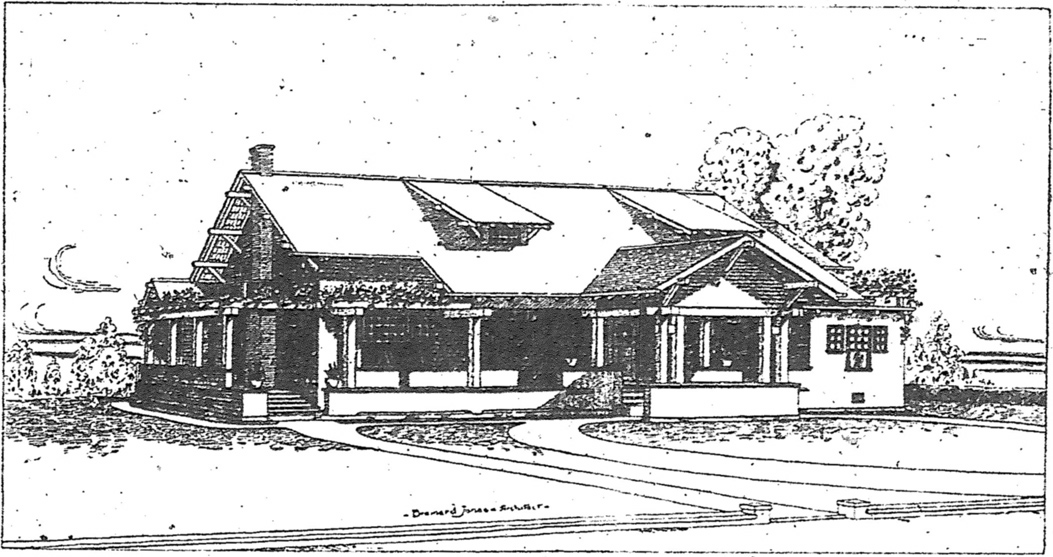 (RIGHT: Brainerd Jones' drawing of the Saturday Afternoon Club appeared in both newspapers. A different sketch also appeared in the August 13 Santa Rosa Republican, but the microfilm is such poor quality that it's not included here. CLICK or TAP any image to enlarge)
Only the Saturday Afternoon Club could have built such a place. The town was awash in "ladies' clubs" in that era, most with the sole function of planning afternoon card parties and get-togethers held at member's homes; a Press Democrat columnist guessed there were about 100 women's clubs, lodges and societies then in Santa Rosa. But no cards were shuffled at meetings of the Saturday Afternoon Club, where women might discuss a member's report on military tensions in Asia or listen to an amateur soprano from the club's Etude section warble through a program of Schubert lieder. One of the few personal details we know about Mattie Oates concerns a witty presentation on "The Laws of California as related to Women and Children."
The Saturday Afternoon Club was a group firmly in the traditions of the club movement, which was founded after the Civil War and took off around the turn of the century. Members were typically older women from the leisure class who sought intellectual challenge and culture. Such lofty aspirations made them easy targets for satirists and jokesters; think of the scene in "The Music Man" where the mayor's insufferable wife and her dowdy friends clumsily pranced and posed in an ode to a Grecian urn. The Club was founded in 1894 under the leadership of Jeanette Cochrane, a farmer's wife who found Santa Rosa to be a cultural sinkhole under the sway of dullards, at least as compared to her former home of Santa Barbara. There she belonged to a small "woman's club" that discussed literature and lobbied for civic improvements. The Club here certainly pursued literary matters with gusto, but until WWI it was not very active in civic affairs, perhaps because Santa Rosa had a busy "Woman's Improvement Club" that was tirelessly working for the town's betterment, such as coordinating with the S.P.C.A. to raise watering troughs to make them more humane for thirsty horses and cleaning up the Rural Cemetery. Rarely were members of that group singled out by the newspapers, but the names that did appear were almost always prominent members of the Saturday Afternoon Club, suggesting there was substantial overlap between the groups.
Central to the success of the Saturday Afternoon Club was its clubhouse, and that almost wasn't built, according to a 1994 Gaye LeBaron column. After the land was purchased from Mark McDonald Jr. for $800, all the banks in town refused to give them a construction loan, saying it was "crazy" to to take a risk on a social club, even one that included the wives of every prominent man in town. A wealthy aunt of club member Laura Cragin finally put up the entire $4,375, with another $100 tossed in for architect Brainerd Jones. Yet curiously, none of those interesting details were mentioned in either Santa Rosa paper at the time, which together printed over three dozen approving items about the Saturday Afternoon Club's mission to establish a clubhouse. Nor is Mrs. Cragin seen in the group photograph at the ground breaking. For having brokered a deal that saved the club's bacon, you'd think that she'd at least be rewarded by a snapshot of her throwing a shovelful of dirt.
 |  | ||
| |||
BEAUTIFUL CLUB HOME AUSPICIOUSLY OPENED
Pretty Scene Thursday Evening at Handsome Structure
The opening of the pretty club home of the Saturday Afternoon Club last evening marks an epoch and a decided step in advance for the City of Roses. The new home will be the center of intellectual and social development, and the scene of many pretty parties and entertainments in the future, as well as the place where splendid musical talent will be heard...
...Mrs. James S. Sweet, the president of the club, made the address of welcome to the assembled guests, and told of the beginning and completion of the work, of the sweet resignation of Architect Brainerd Jones when the ladies proceeded to "prune" his plans, of the painstaking work of Contractor J. B. Durand and his corps of subcontractors....
...Mrs. Robert Potter Hill, former president of the State Federation of Women's Clubs, and Judge James W. Oates made addresses during the evening. Each of the speakers made a talented address, the ladies bringing greetings from the organizations which they represent, and speaking of the pleasures which they had at being present on so auspicious occasion and of the beneficial influence the erection of the Saturday Afternoon Club structure would have on other cities.
Judge Oates was happy in his remarks, and his advice to the ladies on getting rid of the pest known as "knockers" touched a responsive chord in the audience. Judge Oates has been the legal light who has piloted the ladies through the shoals on which they might have wrecked their enterprise, and to him especial credit is due, and which was mentioned by Mrs. Sweet in her opening address. Judge Oates is always heard with pleasure by the people of this city, with whom he is a great favorite, and his well modulated voice was heard to advantage last evening. The speaker suggested that all the members of the male persuasion of the audience should assist the ladies in every way to make their laudable endeavors all the more successful and brilliant. The achievement of the energetic ladies followed the crashing blow which devastated this city less than three years ago, he remarked, was all the more pronounced because of its accomplishments in the face of such an adversity and calamity. Never in the history of the world, declared Judge Oates, had such a blow fallen on a city as Santa Rosa had suffered...- Santa Rosa Republican, December 18, 1908
WORK ON CLUB HOUSE PROGRESSING WELL
Architect Brainerd Jonea was here from Petaluma yesterday looking after the Saturday Afternoon Club's new club house on Tenth street. He expressed himself as well pleased with the manner in which the work is progressing and of the work being done by the contractor. The brick work in the terrace was also commented upon favorably by the architect.
Contractor J. B. Durand has the club house under cover so that the rain will not interfere with the force of men engaged on the job. He sees no reason now why the contract will not be completed well within the specified time limit.- Press Democrat, October 18, 1908
CLUB HOUSE UNDER WAY
Ladies Pleased with New Structure Being Erected
The new structure being erected for the Saturday Afternoon Club on Tenth street is rapidly being pushed to completion. Contractor J. B. Durand has a force of men busy shingling the sides of the structure, and it will soon be enclosed. Some delay has been occasioned in the structure of the roof, as the heavy timbers for that portion of the structure have been ordered direct from Oregon. They will be here at once, and it is expected to have the roof on the structure before the rains set in.
The ladies of the club frequently visit the new structure and are well pleased with what is being done there. The club house, when completed, will fill a long felt want on the part of the ladies of Santa Rosa, and will give them a place where their musicals and other high class entertainments can be staged with proper effect.- Santa Rosa Republican, September 18, 1908
CLUB LADIES BREAK GROUND
Saturday Afternoon Members Start Building
An exceedingly pretty and impressive, tho' informal ceremony took place at 8 o'clock this morning at the site of the Saturday Afternoon Club House on Tenth street near Mendocino Avenue. The building contractors began work at that hour and the members of the club assembled to break ground. The ceremony was begun by the presidents of the organization, Mrs. Finlaw, the "mother president," turning the first shovelful of earth, and starting the work that will go on till a beautiful and artistic club home is completed. Mrs. Finlaw made a short and appropriate address to her sister members and co-laborers and relinquished the shovel to her successor in office. This was followed down the line presidents, who are Mrs. J. W. Oates, Mrs. A. C. McMeans, Mrs. Mark McDonald, Jr., Miss Lulu Leppo, Mrs. T. J. Geary, Mrs. W. E. McConnell, Mrs. James R. Edwards and Mrs. J. S. Sweet, the present presiding officer. Then the vice presidents took a hand, and this finished the official list and the members--the high privates--did their allotted part in preparing for the foundations.
There were present Judge James W. Oates and Professor J. S. Sweet, also Contractor J. B. Durand and Architect Brainerd Jones. John Ross, the photographer, posed the lady builders in an attractive bunch and took several pictures. The shovel will be preserved as a thing sacred in the club house.- Santa Rosa Republican, August 17, 1908
AWARD CONTRACT FOR CLUB HOUSE
Saturday Afternoon Club's Handsome Home on Tenth Street Will Soon Be Under Way
The contract for the erection of the handsome club house on Tenth street for the Saturday Afternoon Club, has been finally awarded to Contractor J. B. Durand of this city. Work will be commenced at once and will be finished as rapidly as possible.
A description of the building and the sketch of the same by Brainerd Jones, the architect, was published in the Press Democrat some weeks ago. The building will cost in the neighborhood of $5,000. An application for a building permit has been filed with the City Council, and will of course be granted.
The chairman of the building board is Mrs. James W. Oates. The members of the club will be glad to know that the work of construction is to be commenced and will be delighted when the building is ready for occupancy. Mrs. James S. Sweet is the president of the Saturday Afternoon Club.- Press Democrat, August 14, 1908
HANDSOME CLUB HOUSE TO BE ERECTED BY THE SATURDAY AFTERNOON CLUB
After some delay incident to certain alterations in the original plans, on Thursday morning the contract was signed with J. B. Durand to erect the elegant new home for the Saturday Afternoon Club on Tenth street, near Mendocino avenue.
This building is the first to be devoted exclusively to club purposes in this city and marks an epoch in the history of Santa Rosa. The ladies of the Building Committee have displayed much energy and business ability in their efforts toward providing the Club with suitable quarters, and they are to be congratulated on the consummation of their undertaking.
The plans, which were drawn by Brainerd Jones, are in the Chalet style of architecture. The exterior is to be wholly in shingles and with its spacious port-cochere, pergolas and porches, forms a very pleasing picture.
The large auditorium, lighted by electricity, will be floored with polished maple. Opposite the stage is a large fireplace and over this is a gallery thirty-six feet in length. From the stage open two dressing rooms provided with all conveniences. The kitchen is to be furnished with a gas range, instantaneous water heater, etc. The auditorium will be wainscoted to the height of seven feet to the plaster line. A unique feature of the finish is the use of stained shakes to ceil the roof under the main rafters.
The acoustic properties have been carefully considered by the architect and the building is admirably adapted to lectures and threatening, while the dancing floor will be unsurpassed in the city. All in all, the new building will be an ornament to Santa Rosa and a credit to the enterprising members of the Saturday Afternoon Club.
[..]- Santa Rosa Republican, August 13, 1908
When the ladies of the Saturday Afternoon Club elect which set of the several plans they are wrinkling their fair brows over, they will begin to build a club home that will be an ornament to Santa Rosa and a joy forever to club women who will dwell therein. The idea uppermost in the minds of the members of the organization is a pretty and commodious club house. It will not be costly nor elaborate in its adornments, but will be simple, artistic and genteel. Club homes are now considered necessary in social and fraternal organizations. The Elks in this city built themselves a splendid place where the cultured members of the order meet and enjoy the social features of their order. It is their rallying point and their home. The local Native Sons are now building a costly temple and it will be their fraternal and social home. Finely equipped club rooms will be a part of construction where the members will gather.
The Saturday Afternoon club house may be a rustic bungalow, wide eves, ornamental galleries, French windows, giving onto grace 11 balconies and terraces, approached by a broad driveway, sweeping in a half circle up through a porte cochere or roofed entrance at the front. The interior will be a large club room, capable of seating several hundred persons, elevated gallery at one end, with ornamental balcony where one may sit and enjoy refreshments and the literary menu from the floor below at the same time. Piano and other musical instruments will be provided for the Etude Section. Flowers and greenery will grow around and over this artistic structure and it will be a home indeed to the Saturday Afternoon Club of Santa Rosa. At the next meeting, the club will choose the plan and the building will begin.- "Pencil Gatherings Among the Social and Other People" Santa Rosa Republican, June 1, 1908
SATURDAY AFTERNOON CLUB FILES ARTICLES
The Saturday Afternoon Club filed its articles of incorporation with the county clerk Thursday afternoon. The ladies are enthusiastic over their project and there were many signers of the club's roll, each taking one share of stock in the proposition. The club is capitalized at $10,000 and the stock is valued at ten dollars per share...- Santa Rosa Republican, March 15, 1907
...A big step in the advancement of club life in our little city was taken on last Monday afternoon, at a special meeting of the Saturday Afternoon Club, held at the home of Mrs. Dr. C. H. Thompson. The object of the meeting was to discuss and decide upon the advisability of purchasing a lot and erecting a modern, up-to-date club house that would not only afford a great deal of pleasure to the members of the club, but would also yield them a good revenue by being rented to other clubs and individuals for social functions and various other purposes. The meeting was largely attended in spite of the inclement weather and the ladies were most enthusiastic and earnest in discussing the proposed plan, and after carefully considering the important question and looking at it from all sides, a vote was taken upon it that resulted in a unanimous decision in favor of building a club house as soon as possible and also an order to file articles at once and incorporate the club under the name of "The Saturday Afternoon Club." Judge J. W. Oates has kindly offered his legal advice and assistance in their future business transactions and the ladies appreciate this generous offer and realize how valuable and helpful Judge Oates can be to them in carrying out such a big undertaking.- "Our Social Affairs, by Madam Trice", Santa Rosa Republican, March 9, 1907
DECIDE ON CLUB HOUSE
Saturday Afternoon Club Will Have Handsome Home
At the meeting of the Saturday Afternoon Club held Monday evening, the members determined to incorporate, purchase the proposed site for their handsome club rooms and erect a large and commodious structure thereon, The meeting was one of the most enthusiastic ever held by the ladies and when it came to a vote on the proposition there was a unanimity of sentiment favoring the club house. Mrs. James R. Edwards, president of the club, presided at the meeting.
The lot which will be purchased by the ladies is one owned by Mark L. McDonald, Jr. It is located on Tenth street facing Joe Davis street, and location for their club house [sic]. The close to Mendocino avenue [sic], and the members believe it will be an ideal election of directors [sic] resulted in the selection of the following to serve in that capacity [sic]...
...The club has decided to incorporate under the name of "The Saturday Afternoon Club," and the articles will be prepared at once and filed. At subsequent meetings of the club the arrangements for the building will be undertaken and architects will be asked to submit plans for the structure. The members can be depended on to erect one of the most beautiful and cozy structures for their occupance that is contained in the City of Roses.- Santa Rosa Republican, March 5, 1907
LADIES TO BUILD FINE CLUBHOUSE
Special Meeting of the Saturday Afternoon Club to Be Held on Monday Afternoon
There is to be an important meeting of the Saturday Afternoon Club, both sections, on Monday afternoon at the residence of Mrs. Dr. C. H. Thompson, on Mendocino avenue, for the purpose of discussing incorporation, for the purchase of a lot at Tenth and Joe Davis streets, and the erection of a club house. It is hoped that all the members will be present and take part in the discussion. Most of the members are very enthusiastic over the probable purchase of the lot and owning their own club house. Mrs. James R. Edwards is the president of the Saturday Afternoon Club. While many lots have been considered it is certain that the club house will be located in or near the location mentioned, which is the locality in which the Saturday Afternoon Club had its origin and development.
[..]- Press Democrat, March 3, 1907
ORIGIN OF THE LADIES' CLUB
How Saturday Afternoon Club Came Into Existence
The Saturday Afternoon Club, Santa Rosa's foremost organization in music and literature, whose handsome club house was dedicated Thursday evening, was founded by five prominent ladies of this vicinity. Many years ago a meeting was held at the resident [sic] of Dr. William Finlaw, on Mendocino avenue, the ladies present being guests Mrs. Dr. Wylie, on McDonald avenue. The idea of forming the club was broached and discussed by these ladies, and from that inception the stately edifice has arisen to crown their splendit efforts.
The ladies were Mrs. Martin Cochrane of Kenwood, Mrs. William Finlaw, Mrs. A. C. McMeans, Mrs. Mark L. McDonald, Sr., and Mrs. J. G. Wylie.
The first officers of the club were Mrs. Finlaw, president; Miss Nellie Porter, vice president; Mrs. McMeans, secretary; Mrs. McDonald, Mrs. Wylie and Mrs. Cochrane, committee on constitution and by-laws. At the next meeting of the ladies, which was held at the residence of Mrs. Finlaw, the constitution and by-laws of the club were presented and adopted.
Miss Nellie Porter, who was chosen vice president of the club, was to have been president of the club, was to have been present at the original meeting, but was unavoidably detained. She was chosen an officer in her absence.- Santa Rosa Republican, December 18, 1908
Rule of thumb: While you're getting beat up, it's never a good idea to become trapped in a barber's chair.
The brawl that started at the Blue Wing saloon in downtown Santa Rosa spilled over into the barber shop next door. One fighter was caught in the chair, where his leg was broken in two places and an arm broken as well. So frenetic was the action that even someone who tried to break up the scuffle was thought to have a broken arm.
BONES BROKEN IN A FIGHT
George Cogswell Sustains Several Injuries
In a fight at the Blue Wing saloon at First and Main streets Sunday afternoon between George Cogswell and James Campion, the former sustained a number of broken bones. One of his legs was broken in two places, and he is said to have also had one bone of his right arm broken. He became entangled in a barber chair and it was while thus entangled that the bones of the leg were broken. The man's injuries were dressed by Dr. J. W. Jesse after which he was taken to his home near this city.
A peacemaker, who endeavored to separate the combatants, was also injured, and for a time it was believed he had sustained a broken arm.- Santa Rosa Republican, November 16, 1908
FIGHT IN BARBER SHOP
The fight Sunday evening in which George Cogswell sustained a broken leg took place in a barber shop adjoining the Blue Wing saloon. S. H. McKee, of the Blue Wing, declares this barber shop has no connection with the business whatever.- Santa Rosa Republican, November 19, 1908
You took a risk driving, riding a buggy, or even walking at night in Santa Rosa's 1908 neighborhoods; streets were frequently dark because the electricity was off, and unwary travelers might crash into wet-cement barriers or hit the piles of building materials that were obstructing streets and sidewalks. So bad was the situation that the Press Democrat - loathe to expose any flaw in the town whatsoever - openly called for contractors to put out 19th century kerosene lanterns to alert the public to the dangers.
The PD was prodded to mention the issue after a woman was thrown from her buggy and seriously injured when the horse became spooked by an unexpected encounter with a pile of stuff blocking the street. The newspaper also complained that there was some sort of wire fence across the freshly-poured sidewalk at College and Mendocino Avenues "which could not be seen even with the light burning, [and] was a snare when the light was out."
This item states that "the electric lights [are] going out nearly every night for a time," and the previous article revealed there was a steam whistle for summoning a lineman to "answer lamp kicks at all hours of the night" ("kick" was common slang for "complaint" at that time, so I presume that meant customers were reporting electric outages and
providing light bulbs was a service of the electric company).
Santa Rosans were understandably angry that the power company couldn't keep the lights on, and a couple of weeks after these incidents, the Chamber of Commerce demanded answers from the superintendent of the Santa Rosa Lighting Company. Alas, he told them, he only did as he was so ordered by a PG&E engineer in another county: "I receive a message from Napa to cut out the street lights until further notice. Out they go."
WARNING LIGHTS SHOULD BE PUT OUT
A number of building and sidewalk contractors are growing careless and indifferent regarding the matter of putting out lights at night where obstructions are left in the streets and sidewalks. The matter is one of importance as was shown last Saturday night when a runaway was caused which resulted in a lady receiving a compound fracture of her arm and a fine buggy was demolished.
With the electric lights going out nearly every night for a time, contractors should use lanterns. A wire fencing was left across some new walks on Mendocino street at College avenue Thursday night which could not be seen even with the light burning, was a snare when the light was out. A number of other obstructions were left unguarded in different parts of the city.
- Press Democrat, October 2, 1908